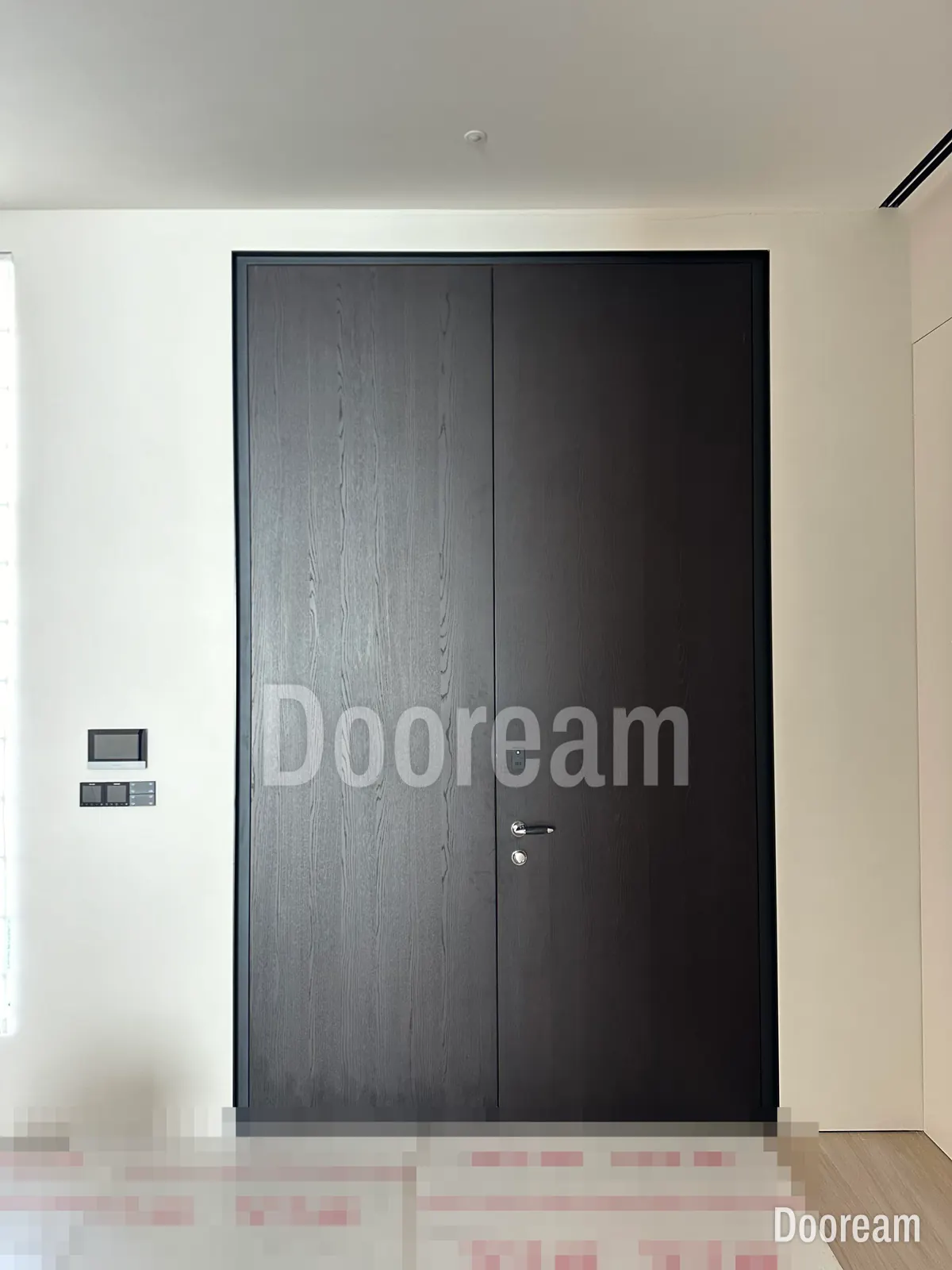
Short answer: this glossary defines 95 terms that architects, dealers and contractors meet on drawings, quotes and specifications for custom entrance doors. Each is a plain definition, linked to the guide that covers it in depth where there is one; parts with several names are in the table at the end.
How should you use this glossary?
Use it to check that everyone on a project means the same thing by each word on the drawings, the quote and the specification. Many costly mistakes on a custom door start with one word read two ways: a size, a hand, a trade term. Look the word up, then write its meaning on the drawing.
Six habits prevent many mix-ups:
- Name each size: rough opening, frame, leaf or clear opening.
- Write handing in words, seen from outside, with a plan sketch.
- State the units on every sheet: millimetres or inches.
- Give a standard with its edition and class, such as “EN 1627:2021, RC 3”.
- Write the Incoterm with its place and edition, such as “EXW Wuyi, Incoterms 2020”.
- Define once: if a word could be read two ways, define it in a note on the first sheet.
How does this work with Dooream?
We make custom aluminium armoured entrance doors in Wuyi, Zhejiang: pivot doors up to 4,000 × 8,000 mm and double and unequal double doors up to 3,000 × 6,000 mm, made to drawing from one door. Our thermal-break construction, with PA66 polyamide insulating strips in the aluminium profiles, reaches a U-value of 1.0 W/m²K in our test report, and any of our designs can be built with it. We hold no EN 1627 rating and make no fire-rated doors; a lab test can be arranged, usually at the buyer’s cost. We quote EXW Wuyi, and production takes 35–45 days after drawing approval and the deposit. If a term on our drawing or quote is unclear, ask us or start at for architects.
A–B
- Active leaf: the leaf of a pair that opens first and carries the lock. The inactive or passive leaf stays shut on flush bolts and carries the active leaf’s keep (grand double doors).
- Anodising: a finish that thickens the aluminium’s own oxide layer instead of adding paint, specified by layer thickness (coastal finishes).
- Armoured door: a door with steel in the leaf, a multipoint lock, hinge-side protection and a strong frame. No standard we know of defines the word: it describes the build, not a tested resistance (armoured doors).
- ASTM F476: US test methods for how well a swinging door assembly, with its hinges, lock, strike and jamb, restrains or delays break-in.
- Astragal: a strip on one leaf of a pair that overlaps the gap between the leaves; the passive leaf must then close first.
- Backset: the distance from the face of the lock’s forend, on the leaf edge, to the centre of the keyway (smart locks on pairs).
C
- Cast aluminium: a face made by pouring molten aluminium into a mould, then finishing and coating it. It suits repeated patterns and undercuts; Lattice has one (cast aluminium doors).
- CE marking: under the EU Construction Products Regulation, the mark showing that a product covered by a harmonised standard, such as EN 14351-1 for external doors, conforms to the performance stated in its declaration of performance (DoP).
- Centre pivot (centre-hung): a pivot door with its axis in the middle: half the leaf swings in, half swings out, and the open leaf splits the opening into two equal passages (offset or centre pivot).
- Clear opening: the space you can walk through with the door open, always less than the leaf. On a pivot door the strip behind the axis takes part of it (measuring).
- CNC carving: cutting a relief from solid aluminium plate on a computer-controlled machine that follows a 3D file, then sanding off the tool marks by hand (CNC-carved doors).
- Concealed hinge: a side hinge set into the leaf edge and frame, hidden when the door is closed; Sail uses them (heavy door hinges).
- Crate: the wooden case a door travels in. We pack doors in blankets and foam inside a wooden crate (crating).
- Cylinder: the part of the lock the key turns. It can be reached from outside, so specify it by test grade and fit it flush (cylinders).
D–E
- Deadbolt: a square-ended bolt thrown by a key or turn, not by a spring, so it cannot be pushed back.
- Declaration of performance (DoP): see CE marking.
- Deflection: how far a frame member, mullion or glass edge bends under load such as wind. Agree a limit for tall doors (wind).
- Doorset: a complete door from one maker: leaf or leaves, frame, glazing, seals and hardware.
- Double-acting: opening both ways, with no stops to seal against, so suited to interiors. A single-acting door opens one way, against a stop such as the frame.
- Drop seal: an automatic seal in the bottom of the leaf that lowers onto the threshold as the door closes. Pivot doors need a pivot type (seals).
- Elevation: the door drawn straight on, from outside or inside, with sizes, leaf divisions, pulls and lock positions.
- EN 1627: the European standard for the burglar resistance of pedestrian doorsets, windows, curtain walling, grilles and shutters, with eight classes from RC 1 N to RC 6. It states that building hardware cannot be classified on its own (security ratings).
- EN 14351-1: the harmonised European product standard for windows and external pedestrian doorsets; see CE marking.
- Escutcheon: a plate around a keyhole or cylinder.
- EXW (Ex Works): an Incoterms 2020 rule: the seller makes the door available at its own premises; the buyer pays for and carries the risk of loading, and handles export formalities (Incoterms).
F–G
- Face: the decorative outer layer of the leaf. Ours are most often carved aluminium, and also cast aluminium, sintered stone, glass, wood or copper.
- Fanlight: glazing over a door; see transom.
- FCA (Free Carrier): an Incoterms rule: the seller clears the goods for export and hands them to the buyer’s carrier at an agreed place, loading them if that place is its own premises.
- Finished floor level (FFL): the height of the final floor surface. Give it inside and outside before the door is drawn (floor preparation).
- Floor box: a case set into the slab to hold a floor spring. Pivot hinges built into the leaf need none (floor box dimensions).
- Floor plate: the small plate on the finished floor under the axis of a pivot door whose hinge is built into the leaf.
- Floor spring: a hydraulic closer set in the floor under the axis of a heavy door; see the table.
- Flush bolt: a bolt set into the edge of the inactive leaf that shoots into the head and floor.
- FOB (Free on Board): a sea-only Incoterms rule: risk passes when the goods are on board the ship at the named port. For goods in containers, ICC says FCA is typically a better choice.
- Frame: the fixed part in the opening that the leaf hangs in: a head, two jambs and, on most entrance doors, a threshold.
- Galvanised steel: steel coated with zinc, which shields it and corrodes in its place where the coating is damaged; our leaves have a galvanised steel sheet behind each face.
- Gasket: a seal held in a groove in the frame or leaf rebate and compressed as the leaf closes (pivot door sealing).
- Gearbox: the central lock case of a multipoint lock, at handle height.
H–K
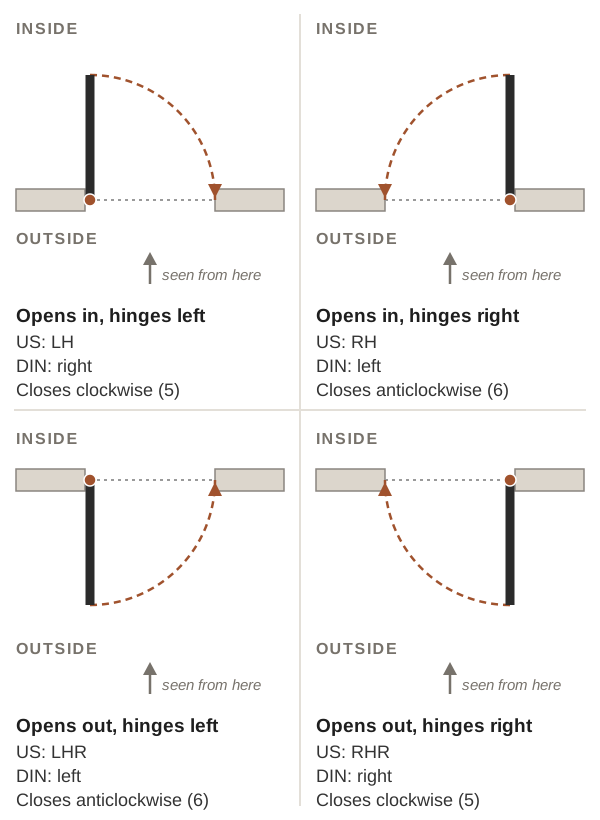
- Handing: the hinge or pivot side plus the opening direction. Systems read it from different places: US handing is read from outside, on the secure side, so LH means hinges on the left, swinging away. Write it in words, seen from outside (door handing).
- Hardware schedule: the list of every hardware item on a door, with quantity, maker, model and finish.
- Head: the top member of the frame. Over a pivot door it takes the top pivot’s sideways force, so it must fix into structure.
- Honeycomb core: thin-walled cells filling the leaf between its sheets at little weight; ours is aluminium.
- Hook bolt: a locking point that hooks behind its keep, resisting prising (multipoint locks).
- HS code: the Harmonized System number customs uses; the first six digits are international. Aluminium doors fall under 7610.10, iron or steel ones under 7308.30, and your broker decides (US imports).
- Incoterms: the International Chamber of Commerce’s rules on who pays for and carries the risk of each step of delivery. The current edition is Incoterms 2020.
- Insulated glass unit (IGU): two or three panes sealed round a spacer, with dry air or gas between them (insulated glass).
- ISPM 15: the international standard for wood packaging: solid wood must be debarked, treated (for example at 56 °C for 30 minutes throughout) and marked. Plywood and similar processed wood is exempt.
- Jamb: a vertical side member of the frame: the hinge or pivot jamb, and the lock jamb.
- Keep: the part in the frame that receives a bolt, one for every locking point; see the table.
L–M
- Laminated glass: panes bonded with an interlayer, so the fragments hold together when it breaks. Use it where a hand through a broken pane could reach the lock (glass).
- Latch: a bevelled, spring-loaded bolt that holds the door shut when it is unlocked.
- Leaf: the moving part of a door, without its frame.
- Leaf and a half: see unequal double.
- Lever: a handle that turns to withdraw the latch. On some multipoint locks, lifting it throws the locking points.
- Meeting stile: the edge where the two leaves of a pair meet, carrying the seal or astragal and the lock.
- Mullion: a vertical bar in the frame between the leaf and a sidelight (sidelights and transoms).
- Multipoint lock: a gearbox at handle height that drives bolts, hooks or cams along the edge into keeps, holding the leaf at several heights. It gives the door no security class by itself.
O–P
- OEM: the factory makes your design to your specification, under your brand, as we do for buyers (OEM and private label).
- Offset pivot: a pivot door with its axis set in near one edge: the long part opens one way and a short strip the other, which gives the widest passage. Contour is one.
- PA66 polyamide strip: the polyamide 66 strip joining the outer and inner halves of a thermally broken aluminium profile. It carries far less heat than the metal.
- Pivot door: a door that turns on a vertical axis between a floor pivot and a top pivot instead of side hinges. We fit FritsJurgens pivot hinges (specifying).
- Pivot point: the distance from the pivot-side edge of the leaf to the axis: small on an offset door, half the leaf width on a centre-hung one.
- Plan: a drawing from above, showing the swing arc, the inside and outside, and the axis or hinge side.
- Powder coating: a dry powder sprayed on and baked into a hard film.
- Pre-shipment inspection: checking the finished door against the approved drawing before crating. We send photos and video of every finished door, and buyers can also inspect at our factory (inspection).
- PVDF: polyvinylidene fluoride, the resin in fluorocarbon paint, used on Lattice and other models of ours. In North America, FGIA/AAMA 2605 is the highest of the architectural coating specifications, with a 10-year outdoor exposure test; coatings that meet it are built on PVDF or FEVE resin.
R–S
- Rebate: a step along a frame or leaf edge that the other part closes against, giving a stop and a face for the seal. A double rebate gives two seal lines.
- Relief: the depth of a carved or cast face, from its deepest cut to its highest point (relief depth and light).
- Resistance class (RC): see EN 1627.
- Rose: a small plate on which a handle or knob is mounted.
- Rough opening: the hole in the wall, also called the structural opening. The frame fits inside it with a fixing gap (what to send).
- Sash: the opening part of a window. If a door quote says sash, ask whether it means the leaf alone or leaf and frame.
- Section: the door drawn cut through, usually at the head, jamb and threshold, showing profiles, seals and fixings (CAD details).
- Shop drawing: the maker’s drawing of how your door will be built: sizes, sections, handing, fixings, hardware, finish and tolerances (shop drawing checklist).
- Shootbolt: a bolt that a multipoint lock drives into the head or floor, holding the far corners of the leaf.
- Side panel: a solid panel faced like the door, where a sidelight would be.
- Sidelight: a narrow glazed panel beside the leaf, in the same frame.
- Sintered stone: a thin slab of man-made stone; Black Warrior has it on its inside face.
- Smart lock: a motorised lock opened by fingerprint, code, card or app, usually with a key override. We fit KFV, G-U and Wintech (smart locks).
- Spindle: the square bar through the leaf that joins the handles on its two faces.
- Stile and rail: the vertical and horizontal members of a framed leaf.
- Submittal: the product data, shop drawings, schedules, samples and test evidence sent to the architect for review before manufacture (submittal checklist).
T
- Thermal break: an insulating strip between the outer and inner aluminium profiles that cuts the path heat takes through the metal (thermal break).
- Thermal bridge: a path through which heat flows more easily than around it, such as metal running from outside to inside.
- Threshold: the bottom member of the frame, which the drop seal lands on and which must shed water (threshold leaks).
- Thumb-turn: a small inside fitting, gripped between thumb and finger, that locks and unlocks without a key. Check local escape rules.
- Tolerance: the allowed difference between a drawn size and the made one. Agree it in writing, flatness included (tall doors and bowing).
- Top pivot: the upper bearing of a pivot door, exactly above the floor pivot. Because the leaf’s weight acts away from the axis, it pushes sideways on the head.
- Toughened glass: heat-treated safety glass that breaks into many small particles rather than shards, leaving an open hole.
- Transom: a bar across the top of a door frame; in North American English, also the window above the door.
U–W
- U-value (Ud): the heat passing through one square metre of the whole door for each degree of temperature difference, in W/m²K; lower is better. ISO 10077-1 sets out the calculation (door U-value).
- Uf and Ug: the U-values of a frame section and of the centre of the glass. Neither is the door’s value.
- Unequal double: a pair with one wide everyday leaf and one narrow leaf bolted shut until the full width is needed. British ironmongers also call it a leaf and a half; Crystal Handle and Facet Light are unequal doubles (choosing a pair).
- Wind load: the pressure wind puts on the closed door. On a pivot door, uneven pressure also tries to turn the leaf.
- Wood-grain print: a picture of wood printed on a coated aluminium face, as on Grain Band. “3D”, “4D” and “5D” are sales names, not test classes (5D prints).
Which parts go by more than one name?
Several parts have two or more names, and some names change with the country. These are the ones we checked against published sources; define any other on the drawing.
| Part | Names you may see | Where each is used |
|---|---|---|
| Plate in the frame that receives a bolt | Keep, strike, strike plate, striking plate, staple | The UK Guild of Architectural Ironmongers gives keep, staple, strike plate and striking plate; ASTM F476 says strike |
| Pair with one wide and one narrow leaf | Unequal double, leaf and a half, penny farthing door, mother-son door | The Guild lists the first three; the last is a literal rendering of the Chinese 子母门, common with Chinese factories |
| Hydraulic closer set in the floor | Floor spring; floor closer | dormakaba: floor spring on its UK pages, floor closer on its US pages |
| Window above a door | Fanlight, transom | Fanlight in British and North American English; transom is the bar, and in North America also the window |
| Heat flow through the door | U-value, in W/m²K; U-factor, in Btu/h·ft²·°F | U-factor is North American; multiply by about 5.68 for W/m²K |
| Handing labels | LH, RH, LHR, RHR; DIN left, DIN right | US labels are read from outside; write the hand in words too |
Sources, checked November 2026: SIS, SS-EN 1627:2021 scope; iTeh Standards, SIST EN 1627:2021 sample (resistance classes); European Commission, declaration of performance and CE marking; BM TRADA, CE marking for external pedestrian doorsets (EN 14351-1); ISO, ISO 10077-1:2017; ASTM, F476-23 security of swinging door assemblies; ICC Academy, EXW or FCA and place of delivery and risk transfer; WCO, HS heading 73.08; Japan Tariff Association, HS 7610.10; IPPC, ISPM 15 (2018); Guild of Architectural Ironmongers, glossary of terms; dormakaba, BTS 80 FLB floor spring (UK) and BTS80 Series floor closer (US); Oxford Learner's Dictionaries, transom; US Department of Energy, fenestration key terms (U-factor); Allegion, what is lock handing?; PPG, FGIA/AAMA 2605; Glass and Glazing Federation, glass breakages consumer guidance; American Galvanizers Association, corrosion protection.
Quick answers
What is the difference between an offset and a centre pivot door?
Where the axis sits across the leaf. On an offset pivot door it is set in near one edge, so the long part opens one way and a short strip the other, which gives the widest passage. On a centre pivot door it is in the middle: half the leaf swings in, half swings out, and the open leaf splits the opening into two equal passages.
What is an unequal double door, or leaf and a half?
A pair with one wide leaf for everyday use and one narrow leaf that stays bolted shut until the full width is needed. British ironmongers also call it a leaf and a half, and Chinese factories often say mother-son door, a literal rendering of 子母门. Our Crystal Handle and Facet Light doors are unequal doubles.
What do EXW and FOB mean on a door quote?
Both are Incoterms 2020 rules. Under EXW (Ex Works) the seller makes the door available at its own premises; the buyer pays for and carries the risk of loading, and handles export formalities. Under FOB (Free on Board), a sea-only rule, risk passes when the goods are on board the ship. ICC says FCA is typically a better choice than FOB for goods in containers.