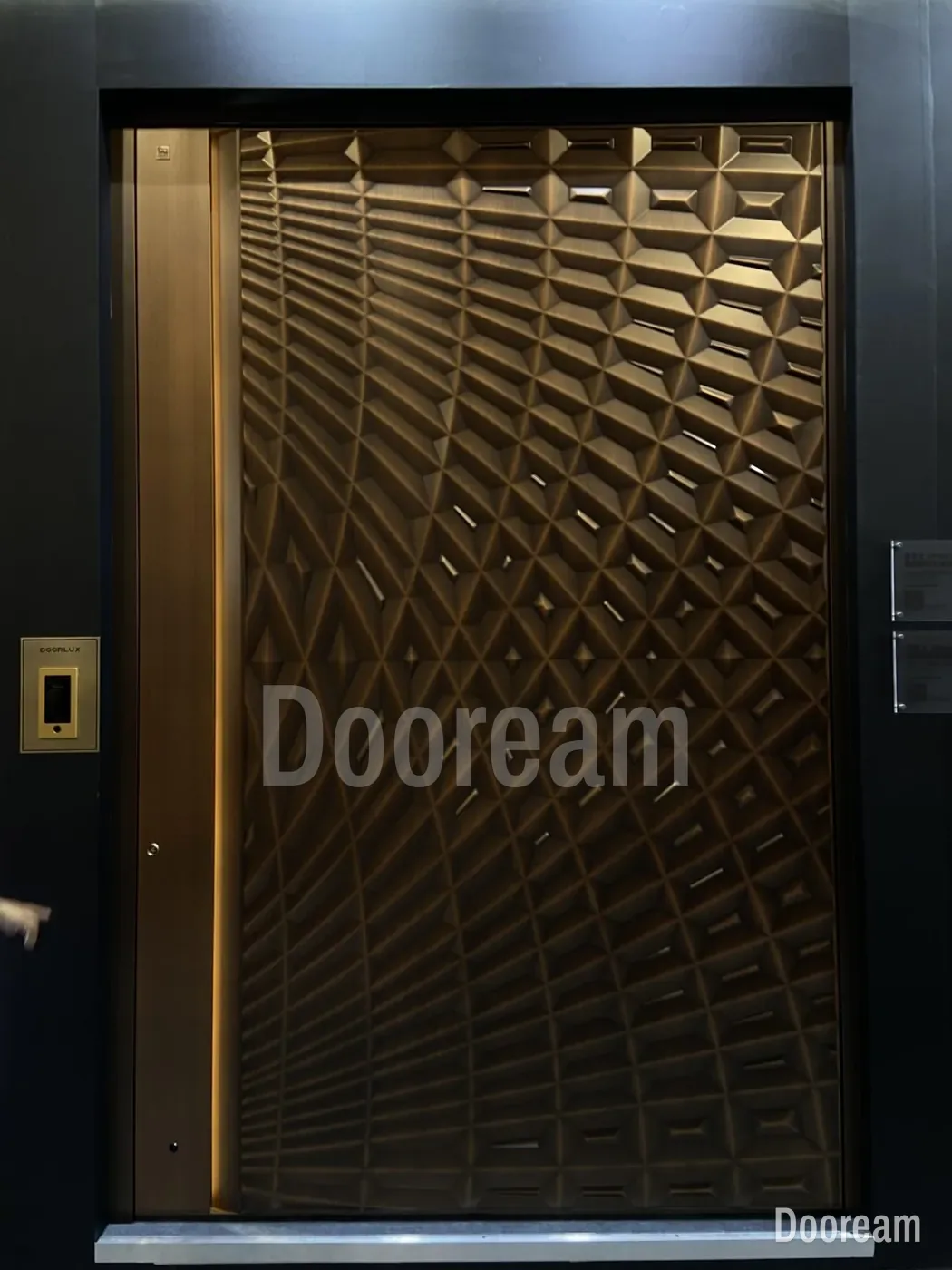
Short answer: a cast aluminium front door has a face made by pouring molten aluminium into a mould, then trimming, finishing and coating it before it is fixed to the door leaf. Casting gives deep, rounded relief at roughly a third of the weight of iron or bronze, and aluminium does not rust. Judge one on porosity, joints, coating and the leaf behind the face.
What is a cast aluminium front door?
A cast aluminium front door is an entrance door whose outer face is an aluminium casting. Molten metal is poured into a mould shaped like the design and left to set. Because the mould carries the relief, a casting can be deep, rounded and undercut in one piece. The face is then cleaned up, coated and fixed to the leaf.
“Cast” describes the face, not the whole door: the frame, core, locks and seals behind it decide how the door performs. Nor is cast the same as carved, which means cut from solid plate; see cast or carved faces.
How is a cast aluminium door face made?
A door face is large, detailed and made in small numbers, which is what sand casting suits. The Aluminum Association calls sand casting the most versatile method, and usually the more economical one for small quantities, intricate designs and very large castings. Gravity casting in a reusable metal mould pays off over longer runs.
| Method | Mould | What it suits |
|---|---|---|
| Sand casting | Sand packed round a pattern; a new mould for every casting | Small quantities, intricate designs, very large castings |
| Permanent-mould (gravity) casting | A reusable metal mould; the metal is usually poured in | Repeat runs; castings can be stronger than sand or die castings |
| Die casting | A steel die; the metal is forced in under pressure | High-volume parts that need little machining |
The steps for a sand-cast face:
- Pattern. A full-size model of the face is made in wood or plastic, slightly oversize, because aluminium shrinks as it cools.
- Mould. The pattern is pressed into fine sand to leave its shape in reverse, with runners to carry the metal in and risers to feed it as it shrinks.
- Melt and degas. Aluminium melts at 660 °C. Hydrogen dissolved in the melt comes out as porosity as the metal sets, so a careful foundry first bubbles argon or another gas through it.
- Pour and cool. The metal is poured and left to set. Sand moulds are broken away; metal moulds are opened and used again.
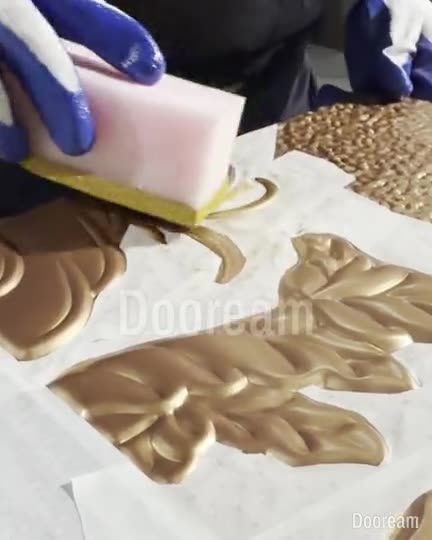
- Fettle. The runners, risers and feeders are cut off, and flash from the mould joints and other surplus metal is ground away.
- Machine. Where the face meets the leaf, it is machined flat and the fixing points are made.
- Finish and coat. The face is sanded, cleaned, pre-treated and coated. Gas trapped in a casting can escape while a powder coat cures and leave bubbles or pinholes, so the powder maker TIGER Drylac advises preheating the part at least 20 °C above the part metal temperature on the powder’s data sheet.
Why is cast aluminium used for luxury entrances?
Relief, weight and weather. A mould can carry deep, rounded and undercut relief that would be slow or impossible to cut from plate. Aluminium weighs roughly a third as much as iron or bronze for the same volume, which matters on a tall leaf. And it does not rust: a microscopically thin oxide layer protects it.
Aluminium has a density of 2.70 g/cm³, against about 7.2 g/cm³ for grey cast iron, 7.7 g/cm³ for wrought iron and 8.47 g/cm³ for architectural bronze. A 10 mm layer of each, one square metre in area, weighs about 27, 72, 77 and 85 kg. That is a yardstick, not the thickness of any particular door face. On a pivot door the hinge carries the whole leaf; see how heavy a pivot door can be.
What are the pros and cons of a cast aluminium door?
The main advantages are deep relief, low weight for a metal face and no rust. The drawbacks are the time and cost of a new pattern and mould, porosity you cannot see, joints on large faces, and a coating that is hard to renew once it fails.
| Advantage | Drawback | |
|---|---|---|
| Relief | Deep, rounded and undercut relief in one piece | Every casting must be fettled and finished before coating |
| Repeats | The same pattern can be cast again and again | A new design needs a pattern and mould first, so a one-off takes longer and costs more than carving |
| Weight | About a third of iron or bronze, volume for volume | Still heavy on a tall leaf; the hinge must be rated for it |
| Strength | Less brittle than cast iron | Weaker than iron, so the leaf behind the face carries the loads |
| Weather | Does not rust; resists corrosion better than cast iron | May corrode galvanically where it touches iron |
| Soundness | Degassing the melt reduces porosity | Porosity weakens a casting, and trapped gas can blister a baked coating |
| Finish | Takes powder, PVDF and bronze-effect finishes | Once the original coating has failed, a durable new one is hard to achieve |
How does it compare with cast iron, wrought iron, bronze and carved aluminium?
Aluminium is by far the lightest of these metals, and it neither rusts like iron nor weathers like bronze. Iron needs its coating kept intact; bronze darkens over time unless it is protected with oil, wax or lacquer. Carved aluminium is the same metal, cut instead of cast.
| Material | Shaped by | 10 mm layer, per m² | Outdoors | Watch for |
|---|---|---|---|---|
| Cast aluminium | Pouring into a sand or metal mould | 27 kg | A thin oxide layer protects it | Porosity, joints, coating |
| Grey cast iron | Pouring into a sand mould | About 72 kg | Rusts quickly in damp air unless kept painted | Brittle; weak in tension |
| Wrought iron | Forging and bending | 77 kg | Rusts unless kept coated | Weight on the hinges |
| Architectural bronze | Casting or extrusion | 85 kg | Darkens towards a patina unless oiled, waxed or lacquered | Weight; patina upkeep |
| CNC-carved aluminium | Cutting a solid plate, no mould | 27 kg | As cast aluminium | Suits one-off designs; see cast or carved |
Genuine wrought iron is almost pure iron, and the US National Park Service notes that new hand-worked metalwork is now made in mild steel. Ask what a “wrought iron” door is really made of.
Which finishes suit a cast aluminium door?
Two common choices are powder coat and PVDF (fluorocarbon) paint. Ask which test the coating meets, not only what it is called: our guide to finishes for coastal and high-sun sites explains AAMA 2605 and the Qualicoat classes. For powder on castings, also ask whether the parts are preheated before coating.
Bronze and patina effects. Real statuary and patina finishes are chemical: solutions react with the copper in bronze to form a coloured film. They are made for copper alloys, so a bronze look on cast aluminium is built up in coating layers, sometimes finished by hand, and does not weather on like bronze. Our Lattice door has a cast face in dark bronze PVDF paint.
How do you judge a cast aluminium door before you buy?
Judge the casting, how it is fixed and how it is coated, not only the design. Look for pits, pinholes, uneven joints and blistered coating. Use this checklist on samples, on photos and video, and when you inspect the finished door.
- Surface. In low, raking daylight, look for an even texture, sharp detail and clean edges, with no sand marks, pits, flash lines, ground patches or filler showing through the coating.
- Porosity. Ask how the melt is degassed and how castings are checked. Look for pinholes on the back and at cut edges.
- Joints and fixing. Is the face one casting or several? Ask where joints fall, how they are lined up and sealed, how the face is fixed to the leaf, whether fixings show and what they are made of.
- Coating. Ask for the system, the standard it is tested to, the film thickness and, for powder, whether castings are preheated.
- Weight. Get the weight of the face and of the whole leaf, and check the hinge is rated for it.
- Sample. See a sample or a finished door before you approve production, or at least daylight photos and video of the actual castings; see also pre-shipment inspection.
How do you look after a cast aluminium door?
Wash it with mild detergent and clean water, using a damp sponge, a soft cloth or a natural-bristle brush with light pressure, then wipe it dry. Test any cleaner on a hidden spot first. Do not use abrasive methods or harsh acid or alkaline cleaners, which can destroy the finish, and use solvents with care.
- Get into the relief. Dirt and salt settle in the recesses; a soft brush reaches them.
- Wash more often near the sea. Our coastal finishes guide covers how often.
- Touch up damage early, with the maker’s matching paint, while the rest of the coating is sound.
How does Dooream make cast and carved doors?
Most of our faces are carved. Some are cast. Behind every face are a galvanised steel sheet, an aluminium frame with aluminium honeycomb core, a second steel sheet and the inner panel. We make every door to drawing, from one door, and offer a 20 × 20 cm carved and painted sample or a scaled or full-size sample door: ask us.
Sources, checked November 2026: Aluminum Association, Processing 101; US National Park Service, Preservation Brief 27, architectural cast iron; UK National Occupational Standards, SEMMPF223, fettling metallic castings; US Department of Energy, degassing aluminium alloys; TIGER Drylac, outgassing in powder coatings; Royal Society of Chemistry, aluminium; AZoM, grey and ductile iron properties, wrought iron and architectural bronze C38500; Copper Development Association, statuary and patina finishes; US General Services Administration, cleaning and repainting exterior aluminium; SAF, cleaning painted aluminium.
Quick answers
What is a cast aluminium door?
An entrance door whose outer face is an aluminium casting. Molten aluminium is poured into a mould shaped like the design, then the casting is fettled, finished, coated and fixed to the door leaf. Door faces suit sand casting, which the Aluminum Association says is usually the more economical method for small quantities, intricate designs and very large castings.
Is cast aluminium better than cast iron or bronze for a front door?
It is much lighter and it does not rust. Aluminium has a density of 2.70 g/cm³, against about 7.2 g/cm³ for grey cast iron and 8.47 g/cm³ for architectural bronze. It is less brittle than cast iron but weaker, so the leaf behind the face must carry the loads. A bronze look on aluminium is a coating, not a natural patina.
How do you judge the quality of a cast aluminium door?
Look at the face in low daylight for pits, pinholes, sand marks, flash lines and ground patches. Ask how the metal is degassed, whether the face is one casting or several, how it is fixed to the leaf, which coating and test apply, and what the whole leaf weighs. See a sample or a finished door before production.