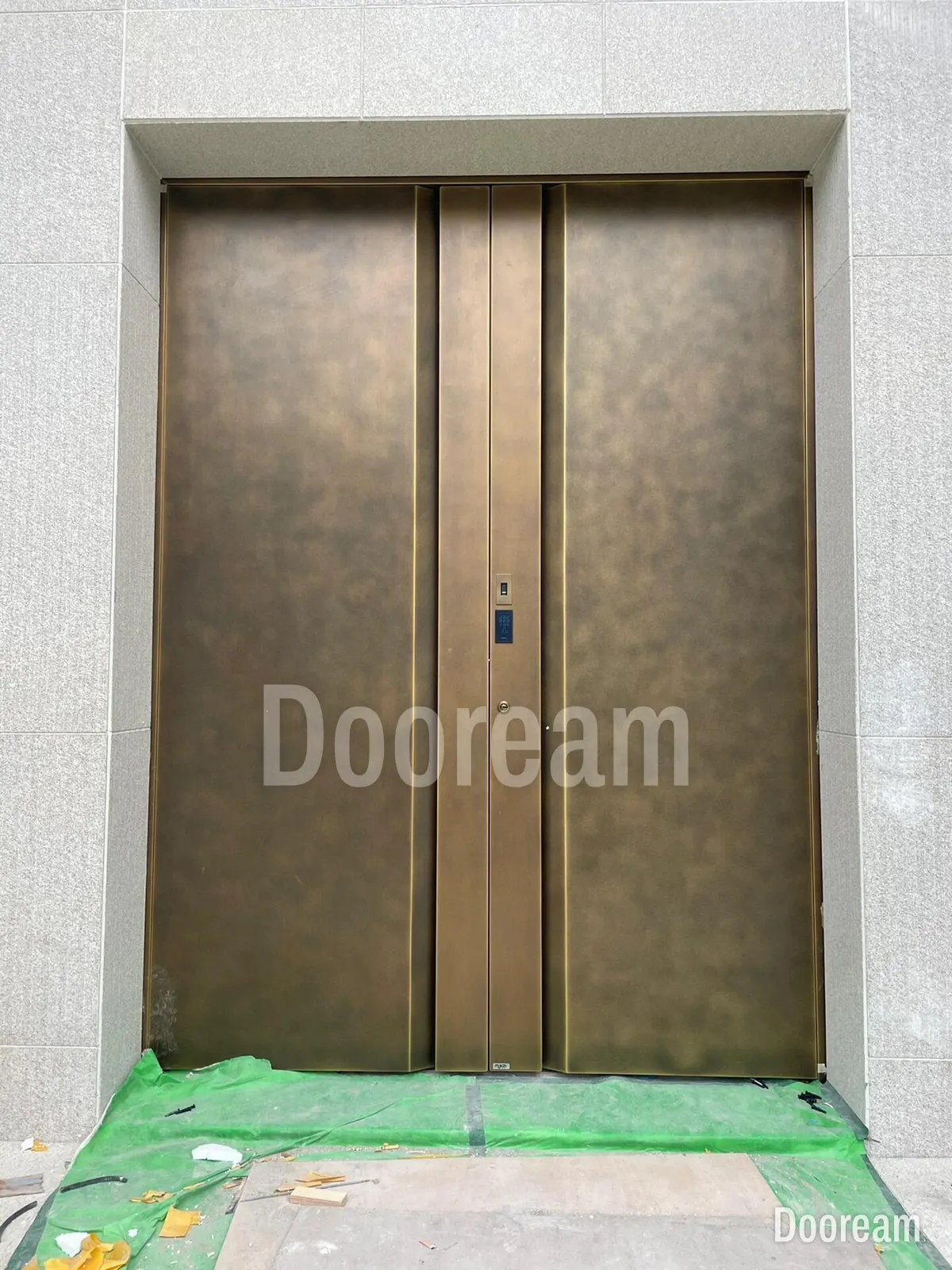
Short answer: choose bronze when the owner wants a metal that darkens and patinates with age, will pay for regular oiling or waxing, and the hinges, floor and structure are designed for about three times the weight of aluminium. Choose cast or carved aluminium for a very large leaf, a hot or coastal site, or a colour that should stay as approved. Aluminium can look like bronze in colour and relief, but it will not age like bronze.
What does “bronze door” usually mean today?
It can mean three different doors: one with faces cast in a solid copper alloy, one clad with bronze sheet over a core of another material, or an aluminium or steel door with a bronze-coloured finish. All three are sold as “bronze doors”, so ask what the metal is, how thick it is and what is behind it.
- Cast or solid bronze. The relief is cast in a copper alloy; only the casting alloys, C80000 to C99999, can be cast. Straight shapes such as angles and channels are extruded, often in architectural bronze, C38500.
- Bronze-clad. Bronze sheet bonded, usually with adhesive, to a core such as steel, plywood, aluminium or rigid insulation. Lighter and less costly than solid metal; edges and joints show the quality.
- Bronze-coloured. Aluminium or steel with a bronze-coloured coating, anodising or patina effect. “Bronze” is then a colour: the Aluminum Anodizers Council’s two-step colour standards run from champagne to deep bronze, plus black.
Even the names are loose. The Copper Development Association (CDA) notes that bronze is technically copper and tin, and brass copper and zinc, yet “bronze” is used for many copper alloys with little or no tin, and “statuary bronze” names a colour. Architectural bronze is 57% copper, 40% zinc and 3% lead; ASTM B455 calls it a leaded brass.
How do bronze and aluminium entrance doors compare?
Bronze wins on a living metal finish that can be refinished and renewed. Aluminium wins on weight, colour stability, upkeep and cost. The table compares the three kinds of “bronze door” for a large villa entrance; the frame, core, lock and seals matter as much as the face. For other materials, see front door materials compared.
| Cast or solid bronze | Bronze-clad | Cast or carved aluminium, bronze-coloured | |
|---|---|---|---|
| Face weight per mm, per m² | About 8.5–8.9 kg | Sheet as bronze; the core sets the rest | About 2.7 kg |
| Colour over time | Darkens through browns towards grey-green unless oiled, waxed or lacquered | As solid bronze | Keeps the approved colour; changes only as the coating weathers |
| Routine care | Oil or wax, weekly to monthly, or renew the clear coating | As solid bronze | Washing |
| Near the sea | Patinates faster; run-off stains porous stone and can corrode aluminium | As solid bronze, plus the core at edges | Coating chosen for the site; keep apart from copper alloys |
| Heat | Conducts heat; needs an insulated core | Set mostly by the core | Conducts heat; needs an insulated core and a thermal break |
| New design | Pattern and mould, then hand finishing | Formed and bonded sheet | Carved: a new 3D file. Cast: a new mould |
| Relative cost | Highest | High | Lower than bronze for the same design |
How much heavier is a bronze door, and what does it change?
About three times heavier, volume for volume. Architectural bronze has a density of 8.47 g/cm³ and copper 8.89–8.94 g/cm³, against about 2.69 g/cm³ for aluminium. So each millimetre of face weighs about 8.5 kg per square metre in bronze and 2.7 kg in aluminium.
A worked example, not the thickness of any particular door: on a 1,500 × 3,000 mm pivot leaf (4.5 m²), a 10 mm face weighs about 380 kg in architectural bronze and 120 kg in aluminium, before the frame, core, lock and inner face. That weight goes into:
- The hinge or pivot, which must be rated for the whole leaf; see how heavy a pivot door can be.
- The floor and head, which carry and steady the leaf; see pivot door floor preparation.
- A hotel entrance, where egress and opening-force rules apply and a heavier leaf is harder to keep within them; see villas and hotels.
How do bronze and aluminium age?
Bronze changes; a coating on aluminium holds its colour. Outdoors, CDA lists architectural bronze weathering to russet and then dark brown, and commercial bronze to a grey-green patina in about six years. Most copper alloys end grey-green, faster in marine and industrial air. A bronze-coloured coating keeps the approved colour.
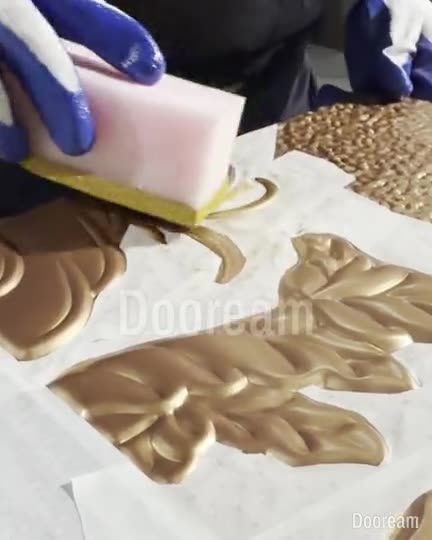
To fix a colour, bronze gets a statuary (oxidised) finish: a chemical film in light to dark browns, commonly applied by hand and rubbed periodically with oil or wax. Clear lacquers slow tarnishing but degrade outdoors and must be stripped and renewed.
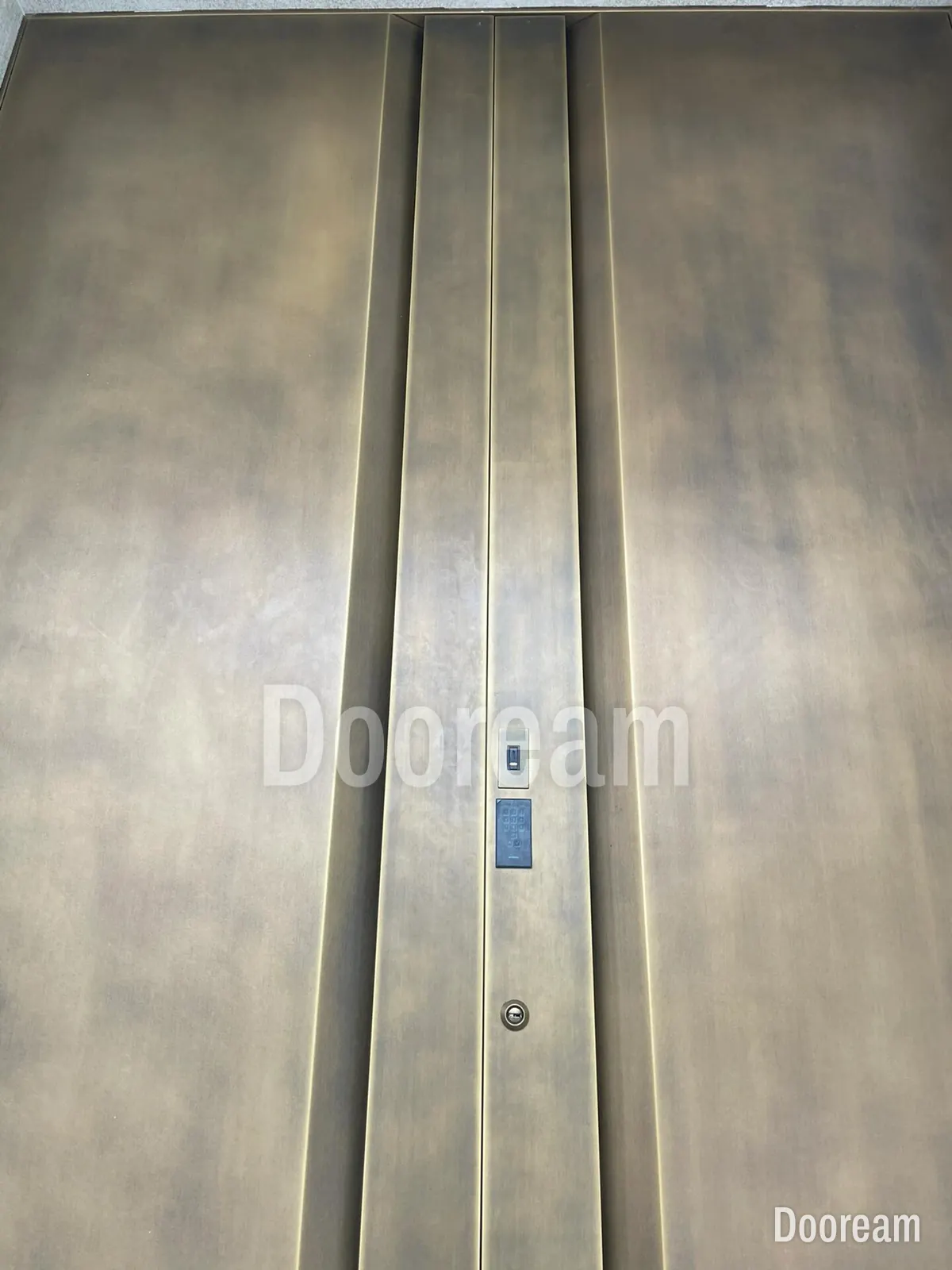
On aluminium the colour comes from the coating: PVDF (fluorocarbon) paint, powder coat or anodising, which includes bronze shades. A patina effect worked in by hand gives the clouded look of aged bronze, but it is fixed when made. It does not darken further, and a deep scratch shows silver aluminium. Compare coatings in our coastal and high-sun finishes guide.
What upkeep does a bronze door need?
Regular oiling or waxing, if the colour is to stay even. CDA advises oiling newly installed metal weekly for the first month to build a base, then every one or two weeks in heavy-traffic areas and monthly in moderate or light duty, rubbing on with a saturated cloth and off with a clean one.
- Oils: lemon oil, lemon grass oil, paraffin oil, linseed oil or castor oil.
- Waxes: carnauba or beeswax, or a good commercial wax.
- No steel wool: CDA warns it can carry a rust inhibitor that stains copper alloys.
- Lacquered bronze: plan for periodic stripping and recoating.
An aluminium door needs washing, not oiling; see how to look after a cast aluminium door.
What changes on a coastal site?
Salt speeds bronze’s patina, and run-off and metal contacts need detailing. Rain washing over copper alloys picks up copper salts, which CDA says stain porous stone such as marble and limestone green, so check stone thresholds, steps and surrounds below a bronze door. The same wash can speed corrosion of aluminium.
Where a copper alloy touches aluminium or zinc and gets wet, the aluminium or zinc corrodes; CDA names them the metals of most concern. Keep them apart with a compatible primer, non-absorbent tape, gaskets or sealant, and keep bronze run-off off exposed aluminium. This applies to a bronze door in an aluminium frame, and to brass or bronze handles on an aluminium door.
Which insulates better, bronze or aluminium?
Neither on its own. Architectural bronze conducts about 123 W/m·K, and pure aluminium about 238 W/m·K (0.57 cal/cm·s·°C). Both need an insulated core, good seals and, where metal runs from outside to inside, a thermal break; see thermal breaks in aluminium front doors.
Our thermal-break construction, with PA66 polyamide insulating strips in the aluminium profiles, reaches a U-value of 1.0 W/m²K in our test report, and any of our designs can be built with it.
Is a bronze door more secure than an aluminium one?
Not because of the metal. Resistance to break-in comes from the whole door: the leaf construction, frame, lock, hinges, any glass and the fixing to the wall. A security class such as EN 1627 belongs to a tested door, not to a material, so ask for the test report for the door you are buying. See door security ratings explained.
How do lead time and customisation differ?
A new cast bronze design needs a pattern and a mould before the first casting, then cleaning up and chemical finishing, much of it by hand. A door built from sheet, extrusions and castings uses a different alloy for each form, and CDA publishes a colour-matching chart because their colours differ.
On aluminium, a cast face also needs a mould, while a carved face needs only a 3D file. See cast or carved faces and how carved doors are made.
How do you choose? A checklist
Bronze suits an owner who wants a metal that changes with age and will pay for its care, on a structure designed for the weight from the start. Bronze-coloured aluminium suits a very large or pivoting leaf, a hot or coastal site, a colour that must stay as approved, or a tighter budget. Ask every supplier:
- Face: which alloy, and is it solid, clad or coated?
- Weight: face thickness, total leaf weight and the hinge rating.
- Finish: patina, lacquer, oil or wax; or the coating system and the test it meets.
- Care: written instructions and intervals for the owner.
- Mixed metals: how frame, threshold, hardware and fixings are kept apart.
- Run-off: where water from the door goes, and what stone sits below.
- Heat and security: the U-value and any security test report, for the whole door.
- Sample: judged outdoors in daylight, parts side by side.
How does this work with Dooream?
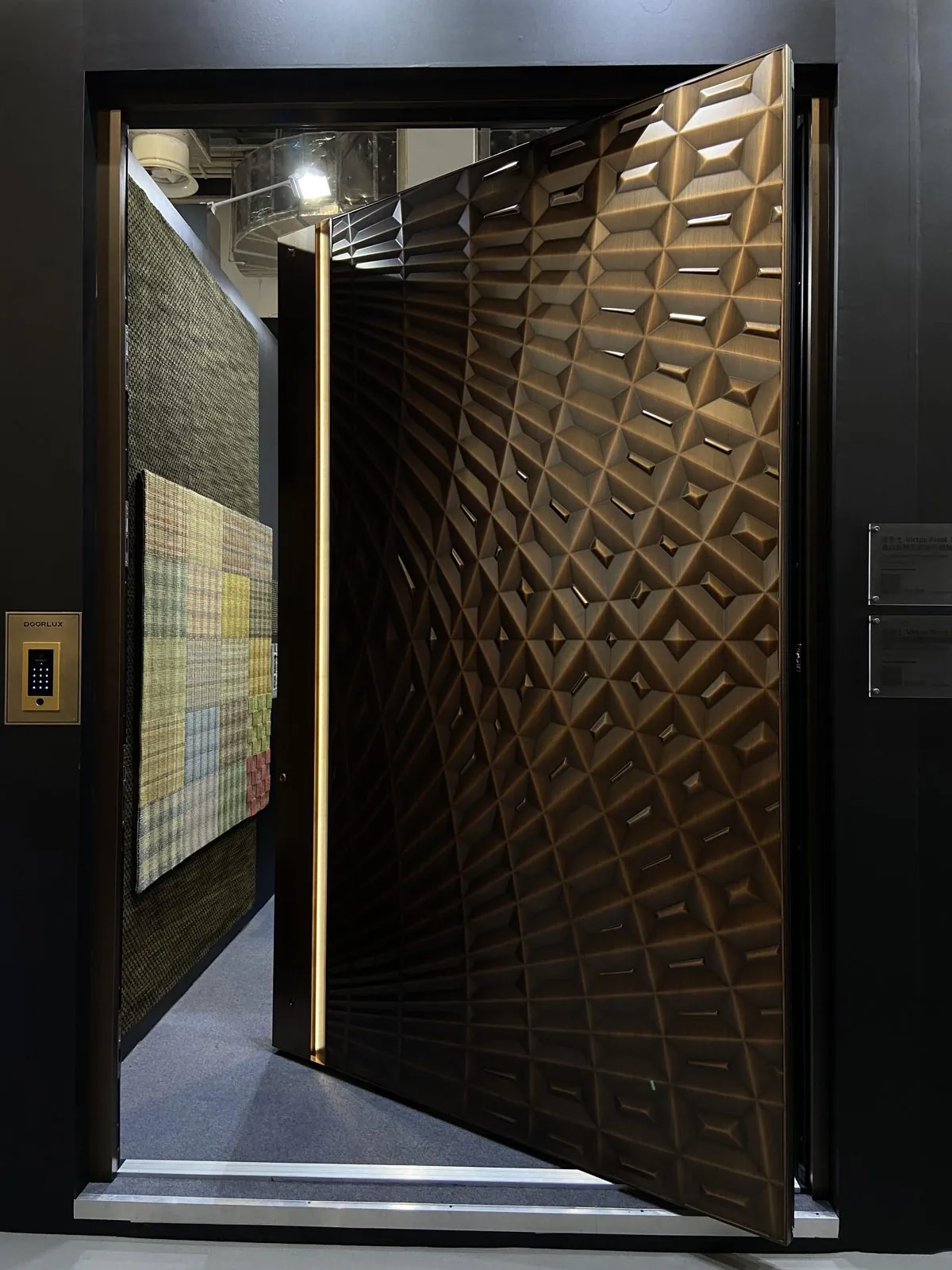
We do not make bronze doors. Our faces are carved aluminium, the face we make most, cast aluminium or aluminium sheet, built into an armoured leaf with galvanised steel sheets and an aluminium honeycomb core. Most of our doors are finished in fluorocarbon (PVDF) paint, including the dark bronze-coloured finish of Lattice, and some designs get a hand-applied patina effect, which you approve on a 20 × 20 cm sample. We do not hold an EN 1627 rating; a lab test can be arranged, usually at the buyer’s cost. Production takes 35–45 days after drawing approval and deposit. Send your opening through our architects page or contact page.
Sources, checked November 2026: Copper Development Association, Copper in Architecture Design Handbook (A4050); ASTM International, ASTM B455/B455M-20, leaded-brass extruded shapes; AZoM, architectural bronze C38500 and aluminium properties; Aluminum Anodizers Council, publications and technical information.
Quick answers
Is a bronze entrance door made of solid bronze?
Not always. "Bronze door" can mean a door with faces cast in a copper alloy, a door clad with bronze sheet over a core such as steel, plywood, aluminium or insulation, or an aluminium or steel door with a bronze-coloured finish. Even architectural bronze, C38500, is a leaded brass of 57% copper, 40% zinc and 3% lead. Ask what the metal is, how thick it is and what is behind it.
How much heavier is bronze than aluminium?
About three times, volume for volume. Architectural bronze has a density of 8.47 g/cm³ and copper 8.89–8.94 g/cm³, against about 2.69 g/cm³ for aluminium. Each millimetre of face weighs about 8.5 kg per square metre in bronze and 2.7 kg in aluminium, and the hinges, floor and head must carry it.
Can a cast or carved aluminium door look like bronze?
In colour and relief, yes. Bronze-coloured PVDF or powder coatings, anodising in bronze shades and hand-applied patina effects can all give an aluminium face a bronze look. It will not age like bronze, though. The colour does not darken further, and a deep scratch shows silver aluminium. We do not make bronze doors; we make cast and carved aluminium faces that can be finished in bronze colours.