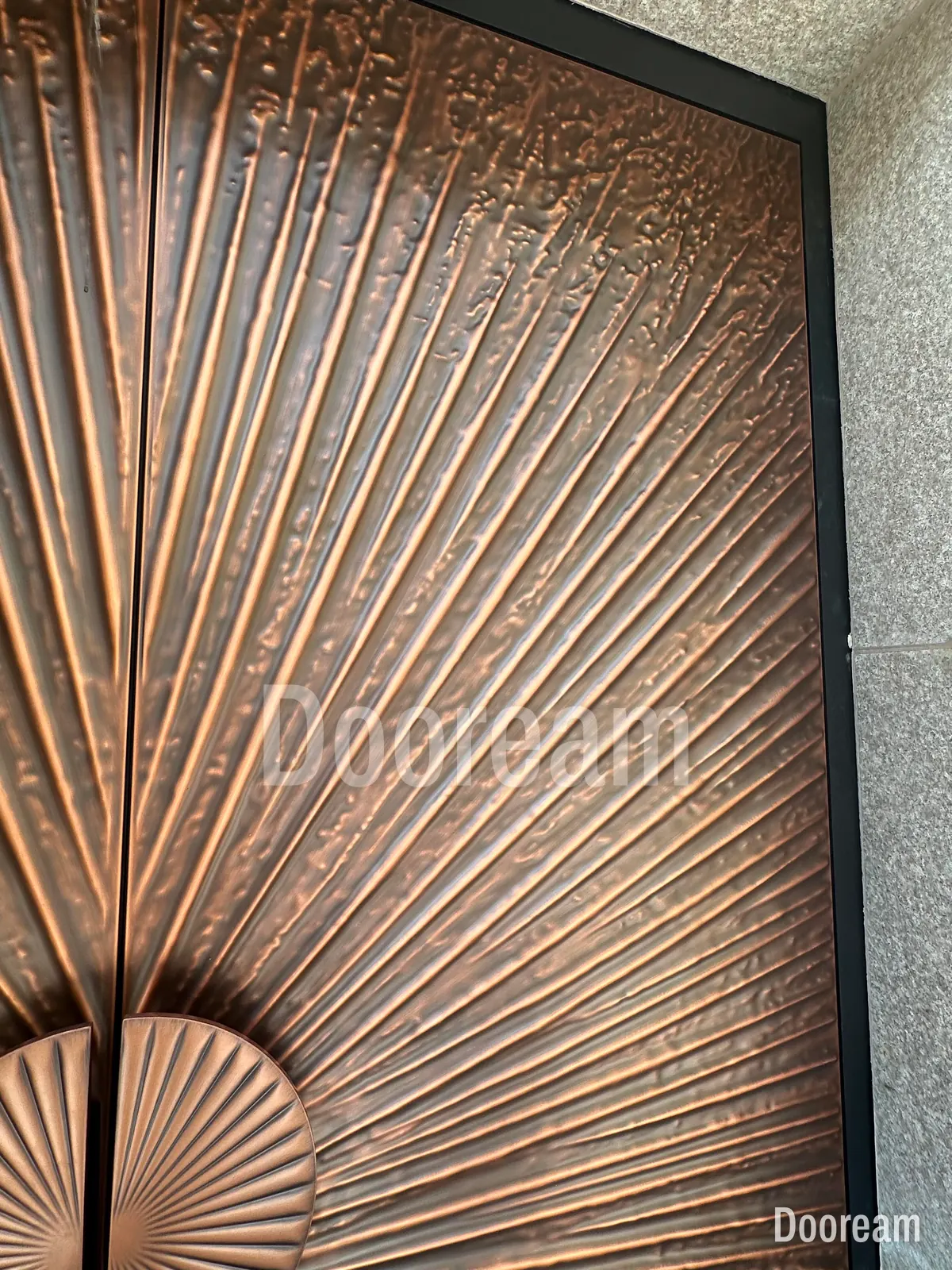
Short answer: no material is best everywhere; it depends on climate, size and upkeep. For a very large leaf in strong sun or sea air, aluminium faces over a light, stiff composite core are usually the most practical. Solid wood suits sheltered entrances, bronze is the heaviest and costliest, and steel and fibreglass do well at standard sizes.
How do the main front door materials compare?
Each material wins somewhere. The table compares them for a large, custom entrance door, assuming good workmanship. In every case the frame, lock, seals and installation matter as much as the material, and relative cost assumes the same size and level of detail.
| Material | Security | Insulation | Rust, rot, warping | Sun and heat | Coastal site | Upkeep | Relief and size | Weight | Relative cost |
|---|---|---|---|---|---|---|---|---|---|
| Cast aluminium | Core and lock decide | Poor alone | No rust or rot | Expands most of the metals | Good, coated | Low | Deep relief, undercuts | Light to medium | High; less if repeated |
| Carved aluminium plate | Core and lock decide | Poor alone | No rust or rot | Expands most of the metals | Good, coated | Low | Crisp one-off relief | Light to medium | High |
| Aluminium sheet | Core and lock decide | Poor alone | No rust or rot | Expands most of the metals | Good, coated | Low | Flat, bent or printed | Light | Moderate |
| Composite armoured, aluminium and steel | Steel inside; test decides | Set by core and seals | Layers must balance | Colour and balance matter | Good, coated | Low | Any face; very large leaves | Medium | High |
| Steel | Strong, stiff | Good with foam core | Rusts where coating breaks | Half aluminium’s expansion | Needs intact coating | Medium | Pressed or laser-cut | Heavy | Lower at stock sizes |
| Solid wood | Good if thick, reinforced | Moderate | Moves; can rot | Sun degrades the surface | Good with upkeep | High | Hand carving; width limited | Medium | Moderate to very high |
| Engineered wood | Core decides | Moderate | Moves less; can rot | Sun degrades the veneer | Good with upkeep | Medium to high | Large, shallow relief | Medium | Moderate to high |
| Fibreglass (GRP) | Core, frame and lock decide | Good with foam core | No rust or rot | Finish may fade | Good | Low | The maker’s moulds | Light | Lower to moderate |
| Bronze | Core and lock decide | Poor alone | No rust; darkens | Near aluminium’s expansion | Very good | Medium | Cast relief, fine detail | Very heavy | Very high |
| Wrought or cast iron | Strong; cast iron is brittle | Poor alone | Rusts unless painted | Like steel or less | Poor unless painted | High | Cast or forged ornament | Heavy | Moderate to high |
What do the numbers say?
Three properties explain most of the differences: density sets the weight, thermal conductivity the heat flow, and thermal expansion how much a material grows as it warms. Aluminium is light but conducts heat and expands the most of these metals; wood hardly conducts heat but moves with moisture.
| Material | Density, kg/m³ | Thermal conductivity, W/m·K | Thermal expansion, × 10⁻⁶ per K |
|---|---|---|---|
| Aluminium, pure | 2,700 | 235 | 23.1 |
| Aluminium alloy EN AW-5083 | 2,660 | 110–140 | 24.2 |
| Structural steel | 7,850 | About 45 | 12 |
| Wood (dry density; conductivity at 12% moisture) | 320–720 for most species | 0.10–0.14 softwoods, 0.17–0.19 oak | 3.1–4.5 along the grain; 5 to over 10 times that across it |
| Architectural bronze C38500 | 8,470 | 123 | 20.9 |
| Grey cast iron, EN-GJL-150 to 250 | 7,100–7,200 | 50–59 | About 10 |
- Weight. On a 4 × 8 m pivot leaf, each millimetre of face weighs about 86 kg in aluminium, 251 kg in steel and 271 kg in bronze; check the leaf against the hinge rating.
- Heat. Aluminium passes heat hundreds to over a thousand times faster than wood, steel a few hundred times faster, so a metal door insulates through its core, seals and frame; see thermal breaks.
- Movement. For each 10 °C of warming, a 3 m face grows about 0.7 mm in aluminium, 0.6 mm in bronze and 0.36 mm in steel. Wood hardly grows with heat along the grain, but when wet it swells 30 to 100 times more across the grain than along it. Uneven warming or wetting bows a leaf; see tall front doors.
What are the strengths and weaknesses of each material?
Every material here makes a good door somewhere. The differences show at large sizes, in hard sun and sea air, and in how much care the owner will give the door. Here is what each one does well and where it struggles.
Aluminium: cast, carved plate and sheet
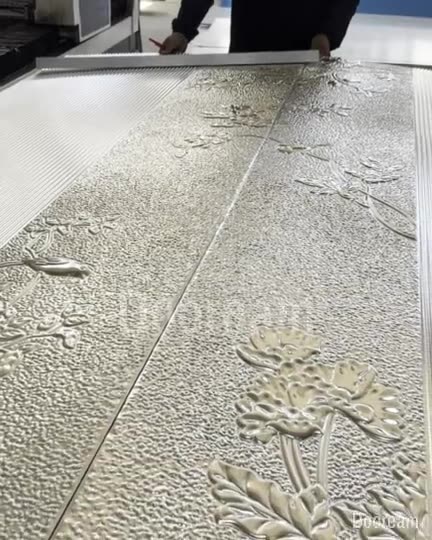
Aluminium does not rust or rot and weighs a third as much as steel. Cast faces suit repeated patterns and undercuts, carved plate suits one-off relief, and sheet suits flat, bent or printed faces; see cast or carved faces. Weaknesses: it conducts heat, expands twice as much as steel and is a third as stiff (70 against 210 GPa), so a large leaf needs a stiff core.
Steel
Steel is strong and stiff, and with a foam core it insulates well: the US Department of Energy puts most insulated steel and fibreglass entry doors at R-5 to R-6 (US units) without glass. Weaknesses: it is heavy, rusts where the coating breaks, and gives pressed patterns rather than deep relief.
Solid wood
Wood insulates far better than bare metal and can be carved by hand. Weaknesses: it swells and shrinks with moisture, mostly across the grain; sunlight breaks down its surface; and finishes only slow moisture change, so they need renewing every few years.
Engineered wood
A core of glued layers, often laid crosswise, sits under a hardwood veneer. Crossed layers restrain each other’s swelling, so the leaf moves far less than solid boards and suits tall doors. Weaknesses: the veneer limits relief and is hard to repair, and the finish needs the same care.
Fibreglass and GRP composite
Moulded fibreglass skins sit over a foam core. They do not rust or rot, insulate like insulated steel and need little upkeep. Weaknesses: sizes and designs follow the maker’s moulds, so very tall doors and one-off relief are uncommon.
Bronze
Bronze casts fine detail and stands up well to sea air. It darkens outdoors: for copper, the Copper Development Association says a natural patina forms in five to seven years near the coast and may never form in arid places. Weaknesses: it is the heaviest and costliest material here, and clear coatings that keep the first colour must be stripped and renewed.
Wrought and cast iron
Cast iron takes almost any ornament and resists corrosion better than wrought iron or steel, but it is brittle and fails in tension with little warning. True wrought iron is now mostly recycled for restoration; new “wrought iron” doors are usually mild steel. Both are heavy and must be kept painted.
How does a composite armoured door combine materials?
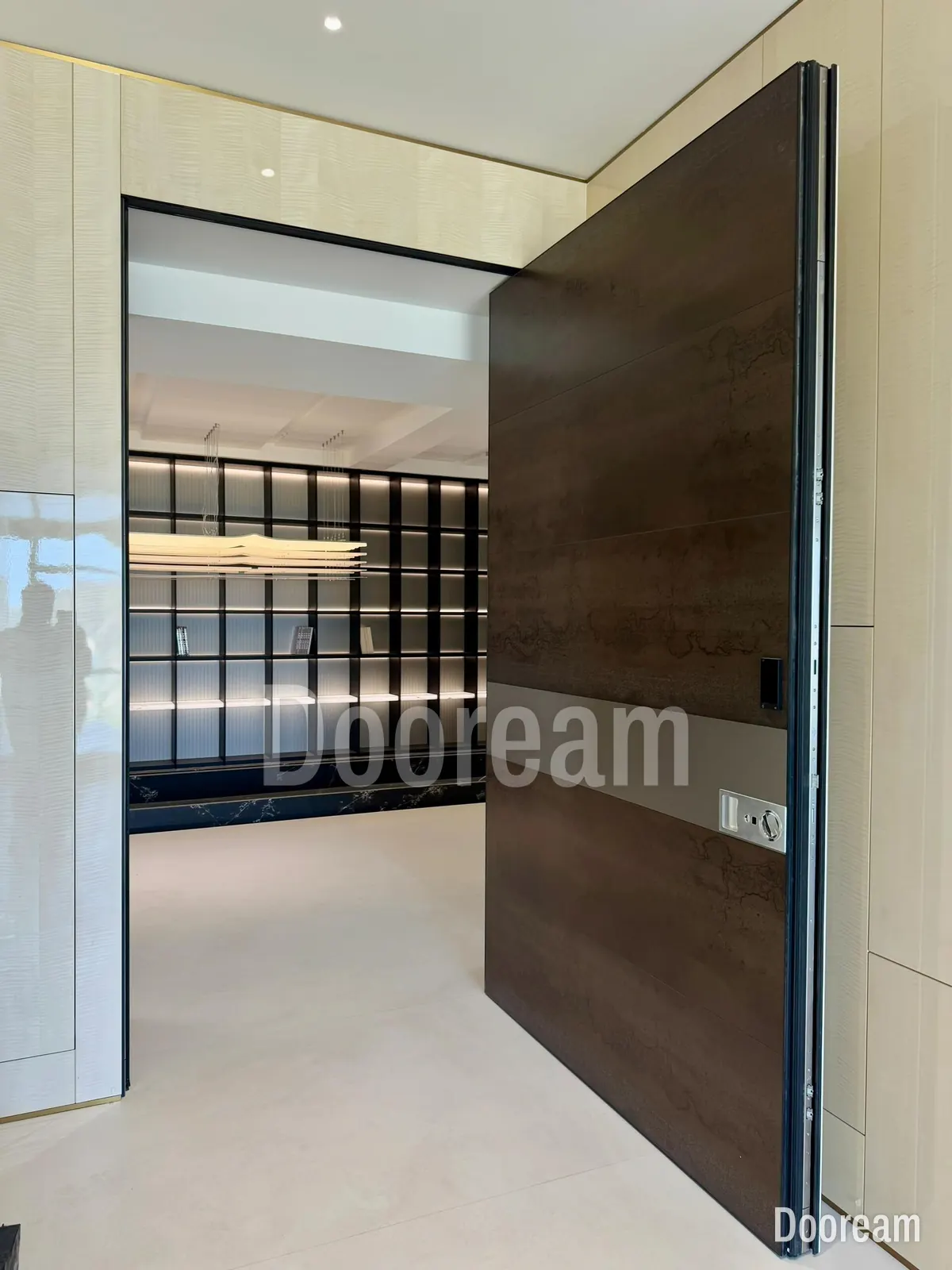
A composite armoured door layers materials so each does what it is good at: a decorative, weatherproof face outside, steel sheets for stiffness and strength, and a light core that keeps the leaf rigid without the weight of solid metal. Ours, from outside to inside:
- The face.
- A galvanised steel sheet.
- An aluminium frame with an aluminium honeycomb core.
- A second galvanised steel sheet.
- The inside face.
Strengths: almost any face and very large leaves, with less weight than solid metal. Weaknesses: more parts, so quality depends on how the layers are bonded and balanced. “Armoured” describes this build, not a test result: we do not hold an EN 1627 rating, and a lab test can be arranged, usually at the buyer’s cost. See door security ratings explained.
Which material suits which situation?
Start from the site and the size, then choose the look. Below is a sensible first choice for six common situations, and what to check. A deep porch or canopy widens the choice every time, because sun and rain separate these materials most.
- Hot desert climate. Coated aluminium or composite in a lighter colour, with a coating tested for strong sun; see high-sun finishes. Solid wood dries and moves; bronze may stay brown.
- Coastal villa. Coated aluminium, composite, fibreglass or bronze, not bare steel or iron. Aluminium touching copper alloys or steel corrodes faster in salt air unless the contact is insulated, painted or zinc-coated.
- Cold winters. Insulation and seals decide; foam-cored steel and fibreglass do well. For a metal-faced door, ask for a tested U-value that matches your size and glass.
- Very tall doors over 3 m. Weight and flatness decide: aluminium-faced composite leaves are light and stiff; solid timber moves, steel gets very heavy, and fibreglass may not come that tall.
- High security. Choose by test result, not by material: ask for a class such as EN 1627 for the whole tested door.
- Intricate relief. Cast aluminium for repeated patterns, carved aluminium plate for one-off designs, cast bronze where weight and cost allow, carved wood for sheltered entrances.
How does this work at Dooream?
We build every leaf in the layers above, with a face to your design: mostly carved aluminium, also cast aluminium, sintered stone, glass, wood or copper. Our thermal-break construction, with PA66 polyamide insulating strips in the aluminium profiles, reaches a U-value of 1.0 W/m²K in our test report, and any of our designs can be built with it. Every door is made to your drawing, from one door, up to 4,000 × 8,000 mm for a pivot; send the opening through our architects page or contact page.
Sources, checked November 2026: American Wood Council, thermal conductivity of wood compared with other materials; US Forest Products Laboratory, Wood Handbook (1999), chapter 3, physical properties and moisture relations of wood; Rowell and Youngs, US Forest Service, dimensional stabilization of wood in use; Cassens and Feist, US Forest Service, finishing wood exteriors; US Department of Energy, Energy Saver, doors; WebElements, University of Sheffield, aluminium physical properties; Abrams Industries, EN AW-5083 data sheet; Eurocode Applied, EN 1993-1-1 steel design properties; AZoM, architectural bronze C38500; Copper Development Association, architectural finishes; Matmatch, grey cast iron EN-GJL-150 and EN-GJL-250; US National Park Service, Preservation Brief 27, architectural cast iron; Chris Topp, The Building Conservation Directory, wrought iron and conservation; National Physical Laboratory, bimetallic corrosion.
Quick answers
Which front door material is best for a large luxury entrance?
It depends on the climate, the size and the upkeep the owner accepts. For a very large leaf in strong sun or sea air, aluminium faces over a light, stiff composite core are usually the most practical. Solid wood suits sheltered entrances, bronze is the heaviest and costliest, and steel and fibreglass do well at standard sizes.
Is aluminium or steel better for a front door?
Each has an edge. Aluminium weighs about a third as much as steel (2,700 against 7,850 kg/m³) and does not rust, but it conducts heat faster and expands about twice as much per degree. Steel is three times stiffer. A composite armoured door uses both.
Does a metal front door insulate as well as wood?
Not on its own. Aluminium conducts heat hundreds to over a thousand times faster than wood, so a metal door insulates through its core, seals and frame. Our thermal-break construction, with PA66 polyamide insulating strips in the aluminium profiles, reaches a U-value of 1.0 W/m²K in our test report.