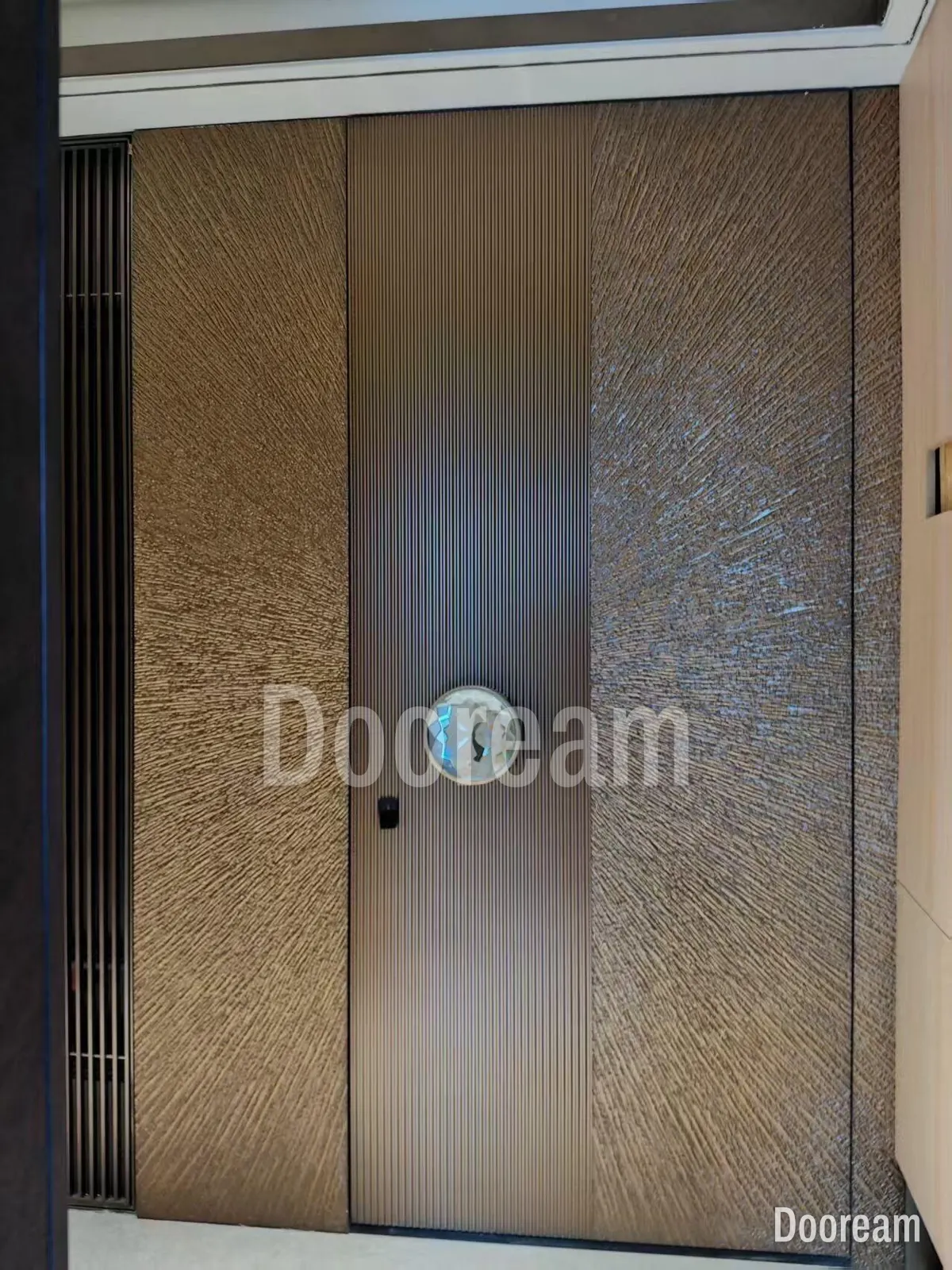
Short answer: there is no right depth in millimetres, only a right depth for the light and the viewing distance. Low relief reads only in raking light and up close; high relief reads in most light but is heavier and holds dust. Choose after seeing a sample outdoors, facing the real direction, at the hour of use.
What do low, middle and high relief mean?
Britannica defines relief as any work in which the figures project from a supporting background, usually a flat surface. In low relief (bas-relief) the design projects only slightly. In high relief (alto-rilievo) the forms project at least half their natural circumference. Middle relief (mezzo-rilievo) falls roughly between the two.
In sunken relief the carving sits below the surface, inside a sharply incised outline that frames it “with a powerful line of light and shade”. The face around it stays flat, leaving room for hardware.
These are proportions, not sizes; the maker puts millimetres on the drawing. Forms that curl back need casting: see cast or carved faces.
How does each kind of light change a relief?
Relief reads by shadow, and shadow depends on the direction of light more than its strength. The National Gallery defines raking light as light from one side only, at an oblique angle: raised parts facing it are lit, those facing away cast shadows. Light from straight in front shows almost no shadow.
In the CIE standard overcast sky, luminance at θ above the horizon is the zenith value × (1 + 2 sin θ) ÷ 3 (MIT course notes), so the zenith is three times as bright as the horizon: soft light, mostly from above.
| Light condition | What happens to the relief | What to choose |
|---|---|---|
| Low sun from the side | Every ridge and sanding mark shows | Low relief and fine texture work |
| High sun (summer noon, or the tropics) | Long shadows under horizontal edges; vertical flutes nearly lost | Horizontal or diagonal main lines |
| Low sun square-on (east at sunrise, west at sunset) | Shadows hide behind forms; gloss glares | Two tones or metallic high points |
| Overcast sky | Soft shadows under upper edges; low contrast | Bold shapes, deeper relief, light or metallic colour |
| Deep canopy or recess | Soft light from front and ground; flattest by day | Deep, steep-sided relief or colour contrast |
| Night, grazing from above | Shadows fall as by day | Linear grazer close to the face |
| Night, uplight | Shadows fall upwards; shallow relief can look inside out | Tall shapes only; test first |
Which way does the door face, and when does sun reach it?
Orientation sets the sun’s angle on the face. Away from the tropics, a door facing the equator gets sun for much of the day, high in summer and low in winter. East and west doors get low sun early and late. A pole-facing door lives mostly in sky light.
Australia’s Your Home guide notes that north-facing walls there get more sun in winter than in summer, as the sun is lower; north of the equator, swap north and south.
Our arithmetic, with the sun’s declination of ±23.45° at the solstices (Penn State): noon sun height = 90° − |latitude − declination|.
- 25°N: about 88° in June, 42° in December. Summer noon light grazes down an equator-facing door.
- 34°S: about 79° in December, 33° in June.
- 51.5°N: about 15° in December: nearly square-on, flattening relief.
PVEducation notes that between the equator and the Tropic of Cancer the summer noon sun comes from the north. Shadow length against sun height is in our geometric pattern guide.
What does a canopy or recess do to the relief?
It removes the light that models relief best. Under a deep canopy the door no longer sees the bright sky overhead, only the dimmer sky near the horizon and the ground in front. Light arrives softly from the front and below, the reverse of normal shading, and pale paving bounces more of it up than dark paving.
Choose deeper, steep-sided relief, a second tone on the raised parts, or a grazer. For canopy depth, see entrance lighting and canopy design.
Is the door seen from the gate or from the step?
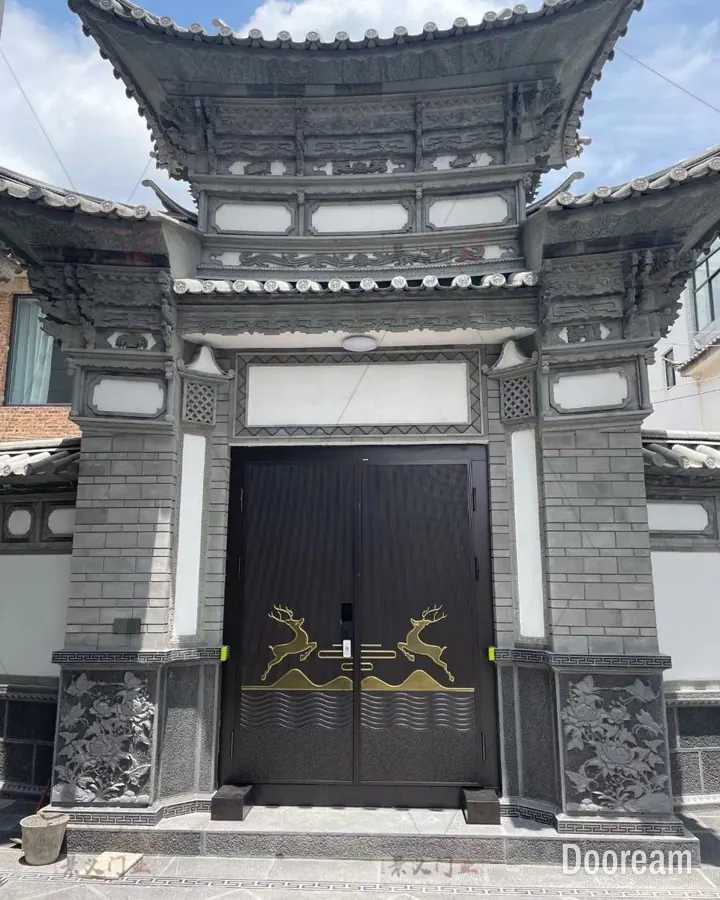
Detail reads by the angle it fills in the eye. EyeWiki, from the American Academy of Ophthalmology, puts the finest detail an ideal eye resolves under optimal conditions at about 1 minute of arc; a chart letter is 5 minutes high. One minute of arc is about 0.29 mm per metre of distance.
Worked example (our illustration, not our specification): one door seen from the step, 1.5 m away, and from a gate 15 m away.
| Feature | Size | From the step, 1.5 m | From the gate, 15 m |
|---|---|---|---|
| Fine texture line | 1 mm | 2.3 arcmin, visible | 0.2 arcmin, merges into a tone |
| Narrow groove | 3 mm | 6.9 arcmin, clear | 0.7 arcmin, below the limit |
| Shadow of a 5 mm step in 45° light | 5 mm | 11.5 arcmin, clear | 1.1 arcmin, at the limit |
| Main motif band | 50 mm | 115 arcmin | 11.5 arcmin, clear |
A relief shadow has far less contrast than a chart letter, so our rule of thumb is about 1 mm per metre of distance (about 3.4 arcmin). Design two scales: large shapes for the gate, fine texture for the step, as on classical carved doors.
How do line width and depth work together?
A groove reads as a dark line when its floor is in shadow, which depends on depth relative to width. Narrow, deep grooves stay dark in almost any light; wide, shallow forms read only when light comes from the side.
Worked example (our geometry, not our specification): a shadow reaches depth ÷ tan α across a groove floor, α being the angle between light and face. In 30° raking light a 3 mm deep groove fills with shadow up to about 5.2 mm wide; at 60°, only up to 1.7 mm. In even, diffuse light the middle of the floor gets about 24% of the flat face’s light if the groove is half as wide as deep, 89% if four times as wide.
Keep fine lines narrow and relatively deep, within the cutter limits in our CNC guide; give broad forms facets at different angles.
Do colour and gloss change how deep the relief looks?
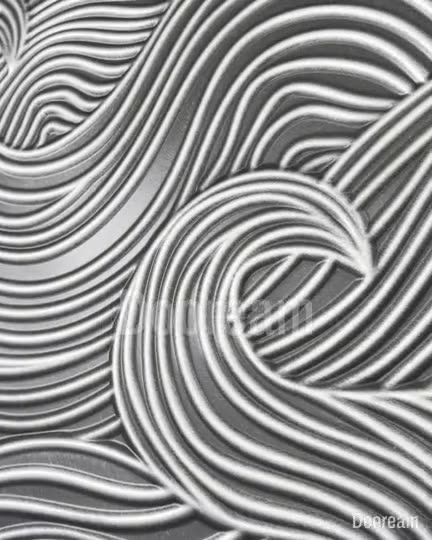
Yes: relief reads by the brightness difference between lit and shaded faces. A pale matt face shows it most, so shallow relief reads; a dark matt face shows it least, so only bold relief and outline read. Gloss and metallic finishes add highlights, which are reflections and move as you walk past.
- Dark matt: a silhouette; needs bold relief, a second tone or a grazer. See black front doors.
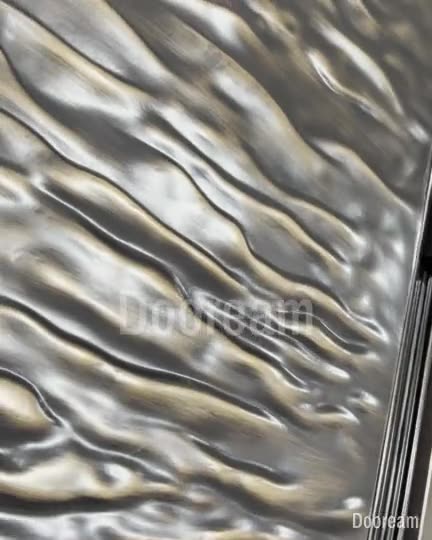
- Metallic or brushed: crests flash, troughs go dark; judge it while moving.
- Gloss: mirrors sky and lamps; shows every ripple in raking light.
- Two tones: a lighter tone on high points carries the design in shade. Gloss levels and codes: front door colours.
How should a relief door be lit at night?
Graze it, from above where possible. ERCO says grazing light emphasises façade detail with strong shadows and suits reliefs, while floodlighting makes a surface look flat. Architect magazine (2015) puts grazing fittings no more than 12 inches, about 300 mm, from the surface.
- Direction. People read shading as if lit from above: Michael Bach’s demonstration, after Ramachandran (Nature, 1988), shows bumps turning into dents when the shading is rotated. Test any uplight on the sample.
- Contrast. ERCO suggests an accent 5 to 10 times brighter than the general lighting.
- Colour temperature. ERCO recommends 2700 K for warm metals such as gold, brass and bronze, 3000 K where warm and cool colours mix, and 4000 K for cool metals such as stainless steel and aluminium. Check local dark-sky limits in our lighting guide.
Why judge a sample outside, at the hour of use?
Because light changes a relief more than any line in a specification. A showroom spotlight rakes from above; the real door may be in shade at six in the evening, and the hero photo shows one texture warm on the left and cool on the right. Before approving a sample, check it:
- Upright, facing the real direction; flat on a table it gets noon light.
- At the hours of use: morning, afternoon, evening arrival.
- In sun, in shade and under an overcast sky; hold it in the canopy’s shadow.
- From the step, about 1.5 m. For the gate view, tape a full-size print in the opening, or use a scaled or full-size sample door.
- At night, with a torch where the grazer will be, from above and below, at the planned colour temperature.
- For both tones and the gloss, against the approved codes.
- For workmanship, with our CNC guide checklist.
- Then record it: depth words on the drawing, millimetres from the maker, sample signed and kept.
How does this work with Dooream?
Dooream is the export brand of Zhejiang Jingyi Door Industry in Wuyi, China. We make complete entrance doors to the buyer’s drawing, from one door; carved aluminium is the face we make most, alongside cast aluminium, sintered stone, glass, wood and copper. The first design direction is free, usually within one working day, and a 20 × 20 cm carved and coloured sample lets you check depth, colour and gloss in your own light before approving the drawing. Examples: Sunburst, radiating carved lines; Contour, an offset pivot door with flowing carved lines; Lattice, a deep cast diagonal relief. Start on our architects page or contact page.
Sources, checked November 2026: Encyclopaedia Britannica, relief (sculpture); The National Gallery, raking light; MIT OpenCourseWare, 4.493 Natural Light in Design, daylight factor notes (2006), CIE overcast sky; Your Home (Australian Government), orientation (updated 2020); Penn State, EME 810, sun-earth relations; PVEducation, elevation angle; EyeWiki (American Academy of Ophthalmology), visual acuity testing in adults; ERCO, façade lighting and selection of suitable light colour; E. Donoff, Architect, wallwashing and wall grazing (September 2015); M. Bach, shape from shading, citing V. S. Ramachandran, Nature 331 (1988).
Quick answers
How deep should the relief on a carved entrance door be?
Deep enough to read in the light the door really gets, at the distance it is really seen from. An ideal eye resolves about 1 minute of arc, which is about 0.29 mm per metre of distance; our rule of thumb is about 1 mm per metre for a line or shadow to read clearly. So fine texture is for the step, and only large shapes and their shadows carry to a gate 15 m away. Agree low, middle or high relief in words, and let the maker fix the millimetres on the drawing after you have seen a sample in the real light.
How does light change the way a carved relief looks?
Light from one side at a low angle, called raking light, makes even shallow relief read: raised parts facing the light are lit and parts facing away cast shadows. Light from straight in front, such as low sun square-on or a floodlight, flattens it. An overcast sky gives soft light from above, with the zenith about three times as bright as the horizon, and deep canopy shade gives soft light from the front and below, which flattens relief most.
How should a carved relief door be lit at night?
Graze it: put a linear light close to the face, no more than about 300 mm away, and aim it along the surface, from above where possible, because people read shading as if light comes from above. Floodlighting from the front makes it look flat. ERCO suggests 2700 K for warm metals such as bronze, brass and gold and 4000 K for cool metals such as aluminium and stainless steel, and an accent 5 to 10 times brighter than its surroundings.