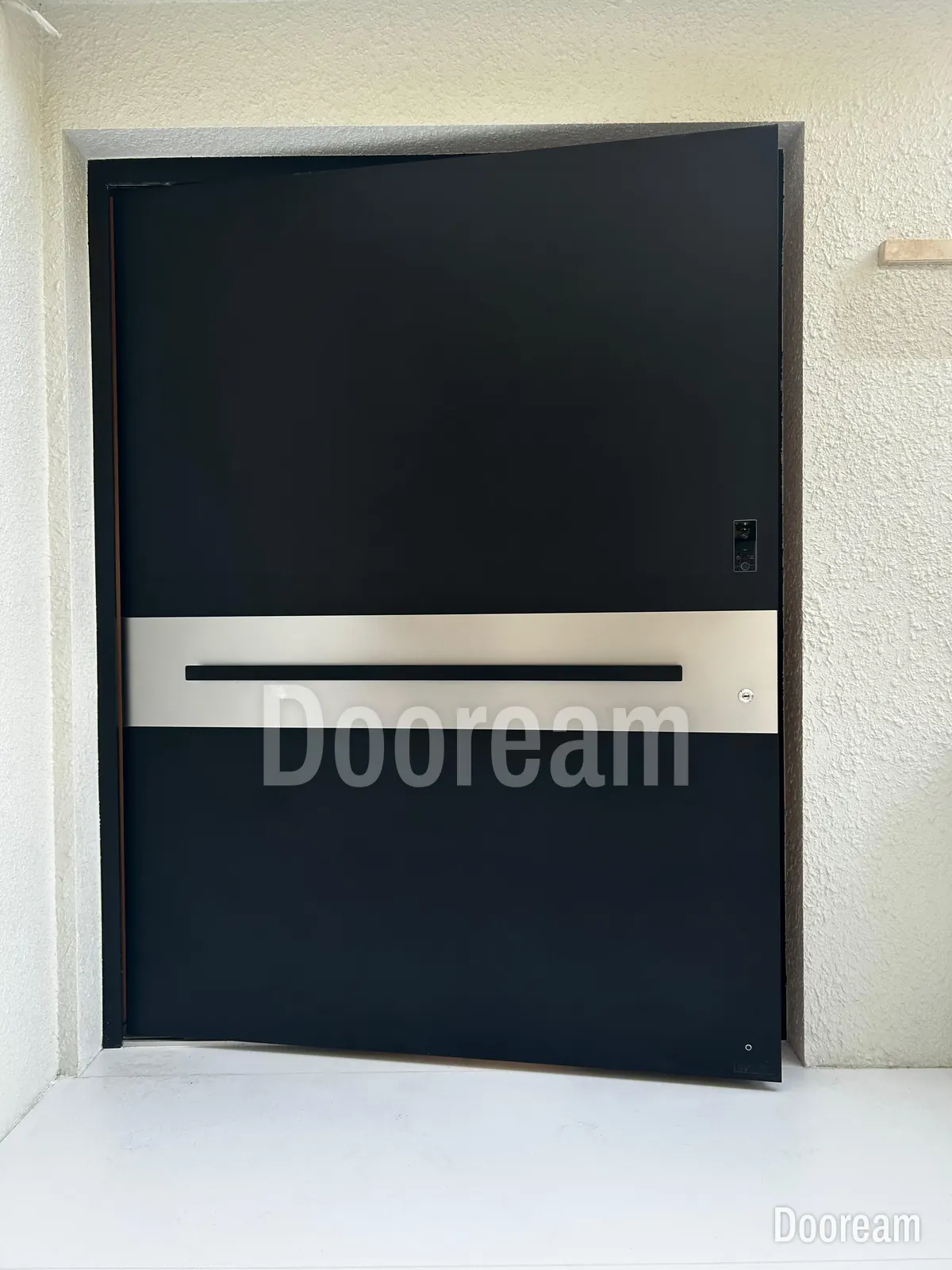
Short answer: yes, where the façade is pale and the door is shaded for most of the day. Black gives the sharpest outline against pale stone or render. In full sun a conventional black runs hotter than any other colour, so shade it or specify a cool (infrared-reflective) black, a durable matt or textured coating and a leaf built to stay flat. Then wash it in the shade and dry it.
Is a black front door a good idea for a villa?
Usually, yes. From the gate, black reads as one clean outline, so it works best against pale limestone, white stone or render, on a modern villa or a classical one. It is a poor choice against dark stone or dark cladding, and it needs care where low afternoon sun falls straight on it.
- Modern: a flush black leaf with one band, pull or light line, as above. See modern minimalist front doors.
- Classical: raised mouldings in a carved stone surround. Mouldings read by shadow, which merges with pure black, so a softer graphite keeps them visible.
- Where it fails: black on dark stone loses its outline; see front door colours for luxury villas.
Which black: jet, graphite, black bronze, textured or metallic?
Black is a family, not one colour. RAL Classic alone lists Jet black (RAL 9005), Signal black (RAL 9004), Graphite black (RAL 9011) and Traffic black (RAL 9017), with near-blacks such as Black grey (RAL 7021) and Anthracite grey (RAL 7016). A code fixes the colour, not the gloss or texture, so specify all three.
| Finish | Looks | Pros | Cons |
|---|---|---|---|
| Jet black, matt | Deepest, flattest black | Hides glare and ripples | Hottest in sun; dust and pale scuffs show |
| Jet black, satin or gloss | Richest, reflective | Depth of colour | Shows ripples, fingerprints, fine scratches |
| Graphite or black grey | Softer, slightly grey | Mouldings stay visible | Still dark in sun |
| Black bronze-coloured | Warm brown-black, often metallic | Suits bronze or brass hardware | Shade varies with angle and batch |
| Textured matt black | Fine grain or sand texture | Hides scratches and hand marks | Dirt settles in the texture |
| Metallic or pearl black | Flakes shift with angle | Lively under light | Ask for a clear coat; finish all parts together |
| Cool black | Black to the eye | Runs cooler in sun | Get its solar reflectance in writing |
How hot does a black door get in the sun?
Hotter than any other colour. PPG says a standard black pigment reflects only about 5% of sunlight, and Lawrence Berkeley National Laboratory (LBNL) measured a black roof about 30 °C warmer than a white one on a summer afternoon. A vertical door gets less sun than a roof, but the order of colours is the same.
Worked example (our arithmetic). Surface heat balance under the ASTM E1980 roof-rating conditions: sun 1,000 W/m² square-on, air 37 °C (310 K), sky 27 °C (300 K), medium wind (12 W/m²K), thermal emittance 0.9. The hall is at 24 °C, and aluminium grows 23.5 × 10⁻⁶ per kelvin (Hydro, EN AW-6063).
| Outer face | Solar reflectance | Face temperature | Extra growth of a 3,000 mm outer face over the inner face |
|---|---|---|---|
| Conventional black | 0.05 | about 82 °C | about 4.1 mm |
| Cool black | 0.25 | about 73 °C | about 3.4 mm |
| White | 0.80 | about 45 °C | about 1.5 mm |
With 700 W/m² instead, black still reaches about 69 °C.
- Bow. Deceuninck Aluminium has said UK summer temperatures in the high 30s are enough to bow many dark-coloured doors on south-facing elevations; it tests its own entrance door to 80 °C and limits bow to 2.5 mm. See bowing and warping and, for clearances and canopies, hot climates.
- Hardware. A dark metal pull in the same sun heads for the same temperatures, too hot to hold for long.
- Smart lock. A reader in a black face sits in that heat: check its rated operating range and keep a key; see fingerprint locks in hot climates.
What is a cool black, and does it help?
A cool black uses pigments that absorb visible light, so it still looks black, but reflect much of the invisible near-infrared, which carries roughly half the sun’s energy. Against about 5% for a standard black pigment, PPG puts an infrared-reflective black at a total solar reflectance of roughly 25–30%. It helps, but it does not make black cool.
- The gain: in the worked example, 0.05 to 0.25 takes the face from about 82 °C to about 73 °C; white stays near 45 °C.
- The product sets the figure: LBNL reported a prototype cool black shingle at 18%, against 4% for conventional black (2004).
- No carbon black: a 2005 PCI Magazine article on Shepherd Color’s Arctic pigments puts carbon black at about 6% and Arctic Black 10C909 at 25–30%, and says as little as 0.10% carbon black greatly affects a mix.
- Ask for the number: the finished coating’s measured solar reflectance (0–1), new and weathered. The Cool Roof Rating Council rates walls this way, with aged values after three years outdoors.
Gloss, matt or texture: what shows marks on black?
On black, nearly everything that lands is paler than the door: dust, pollen, salt, hard-water spots and fine scratches. Gloss adds reflections, so it shows ripples and hand marks most; matt hides glare; texture hides most. AkzoNobel says textured finishes are less prone to scratches and typically need less cleaning.
- Gloss black outdoors. Sherwin-Williams says most PVDF formulas use a standard gloss level, and FEVE coatings give higher gloss. For high-gloss black, ask which coating delivers it and how it is rated outdoors; gloss categories are in our colour guide.
- The touch zone. Hand marks gather round the pull; texture or a metal band there keeps the black clean.
Will a black door fade or chalk, especially near the sea?
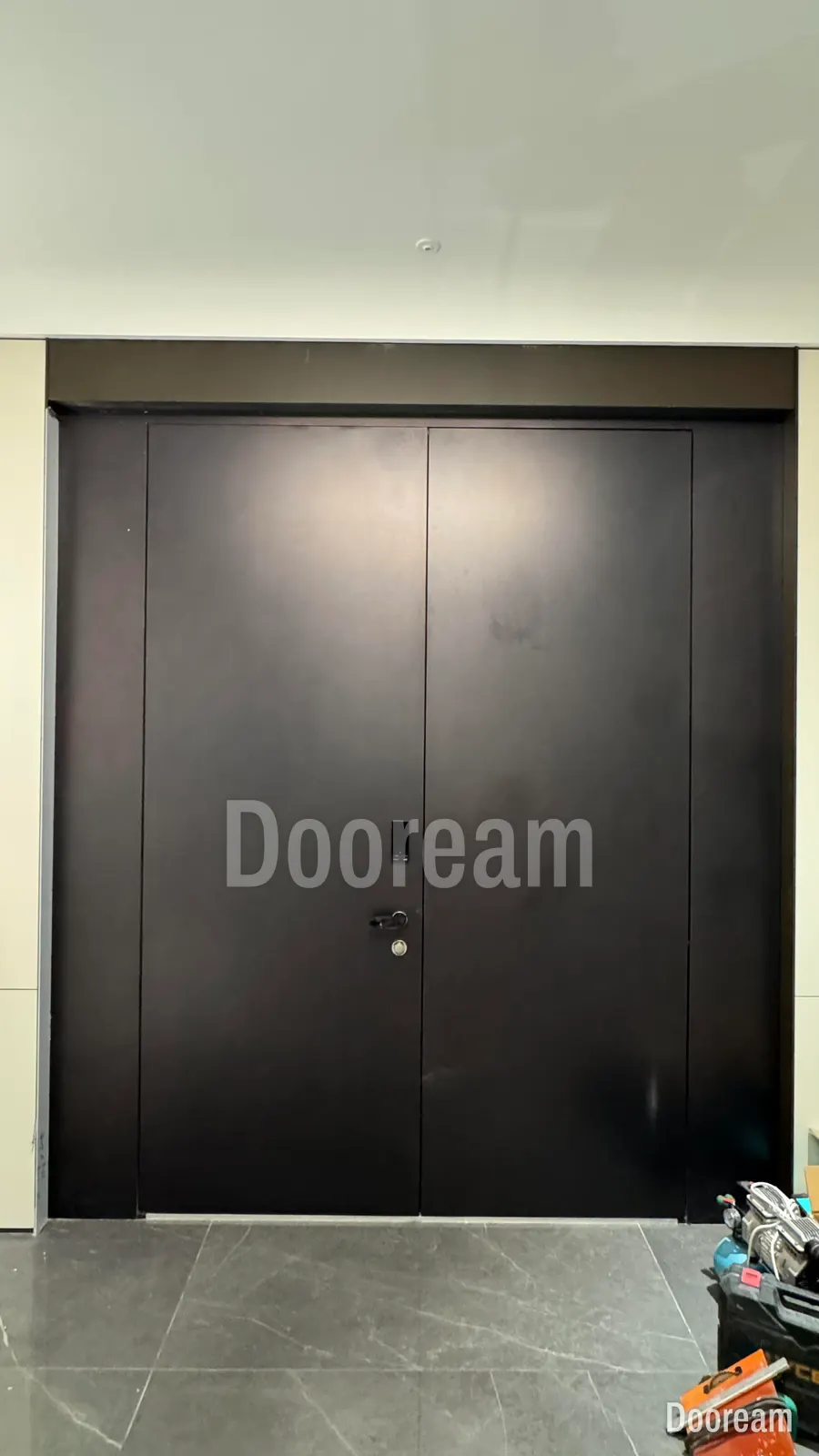
Slowly, if the coating is rated for its sun. AkzoNobel calls chalking the powdery residue a coating leaves as it breaks down; on black it shows as a grey bloom. Per PPG, FGIA/AAMA 2605 requires 10 years in South Florida, colour change of 5 ΔE or less, chalk rated 8 or better and at least 50% gloss retention.
- PVDF or polyester powder. Writing for PPG, which makes PVDF coatings, Scott Moffatt said in 2012 that polyesters can match 70% PVDF for a time, then abruptly lose performance, and that durable polyesters may have half its life expectancy. Top-tier powders exist: AkzoNobel’s Interpon D3000 range is Qualicoat Class 3 and AAMA 2605, with 10 years of Florida exposure.
- Metallic blacks. PPG notes that clear coats protect metallic flake; ask whether yours has one.
- Near the sea. Salt dries to a pale film that shows at once on black; see coastal finishes.
What goes with black: bronze, gold, light lines or glass?
One contrasting element, placed where the hand or eye goes. Black makes metal, light and glass read strongly, so one band, pull or light line looks deliberate; several compete. Choose the accent’s finish as carefully as the black, because it weathers in the same sun and salt.
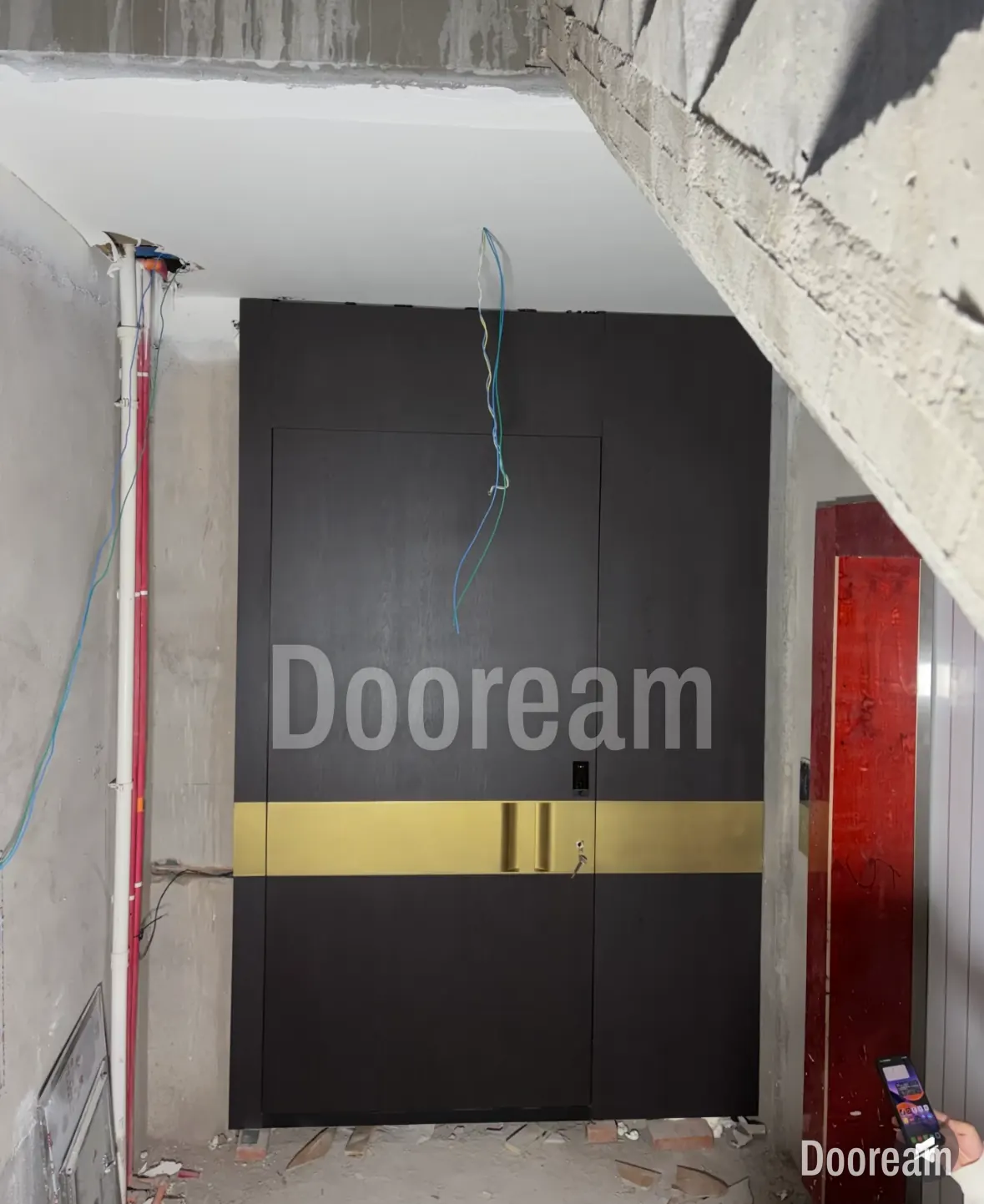
- Gold, bronze or stone. Villa Double has a copper-tone band on a dark vertical grain; Malachite, a square green stone-pattern pull on matt black panels. Ask what a pull is made of and how its colour is protected.
- Brushed steel. Cooler and more modern, as on the door at the top.
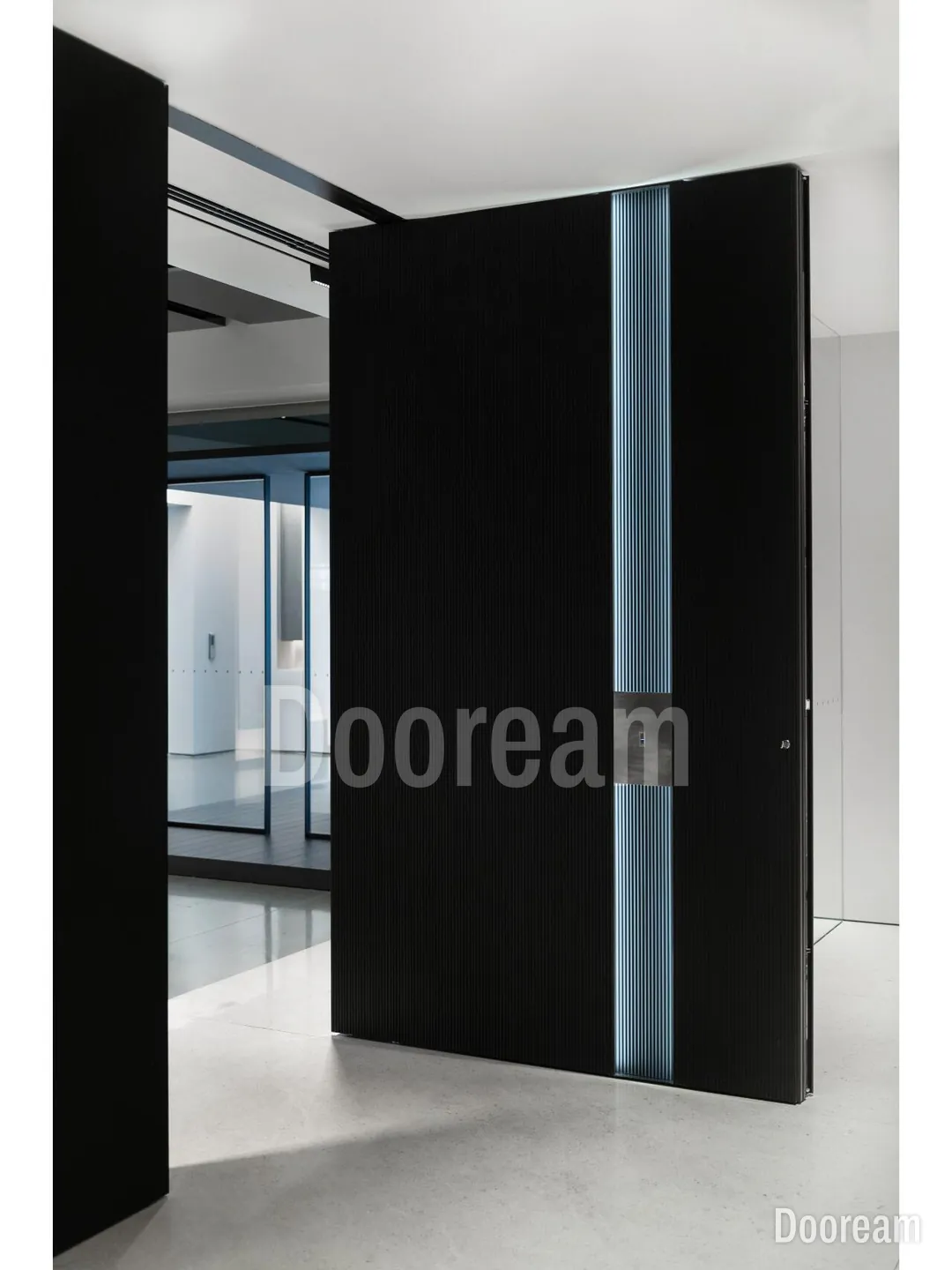
- Light lines. Black Warrior has a full-height strip of soft blue light on black fluted aluminium; Facet Light has light lines in folded dark facets. At night the line is all that shows, so plan it with the porch lighting.
- Glass. Black frames suit glass side panels; see sidelights and transoms.
How do you keep a black door looking good?
Shade it, wash it more often than a pale door, and dry it. Black shows anything pale, so marks that would vanish on white show from the path. Follow the coating maker’s schedule and our maintenance guide; this checklist covers what is specific to black.
- Approve a sample of the actual black, gloss and texture outdoors, beside the façade.
- Get the coating’s test tier (AAMA 2605, Qualicoat Class 3 or equivalent) and, for a sunlit door, its solar reflectance in writing.
- Build the canopy or recess before the door’s first summer.
- Weekly, wipe the pull zone and reader with a damp cloth.
- Wash in the shade, never on a hot face, with a pH-neutral detergent; rinse from the top down.
- Dry with a microfibre cloth so hard-water spots do not dry onto the black.
- Brush out relief and texture; dust shows grey in black recesses.
- Yearly, wipe a hidden spot with a clean white cloth; a grey smear means chalking has started.
- Touch up chips that reach bare metal with the coater’s matched paint.
- After the first summer, check gaps, seals and locking on a hot afternoon.
How does this work with Dooream?
Most of our doors are finished in fluorocarbon (PVDF) paint, including the black Black Warrior and Malachite. If your project sets a minimum solar reflectance or a coating test, tell us when you ask for a quote; third-party testing can be arranged, usually at the buyer’s cost. Our thermal-break construction, with PA66 polyamide insulating strips in the aluminium profiles, reaches a U-value of 1.0 W/m²K in our test report, and any of our designs can be built with it. Every door is built to the buyer’s drawing, and we can send a 20 × 20 cm sample of the face so you can judge the black outdoors. Send the opening size, orientation and a façade photo via our architects or contact page.
Sources, checked November 2026: Lawrence Berkeley National Laboratory, Heat Island Group, cool roofs, and Berkeley Lab news, cool colors, cool roofs (August 2004); PPG, cool coatings (August 2025) and FGIA/AAMA 2605; PCI Magazine, introduction to IR-reflective pigments (August 2005); Shepherd Color, Arctic IR reflective pigment technology; ASTM E1980-11, solar reflectance index (sample pages); Hydro, EN AW-6063 data sheet (rev. 4, March 2023); Cool Roof Rating Council, wall rating program fact sheet (April 2024); Glass Times, no more call backs for bowed doors (January 2021); S. Moffatt, PPG, in PCI Magazine, performance expectations for UV-durable coil coatings (December 2012); AkzoNobel, Interpon D for Architecture specification guide (issue 1, June 2026); Sherwin-Williams, the complete guide to PVDF coatings; RAL, all RAL colours.
Quick answers
Is a black front door a good idea for a villa?
Usually, where the façade is pale and the door is shaded for most of the day. Black gives the sharpest outline against stone or render. In full sun it runs hotter than any other colour; under the ASTM E1980 standard conditions our arithmetic puts a conventional black face near 82 °C, against about 45 °C for white. Shade it, or specify a cool black and a leaf built to stay flat.
What is a cool black?
A black made with infrared-reflective pigments instead of carbon black. It still absorbs visible light, so it looks black, but it reflects much of the invisible near-infrared. PPG puts a standard black pigment at a total solar reflectance of about 5% and an infrared-reflective black at roughly 25–30%. Ask for the measured solar reflectance of the finished coating.
How do you keep a black front door looking good?
Specify a durable coating, such as one meeting FGIA/AAMA 2605 (10 years in South Florida with colour change of 5 ΔE or less, a chalk rating of 8 or better and at least 50% gloss retention), in matt or textured rather than high gloss, and shade the door. Wash it in the shade with a pH-neutral detergent, dry it so water spots do not form, and touch up chips early.