Short answer: choose the pattern family first, because its grid sets everything else: star-and-polygon, interlaced strapwork, ten-point girih or an open lattice. Then size the repeat to the leaf so motifs end cleanly at the edges and run on across the meeting stile, pick a relief depth and colour that read in the door’s light, and approve a sample.
What are the main families of Islamic geometric pattern?
Four families cover most door designs: star-and-polygon patterns, interlaced strapwork, girih patterns built from a set of tiles, and open lattices of the mashrabiya kind. The arabesque, made of plant forms, is a separate family that can be combined with them.
The Metropolitan Museum of Art names four basic repeat units: circles, squares, star patterns “ultimately derived from squares and triangles inscribed in a circle”, and multisided polygons. Encyclopaedia Iranica stresses “an underlying geometric grid”, with two-, three-, four- or six-fold rotational symmetry.
- Star-and-polygon. Six-, eight-, ten- or twelve-point stars with polygons between. The eight-pointed star is two squares in one circle, one turned 45°, and usually repeats on a square grid; six- and twelve-point stars repeat on a triangular (hexagonal) grid.
- Interlaced strapwork. Iranica describes gereh-sāzī, literally “knot-making”, as “geometric interlaced strapwork”: bands passing over and under one another. In relief that needs three levels: ground, band, and a step where one band passes under another.
- Girih tiles. Lu and Steinhardt showed in Science (2007) that by 1200 CE girih patterns were reconceived as tilings of five equal-edged tiles (decagon, pentagon, hexagon, bowtie, rhombus) decorated with lines: the ten-point star family. No repeating pattern can have overall tenfold symmetry, they note.
- Lattices. Britannica describes the mashrabiyya as a projecting window of small turned wooden bobbins in geometric patterns, giving light, air, shade and privacy instead of glass and shutters. Iranica notes that wooden window grilles in Safavid buildings were usually filled with clear or coloured glass. On a door, that becomes a cut-through lattice with glass behind.
- Arabesque. Britannica defines it as “intertwining plants and abstract curvilinear motifs”; the Met says geometric patterns “have much in common” with it. Geometric bands want flat tops and crisp edges; arabesque wants rounded relief.
Doors carried such patterns centuries ago: the Met notes that assemblages of small carved pieces forming stars and polygons were common in Mamluk Egypt in furnishings and doors.
Which pattern suits a door, and how is it best made?
Choose by viewing distance and by what the face must do. Large stars read from the gate, small repeats read as texture, interlace needs side light, and only a cut-through lattice lets light pass. The table is general guidance; confirm the method with your maker.
| Pattern family | Grid and symmetry | How it reads on a 3–6 m door | Best made as | Notes |
|---|---|---|---|---|
| Eight-point stars | Square grid, fourfold | Calm; large stars read from a distance | Carved; cast if repeated on many doors | Square repeat: width fixes height |
| Six- and twelve-point stars | Triangular (hexagonal) grid, sixfold | Busier; twelve-point stars need a large repeat | Carved | Repeat about 1 : 1.73 |
| Ten-point girih | Girih tiles; no overall tenfold symmetry | Most complex; best large or as a medallion | Carved | Cannot be stretched; check the edges early |
| Interlaced strapwork | Any grid, drawn as bands | Needs side light to show the over-and-under | Carved or cast | Keep bands wide enough to read |
| Lattice | Usually square or diagonal | A screen; glows at night if lit inside | Cut through with glass behind, or blind relief | Glass, not solid core, behind it: check security and safety-glass rules |
| Arabesque (for comparison) | Scrolling repeat | Soft; reads close up | Carved; cast for undercuts | Combines with a geometric field |
How should the pattern be scaled and laid out on a tall door?
Set the pattern out on the whole closed opening, not leaf by leaf. Fix the centre line, the borders and a whole number of repeats across the width; the grid then fixes the repeat height. Then settle the edges, the meeting stile and the hardware.
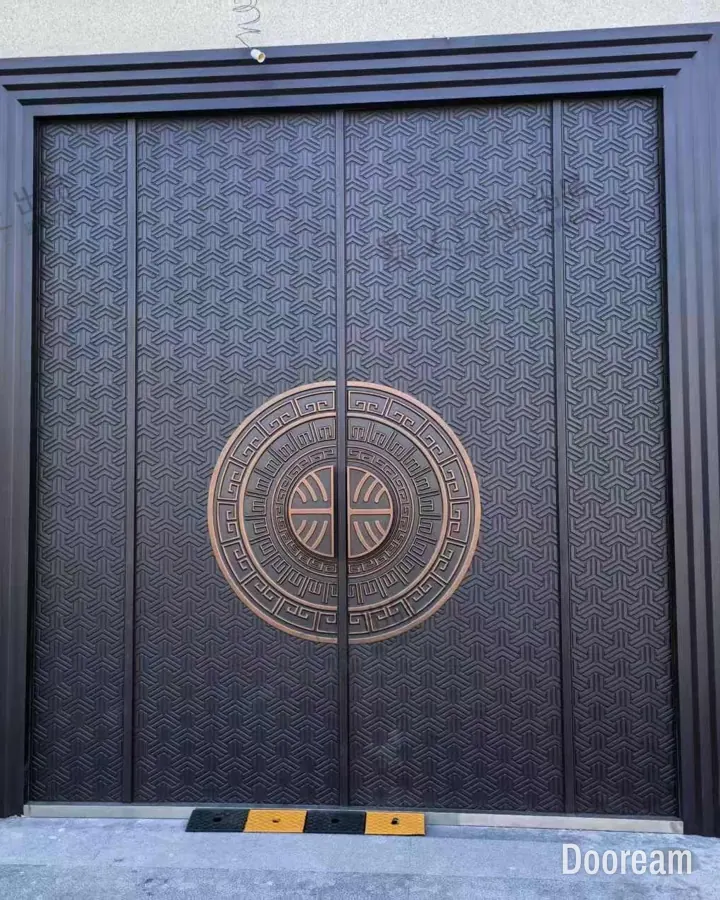
Repeat size. Divide the leaf width, less its borders, into whole repeats: 1,200 mm of field takes three repeats of 400 mm or four of 300 mm. Fewer, larger repeats read as stars from a distance; many small ones read as texture, as on the door below. Check by viewing a 1:10 print from a tenth of the distance.
Height follows width. A star pattern can be scaled but not stretched. A square-grid repeat is as tall as it is wide, a hexagonal one 1.73 times as tall. On a 4,000 mm leaf, 400 mm square repeats fit ten times; 400 × 693 mm hexagonal ones fit 5.77 times, so put the remainder into a border, a band or an equal crop.
Edges. The Met notes that geometric ornament “offers the possibility of infinite growth”, so the edge must be designed: whole motifs at the border, or an equal crop at both edges, never a sliver of a star on one side.
Medallion and meeting stile. An all-over field is quiet; a central medallion gives one focus and can carry the pull, but on a pair it splits when the door opens, so each half must read alone. Put a mirror line of the pattern on the meeting stile so it runs on across the joint. On an unequal double door, centre the pattern on the opening and let the joint fall on a band or polygon edge.
Handle and lock. For accessible entrances, the 2010 ADA Standards put the operable parts of door hardware 865–1,220 mm above the floor. Run a plain band at that height, or set the rows so the pull sits within a polygon, not across a star point; see also luxury front door design ideas.
How do relief depth, light and colour change the pattern?
Relief reads by shadow, and shadow depends on the angle of the light more than its strength. Grazing light makes shallow relief read; light straight on flattens deep relief. In shade, colour must carry the pattern: a second tone on the raised lines, or a darker ground.
Angle. With the sun square to the face, the shadow under a horizontal edge is the relief depth times the tangent of the sun’s height: per 10 mm of depth, about 6 mm at 30°, 10 mm at 45°, 17 mm at 60° and 37 mm at 75°. High sun draws long shadows even from shallow relief; low sun straight on, such as evening sun on a west-facing door, washes it flat.
Depth. Agree shallow, medium or deep, then fix the millimetres on the drawing. Deep relief reads even in soft shade, such as under the canopy our hot-climate guide recommends, but narrow recesses hold dust and, near the sea, salt, and the coating must reach their bottoms.
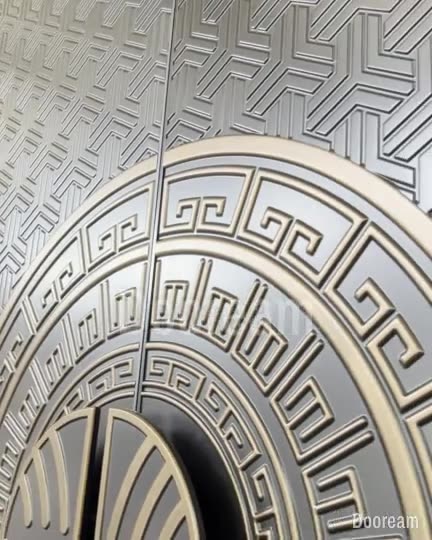
Colour. Dark bronze or black shows the pattern mainly where light catches an edge; gold, champagne and light bronze show shadows clearly. Two tones, as in the photos above, read in any light. For coatings, see coastal and high-sun finishes.
Carved or cast for a geometric face?
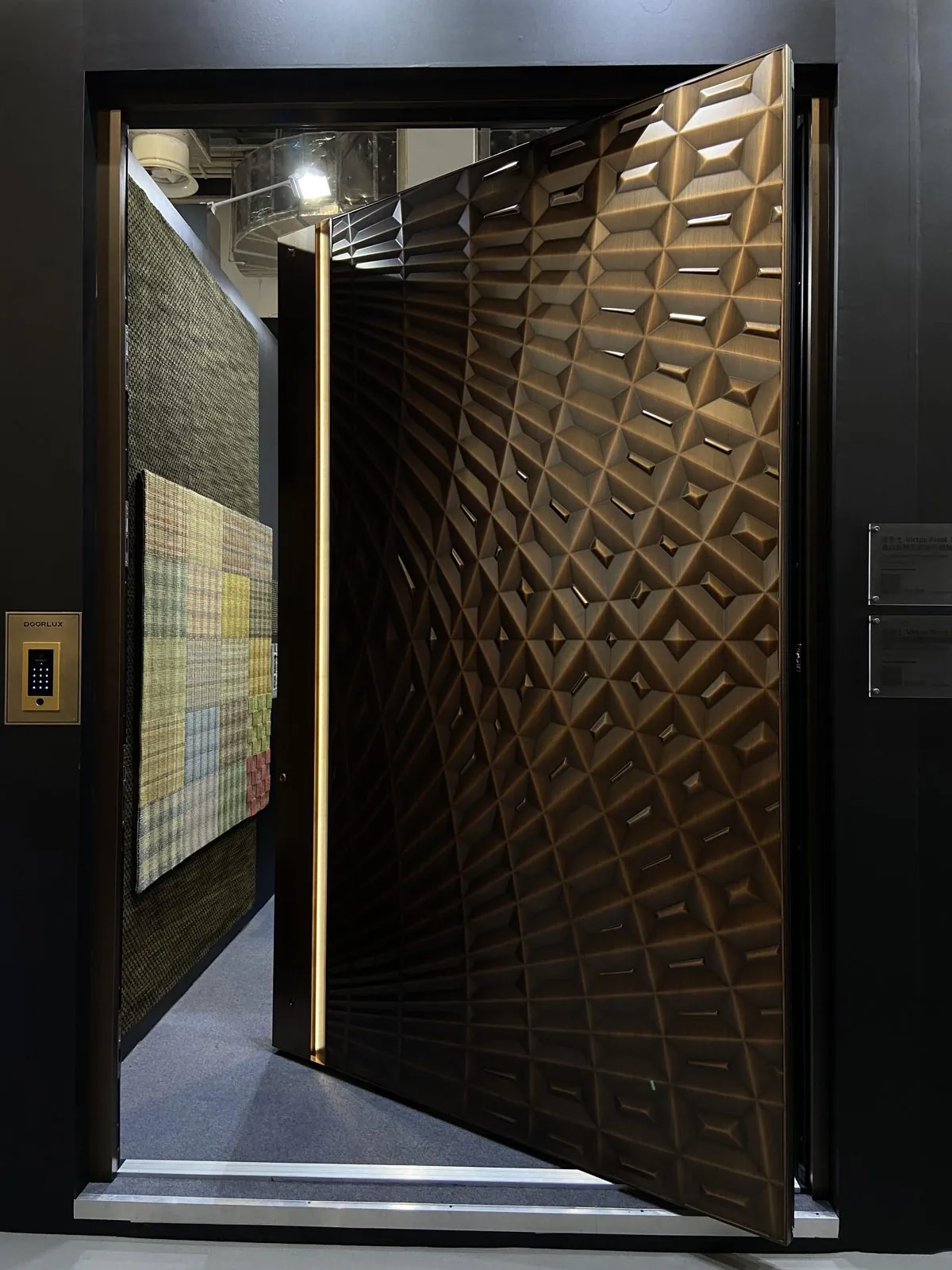
CNC carving cuts the face from solid plate, so a one-off pattern needs no mould, but an inside corner keeps at least the cutter’s radius: notches between raised star points come out slightly rounded. Casting needs a mould, which pays off for repeated patterns and can form undercuts. See cast or carved faces and how a carved door is made.
What should you send a maker?
Send enough for the maker to draw the pattern without guessing: how it looks, how it is built and how it meets the door. Use this list for the first message; our guide on what to send a door manufacturer covers the opening itself.
- Reference images, noting what you like in each: star, band width, depth or colour.
- Pattern family and grid, such as “eight-point stars on a square grid”.
- Repeat size in millimetres, and the number of repeats per leaf.
- Centre point: what sits on the centre line, and at what height.
- Border: width, plain or patterned, and whether it crops the field.
- Edges and meeting stile: whole motifs or an equal crop, and how the pattern crosses the meeting stile.
- Hardware: handle, cylinder and keypad positions, on plain areas.
- Relief depth: shallow, medium or deep, and which parts stand highest.
- Finish and colour: base colour, any second tone, gloss and coating.
- Sample first: approve a carved and coloured sample, outdoors in daylight, before production.
How does this work with Dooream?
Each door is made to a drawing for your opening, and the first design direction is free, usually within one working day. Carved aluminium is the face we make most, and we also make cast aluminium faces, as on our Lattice door. A 20 × 20 cm carved and painted sample can fix the colour first, and a scale sample door using the real construction is possible. We make double and unequal double doors up to 3,000 × 6,000 mm and pivot doors up to 4,000 × 8,000 mm, and provide SABER product documents for Saudi Arabia. Start on our contact page, or see villa doors for Saudi Arabia and the UAE.
Sources, checked November 2026: The Metropolitan Museum of Art, Department of Islamic Art, Geometric patterns in Islamic art and Vegetal patterns in Islamic art (Heilbrunn Timeline of Art History, October 2001), and Panel, Cairo, 14th–15th century (07.236.101); Encyclopaedia Iranica, S. S. Blair and M. Milwright, Gereh-sāzī; P. J. Lu and P. J. Steinhardt, Decagonal and quasi-crystalline tilings in medieval Islamic architecture (Science 315, 2007); Encyclopaedia Britannica, arabesque and moucharaby; Hubs, sharp corners in CNC machining; 2010 ADA Standards, 404.2.7 door and gate hardware.
Quick answers
What are the main types of Islamic geometric pattern for a door?
Star-and-polygon patterns, with eight-point stars usually on a square grid and six- and twelve-point stars on a hexagonal one; interlaced strapwork; ten-point girih patterns built from a set of tiles; and open lattices of the mashrabiya kind. The arabesque is the plant-based counterpart: intertwining plants and curving motifs.
How big should the pattern repeat be on a large door?
Work from the width. Take the leaf width less the borders and divide it into whole repeats, for example 1,200 mm into three repeats of 400 mm or four of 300 mm. Fewer, larger repeats read as stars from a distance; many small ones read as texture. The grid then fixes the repeat height, so plan where the remainder goes.
What should I send a maker for a geometric-pattern door?
Reference images, the pattern family and grid, the repeat size, the centre point, the border, how the pattern meets the edges and the meeting stile, the hardware positions, the relief depth as shallow, medium or deep, and the finish and colour. Then approve a sample before production.