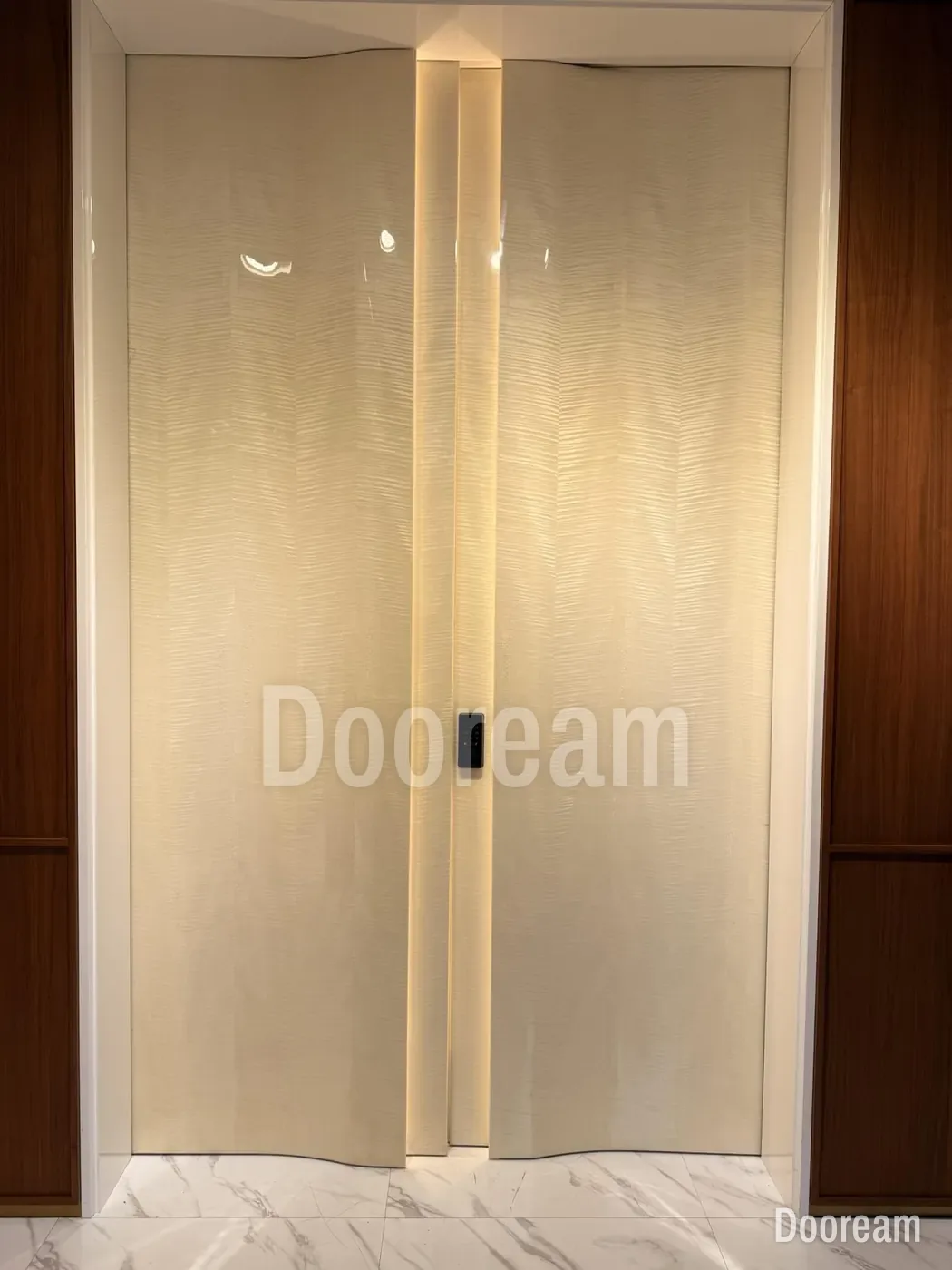
Short answer: usually yes. White stays far cooler in sun than any dark colour and shows relief through soft shading, but dark dirt, rust and stains show at once. Choose a cool white such as RAL 9016 Traffic white for render, glass and stainless steel, or a softer one such as 9010 Pure white, 9001 Cream or 1013 Oyster white for warm stone and brass, and approve it on a physical sample outdoors.
Is a white front door a good choice for a villa?
Usually, yes. White suits modern and classical villas, keeps a sunlit door far cooler than a dark one and shows relief by shading. It is a weaker choice where the façade is already white and nothing separates the door from it, or where soot or red dust will mark it.
For a dark door see black front doors; for colours by façade material, front door colours for luxury villas.
Which white: RAL 9016, 9010, 9003, 9001 or an off-white?
Choose the undertone first. Side by side, RAL’s whites and off-whites look clearly different: cool and clean, soft, creamy or grey. A code fixes the colour only, so add the gloss level and texture, and judge the undertone on a physical sample, never on a screen.
| RAL | Name | Character | Best with |
|---|---|---|---|
| 9016 | Traffic white | Clean, with no yellow or red undertone; reads cool | Modern render, white window frames in the same code, glass, stainless steel, black |
| 9003 | Signal white | Bright white; compare it with 9016 on samples | Crisp modern façades, light grey stone, glass |
| 9010 | Pure white | Slightly off-white, less cool than 9016; can look yellower in evening light | Warm render, limestone, timber, brass |
| 9001 | Cream | Somewhat yellowish, less fresh than 9010 or 9016 | Sandstone, travertine, classical mouldings, gold-coloured accents |
| 9002 | Grey white | A grey-tinted white | Concrete, grey granite, stainless steel |
| 1013 | Oyster white | A beige off-white | Beige stone and render, bronze-coloured accents |
| 1015 | Light ivory | A pale ivory | Classical façades, gold-coloured mouldings |
Names are RAL’s; the notes on 9016, 9010 and 9001 follow an independent RAL reference site.
How does white read next to render, stone and glass?
By contrast with its neighbours. Two whites that almost match look like a mistake, so either match the neighbouring white exactly, code and sheen, or step away from it on purpose with an off-white, a second tone, a dark frame or a deep reveal. Render and stone are matt, so a satin door beside them reads brighter.
- White render: match the window frames, not the render, or use a dark frame.
- Limestone, travertine, sandstone: 9010, 9001, 1013 or 1015.
- Grey granite, concrete: 9002 or 9016.
- Glass: glazing usually reads dark by day, so a white door between sidelights reads as a bright block; match white frames in code and gloss (sidelights and transoms).
Matt, satin or gloss on a white door?
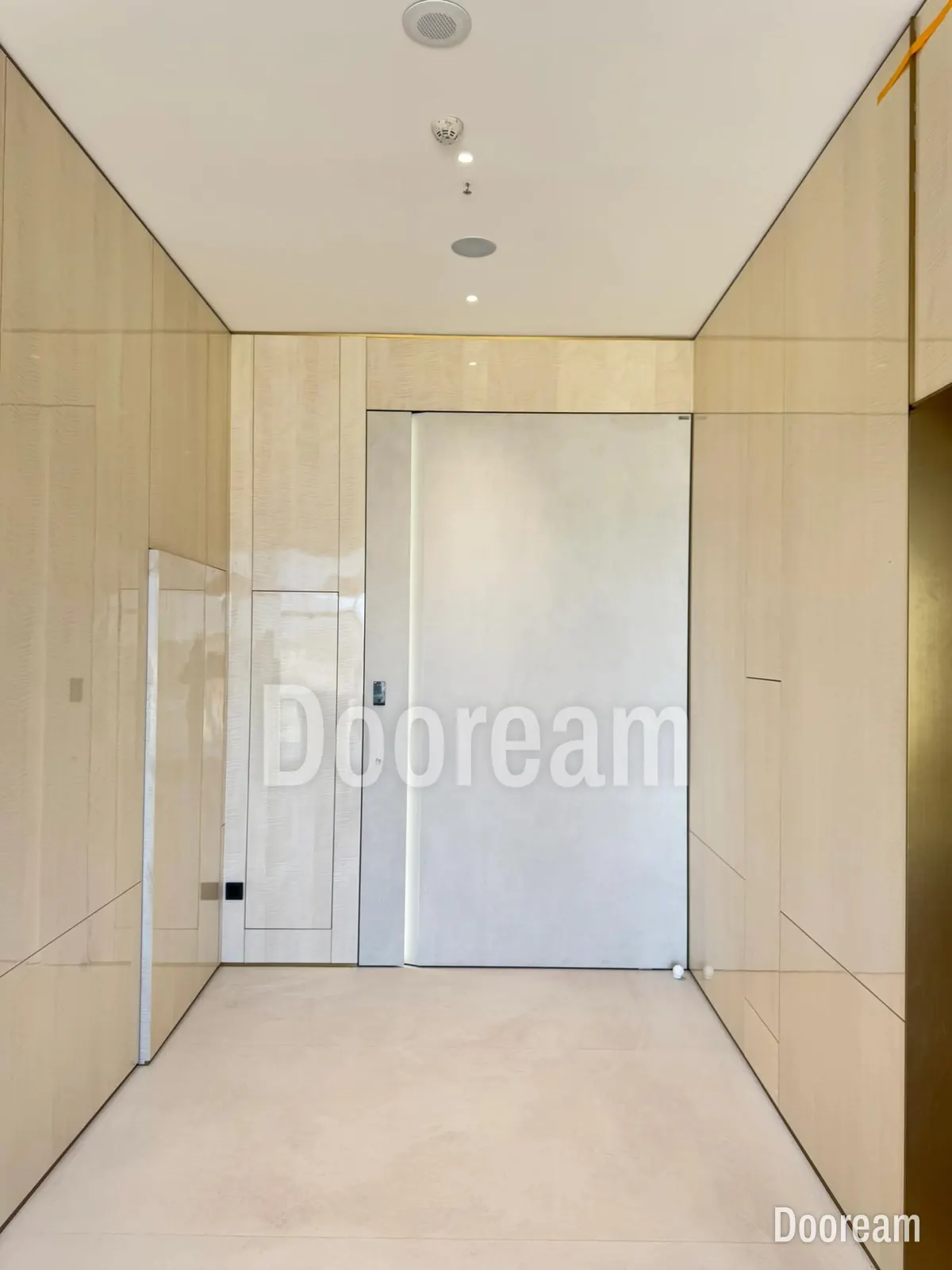
Satin or matt for most white doors. Qualicoat, measuring to ISO 2813 at 60°, sets matt at 0–30 gloss units (±5), satin at 31–70 (±7) and gloss at 71–100 (±10). Gloss shows less on white than on black, but it still mirrors lamps and sky, and the same code in two gloss levels reads as two whites.
The Metal Construction Association notes that waviness in metal panels is harder to see on lighter colours and on low-gloss or embossed finishes, because the eye reads it through reflected light. Texture hides scratches but holds dust.
How does white weather near the sea and in the desert?
Well, if the coating is rated for the site: fading and chalk are themselves pale. What shows is dark grime, brown rust or tea staining, and a slight yellow shift. The coast adds salt and damp air; the desert adds dust and hard sun.
- Chalk. Sherwin-Williams defines chalking as a fine white powder forming on paint as it weathers. On white it hardly shows, but it can run down onto stone below. ASTM D4214 picks up chalk with black felt (white for dark coatings), so once a year wipe a hidden spot with a dark cloth.
- Coating class. Per the Powder Coating Institute’s comparison, Qualicoat’s top class must keep at least 50% of its gloss after 10 years outdoors, and AAMA 2604 and 2605 require a chalk rating of 8 or better. Ask which class the white meets (coastal finishes).
- Coast. In a Lawrence Berkeley National Laboratory (LBNL) study, pale roofing products lost reflectance as they soiled; for medium-to-high reflectance samples, losses were two to three times greater at a hot, humid test site than a hot, dry one. Wash coastal doors more often.
- Desert. Dust is pale, so cream and off-white hide it better than brilliant white and glare less. See dust-proof doors for desert sites.
- Yellowing. TIGER Coatings lists curing too hot and direct-fired gas ovens among its causes, so compare the delivered door with the signed sample.
Does a carved or cast relief show on white?
Yes, but softly. Relief reads by the brightness difference between faces turned to the light and faces turned away. White bounces light into its own recesses, so its shadows are pale and a white relief looks gentle rather than sharp. In side light every ridge reads; in flat frontal or overcast light, shallow relief can almost vanish.
On a dark colour the lit faces are dark too, so the pattern reads mainly where an edge catches a highlight. For white relief:
- choose clear depth changes and crisp edges over fine texture;
- light it from the side or above, not head-on;
- keep it matt or satin, so highlights do not wash out the shading;
- or add a slightly darker background tone.
More in carved relief depth and light.
Which hardware goes with white: black, brass or stainless?
Any of the three, matched to the white’s undertone. Black gives the strongest line and suits cool whites and modern façades; brass and gold-coloured finishes suit warm whites and classical stone; brushed stainless steel suits cool whites and concrete. On white every part shows, so align pull, reader and cylinder.
- Black: a pull, reader or frame reads like a drawing, but a black pull gets hot in sun.
- Brass and gold-coloured: keep it to one band, pull or medallion; see gold and brass accents.
- Stainless steel: the Australian Stainless Steel Development Association recommends at least grade 316 within about 5 km of a surf beach, abraded no rougher than about 0.5 µm Ra; lower grades are likely to tea-stain, which shows at once on white.
Is white a good colour for a very large pivot door?
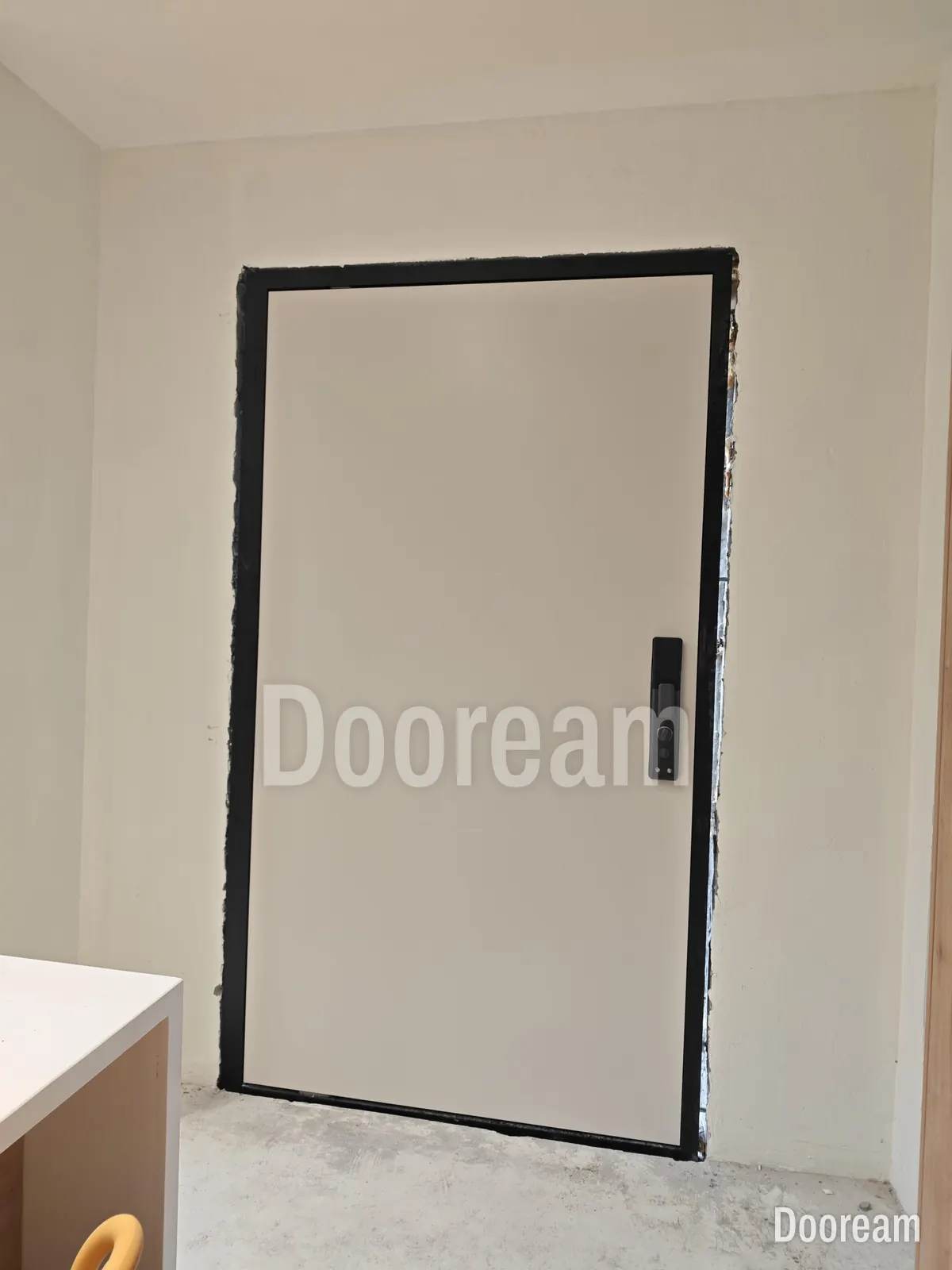
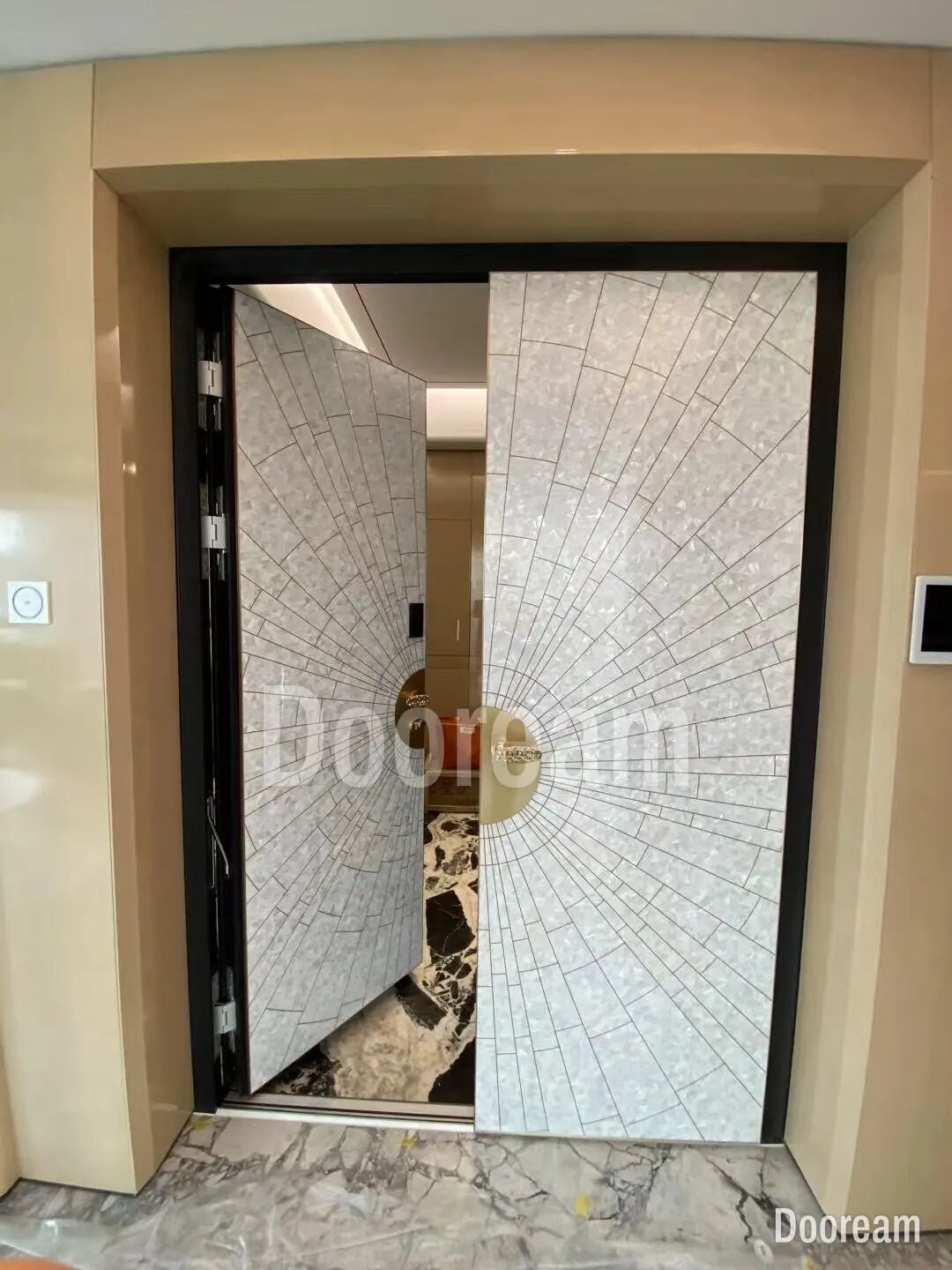
Yes, it is the coolest choice. By the sums in our black front doors guide, a conventional black face reaches about 82 °C in standard sun and a white one about 45 °C. LBNL measured a black roof 30 °C warmer than a white one.
LBNL adds that a clean white roof reflecting 80% of sunlight stays about 31 °C cooler than a grey one reflecting 20%, so the gain needs the white to stay clean. On a tall leaf the hot outer face grows against the cooler inner face; the smaller the difference, the less the leaf tries to bow (see bowing and warping). On a leaf of several square metres (size and weight), any colour or gloss difference between leaf, frame and wall panels shows along every long joint, so finish them together.
How do you keep a white door white?
Wash it in the shade with lukewarm water and a pH-neutral detergent, rinsing from the top down; intervals and what never to use are in our maintenance guide. On white, also wipe the pull and reader weekly and rinse splash off the bottom of the leaf.
During building, protect it from plaster, mortar, sealant and grinding dust. Keep the signed sample and batch reference for touch-ups.
Checklist: how do you choose and approve a white?
- Note the façade’s whites: render, stone, window frames.
- Shortlist two or three codes with different undertones, such as 9016, 9010 and 1013.
- Fix gloss category and texture for leaf, frame and panels.
- Get samples in the real coating on the real face; a relief needs a relief sample.
- Judge them outdoors, morning and afternoon, beside the façade material and window frames.
- For factory checks, compare to ISO 3668, under artificial light in a standard booth; it excludes metallic and other effect finishes unless conditions are agreed.
- Ask which coating class the white meets for your site.
- Sign and date the approved sample; write code, gloss and texture on the drawing.
- Ask for leaves, frame and panels from one batch; TIGER Coatings puts batch differences in lighter shades at about 1–2 ΔE.
- Check the delivered door against the sample, yellowing included, before installation.
How does this work with Dooream?
We make custom aluminium armoured entrance doors with carved or cast aluminium faces, made to drawing, from one door: pivot doors up to 4,000 × 8,000 mm on pivot hinges, most often FritsJurgens, and double or unequal double doors up to 3,000 × 6,000 mm. Among our models, Ivory Wave is an ivory double door with an aluminium sheet face, a soft vertical wave texture and a recessed light strip; for other designs, ask us which finishes are available. A 20 × 20 cm carved and painted aluminium sample lets you judge a white beside your façade, and we send photos and video of the finished door before shipping. Send the opening size and a façade photo via our architects, dealers or contact page.
Sources, checked November 2026: RAL, overview of RAL Classic colours; RAL Colour Chart (independent reference site), which RAL colour to choose for white walls; Powder Coating Institute, architectural specification comparison (March 2021); Metal Construction Association, oil canning in metal roof and metal wall systems (2013); Sherwin-Williams, chalking; ASTM D4214-23, degree of chalking of exterior paint films (sample pages); Lawrence Berkeley National Laboratory, Heat Island Group, cool roofs, and M. Sleiman et al., soiling of building envelope surfaces and its effect on solar reflectance, part I (2011); TIGER Coatings, powder coating troubleshooting guide; Australian Stainless Steel Development Association, preventing coastal corrosion (tea staining) (June 2018); ISO, ISO 3668:2017, visual comparison of colour of paints.
Quick answers
Is a white front door a good choice for a villa?
Usually, yes. White stays far cooler in sun than a dark colour; Lawrence Berkeley National Laboratory measured a black roof 30 °C warmer than a white one. White also makes waviness on a large leaf harder to see and shows relief by soft shading. The cost is that dark dirt, rust and stains show at once.
Which white should I choose for a front door?
Choose by undertone. RAL 9016 Traffic white or 9003 Signal white suit render, glass and stainless steel; RAL 9010 Pure white, 9001 Cream, 1013 Oyster white or 1015 Light ivory suit limestone, sandstone and brass; RAL 9002 Grey white suits concrete and grey stone. Approve it on a physical sample outdoors.
How do you keep a white front door white?
Specify a coating rated for the site and ask which class it meets, have every part finished from one batch, use grade 316 stainless steel near the sea, and wash the door in the shade with a pH-neutral detergent. Once a year, wipe a hidden spot with a dark cloth to check for chalking.