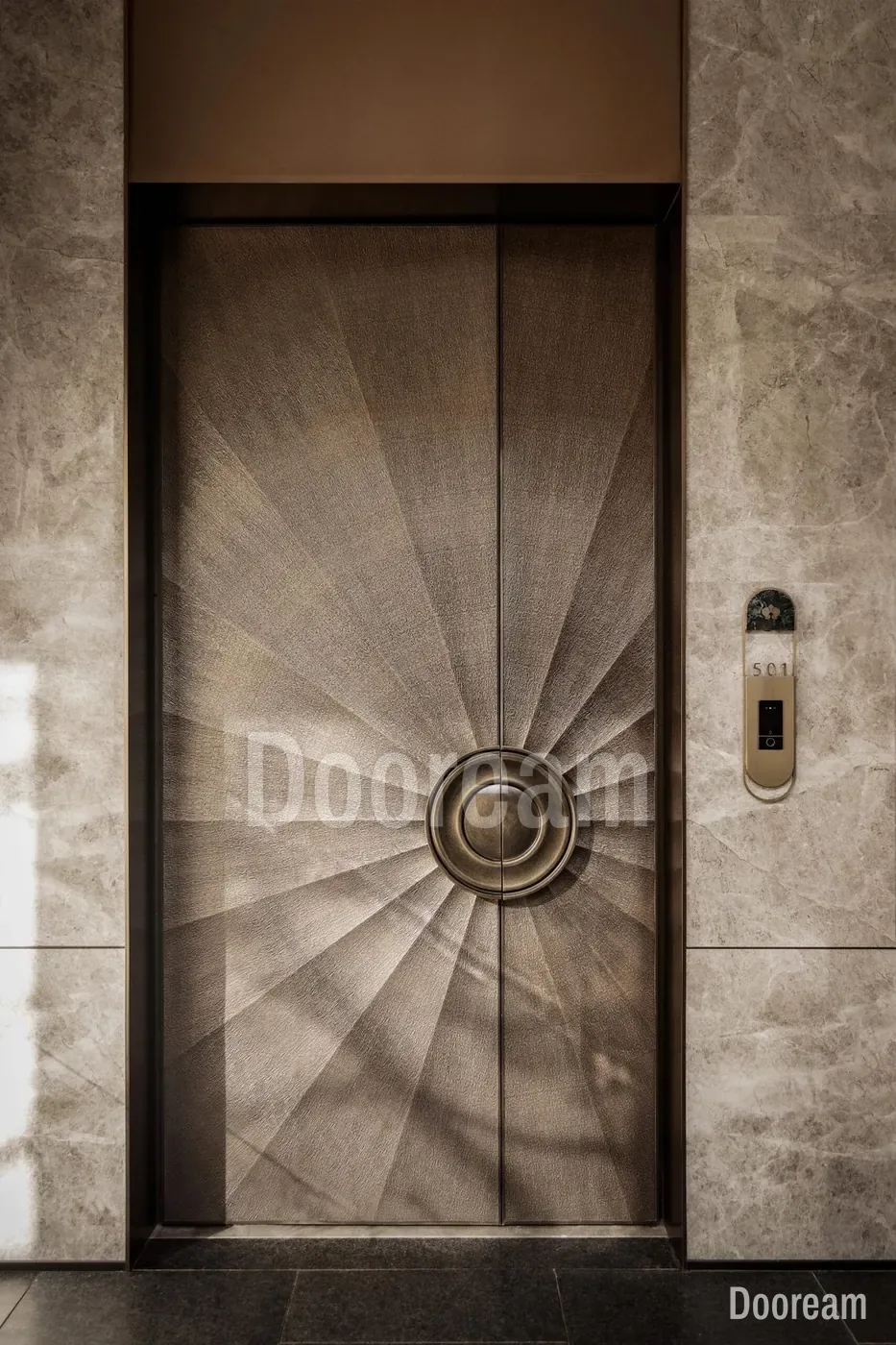
Short answer: an Art Deco entrance door is tall, mirrored about a strong centre line, and carries geometric or stylised ornament in low relief: sun rays and fans, chevrons and zigzags, stepped outlines, fluting and reeding, stylised plants. To design one today, choose one main motif, size it to read from the gate, put the hardware on the centre line, and use one metal tone against a dark or pale ground.
Where does Art Deco come from, and why did the entrance matter?
The style takes its name from the Exposition internationale des arts décoratifs et industriels modernes, which opened in Paris on 28 April 1925. The Metropolitan Museum of Art says more than 16 million visitors came during its seven-month run, and that every work had to be thoroughly modern: no copying of historical styles.
- The name came later. The V&A says “Art Deco” was coined in the 1960s; at the time it was Style Moderne. JSTOR Daily ties the name to the 1966 retrospective Les Années 25 at the Musée des Arts Décoratifs.
- Sources. Britannica names Cubism and the Ballets Russes, and Egyptian, American Indian and early classical ornament. The V&A says the excavation of Tutankhamun’s tomb in 1922 set off a wave of Egyptian imagery, lotus flowers included.
- Doors at the show. Edgar Brandt made a wrought iron and gilt bronze gate, 201 × 150 cm, for his stand; it is now in the Detroit Institute of Arts. His lift doors for Calouste Gulbenkian’s Paris house, from a model shown in 1925, combine wrought iron, glass and patinated and gilt bronze.
Why the entrance? Docomomo US calls Art Deco “first of all a style of ornament”, in very low relief, and notes that buildings were composed symmetrically around their entrances, with fluting and reeding flanking the doors or in bands above them. The Pennsylvania Historical and Museum Commission (PHMC) lists low-relief panels at entrances. On a villa the rule holds: spend the ornament on the entrance.
Which motifs make a door Art Deco, and how are they made today?
Five motifs carry most Deco doors. Britannica lists sun rays and foliage in conventionalised forms; PHMC lists zigzags, chevrons and stepped façades; Docomomo US calls fluting and reeding “the commonest motifs of all”. Britannica defines them as regular concave grooves or convex ridges, and a ziggurat as a stepped temple tower of ancient Mesopotamia.
| Motif | Where it sits on a door | How it is made on a modern aluminium door |
|---|---|---|
| Sunburst | Rays from a medallion on the seam, across both leaves | Carved grooves or facets; applied metal medallion; inlaid lines on a shell or stone face |
| Fan (half sunburst) | Above the hardware, or at the head | Carved; stone or shell segments in metal-tone lines; glass in a fanlight |
| Chevron and zigzag | V-shapes stacked up the seam; bands at head and foot | Carved grooves; applied metal strips; cast for a deep repeated border |
| Stepped (ziggurat) outline | Medallion edge, panel corners, a fixed panel above, the surround | Carved steps; stepped frame or surround profile; applied stepped plate |
| Fluting and reeding | A strip over the seam, the stiles, or the whole leaf | Carved flutes; reeded glass in sidelights or transom |
| Stylised plants (lotus, leaves) | Medallion, top panels, a frieze at head height | Carved low relief; cast where forms undercut; inlay for colour |
Carving suits one-off designs, casting repeats and undercuts: see cast or carved faces. Relief depth for the light a door gets is in our relief guide.

What proportions make an Art Deco door look right?
Tall, mirrored and built on one vertical centre line. Docomomo US says most Art Deco buildings emphasise verticality. A Deco pair does the same: narrow leaves, one seam, one medallion on it, and a pattern mirrored exactly across the seam.
Our example (an illustration, not a specification): a pair for an opening about 2 m wide and 3 m high.
| Element | Example size | Why |
|---|---|---|
| Each leaf | 950 × 2,900 mm | About 3 : 1, tall and narrow |
| Medallion | 400 mm diameter, on the seam | Room for two levers, a cylinder and a reader |
| Medallion centre | 1,050 mm above finished floor | Inside the 865–1,220 mm the 2010 ADA Standards set for door hardware in public buildings |
| Plain margin | 60–80 mm round the pattern | Frames the rays |
| Rays | 15 per leaf, 12° apart, mirrored | About 210 mm apart 1 m from the centre, 435 mm at the top corners |
| Or a fluted strip | 200 mm wide over the seam, flutes at 15–20 mm | One line from floor to head |
- Burst height. At 1,050 mm the rays rise like a morning sun and the medallion carries the levers; a centre near half height looks calmer but puts the boss out of reach.
- Gate view. Our rule of thumb is about 1 mm of line or shadow per metre of distance: a ray read from 15 m needs about 15 mm.
- Taller openings. Above about 3 m, carry the pattern into a fixed panel or fanlight; see sidelights and transoms.
Which materials and finishes suit it, and how do they age outdoors?
Deco set one bright material against a dark or pale ground. Britannica lists chrome, silver, jade, ivory, obsidian and rock crystal; the Met adds lacquer, sharkskin and exotic woods. On an aluminium door outdoors, coatings and applied parts give the same effects, and each weathers differently.
- Brass and bronze tones. Brushed metallic paint on the carved face, as on our Sunburst; solid, PVD or anodised metal where hands go. Metallic paint shifts with angle and batch, raw brass darkens, lacquer fails outdoors: see our gold and brass guide.
- Black lacquer. Gloss black outdoors shows ripples and hand marks and runs hot in sun; satin black with one bright line keeps the contrast. See black front doors.
- Chrome-like silver. Silver metallic paint on the face, brushed or polished stainless steel for strips and pulls; near the sea, see coastal finishes.
- Shell, stone and glass. Mother-of-pearl, stone inlay and reeded or etched glass belong here too. Ask how an inlay is sealed and approve it outdoors.
What hardware and lighting suit an Art Deco door?
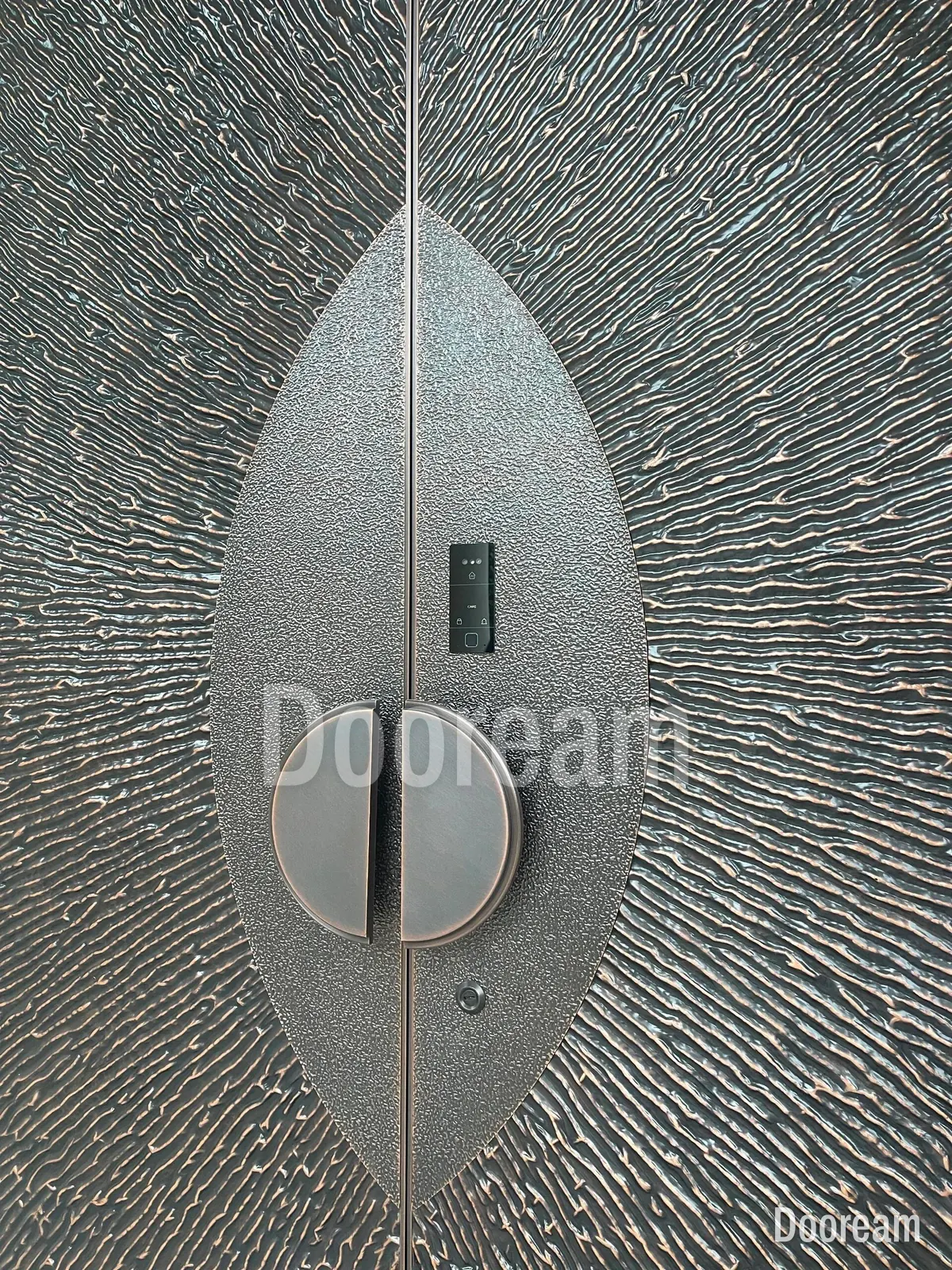
Put the hardware on the centre line. A round, stepped or leaf-shaped medallion on the seam can carry the levers or pulls, the cylinder and the reader, so nothing cuts the rays or flutes. Where the medallion is pure ornament, the reader goes on a wall plate beside the door, as at the top of this page.
- One metal tone for medallion, levers, strips and wall lights; hide the hinges.
- Smart locks on a pair: see smart locks for double doors.
- Light. Paired wall lights keep the symmetry. A grazer at the head models horizontal and diagonal rays and chevrons but flattens near-vertical rays and flutes, which need side light. Brightness and colour: our lighting guide.

Modern Art Deco or pastiche: what is the difference?
A modern Deco door takes the grammar, not the souvenirs: symmetry, verticality, one geometric motif and one bright metal, made in today’s materials and sized for today’s openings. Pastiche copies period ornament at period scale, mixes motifs and puts gold on every edge.
| Modern interpretation | Pastiche | |
|---|---|---|
| Motif | One main motif and one echo | Rays, chevrons, lotus and zigzags together |
| Scale | Few large rays or flutes | Fine lines that merge into a tone |
| Metal | One tone, on the medallion and one line | Gold on every edge |
| Hardware | On the medallion or a plain band | Catalogue levers across the pattern |
| Context | Echoes the façade | No Deco anywhere else on the house |
Check the façade’s style. PHMC dates Art Deco 1925–1940 and the later Moderne 1930–1950: smooth walls, little ornament, horizontal window bands, curved corners, aluminium or stainless steel detailing. A Moderne façade wants horizontal grooves or a stainless band, not a sunburst.
Checklist: how do you design an Art Deco entrance door?
- Read the façade: vertical Deco or horizontal Moderne. Other styles: door styles by architecture.
- Pick one motif and one echo at hand height.
- Fix the centre line: mirrored leaves, one medallion on the seam.
- Set the proportion: leaves about 3 : 1; extra height into a fixed panel or fanlight.
- Size lines for the gate: about 1 mm per metre.
- Choose the making per element: carved, cast, inlay, applied metal or glass.
- Choose one ground and one metal; put colour, gloss and coating on the drawing.
- Place the hardware within 865–1,220 mm, or the reader on a wall plate.
- Plan the light and test it on the motif.
- Approve a sample outdoors, at the hour of use and from the gate.
How does this work with Dooream?
We make complete entrance doors to the buyer’s drawing, from one door. Sunburst is a double door with carved rays meeting at a round central boss; Shell has fine radiating lines around a round brass medallion on a natural shell face; Black Warrior is a black fluted aluminium pivot door. Double doors go up to 3,000 × 6,000 mm, pivot doors to 4,000 × 8,000 mm. Send the opening size and a façade photo via our architects or contact page: the first design direction is free, usually within one working day; a 20 × 20 cm carved and coloured sample shows the finish in your light; production takes 35–45 days after drawing approval and deposit.
Sources, checked November 2026: M. Villanueva Fernández and H. García-Diego Villarías, JSTOR Daily, Art Deco: 100 years since the Paris exhibition (May 2025); J. Goss, The Metropolitan Museum of Art, French Art Deco (June 2010); Encyclopaedia Britannica, Art Deco, Exposition Internationale des Arts Décoratifs et Industriels Modernes, fluting and reeding and ziggurat; Victoria and Albert Museum, an introduction to Art Deco; Detroit Institute of Arts, Gate, Edgar Brandt, about 1925; Calouste Gulbenkian Museum, the lift doors by Edgar Brandt; Docomomo US, Art Deco; Pennsylvania Historical and Museum Commission, Pennsylvania Architectural Field Guide: Art Deco and Moderne; US Access Board, 2010 ADA Standards, chapter 4 (404.2.7).
Quick answers
What makes an entrance door Art Deco?
A tall door, mirrored about a strong centre line, with geometric or stylised ornament in low relief: sun rays and fans, chevrons and zigzags, stepped outlines, fluting and reeding, and stylised plants. The style takes its name from the 1925 Paris Exposition internationale des arts décoratifs et industriels modernes, where, the Metropolitan Museum of Art says, every work had to be thoroughly modern and no copying of historical styles was allowed.
How is an Art Deco motif made on a modern aluminium door?
Most motifs are CNC-carved in low relief into the aluminium face. Undercut or repeated shapes can be cast; fans and medallions can be inlaid with stone or shell, or fixed on as a separate metal part; and reeded or etched glass goes in sidelights or a fanlight. Size every line to read from where the door is seen: about 1 mm per metre of distance, by our rule of thumb.
How do you keep an Art Deco door from looking like pastiche?
Use one main motif, scaled to read from the gate, plus one echo at hand height, and keep the rest plain. Mirror the leaves on the seam, use one metal tone, put the hardware on the centre medallion or a plain band so it never cuts the pattern, take the cue from the façade, and approve a sample outdoors.