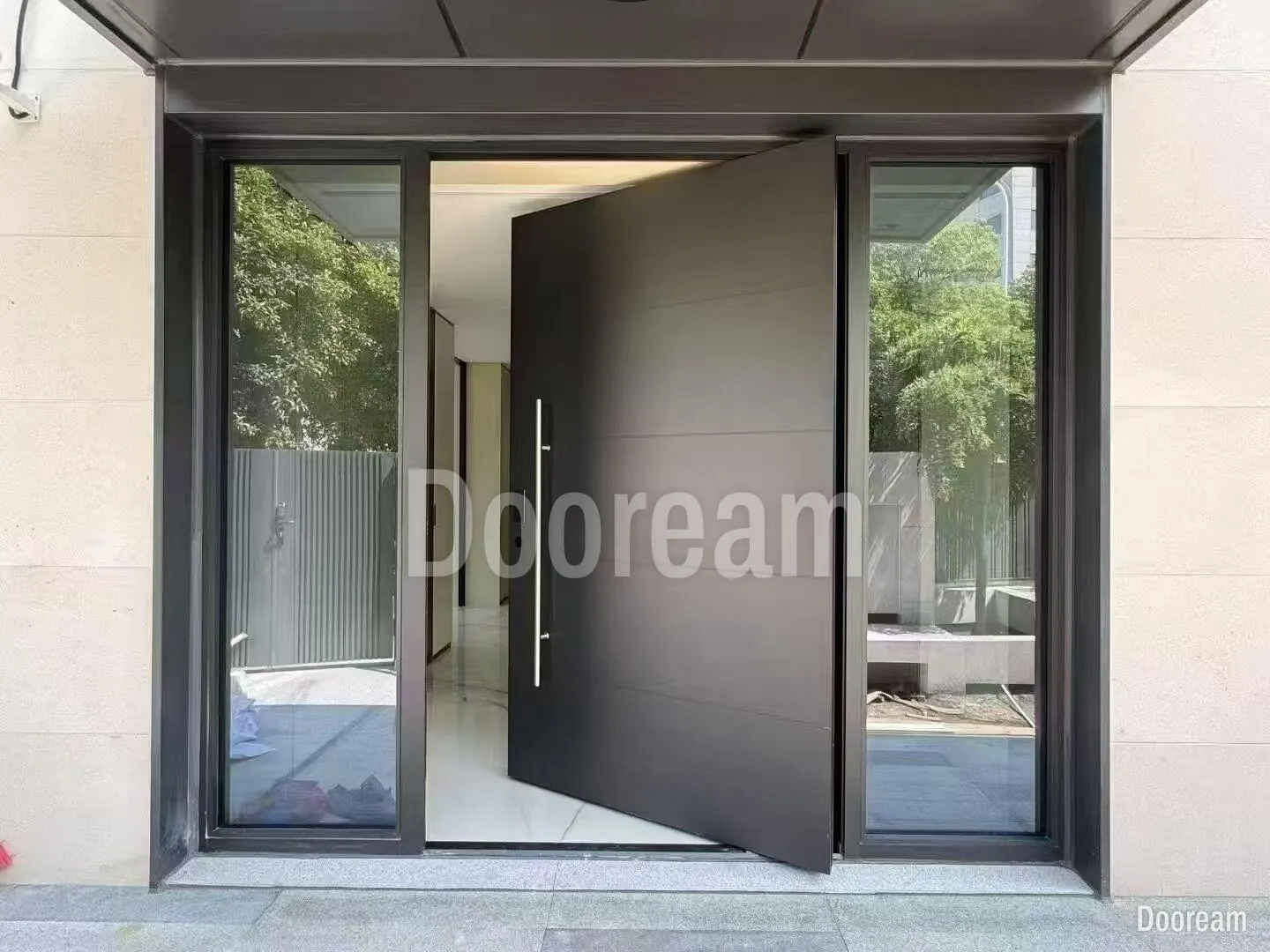
Short answer: size the pull to the hand first and the door second. Keep the grip 865–1,220 mm above the floor, start a vertical pull 700–1,000 mm up and, up to about 4 m, make it about a third of the leaf height; above that, a band or the face carries the height. On a pivot door, put it near the free edge and fix it through solid backing.
How long should a pull handle be on a tall door?
No standard sets a length. As design guidance, start at about a third of the leaf height up to about 4 m, with the bottom end 700–1,000 mm above the floor. Beyond that, the hand stays at the same height while the door keeps growing, so the pull stops scaling and a band or the face pattern carries the height.
| Leaf height | Vertical pull to start from | Notes |
|---|---|---|
| Up to 2,400 mm | 300–1,000 mm | A lever alone also works |
| 2,400–3,000 mm | 800–1,500 mm | A third to a half of the leaf |
| 3,000–4,000 mm | 1,000–2,000 mm | Ask whether a long bar needs a middle standoff |
| 4,000–6,000 mm | 1,500–2,500 mm | Consider a full-height band |
| 6,000–8,000 mm | 2,000–3,000 mm, or a full-height band | Ask how a very long bar is fixed and shipped |
These ranges are our design guidance, not a rule. Worked examples, our arithmetic:
- 3,000 mm leaf: a third is 1,000 mm; fixed from 800 to 1,800 mm, its lower half covers the grip zone.
- 6,000 mm leaf: 2,000 mm from 800 mm reaches 2,800 mm. Centred at mid-height, 2,000–4,000 mm, nobody could reach it.
- 8,000 mm leaf: 3,000 mm from 800 mm reaches 3,800 mm; a band or the face runs the rest.
At what height should the grip be?
At hand height, whatever the leaf height. The 2010 ADA Standards put operable parts of door hardware 865–1,220 mm above the floor. BS 8300-2, as the Guild of Architectural Ironmongers (GAI) summarises it, puts a vertical pull’s bottom fixing 700–1,000 mm above the floor and its top fixing at least 1,300 mm up.
Keep a horizontal pull inside 865–1,220 mm along its length. The ADA advisory favours hardware usable with a closed fist or a loose grip. On accessible entrances to buildings other than dwellings in England, Approved Document M Volume 2 adds that door furniture should contrast visually with the door and not be cold to the touch.
How thick should the grip be, and how far from the door?
BS 8300-2 asks for a vertical pull section of 19–35 mm. The Access Board’s ADA guide recommends at least 1½ in (38 mm) of knuckle clearance behind bars and pulls, and the GAI’s drawing of a cranked pull shows at least 45 mm. On a heavy leaf, use the upper end of both ranges, and more where people wear gloves.
Depth costs width. Approved Document M measures effective clear width to any projecting door furniture, and the ADA Standards allow no projection into the required clear width below 865 mm and no more than 100 mm between 865 and 2,030 mm. On an inward-opening door, the outside pull ends up in the opening, so take its depth off the clear widths in our offset or centre-hung guide.
Where should the pull go on a pivot door?
As far from the axis as the design allows. Whatever resists the leaf (the pivot’s closing mechanism, seal pressure, a draught) acts as a turning moment about the axis. The force at your hand is that moment divided by your hand’s distance from the axis, so halving the distance doubles the force.
Worked example, our arithmetic: the offset leaf from our offset guide, 1,374 mm wide, axis 1,304 mm from the leading edge. Assume it needs 30 N at the edge, Approved Document M’s limit for accessible entrance doors from 0° to 30°: a moment of 30 × 1.304 = 39 N·m.
| Hand position | Distance from axis | Force needed |
|---|---|---|
| Leading edge | 1,304 mm | 30 N |
| Pull 100 mm in from the edge | 1,204 mm | About 32 N |
| Pull at mid-leaf | 600 mm | About 65 N |
| Pull 200 mm from the axis | 200 mm | About 196 N |
A 1,000 mm horizontal pull starting 100 mm from the edge takes about six times the force at its axis end. Never put a pull on the short side of an offset pivot, or over the axis of a centre-hung one. The ADA Standards set no opening force for exterior hinged doors; the Access Board recommends automation where opening force is likely to be significant. See also pivot door size and weight and, for side-hung leaves, hinges for heavy doors.
Back-to-back or one pull, and how does it work with the lock?
A fixed pull does not move a latch, so something else must hold the door shut: an automatic or motorised multipoint lock, or a lever inside. Back-to-back pulls are joined through the leaf and match on both faces. A single outside pull leaves the inside free for a lever, a thumbturn or a smaller pull.
- Fixings: ask that they undo from inside only.
- Lock zone: fixings near the edge must clear the lock case and rods.
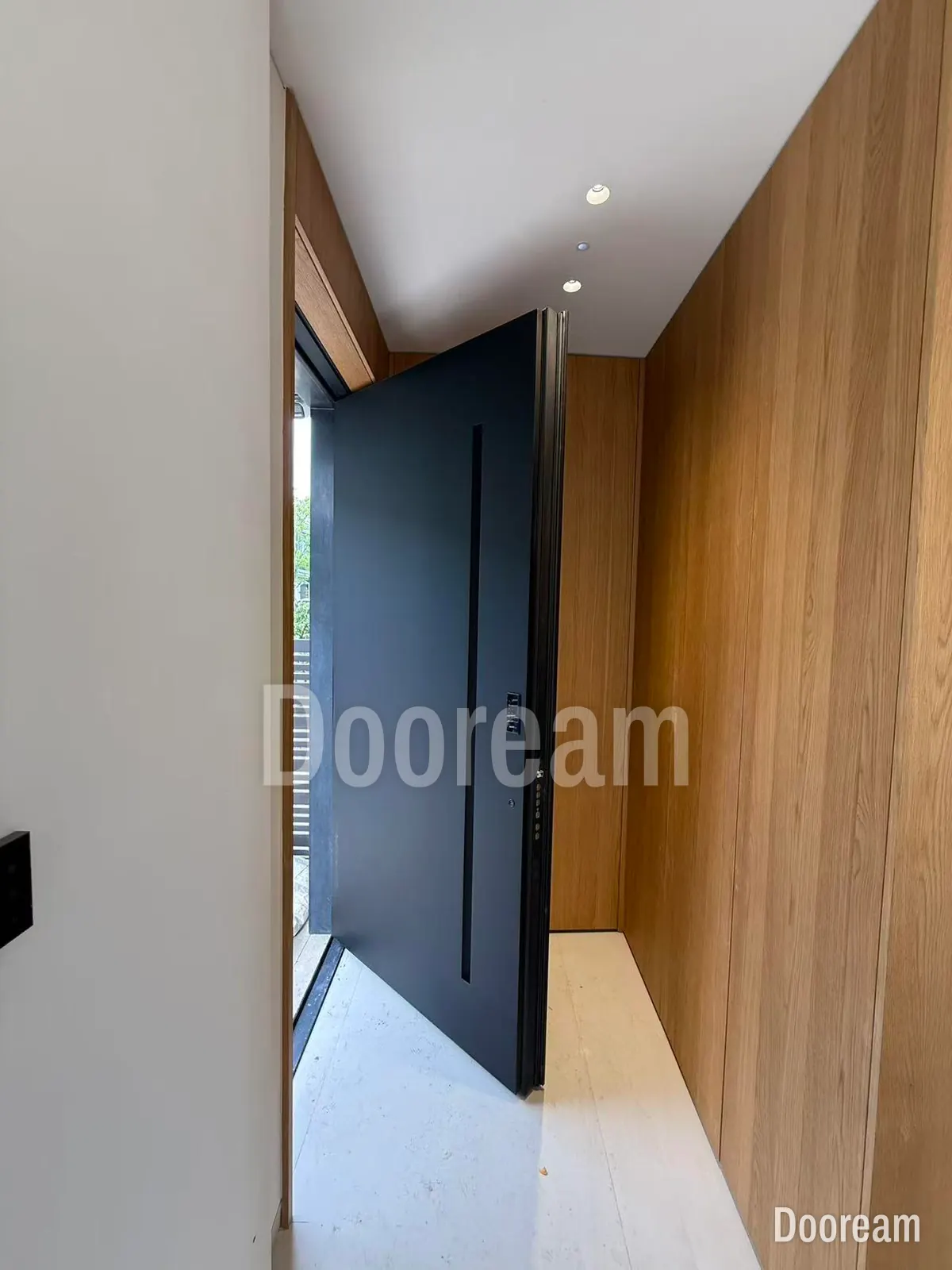
- Reader: on our Contour pivot door, a long black pull carries the smart lock. A reader in a pull ties handle to lock; see smart locks on large and pivot doors.
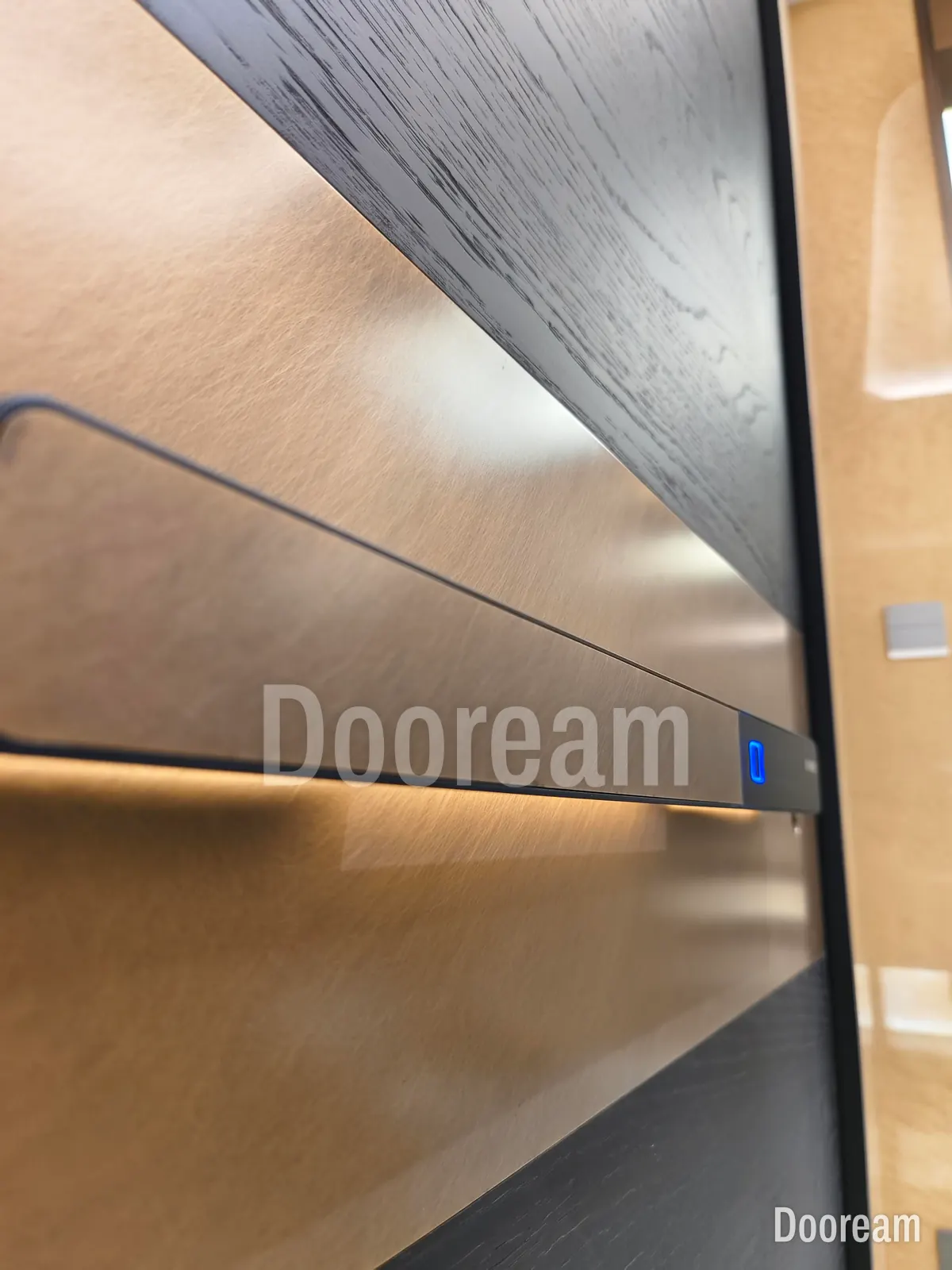
How is a pull fixed through an armoured or composite leaf?
Through solid backing, never the core alone. An armoured leaf is a sandwich; ours is, from outside in, a face, galvanised steel sheet, an aluminium profile frame with an aluminium honeycomb core, galvanised steel sheet and an inner face. Hexcel’s sandwich design guide says the core must resist local loads, and that inserts or bar sections can be bonded in.
A bolt clamping two skins over a core can crush it and work loose. Ask the maker how your handle is fixed through the core and what sits behind each fixing. Backing goes in before the leaf is closed, so fix handle positions before production; moving a pull later means drilling blind.
Which materials work, and will the pull get hot or cold?
Low-conductivity materials are kinder to the hand: the GAI calls timber or nylon-sleeved steel handrails the most comfortable in extreme temperatures. A dark pull in sun gets as hot as a dark face (black front doors).
Near the sea, the British Stainless Steel Association prefers grade 316, mirror polished by default, and rules out a standard 240 brushed finish there, even in 316. It advises against aluminium fasteners on stainless panels because galvanic corrosion of the aluminium can be a problem in harsh environments; a stainless pull on an aluminium face is the same pairing, so ask how they are isolated (bronze on aluminium).
Do recessed pulls and handle bands work on large doors?
Yes, with limits. A recessed pull projects nothing, so it keeps the clear width and a flush face, but it is gripped with the fingertips, not a closed fist. Give it room for knuckles (the Access Board recommends 38 mm of knuckle clearance for pulls), a closed back and a way for water and dust out.
A band can carry the pull, reader and cylinder, and gives a tall leaf scale. On our Grain Band pivot door, wood-grain printed panels are split by a brushed metal band that carries the handle. A band is part of the face, so decide it first (design ideas).
How do handles work on an unequal double door?
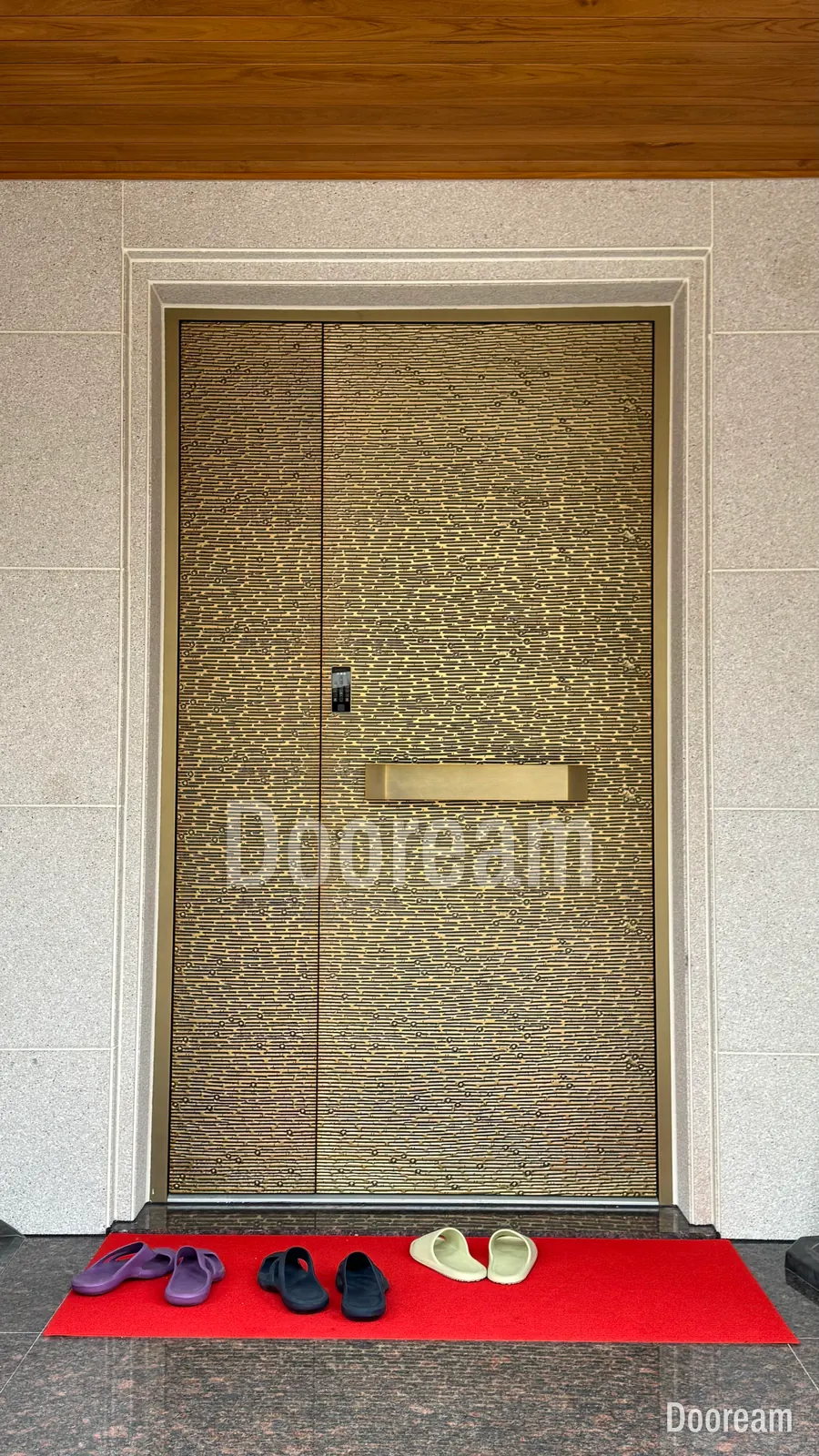
The wide leaf is used every day, so it carries the working pull and the lock; the narrow leaf is bolted shut and opened when you need the full width (single, double or unequal). For the handles, three common choices:
- Pull on the wide leaf only, as below.
- A matching dummy pull on the narrow leaf, mirrored at the seam (grand double doors).
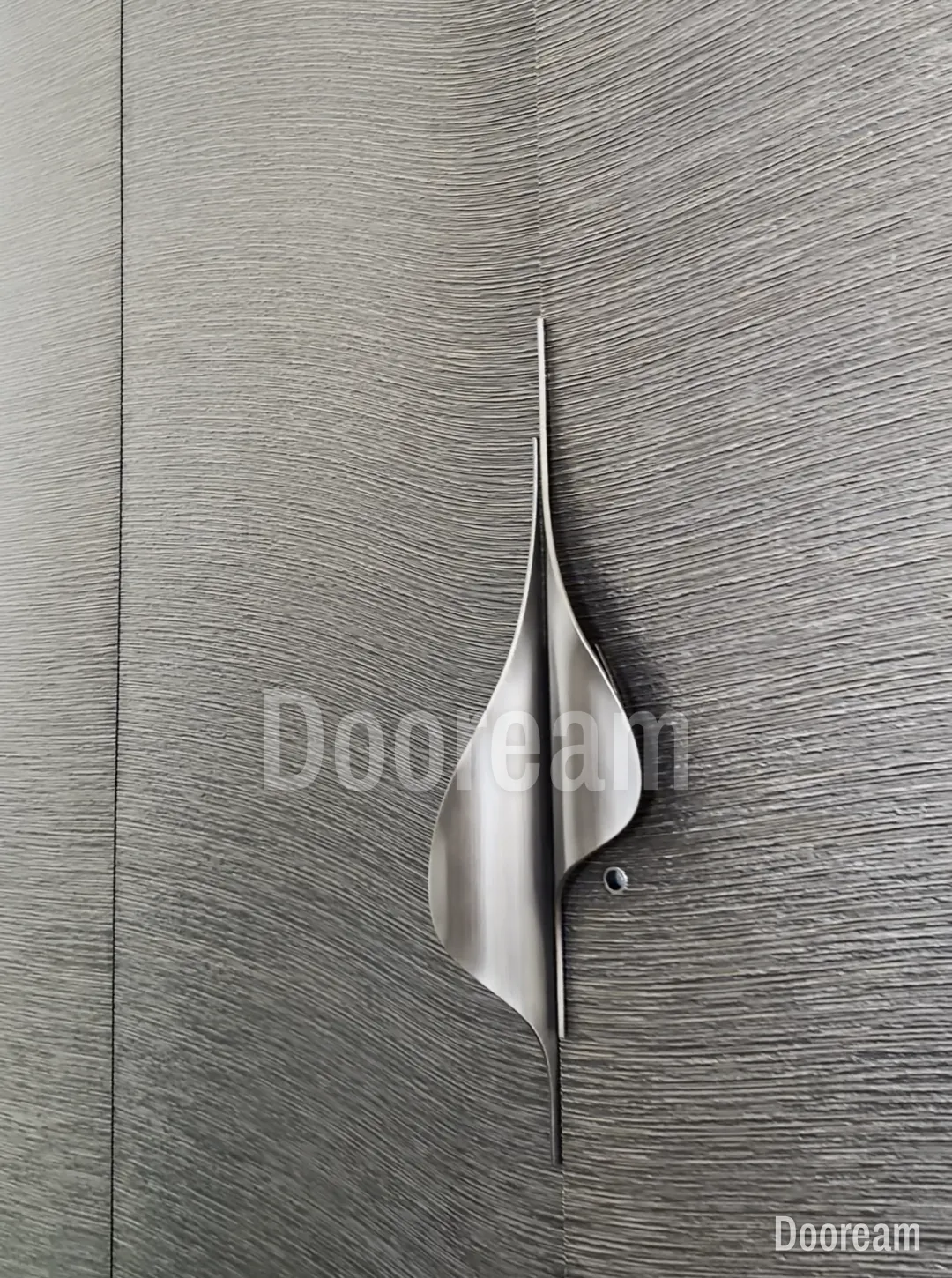
- One centrepiece. Our Crystal Handle, an unequal double door, has a round crystal handle at the centre; Sail has a sculpted pull shaped like a sail across the seam.
What should a pull handle specification include?
Everything that sets the handle’s size, place and fixing, agreed before the leaf is built, because the backing inside the leaf follows it. Check these against the elevation and the lock drawing, then put them on the shop drawing.
- Leaf size, weight and axis position.
- Type: bar on standoffs, flat bar, recessed pull or band; vertical or horizontal.
- Length, bottom-end height and grip zone.
- Distance from the leading edge and the axis.
- Section and clearance behind the grip.
- Inside face, and how the lock opens from each side.
- Reader and cylinder positions.
- Fixings: how many, what backs each, which side undoes them.
- Material, grade, finish and isolation from aluminium.
- Clear width at 90°, pull included.
- On a pair: active leaf, dummy pull or centrepiece.
How does this work with Dooream?
We make pivot doors up to 4,000 × 8,000 mm on FritsJurgens pivot hinges, and double and unequal double doors up to 3,000 × 6,000 mm, with smart locks by KFV, G-U or Wintech. Production takes 35–45 days after drawing approval and deposit, so settle the handle and its fixing on that drawing: send your handle drawing with the opening and ask us how it will be fixed through the leaf. See for architects or contact us.
Sources, checked November 2026: U.S. Access Board, 2010 ADA Standards, chapter 4 (404.2.3 clear width, 404.2.7 door hardware, 404.2.9 opening force), guide to operable parts (309.4) and guide to entrances, doors and gates; GOV.UK, Approved Document M Volume 2, 2015 edition incorporating 2020 and 2024 amendments (paragraph 2.17 and Table 2); Guild of Architectural Ironmongers, Ironmongery and Accessibility specifier's guide, September 2024 (summarising BS 8300-2); Hexcel, Honeycomb Sandwich Design Technology (AGU 075b); British Stainless Steel Association, selection of stainless steels for building external applications.
Quick answers
How long should a pull handle be on a tall front door?
No standard sets a length. As design guidance, start at about a third of the leaf height up to about 4 m, with the bottom end 700–1,000 mm above the floor. Above that the hand stays at the same height while the door grows, so the pull stops scaling and a band or the face pattern carries the height.
At what height should a door pull handle be?
The 2010 ADA Standards put the operable parts of door hardware 865–1,220 mm above the floor. BS 8300-2, as summarised by the Guild of Architectural Ironmongers, puts the bottom fixing of a vertical pull 700–1,000 mm above the floor and the top fixing at least 1,300 mm up. These heights hold for a 6 m leaf as much as for a 2.4 m one.
Where should the handle go on a pivot door?
Near the free edge, as far from the pivot axis as the design allows, and never on the short side of an offset pivot. The force at the hand is the turning moment divided by its distance from the axis. In our worked example, a leaf needing 30 N at its edge needs about 65 N at a pull 600 mm from the axis.