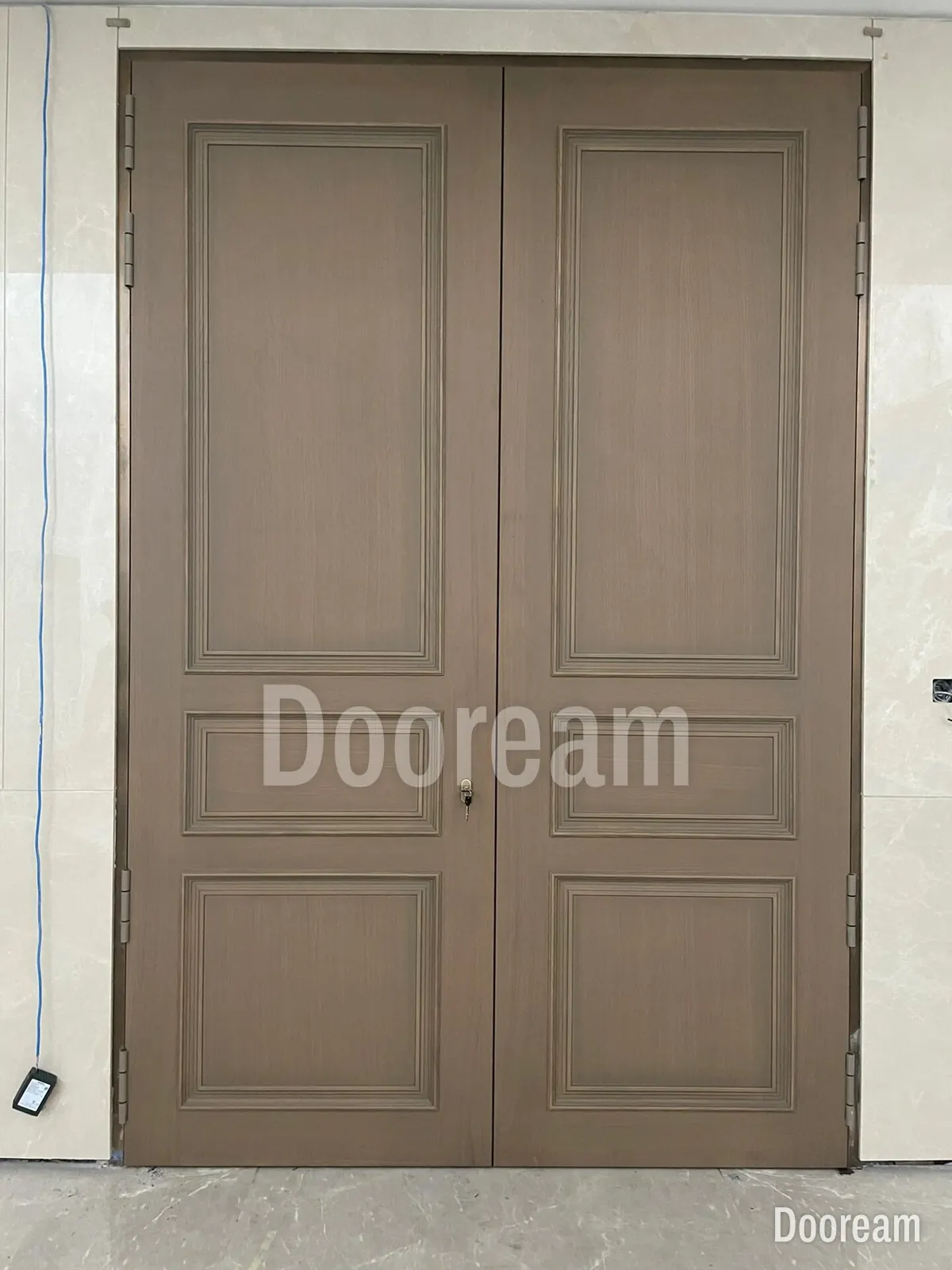
Short answer: side hinges hang the leaf from its jamb and pull the top hinge out of the frame, so hinge, frame and wall fixing together set the limit. Published ratings run from about 100 kg for a door on heavy US butt hinges to 300 kg for a leaf on SIMONSWERK’s highest-rated TECTUS concealed hinges, each for a stated leaf size. A pivot stands the weight on the floor; FritsJurgens lists pivots for doors up to 500 kg, depending on width.
Which hinges can carry a heavy entrance door?
Four kinds are used: ball-bearing butt hinges, surface-mounted barrel hinges, concealed 3D-adjustable hinges and pivots. The first three hang the leaf from its jamb; a pivot stands it on the floor. Each rating below holds only for its stated hinge count and leaf size, so check it against your own leaf.
| Ball-bearing butt | Surface barrel | Concealed 3D | Pivot | |
|---|---|---|---|---|
| Published example | Hager 6 in (152 mm) full mortise: doors up to 230 lb (104 kg), 36 in (914 mm) wide (2016) | Dr. Hahn Rollenband AT, aluminium doors: 210 kg on four hinges (2022) | SIMONSWERK TECTUS TE 640 3D 200 kg, TE 645 3D 300 kg; two per leaf, height twice width (07/2024) | FritsJurgens System M+ and System One: up to 500 kg, depending on width (04/2026) |
| Weight goes to | Hinge jamb | Hinge jamb | Hinge jamb | Floor |
| Adjustment | None built in | Three directions | ±3 mm side and height, ±1 mm compression | Closing and position settings |
| Look | Knuckles show | Barrels show | Hidden when closed | Plates at floor and head |
| Hinge side, closed | Pins outside on outward doors | Same | Nothing to reach | Lifting the leaf off its floor plate |
How does a side-hung leaf load its hinges, and how is a pivot different?
A side-hung leaf is a cantilever. Its weight acts about half its width from the hinge axis, pulling the top hinge out of the frame and pushing the bottom one in. The force is roughly the weight times that distance, divided by the spacing between top and bottom hinges.
SIMONSWERK says the upper hinge “takes most of the major tractive forces”, and that closers, stops, locks and seals can make the load many times the door weight. Our arithmetic, assuming 50 kg/m² (not our doors’ weight) and hinges 250 mm from top and bottom:
| Leaf W × H | Assumed weight | Hinge spacing | Pull at top hinge |
|---|---|---|---|
| 1,200 × 3,000 mm | 180 kg | 2,500 mm | About 424 N |
| 2,000 × 3,000 mm | 300 kg | 2,500 mm | About 1,177 N |
| 1,500 × 6,000 mm | 450 kg | 5,500 mm | About 602 N |
Width counts twice: from 1,200 to 2,000 mm, weight and lever both grow and the pull rises 2.8 times. Height spreads the hinges, but 450 kg is beyond every side hinge above. SIMONSWERK adds that, at the same hinge spacing, ratings fall for leaves wider than its reference size.
On a pivot, FritsJurgens’ 04/2026 catalogue says the bottom pivot “carries the full weight of the door”. The top pivot only holds the leaf upright against a sideways force set by the axis offset (offset or centre-hung pivot doors).
How many side hinges does a tall leaf need, and where do they go?
Hager’s catalogue gives the US rule: one hinge per 30 in (762 mm) of door height or part of it, so four up to 120 in (3,048 mm), plus an optional one on doors wider than 37 in (940 mm). SIMONSWERK recommends three hinges on every exterior door.
- US positions (“5, 10 and equal”): top hinge 5 in (127 mm) below the frame head, bottom hinge 10 in (254 mm) above the bottom of the frame, the rest equally spaced.
- Heavy European leaves: the third hinge goes in the upper third, 350 mm below the upper hinge, centre to centre, in SIMONSWERK’s TECTUS brochure. SIMONSWERK recommends pairing hinges at the top on doors used very often, and says a third hinge does not automatically raise the rated load.
- Over 3 m: see grand double front doors. Hinges keep the hinge edge straight, not the lock edge (tall front doors).
- Handing: hinge pockets are made for one hand (door handing).
What do hinge grades and load ratings tell you?
A grade tells you how a hinge did in a standard test; a load rating, what its maker allows on a stated door. Neither covers a heavy custom leaf alone, so ask for the rating at your leaf’s weight, width and hinge count.
- ANSI/BHMA A156.1 (US butt hinges): cycle tests of 2,500,000 for Grade 1, 1,500,000 for Grade 2 and 350,000 for Grade 3.
- EN 1935 (European single-axis hinges): an eight-digit code. Its test door mass runs from grade 0 (10 kg) to grade 7 (160 kg); hinge grade 14 means 200,000 cycles on a 160 kg door. Above that, rely on the maker’s data. Other digits give corrosion resistance (0 to 4) and suitability for burglar-resistant doors.
- Pivots use weight classes: FritsJurgens runs from AA (up to 79 kg) to G (up to 500 kg), depending on door width (pivot size and weight).
How secure is the hinge side?
Exposed hinges on an outward-opening door put the pins outside. Concealed hinges and in-leaf pivots leave nothing to reach when closed, but a heavy security door still needs its hinge edge held. A security rating belongs to the tested door, hinges included (door security ratings).
- Non-removable pins: Hager’s set screw can be reached only with the door open.
- Safety studs: a stud on one hinge leaf locks into the other if the pin is removed. Hager calls both deterrents.
- Hinge bolts (dog bolts): pins in the hinge edge that engage as the door closes. ProtectUK (2022) recommends them “particularly for outward opening doors where the hinges are exposed”.
- Pivots: FritsJurgens names lifting the leaf off the floor plate as the main weak point, and three-point locks on both sides as the answer.
We hold no EN 1627 rating; testing can be arranged, usually at the buyer’s cost.
What must the frame and wall take?
Everything the top hinge pulls goes through the frame into the wall, so a heavy side-hung leaf needs mechanical fixings at each hinge into solid structure. SIMONSWERK advises against foam alone above 40 kg and asks for a screw or dowel through the hinge holder, or within 100 mm of the hinge.
Behind the hinge jamb, use concrete, solid masonry or a steel post; in hollow blocks or a stud wall, a steel sub-frame.
When should you switch from side hinges to a pivot?
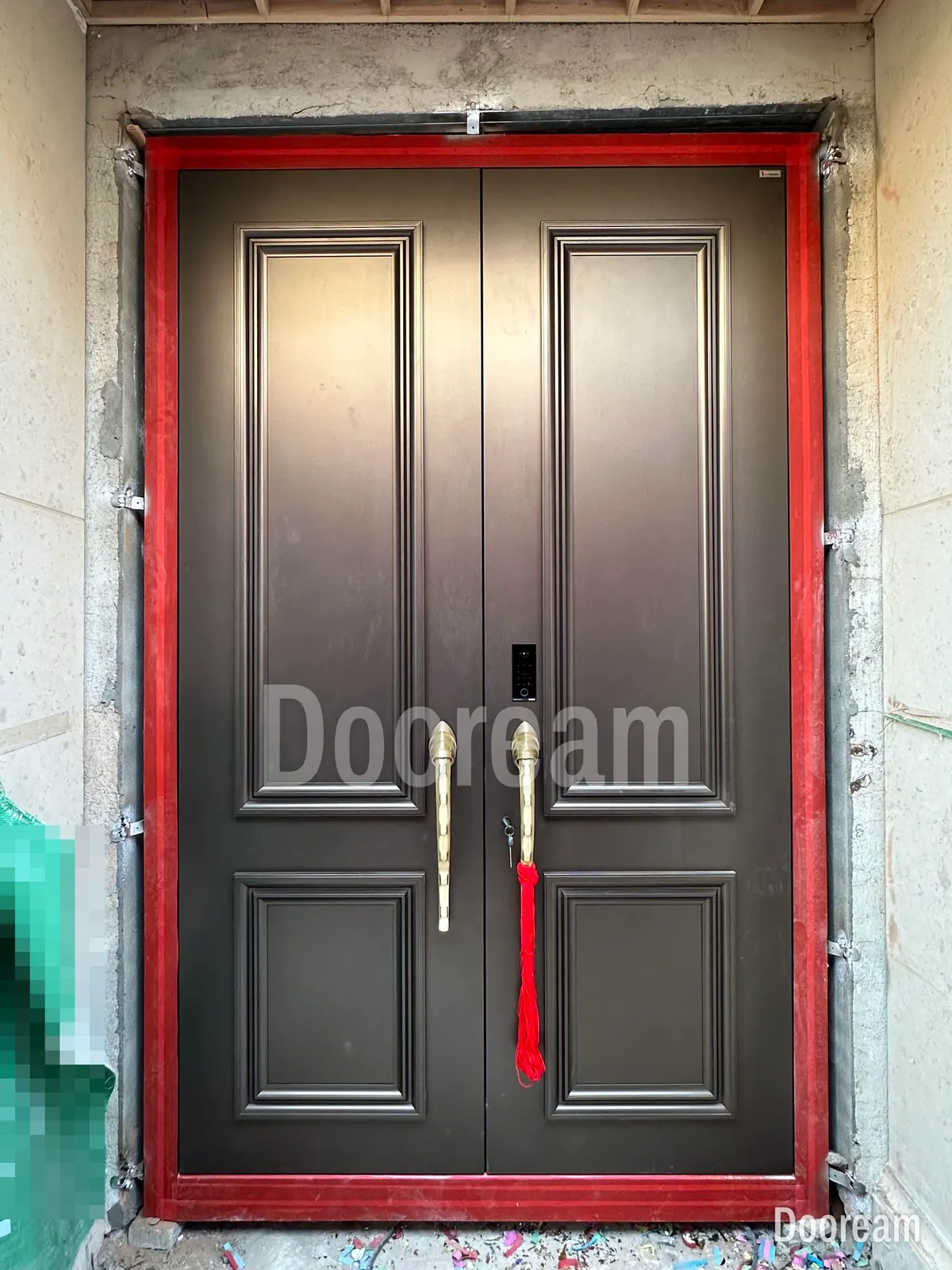
Switch when the leaf is heavier or wider than any side hinge is rated for at that size, when the jamb or wall cannot take the pull, or when you want nothing on the edge. Keep side hinges where you need the full leaf width as clear opening, or the floor cannot take a pivot plate.
- Weight and width: past 160 kg you leave the EN 1935 grades, and SIMONSWERK treats doors over 1,000 mm as extra-wide.
- Look: a pivot shows nothing on the edge, which suits a carved or cast face (pivot front doors: pros and cons).
- Clear width: a pivot leaf’s narrow strip swings the other way and costs clear opening.
How do you hang a double door on side hinges?
Each leaf hangs from its own jamb, so both jambs need hinge-jamb fixings and the head must not sag at mid-span. The inactive leaf bolts into head and floor; the active leaf locks into it. On an unequal pair the wide leaf carries most of the load.
ProtectUK advises two pairs of hinge bolts on double doors, close to the hinges. Choose the everyday leaf first (single, double or unequal double).
What maintenance do heavy door hinges need?
Little, if the frame stays put. Check the gaps along the head and lock edge twice a year: a gap closing at the top of the lock edge means the leaf is dropping, often because a fixing has moved. Lubricate only as the hinge maker says.
- Concealed hinges: TECTUS hinges have “maintenance-free slide bearings”; if their ±3 mm adjustment runs out, check the frame.
- Floor seals: badly adjusted seals strain the bottom hinge (SIMONSWERK).
Checklist: how do you specify hinges for a heavy door?
- Leaf weight in kg for the exact construction, and the leaf size.
- Hinge make, model and published rating, with its hinge count, reference size and date.
- A156.1 grade or EN 1935 code, including the corrosion digit on a coastal site.
- Hinge count and positions on the drawing, any third hinge near the top.
- Closers, stops, locks and drop seals that add load.
- Pins, studs or hinge bolts, on both leaves of a pair.
- Anchor type, a fixing at every hinge, and what is behind the cladding.
- Adjustment directions and range in millimetres.
- Handing and opening direction, seen from outside.
How does this work with Dooream?
Our pivot doors run on FritsJurgens pivot hinges and go up to 4,000 × 8,000 mm; our double and unequal double doors go up to 3,000 × 6,000 mm, and we make single doors. Every door is built to your drawing, so you can specify the side hinges for a double or single door, or ask us which hinges are fitted for your door. We fit the hardware and test it in our workshop before the door is crated; your local installers fit it with our installation drawings and remote guidance. See for architects or contact us.
Sources, checked November 2026: Allegion, what are ANSI/BHMA hardware grades? and what is 5, 10 and equal hinge spacing?; Hager, commercial hinges catalogue (2016); HOPPE, BS EN 1935 single-axis hinges; SIMONSWERK, TECTUS product brochure, North America (07/2024) and load capacities; Aluprof, Rollenband AT roller hinges from Dr. Hahn (2022); FritsJurgens, product catalogue (04/2026) and exterior pivot doors; ProtectUK, security at home (2022).
Quick answers
How much weight can concealed door hinges carry?
It depends on the model, the number of hinges and the leaf size. In SIMONSWERK's TECTUS brochure for North America (07/2024), the TE 640 3D is rated for 200 kg and the TE 645 3D for 300 kg, with two hinges per leaf and a leaf twice as tall as it is wide. SIMONSWERK says ratings fall for wider leaves at the same hinge spacing.
Which hinge takes the most load on a heavy door?
The top hinge. The leaf's weight acts about half its width from the hinge axis, so the top hinge is pulled out of the frame and the bottom hinge pushed into it, by roughly the weight times that distance divided by the spacing between them. SIMONSWERK puts a third hinge in the upper third of the leaf.
When should a heavy entrance door be a pivot instead of side-hinged?
When the leaf is heavier or wider than the side hinges are rated for at that size, when the hinge jamb or wall cannot take the pull, or when you want nothing on the edge. A pivot stands the weight on the floor: FritsJurgens' 04/2026 catalogue lists System M+ and System One for doors up to 500 kg, depending on door width.