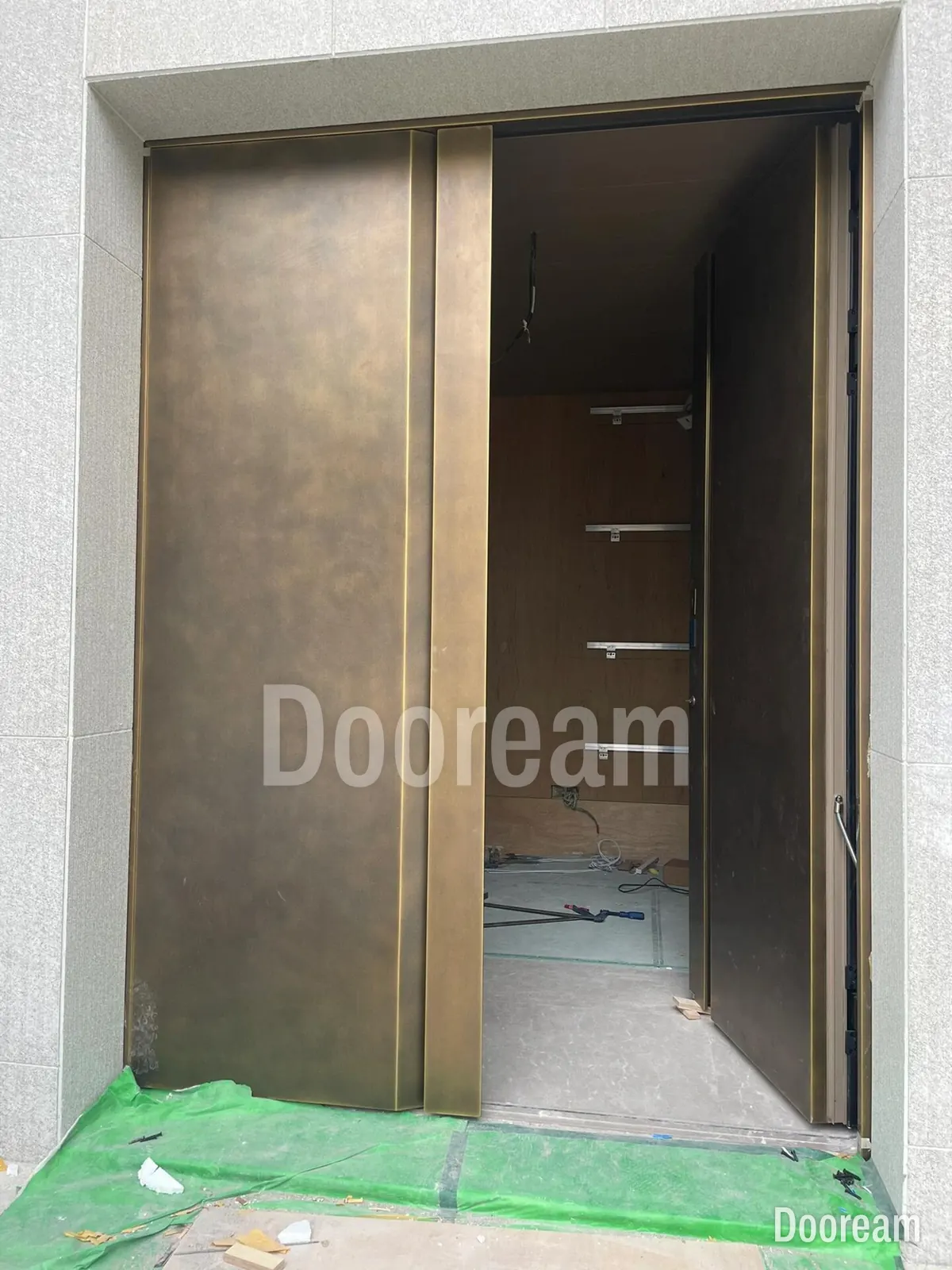
Short answer: handing is the hinge or pivot side plus the opening direction, but each system reads it from a different place. US handing (LH, RH, LHR, RHR) is read from outside and German DIN handing from the side the door opens towards, so a door that opens inwards, hinged on the left seen from outside, is LH in the US and DIN right in Germany. Write handing in words, seen from outside, with a plan sketch.
What is door handing, and why is a mistake so expensive?
Handing says which side of the opening the hinges or pivot are on, and whether the leaf opens inwards or outwards. On a custom entrance door it is built in: the leaf, frame, lock, keeps, seals, threshold and pivot or hinge preparation are all made for one hand. A door made the wrong way round usually has to be remade.
Which handing systems are there, and where do you stand to read them?
There are three ways of reading handing. The US system reads it from outside, the secure or key side. German DIN 107 reads it from the side the door opens towards, where the hinges are visible. A third way names the closing direction, clockwise or anticlockwise on plan, and needs no viewer. British practice uses all three.
| System | Where you stand to read it | What “left” means | Typical labels |
|---|---|---|---|
| US and North America | Outside (secure or key side), whichever way the door swings | Hinges on your left | LH, RH (swings away); LHR, RHR (swings towards you); pairs LHA, RHA, LHRA, RHRA |
| Germany, DIN 107 | The side the door opens towards, where the hinges show (pull side) | Hinges on your left | DIN links, DIN rechts; faces 0 (opening) and 1 (closing) |
| Britain, NHS guidance HTM 59 | The pull side | Hinges or pivots on your left | Left hand, right hand |
| Britain, some door retailers | Outside the room or property | Hinges on your left | Left-handed, right-handed |
| Closing direction (ISO draft, India’s IS 4043) | Nowhere: read on plan, from above | No left or right | 5 clockwise, 6 anticlockwise; 0 and 1 for the faces |
DIN 107 dates from 1974 and is still current. India’s IS 4043 (1969) sets out the 5 and 6 codes from an ISO draft; the ISO recommendation of the same title, ISO/R 1226, was withdrawn in 1998, but some UK ironmongery suppliers still use the codes, such as 5 for clockwise closing. EN 12519:2018, the European terminology standard for windows and pedestrian doors, uses clockwise and counter-clockwise for casement windows. British sources disagree: for a door that opens inwards, HTM 59 and a retailer reading from outside, such as Direct Doors, give opposite answers.
How does each system name the same door?
Take two single doors, both described seen from outside. Door A opens inwards with its hinges on the left. Door B opens outwards with its hinges on the right. In the US they are LH and RHR. In DIN terms both are DIN right, because DIN is read from whichever side the door opens towards.
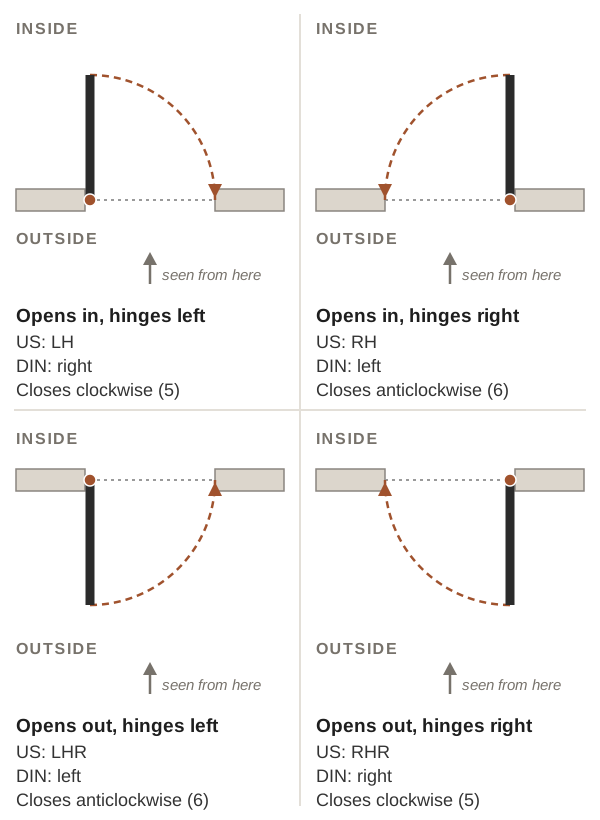
| System | Door A: opens in, hinges left | Door B: opens out, hinges right |
|---|---|---|
| US | LH | RHR |
| DIN 107 | DIN right, read from inside | DIN right, read from outside |
| Closing direction | Clockwise, 5.0: the inside face is the opening face | Clockwise, 5.1: the inside face is the closing face |
| Britain | Left-handed from outside; right hand under HTM 59 | Right-handed either way |
| In words | Opens inwards, hinges on the left, seen from outside | Opens outwards, hinges on the right, seen from outside |
Doors A and B are the same leaf turned round. DIN and the closing direction name it the same both ways, so a DIN order must also say inwards or outwards; IS 4043 adds the face number. For doors that open outwards, the US and DIN letters agree: LHR is DIN left and RHR is DIN right. For doors that open inwards they are always opposite.
How is a pivot door handed?
A pivot door is handed like a hinged one: by the side its axis is set towards and the way it opens, both seen from outside. HTM 59 includes pivots in its definition. The difference is the narrow strip between the axis and the edge. It turns the other way, so on a door that opens inwards it swings outwards.
- Single- or double-acting. In FritsJurgens’ terms, a single-acting door opens to one side only, stopped by the frame or another external stop; a double-acting door opens both ways, holding at 90° on either side. It has no “in” or “out”, but its axis still has a side.
- The narrow side. Keep its sweep clear of handles, wall lights, cladding and steps.
- Frame and gaps. FritsJurgens’ side-gap method gives different gaps on the two sides of the leaf, so the frame and its seals are made for one hand.
- In words: “Pivot door, opens inwards, axis towards the left jamb seen from outside, ___ mm from the frame; narrow part swings outwards.” For the drawings, see pivot door technical drawings.
How are double and unequal double doors handed?
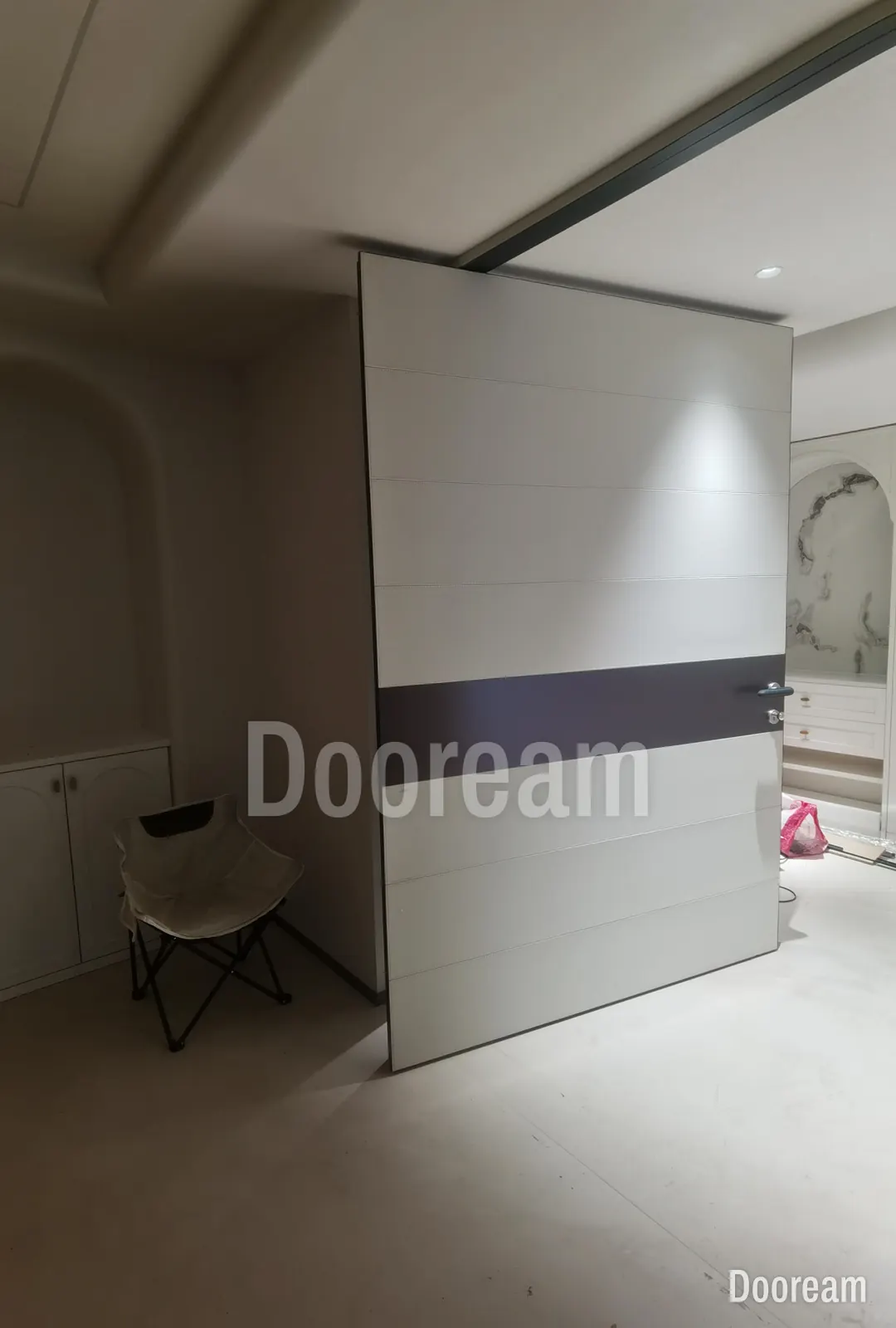
A pair has an active leaf, opened first and usually carrying the lock, and an inactive leaf, bolted at the top and bottom and opened only when needed. In German they are the Gehflügel and the Stehflügel. The systems hand pairs differently, so name the active leaf and its side, seen from outside.
- US: the active leaf, the one with the lockset, sets the hand: LHA, RHA, LHRA or RHRA.
- HTM 59: a pair of equal leaves is “symmetrical in plan” and not handed; an unequal pair is handed by its larger leaf.
- Unequal pairs: the wide leaf is normally the everyday one. If the narrow leaf is active, the US and HTM 59 names refer to different leaves.
- In words: “Pair, opens inwards; active leaf on the right, seen from outside; inactive leaf bolted top and bottom.” For choosing a pair, see single, double or unequal double.
What does handing decide on a custom entrance door?
Almost everything at the edges of the leaf and in the frame. Each part below is made, drilled or milled for one hand before the door leaves the factory. Some hardware can be reversed; the frame, keeps, seals and pivot or hinge preparation cannot.
| Part | What the hand fixes | Change on site? |
|---|---|---|
| Frame and keeps | Hinge or pivot jamb; lock jamb with a keep for every locking point; the rebate the leaf closes against | No |
| Hinge or pivot preparation | Hinge pockets on one edge; pivot pockets at one end; floor plate and top fixing set out from one jamb | No |
| Lock case and latch | Under DIN 107 a left lock suits a left leaf; some, such as Fuhr’s multisafe 856, suit either hand | Sometimes |
| Cylinder and handles | Key outside, thumbturn inside; a set with a fixed knob outside and a lever inside (Wechselgarnitur) is ordered DIN left or right | Sometimes |
| Seals and threshold | Rebate seals on the stop side; threshold upstand, drop seal and drainage for inwards or outwards | No |
| Faces and wiring | Pull and lock positions on each face; the cable usually enters on the hinge or pivot side | No |
Turning a finished door round does not re-hand it: a DIN-right leaf stays DIN right but opens the other way, outside face in. Upside down, its lock, drop seal and floor pivot are in the wrong place. Labels vary by product too: for one clockwise-closing door, a UK supplier lists left-handed hinges and a right-handed lock, and Allegion pairs an LHR door with a right-hand closer. Specify the door and let the maker hand the parts; see multipoint locks explained.
How do you specify handing so it cannot be misread?
Use one viewpoint, words and a sketch, and check them again on the shop drawing. A label such as LH or DIN rechts is a useful cross-check but should never stand alone. The method below works in any country and alongside any of the systems above.
- Door ID matching the plan, schedule and drawing, such as D01.
- Plan sketch: the leaf open at 90°, its swing arc, and INSIDE and OUTSIDE marked.
- “Seen from outside” before any left or right.
- In or out: “opens inwards” or “opens outwards”.
- Hinge or pivot side; for a pivot, the axis distance from the frame and “narrow part swings outwards”.
- For a pair, the active leaf, seen from outside, and how the other is held.
- Any label with its system: “US: LH” or “DIN rechts (DIN 107)”.
- The same words and arc on the shop drawing before you approve it; see the shop drawing approval checklist.
A complete line: “D01, single door, opens inwards, hinges on the left seen from outside (US: LH; DIN right).” Use the same words on the site survey and in your request for a quote.
How does this work with Dooream?
We make each door to a drawing for your opening, in millimetres, showing the sizes, opening direction, pivot or hinge side, face, finish, hardware and lock. Production starts only after the drawing is approved and the deposit is paid, and takes 35–45 days. The first design direction is free, usually within one working day. See for architects or contact us.
Sources, checked November 2026: Allegion, how do I determine the hand of a door?; Lori Greene, iDigHardware, Back-2-Basics: handing 101; DIN, DIN 107:1974-04; BauNetz Wissen, DIN links und DIN rechts, DIN-links und DIN-rechts and Gehflügel; NHS Estates, HTM 59 Ironmongery (2005), via NHS Wales; Direct Doors, what is handing?; Door Furniture Direct, handing; ISO, ISO/R 1226:1970 (withdrawn); Bureau of Indian Standards, IS 4043:1969; iTeh Standards, EN 12519:2018; FritsJurgens, System M+ technical documentation (04/2026); Fuhr, multisafe 856.
Quick answers
Is a left-hand door the same in the US and in Germany?
Not if it opens inwards. US handing is read from outside, German DIN handing from the side the door opens towards. A door that opens inwards with its hinges on the left, seen from outside, is LH in the US and DIN right in Germany. For doors that open outwards the letters agree: LHR is DIN left and RHR is DIN right.
How should I write door handing on a drawing or order?
In words, seen from outside: whether the door opens inwards or outwards, which side the hinges or pivot are on, and for a pair which leaf is active. Add a plan sketch with the swing arc and the inside and outside marked. If you add a label such as LH or DIN rechts, name the system it comes from.
Can a custom entrance door be re-handed on site?
Usually not. The frame, hinge or pivot preparation, keeps, seals and threshold are made for one hand, and some locks and handle sets too. Turned round, a DIN-right leaf stays DIN right but opens the other way, outside face in; upside down, its lock, drop seal and floor pivot are in the wrong place.