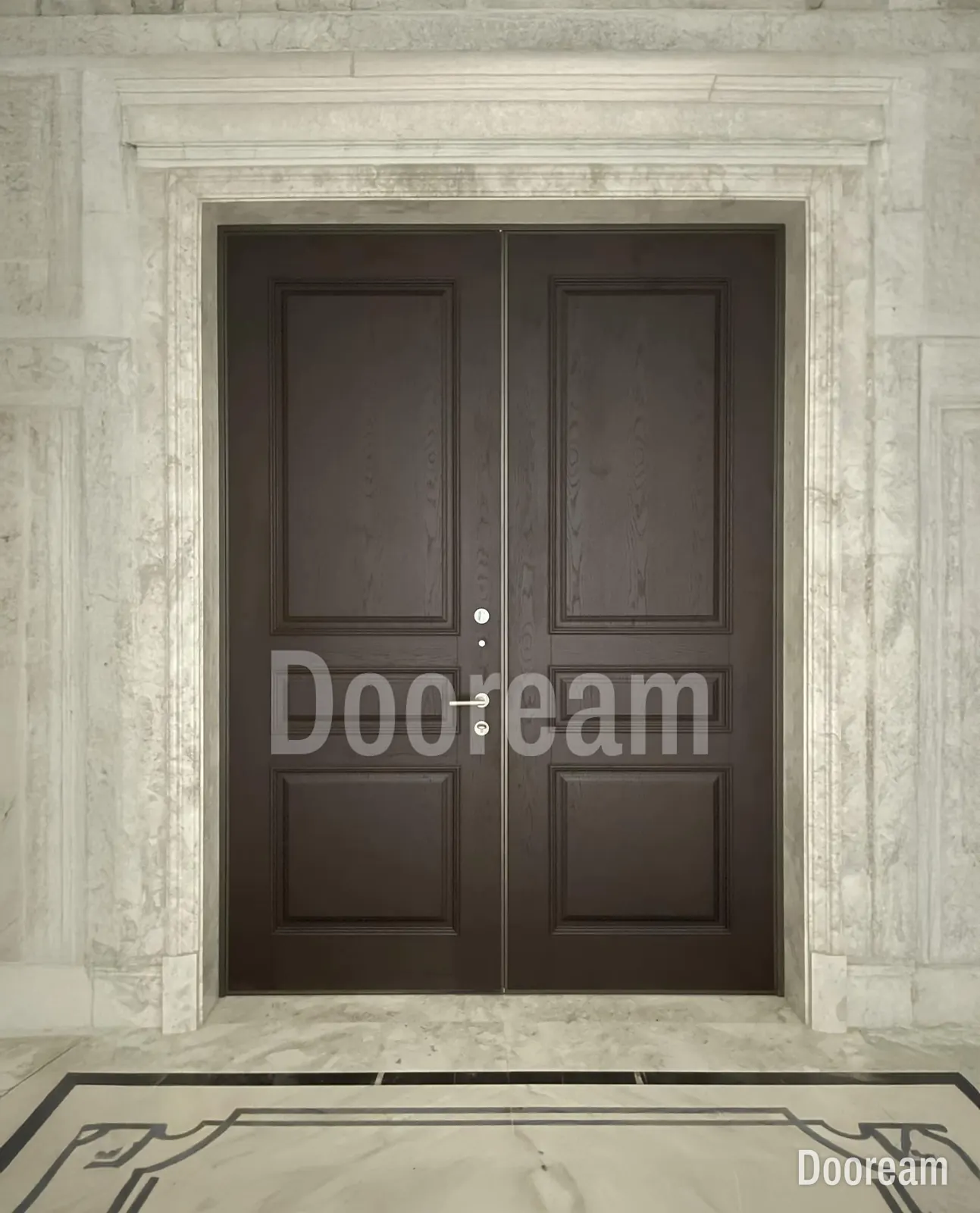
Short answer: where the two leaves of a double or unequal double entrance door meet, the gap cannot rely on a bare butt joint. A custom pair uses either a planted overlapping astragal or a stepped, rebated meeting-stile profile that houses perimeter seals and shields the latch, while the passive leaf locks firmly into the head and threshold with top and bottom flush bolts so the active leaf’s multipoint lock engages a rigid, sealed edge.
Why is the centre meeting stile the hardest edge to seal and lock?
On a single entrance door, the lock edge closes against a continuous masonry-fixed frame jamb. On a double or unequal double door, the active leaf locks instead into a second movable leaf—and any play in that passive leaf’s top and bottom bolts opens gaps in the centre seam.
Three things happen along the centre line whenever wind, pressure or forced entry pushes on the door:
- Air and wind-driven rain. Without an overlapping lip and continuous gasket line, wind drives water straight down the vertical seam onto the threshold.
- Light and acoustic leakage. Even a 2 mm unsealed gap at the centre seam drops whole-door sound insulation noticeably and lets porch light bleed around the latch.
- Latch and bolt exposure. An exposed gap between square-edged leaves allows a pry bar or thin blade to reach the latch tongue or hook bolts unless a metal overlap or rebate shields the joint.
Overlapping astragal, T-astragal or rebated meeting stile: how do they compare?
Door manufacturers handle the centre joint in three common geometric ways, depending on whether the pair is single-swing, double-acting or fitted with decorative faces across both leaves.
| Meeting-stile design | How the joint works | Sealing and security | Closing sequence |
|---|---|---|---|
| Rebated (stepped) meeting stiles | Active and passive stile profiles step into one another like a tongue-and-groove frame | Houses one or two gasket lines cleanly inside the step; strong pry protection and slim sightline | Passive leaf must close first unless stepped symmetrically with a coordinator |
| Overlapping flat astragal (Z- or flat-bar) | A strip fixed to the outside face of the active leaf (or inside of passive) overlaps the seam gap | Covers the crack from view, blocks direct water spray and hides latch bolts; needs a clean gasket pocket behind it | Requires passive leaf closed first so the overlap seats properly |
| T-astragal (centre mullion strip on passive leaf) | A T-shaped profile mounted to the passive leaf forms a central stop for the active leaf | Acts like a rigid jamb stop with compressible EPDM seal; accommodates thick carved faces and flush bolts cleanly | Passive leaf closes first and bolts into head and sill; active leaf closes against the T-stop |
On thick carved or cast aluminium entrance doors, manufacturers often favour a T-astragal or deep rebated aluminium meeting-stile profile built directly into the perimeter extrusion, because a thin surface-screwed timber or sheet strip is easily knocked loose on an exposed villa porch.
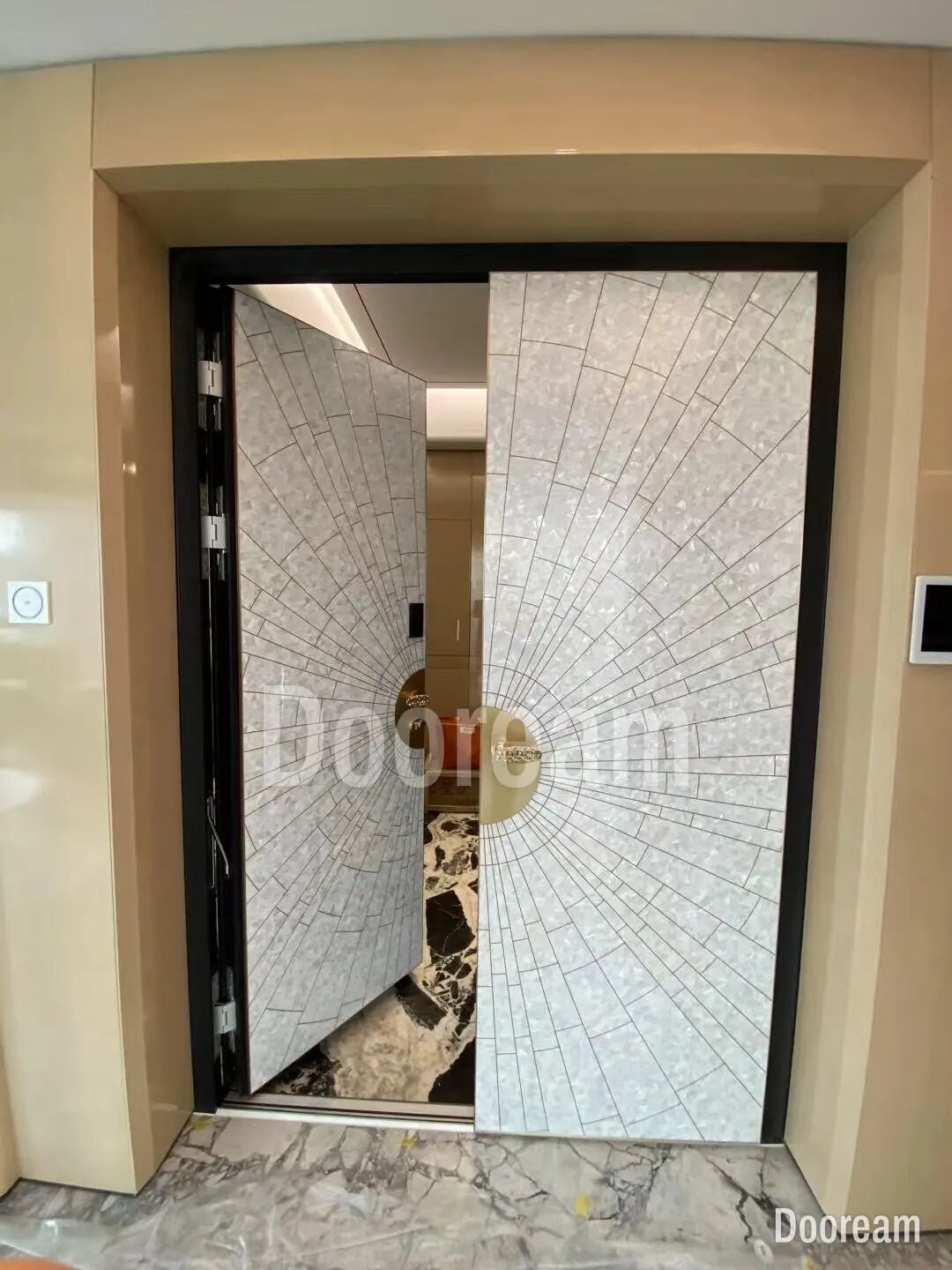
How do flush bolts and multipoint locks work together at the meeting stile?
The passive leaf forms the foundation for the active leaf. Every locking hook, deadbolt and latch on the active leaf throws into strike keeps machined into the passive leaf’s stile—so if the passive leaf is unbolted, the entire pair can swing inward or outward together.
Hardware standards classify auxiliary bolts by cycle durability and strength: in North America, ANSI/BHMA A156.16 covers flush bolts and surface bolts across Grades 1 to 3, while in Europe EN 12051 defines test methods and performance grades for door bolts and flush bolts. Four practical options exist:
- Manual flush bolts. Recessed levers in the top and bottom edge of the passive leaf extend steel rods into head and threshold strikes. Simple and reliable, provided users remember to throw both bolts every time the passive leaf closes.
- Constant-latching flush bolts. The top bolt latches automatically when the passive leaf shuts, while a manual lever remains at the bottom (Ives).
- Automatic flush bolts. Mechanical triggers engage top and bottom bolts whenever the active leaf closes against the passive leaf, and release automatically when the active leaf opens (common in pairs with door coordinators).
- Self-locking or motorised passive-leaf locks. Systems such as G-U’s bolt locks or ASSA ABLOY passive-leaf locks bolt top and bottom automatically on closing and can carry monitoring contacts or motor release.
See smart locks for double and unequal double doors for how smart readers and wired locks coordinate with passive-leaf bolts, and multipoint locks explained for hook and deadbolt engagement along the stile.
How do you seal the top and bottom ends of the astragal?
Even a tight vertical gasket fails if water runs down the seam and bypasses the bottom threshold, or if air leaks through the gap at the top corner where the astragal ends. Ask your door maker to show both end junctions on the section drawing.
- Top end cap and head seal. The meeting-stile gasket must run cleanly up to meet the continuous head frame seal without leaving a triangular air gap above the flush-bolt strike.
- Bottom astragal boot and drop seal. At the sill, an automatic drop seal in the bottom of each leaf lowers onto the threshold when closed (door seals and weatherstripping). Check how the two drop seals meet beneath the astragal—many makers add a flexible rubber astragal boot or shaped weather pad at the foot of the meeting stile to close the centre pin-hole.
- Equal versus unequal double splits. On an unequal double door, the centre seam sits off-centre; check that the active everyday leaf alone gives at least 815–850 mm clear passage (matching ADA 404.2.3 / AS 1428.1 benchmarks) so you rarely need to unbolt the narrow leaf.
Specifier checklist for double door meeting stiles
Confirm these seven items on the shop drawing before releasing a double or unequal double door to production:
- State on the elevation which leaf is active (everyday use) seen from outside, and whether the split is equal or unequal.
- Specify the meeting-stile profile (rebated extrusion, T-astragal or overlapping astragal) and show the gasket line in horizontal section.
- Confirm flush bolt type on the passive leaf (manual, constant-latching, automatic or self-locking) and check threshold strike dust-proof sockets.
- Check how the multipoint lock keeps sit inside the passive stile without colliding with vertical flush-bolt rods.
- Check handle clearance and smart-lock backset so levers, readers and recessed pulls clear the astragal overlap cleanly.
- Verify the top corner junction and bottom drop-seal boot detail where the vertical seam meets head and sill seals.
- Confirm whether any local accessibility or commercial egress code restricts manual flush bolts on the exit path.
How does this work with Dooream?
Dooream is the export brand of Zhejiang Jingyi Door Industry Co., Ltd. in Wuyi County, Jinhua, Zhejiang, China. We build complete custom aluminium armoured double and unequal double entrance doors up to 3,000 × 6,000 mm, from one door, including Shell, Ivory Wave, Sunburst, Classic Mint, Villa Double, Facet Light, Crystal Handle and Sail, as well as offset pivot doors up to 4,000 × 8,000 mm on pivot hinges, most often FritsJurgens. Tell us on your enquiry which leaf is active, how you want the passive leaf bolted and which KFV, G-U or Wintech smart lock you prefer so we can detail the meeting stile, keeps and seals on your shop drawing. Our thermal-break construction, with PA66 polyamide insulating strips in the aluminium profiles, can be used with any of our designs; we don’t publish a U-value for it, and if your project needs one, we can arrange a test for your order, usually at the buyer’s cost. Production runs 35–45 days after drawing approval and the 50% deposit (50% balance before shipment EXW Wuyi), with installation drawings, remote guidance for your local installers and a two-year warranty from shipment. Share your opening details via our architects page or contact page.
Sources, checked November 2026: Ives (Allegion), flush bolts, strikes, coordinators and mounting brackets; G-U, bolt locks for double-leaf doors; ASSA ABLOY, Casa Alpha passive-leaf locking system 1711; iDigHardware (Allegion), code update on flush bolts.
Quick answers
What is an astragal on a double entrance door?
An astragal is the vertical moulding, overlap strip or aluminium profile fitted along the meeting stile of one leaf in a double or unequal double door to cover the clearance gap between the leaves, house weather seals, block light and air leaks, and shield the latch bolt from tampering.
How does a double door stay sealed and secure at the centre seam?
Security and sealing depend on two systems working together: flush bolts (manual, constant-latching or automatic) anchoring the top and bottom of the passive leaf into the frame head and sill, and a stepped or overlapping astragal with compressible EPDM seals against which the active leaf's multipoint lock closes.
Which leaf carries the lock on an unequal double entrance door?
The wider everyday active leaf carries the main lock case, smart-lock reader, key cylinder and working handle at its meeting stile, while its latch and locking points engage keeps built into the meeting stile of the narrower passive leaf.