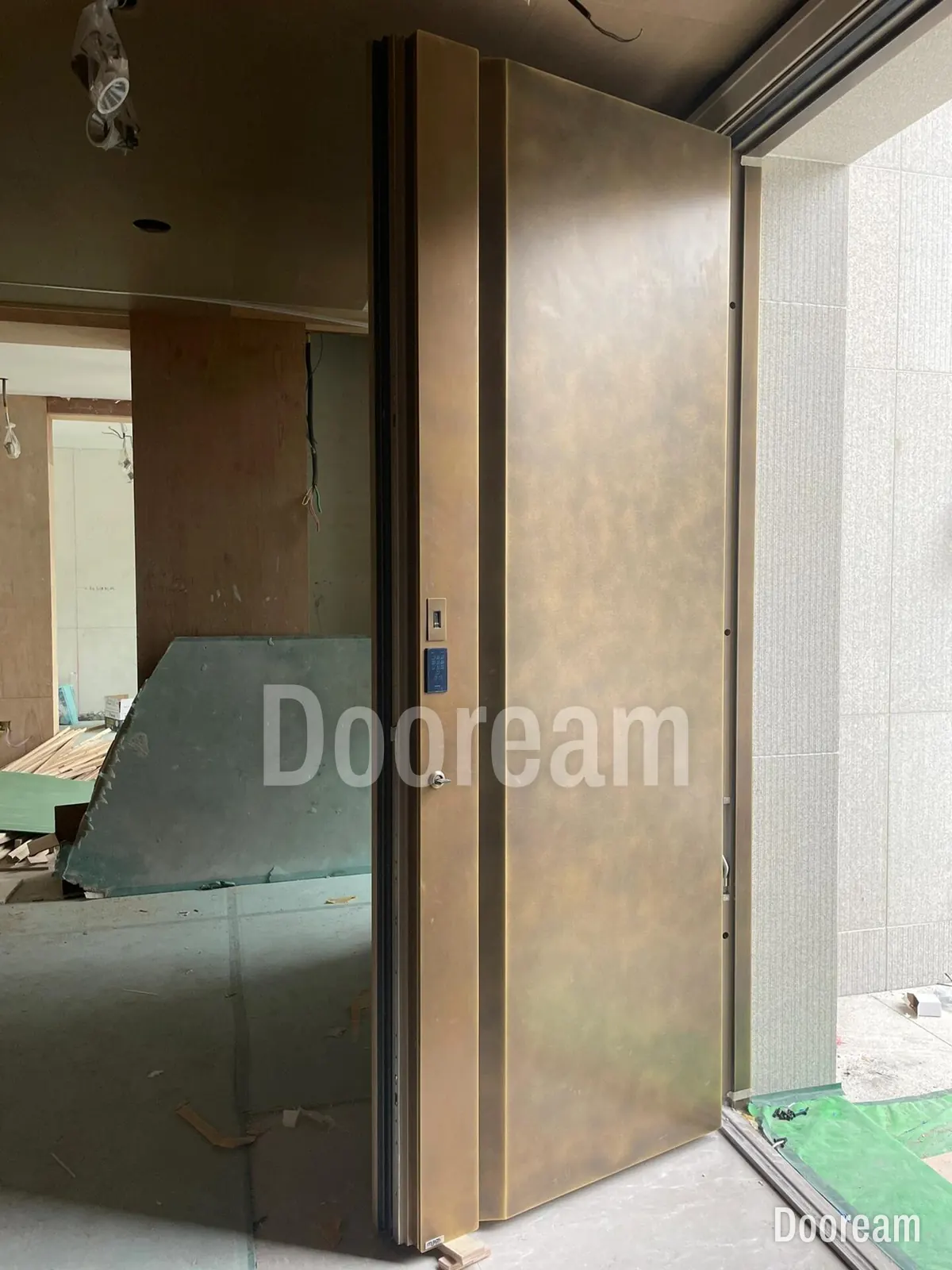
Short answer: a high-end entrance door needs a continuous seal on every edge: compression gaskets in the frame and leaf rebates, a meeting-edge seal on a double door, brush or fin seals where a pivot leaf sweeps past the frame, and a drop seal landing on a threshold. Exposed doors usually get two seal lines. Only a lab test proves the result: EN 12207 and EN 12208 classes in Europe, ASTM E283 and E331 in North America.
Where does an entrance door need seals?
On every edge, as one unbroken loop: head, both jambs, the meeting edge of a double door, and the bottom. The places to watch are where two seal types meet: at the corners, where the jamb seal meets the drop seal, and on a pivot door, where the seal changes sides at the pivot.
| Position | Usual seal | Usual material | Main job |
|---|---|---|---|
| Frame rebate, head and jambs | Compression gasket in a groove | EPDM, TPE/TPV, silicone | Air, water, sound |
| Leaf rebate | Second gasket, closing on the frame | EPDM, TPE/TPV, silicone | Second air line |
| Centre of the profile | Centre gasket | EPDM or TPE | Middle line in thermally broken systems |
| Meeting stiles, double doors | Rebate gasket or astragal; brush or fin on a plain edge | EPDM, silicone, pile | The centre joint |
| Pivot side of a pivot leaf | Brush or fin seal | Polypropylene pile, silicone or TPE fin | Contact while the leaf turns |
| Bottom of the leaf | Automatic drop seal | Silicone lip in an aluminium carrier | Air and sound |
| Threshold or sill | Sill for the drop seal, sometimes with an insert | Aluminium or stone | Sheds water; gives a seal face |
For pivot leaves, which sweep past the frame, see how pivot doors are sealed and double pivot doors.
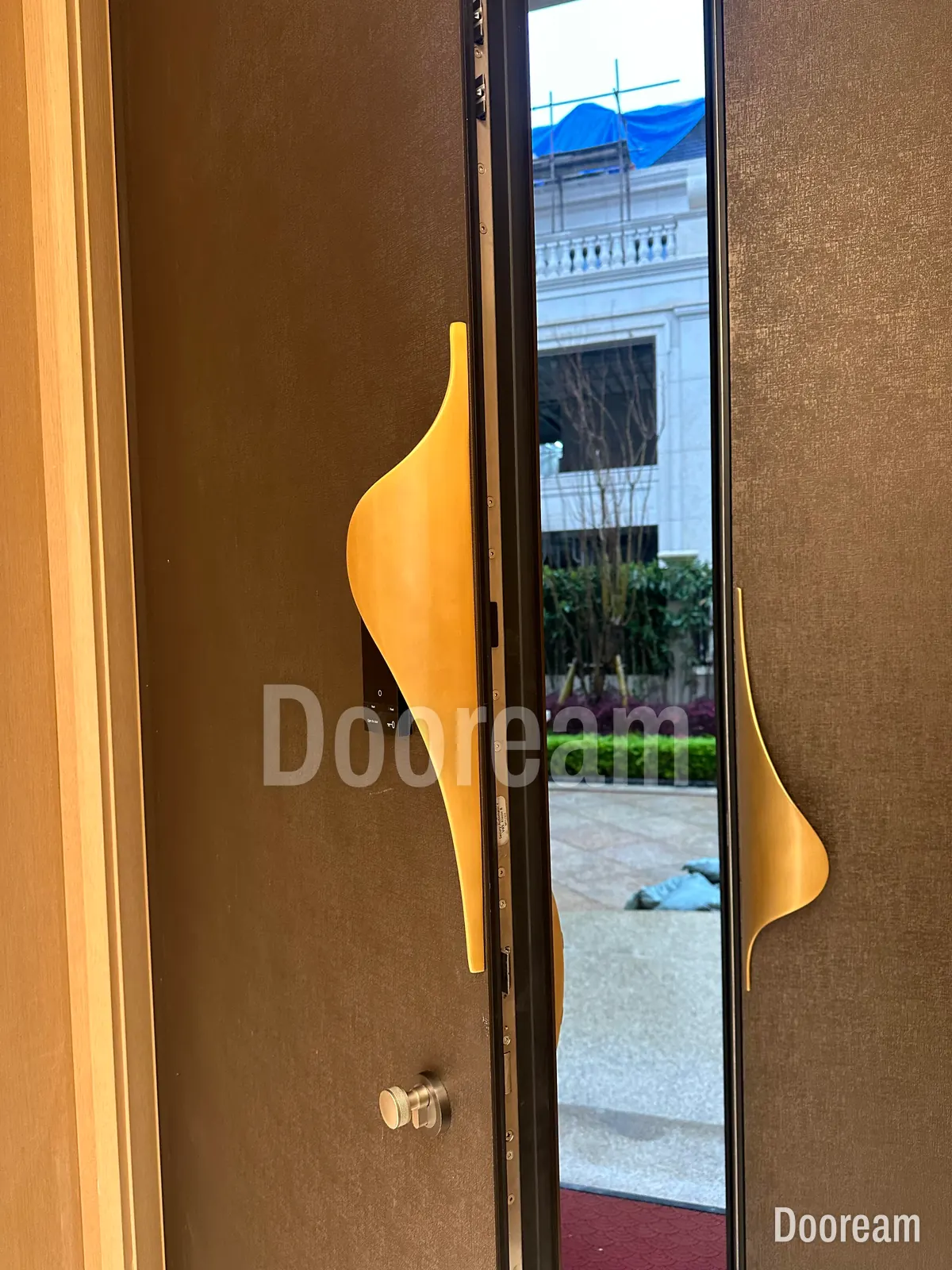
How many seal lines does a door need?
One continuous line can stop draughts on a sheltered door. Two lines, one in the frame rebate and one on the leaf, are usual on exposed entrances: the outer line sheds most of the water, the inner line is the air seal, and water that passes the first drains out between them. Thermally broken systems often add a centre gasket.
Schüco, for example, describes a continuous double centre gasket on its AD UP 90 door. Each extra line resists air and rain better but adds closing force.
Which seal materials are used, and how long do they last?
Four families cover most entrance doors: EPDM rubber, thermoplastic elastomers (TPE and TPV), silicone, and polypropylene brush pile. The name alone says little, so ask for each seal’s EN 12365-1 code, which grades its working range, compression force, temperature range and recovery after ageing.
- EPDM is vulcanised, so it does not flow. Trelleborg Sealing Solutions gives it good heat, ozone and ageing resistance from −45 to +150 °C.
- TPE and TPV are thermoplastic. Trelleborg says its TPV, a blend of EPDM and polypropylene, has very good compression set, thermal and UV stability.
- Silicone keeps its mechanical properties “more or less constant” from −60 to +200 °C, says Trelleborg. Schlegel specifies silicone for external entry doors where temperature resilience and resistance to deformation are critical.
- Brush pile is woven polypropylene, often silicone-treated, and seals “against moving elements and uneven surfaces”, in Schlegel’s words.
Reading the code. In Schlegel’s example, W 3 4 2 4 3 is a weatherstrip working over a 2–4 mm gap, needing 50–100 N/m to compress, rated −10 to +55 °C, recovering 60–70% when new and 50–60% after ageing.
Lifespan. Schlegel guarantees its extruded seals for 10 years. A flattened, cracked or shrunk seal no longer fills its gap.
How do compression and closing force decide whether a seal works?
A compression seal seals only inside its working range. Open the gap beyond it and air and dust pass; squeeze it harder and the door is stiff to close and the lock hard to throw. The gap all round the leaf must stay inside that range when installed, in winter and on a hot afternoon.
Seal force adds up. A 1,200 × 3,000 mm leaf has 8.4 m of perimeter, so one line of a class 4 seal (over 50 up to 100 N/m) pushes back with 420 to 840 N. A second line doubles it.
EN 12217 limits the force to close a door or start it moving to 75, 50, 25 and 10 N for classes 1 to 4, measured to EN 12046-2. Much of the seal force sits at the latch edge, so it is felt at the handle, one reason large doors use multipoint locks that hold the leaf against its seals at several points.
What do air and water tests measure?
Both put a whole door in a chamber and apply a pressure difference across it. Air tests measure how much air leaks through; water tests spray the outside and raise the pressure in steps until water gets in. The class applies only to the door as tested, with its size, seals and threshold.
Air: EN 1026 test, EN 12207 classes. Leakage at 100 Pa, roughly the pressure of a 46 km/h wind blowing straight at the door, is checked per square metre of door and per metre of opening joint:
| EN 12207 class | Per m² of door | Per m of opening joint | Maximum test pressure |
|---|---|---|---|
| 1 | 50 m³/h | 12.50 m³/h | 150 Pa |
| 2 | 27 m³/h | 6.75 m³/h | 300 Pa |
| 3 | 9 m³/h | 2.25 m³/h | 600 Pa |
| 4 | 3 m³/h | 0.75 m³/h | 600 Pa |
A door 1,200 × 3,000 mm overall (3.6 m²) may leak at most 10.8 m³/h at 100 Pa for class 4, about 97 m³/h for class 2.
Water: EN 1027 test, EN 12208 classes. Method A is for fully exposed doors, method B for partly sheltered ones. Class 1A is 15 minutes of spray at no pressure; each class adds 5 minutes at the next step: 2A 50 Pa, 3A 100, 4A 150, 5A 200, 6A 250, 7A 300, 8A 450, 9A 600 Pa. Method B stops at 7B. A door tight above 600 Pa is Exxx, xxx being the highest pressure held.
North America: ASTM E283, ASTM E331 and NAFS. E283 measures air leakage in a lab at a pressure the specifier chooses; E331 sprays the outdoor face under uniform static pressure. AAMA/WDMA/CSA 101/I.S.2/A440 (NAFS) sets pass levels: at most 1.5 L/s·m² of air at 75 Pa for its R, LC and CW classes, in window maker Isothermic’s summary, and water tested at 15% of design pressure (20% for AW), capped at 580 Pa in the US and 720 Pa in Canada, says FGIA.
What the tests leave out. E283 covers the assembly, not the installation; EN 1027 excludes the joint between frame and building. Neither covers sound, dust or heat loss. Sound is quoted per product: Planet lists its KT drop seal at 48 dB at a 7 mm gap but 44 dB at 14 mm. For dust and sand, a low air leakage class is the closest measure, and grit wears seals; for heat, UV and salt, see hot climates and coastal finishes.
How is the bottom of the door sealed?
With an automatic drop seal in the bottom of the leaf. It lowers onto the sill as the door closes and lifts as it opens, so it does not drag. On its own it is not a weather barrier: an exposed door also needs a threshold that sheds water, or drainage and a canopy.
- Pivot doors need a drop seal made for pivots. athmer’s Schall-Ex L-15/30 WS Pivot runs a roller on the jamb, travels up to 20 mm, lists up to 52 dB at a 7 mm gap and is tested to 150 Pa for air; athmer rates it for outside use only under cover.
- Hinged doors. Planet quotes EN 12208 class 7A (300 Pa) for its X3, made for entrance and balcony doors, which needs two sealing surfaces on the frame and a level floor.
For level and stepped sills, see pivot door thresholds.
How are seals maintained and replaced?
Clean them with mild detergent, never solvents, and check them yearly for tears, flattening and shrunk corners (maintenance). Replace a worn length with the same profile from the same maker; seals keyed into a groove are easier to change than glued ones. Water along a seal on a cold morning may be condensation, not a leak.
What should you ask the door maker?
- A section of every edge showing each seal line.
- Maker, profile number, material and EN 12365-1 code of each seal.
- Each seal’s working range against the designed gap.
- The closing force, and how the lock holds the leaf against the seals.
- How corners are made, and how the jamb seal meets the drop seal.
- The drop seal model and exterior rating; the threshold section.
- On double doors, the meeting-edge seal and which leaf closes first.
- Test reports to EN 12207/EN 12208 or ASTM E283/E331: lab, date, size and seals tested.
- Whether seals can be replaced on site, and where spares come from.
How does this work with Dooream?
We do not hold an air or watertightness classification for our doors. Check what your jurisdiction requires; if it needs a class or test result, tell us with your enquiry, and lab testing can be arranged, usually at the buyer’s cost. Each door is made to a drawing you approve, so ask for the seal details above on it. Your local installer seals the frame to the wall, working from our installation drawings with our remote guidance. See the architects page or contact us.
Sources, checked November 2026: Schlegel, EN 12365 seal classifications, aluminium window and door seals and Brush Fin-Seal FS; Trelleborg Sealing Solutions, materials and chemical compatibility; Trelleborg, material choice for sealing profiles; Schüco, AD UP 90 door system; EN 12207:2016 (sample); NC EN 12208:2005 (Cuban adoption of EN 12208:1999); STN EN 1027:2016 (preview); EN 12217:2015 (sample); ASTM, E283/E283M-19 and E331-00(2023); FGIA, performance class overview; Isothermic, NAFS testing overview; athmer, Schall-Ex L-15/30 WS Pivot spec sheet and drop seals catalogue; Planet, automatic door seals catalogue excerpts.
Quick answers
What seals does a high-end entrance door need?
A continuous loop on every edge. That means compression gaskets in the frame and leaf rebates at the head and jambs, a seal at the meeting edge of a double door, brush or fin seals where a pivot leaf sweeps past the frame, and an automatic drop seal landing on a threshold or sill at the bottom. Exposed doors usually get two seal lines rather than one.
Which is better for door seals, EPDM, TPE or silicone?
Each works when it is graded for the site. Trelleborg gives EPDM good heat, ozone and ageing resistance from −45 to +150 °C, and says silicone keeps its properties from −60 to +200 °C; Schlegel specifies silicone for external entry doors where temperature resilience matters. TPE and TPV are thermoplastic. Compare the seal's EN 12365-1 code, not just its material.
What do the EN 12207 and EN 12208 classes mean?
EN 12207 grades air leakage measured to EN 1026 in classes 1 to 4; class 4 allows at most 3 m³/h per m² of door at 100 Pa. EN 12208 grades watertightness measured to EN 1027, from 1A (15 minutes of spray, no pressure) to 9A (600 Pa) for exposed doors, 1B to 7B for partly sheltered ones, and Exxx above 600 Pa.