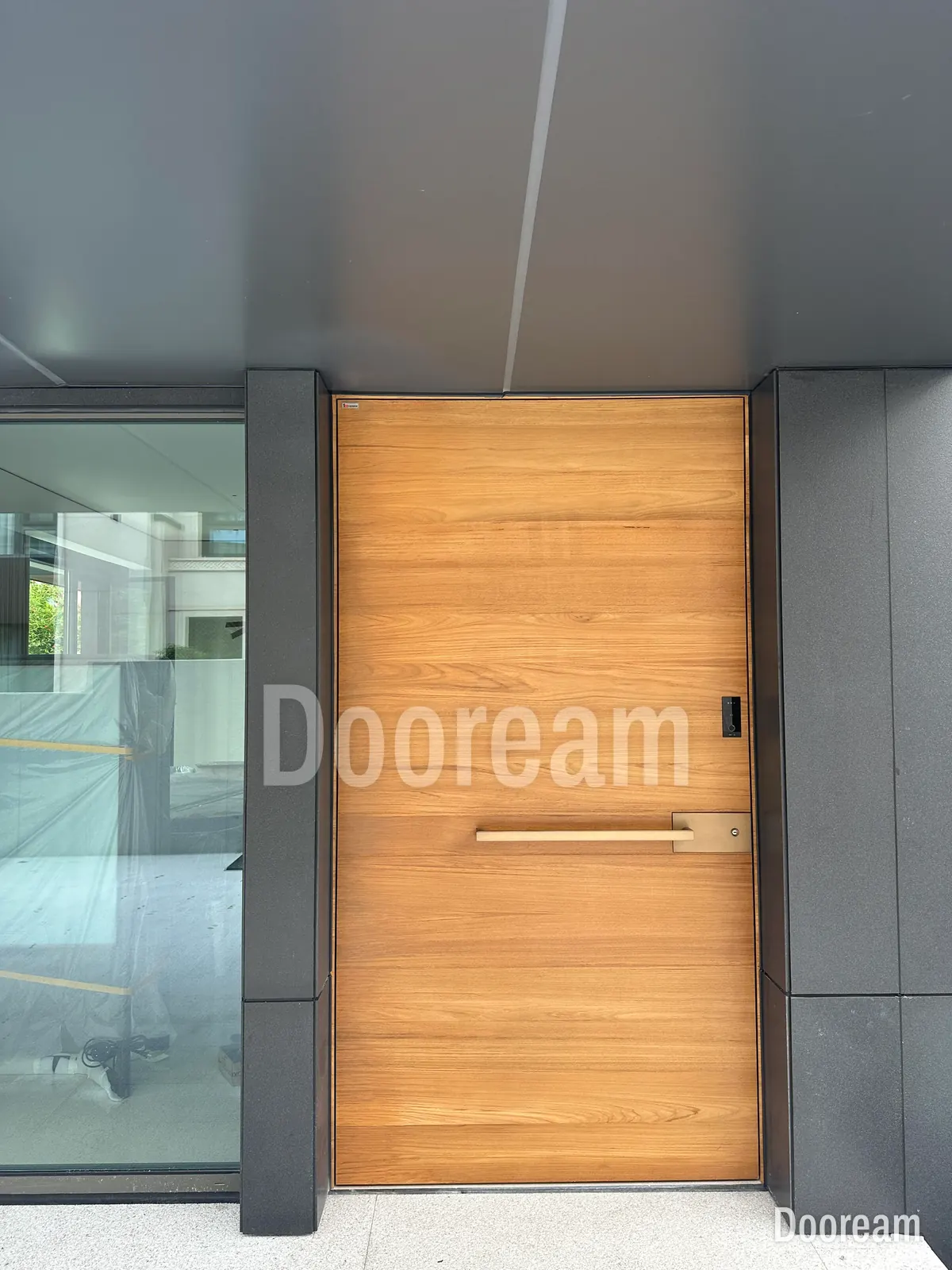
Short answer: water condenses on any surface colder than the dew point of the air touching it. In winter that is the inside of the door, at glass edges, metal frames, the threshold and the lock; in hot, humid climates it can be the outside, where muggy air meets glass or metal chilled by air-conditioning. Stop it with thermal breaks, an insulated core, warm-edge spacers, tight seals and humidity control.
What is the dew point, and why does it matter?
The dew point is the temperature at which air is saturated with the water vapour it carries; below it, the surplus condenses. A door gets wet wherever a surface is colder than the dew point of the air touching it. Room air at 21 °C and 60% relative humidity (RH) has a dew point of 12.9 °C.
Our figures use the Magnus formula with the coefficients M. G. Lawrence recommends (Bulletin of the American Meteorological Society, 2005): dew point = 243.04γ ÷ (17.625 − γ), where γ = ln(RH ÷ 100) + 17.625T ÷ (243.04 + T), T in °C.
| Air | RH | Dew point (our calculation) |
|---|---|---|
| Heated hall, 21 °C | 50% | 10.2 °C |
| Heated hall, 21 °C | 60% | 12.9 °C |
| Heated hall, 21 °C | 70% | 15.3 °C |
| Hot afternoon, 35 °C | 60% | 26.1 °C |
| Hot afternoon, 35 °C | 70% | 28.7 °C |
| Tropical pre-dawn, 25 °C | 90% | 23.2 °C |
| Tropical afternoon, 32 °C | 60% | 23.3 °C |
Tropical rows: Meteorological Service Singapore figures (RH above 90% before sunrise, around 60% on dry afternoons; nights usually no cooler than 23–25 °C, days no hotter than 31–33 °C).
Where on an entrance door does condensation form?
On the coldest surfaces: the glass, and the thermal bridges where heat finds an easy way through, at the glass edges, metal frames and leaf edges, the threshold and the lock. An insulated leaf face stays much warmer, so water rarely appears there first.
- Glass edges. Aluminium and galvanised steel spacers exceed 2.0 W/mK effective conductivity, foam ones 0.15–0.22, says a 2013 review of window spacers in Energy and Buildings, which notes that cold glass edges raise condensation risk. Expect a misted band, worst at the bottom.
- Metal frames and leaf edges. Aluminium running unbroken from outside to inside brings the cold to the room side; see thermal breaks.
- Threshold. It sits in the coldest air and must carry foot traffic, so it is often the weakest frame section; see door U-values.
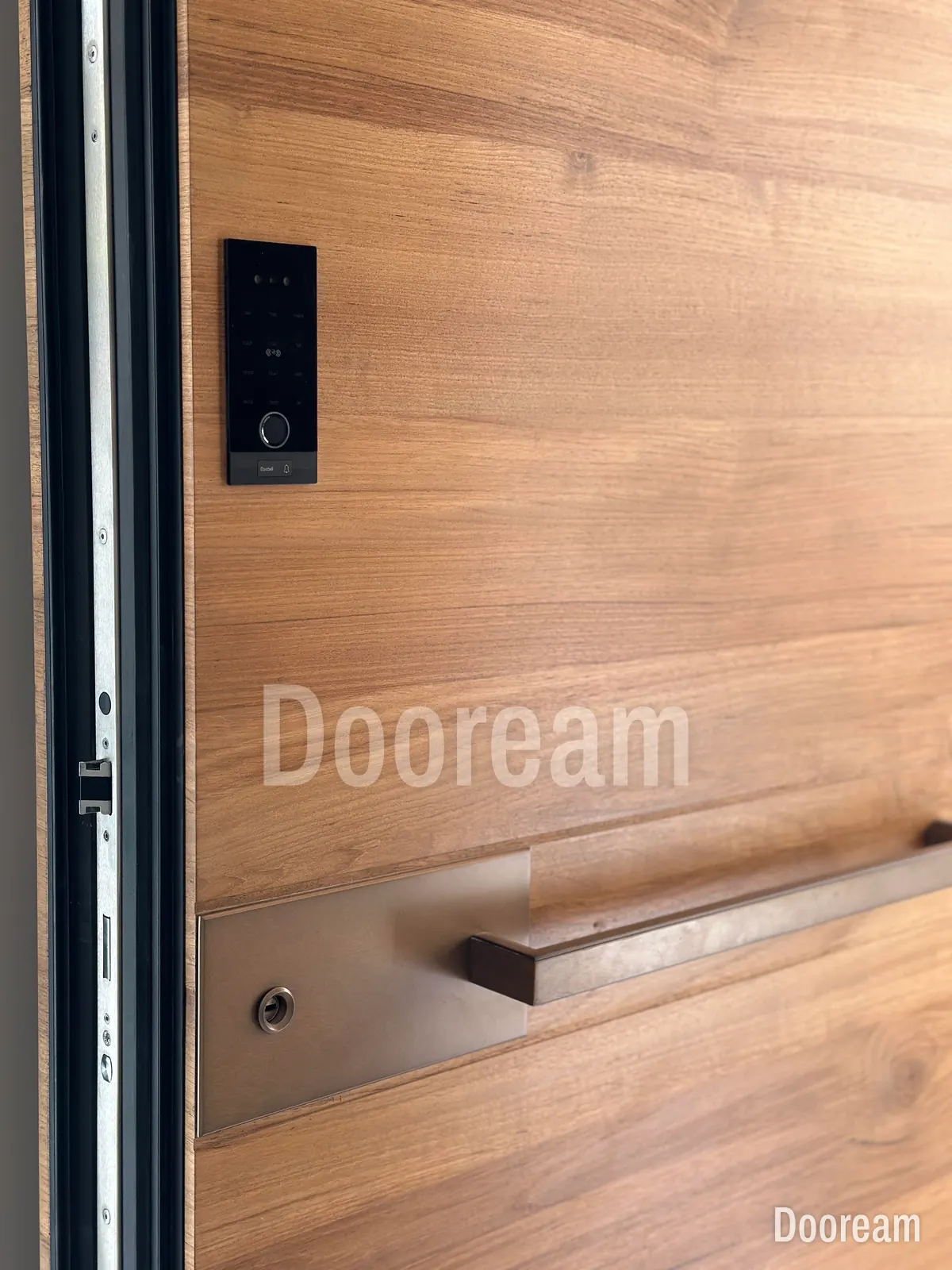
- Lock area. The lock case, keeps, cylinder and handle fixings cross the insulation.
Is it condensation or a leak?
Condensation follows temperature and humidity; a leak follows rain. Condensation comes on cold days, rain or not, as mist or droplets on the coldest surfaces, worst in the early morning. A leak comes with rain and wind, at one joint or corner, and runs from there.
- Wipe it dry and note when water returns: on cold, dry mornings, or only in driving rain.
- Check the wet surface with a contact thermometer: below the indoor dew point means condensation.
- A draught at the spot means air is leaking past the seals.
How do standards measure condensation risk?
With a temperature factor, fRsi, which places the coldest point of the inside surface on a scale from 0 (outdoor temperature) to 1 (indoor temperature): fRsi = (surface − outdoor) ÷ (indoor − outdoor). It does not depend on the weather, so one figure checks a detail at any outdoor temperature.
ISO 10211 (confirmed 2022) sets how to calculate a thermal bridge’s minimum surface temperature to assess condensation risk. ISO 13788 has design checks to avoid mould growth and to limit surface condensation on “low thermal inertia elements”, light parts that cool quickly, as glass and frames do.
- UK. A 2006 University College London study, citing BS 5250, takes fRsi 0.75 as enough to avoid mould growth in dwellings.
- Passive House Institute. Its hygiene criterion for cool, temperate climates is fRsi ≥ 0.70; one certificate for a timber door lists 0.70 at the threshold but 0.64 at the lock side, noted as below it.
- North America. NFRC’s Condensation Index (ANSI/NFRC 500-2020) rates the coldest point from 1 to 100, higher being better, at −18 °C outside and 21 °C inside; AAMA 1503 gives a Condensation Resistance Factor from a hot-box test.
| fRsi | Surface, −5 °C outside | Dry up to | Surface, −15 °C outside | Dry up to |
|---|---|---|---|---|
| 0.64 | 11.0 °C | 56% RH | 7.4 °C | 44% RH |
| 0.70 | 12.5 °C | 62% RH | 9.5 °C | 51% RH |
| 0.75 | 13.8 °C | 67% RH | 11.3 °C | 57% RH |
| 0.80 | 15.0 °C | 73% RH | 13.0 °C | 64% RH |
Our calculation, for a 20 °C hall: at −5 °C, the 0.64 lock edge is dry at 50% RH but wet at 60% (dew point 12.0 °C); 0.70 just stays dry.
Why does a door sweat outside in hot, humid climates?
Because air-conditioning makes the inside the cold side. Glass, and metal without a thermal break, carry that cold to the outer face, and below the outdoor dew point the humid air condenses on it. At 35 °C and 70% RH that is 28.7 °C, only 6.3 K below the air.
A 1989 King Fahd University of Petroleum and Minerals study calls it a problem on windows of air-conditioned buildings in hot, humid climates. Three things decide it:
- Indoor temperature. The outer face sits between indoor and outdoor temperature, unless it radiates to a clear night sky. So a hall warmer than the outdoor dew point cannot wet the outside, unless a cooling outlet blows at the door: at a 23 °C dew point, 24 °C indoors is safe, 20 °C is not. At a 28.7 °C dew point, above any comfortable hall, the door decides.
- The door. Single glass and unbroken metal pull the outer face towards indoor temperature; insulated glass and a thermal break keep it near outdoor temperature.
- Sun and wind. Both keep the face near or above the air temperature, so outside condensation shows most at night, at dawn and in still, shaded porches.
Humid air leaking in past the seals can also condense unseen on metal cooled from inside, so keep the outer seal line continuous. For sun and glass, see entrance doors for hot climates.
In cool climates, well-insulated glass can also mist outside on clear nights, as the outer pane radiates heat to the sky. A 2018 Tampere University study found energy-efficient windows more at risk; external shading and outer-surface emissivity strongly affect how often.

What stops condensation on an entrance door?
Two levers: warm the coldest surface, or lower the dew point; the door, the building and its occupants all pull them. The US Environmental Protection Agency advises indoor RH below 60%, ideally 30–50%, ventilating when outdoor air is cold and dry and dehumidifying when it is warm and humid.
| Cause | Symptom | Fix |
|---|---|---|
| Moist indoor air | Mist on all cold surfaces | Extract fans, ventilation, RH below 60% |
| Cold, closed-off hall | Door and walls wet on cold mornings | Heat the hall; keep radiators clear |
| Metal glass spacer | Wet band at the glass edge | Warm-edge spacer |
| No thermal break | Water or ice on frame, leaf edges or threshold | Polyamide thermal breaks; insulated core |
| Lock case and keeps | Wet spots at the lock | Insulation round the lock case |
| Air leaking past the leaf | Frost along the seal; a draught | Continuous seals, drop seal, keeps adjusted |
| Air-conditioning in humid heat | Outside wet at night or dawn | Thermal break, insulated glass, higher set point, outlets aimed elsewhere |
| Bare frame-to-wall joint | Damp reveal | Insulated, air-sealed joint |
What should you specify in a condensation-prone place?
Design conditions, then figures for the door’s coldest points, not just its U-value: a U-value averages the whole door, but condensation starts at the worst detail. Get each item in writing, for your door’s size, configuration and real indoor conditions.
- Design conditions: winter indoor temperature, RH and outdoor design temperature; in humid climates, the cooling set point and outdoor dew point.
- Coldest points: fRsi at lock, threshold, corners and glass edge (ISO 10211), or NFRC or AAMA 1503 ratings.
- U-value report for the whole door at a matching size.
- Thermal breaks in frame, leaf edges and threshold.
- Glass: insulated, low-e, warm-edge spacers.
- Seals all round plus a drop seal; see pivot door sealing.
- Lock zone: how the lock case sits in the insulation.
- Installation: joint insulated and air-sealed; rebates and sill drained outwards.
- Hall and tests: heating, cooling outlets, ventilation, dehumidification; tests needed, and who pays.
How does this work with Dooream?
Our thermal-break construction, with PA66 polyamide insulating strips in the aluminium profiles, reaches a U-value of 1.0 W/m²K in our test report, and any of our designs can be built with it. It is a construction option, not on every door, so specify it for a cold site or a humid, air-conditioned one; ask us for a copy of the report through our contact page. If a project needs a condensation test, lab testing can be arranged, usually at the buyer’s cost. Your local installer fits the door from our installation drawings, with our remote guidance.
Sources, checked November 2026: M. G. Lawrence, the relationship between relative humidity and the dewpoint temperature in moist air (Bulletin of the American Meteorological Society, 2005); Meteorological Service Singapore, climate of Singapore; Van Den Bergh, Hart, Jelle and Gustavsen, Lawrence Berkeley National Laboratory, window spacers and edge seals in insulating glass units (Energy and Buildings, 2013); ISO, ISO 10211:2017; ISO 13788:2012 (preview); Mumovic, Ridley, Oreszczyn and Davies, University College London, condensation risk: comparison of steady-state and transient methods (Building Services Engineering Research and Technology, 2006); Passive House Institute, certificate for a timber door system (component 1483ds03); NFRC, Condensation Index; Intertek, AAMA 1503; El Diasty and Budaiwi, King Fahd University of Petroleum and Minerals, external condensation on windows (Construction and Building Materials, 1989); Laukkarinen, Kero and Vinha, Tampere University, condensation at the exterior surface of windows (Journal of Building Engineering, 2018); US Environmental Protection Agency, mould remediation guide for schools and commercial buildings, chapter 2.
Quick answers
Why does my front door get condensation on the inside?
Because part of it is colder than the dew point of the room air. Air at 21 °C and 60% relative humidity has a dew point of 12.9 °C, so any surface below that gets wet. On an entrance door the coldest surfaces are usually the glass edges, metal frames and leaf edges without a thermal break, the threshold and the lock area.
Why is my front door wet on the outside?
In a hot, humid climate the air-conditioning makes the inside of the door the cold side, and glass or metal without a thermal break carries that cold to the outer face. Outdoor air at 35 °C and 70% relative humidity has a dew point of 28.7 °C, so an outer surface only 6.3 K below the air gets wet. It shows most at night, early in the morning and in still, shaded porches.
How do you stop condensation on an entrance door?
Keep the door's coldest surface warmer than the dew point, and keep the dew point down. On the door that means thermal breaks in the frame, leaf edges and threshold, an insulated core, insulated glass with warm-edge spacers and continuous seals. In the building it means ventilation, heating the hall in winter, dehumidifying in humid weather and keeping indoor relative humidity below 60%, as the US Environmental Protection Agency advises.