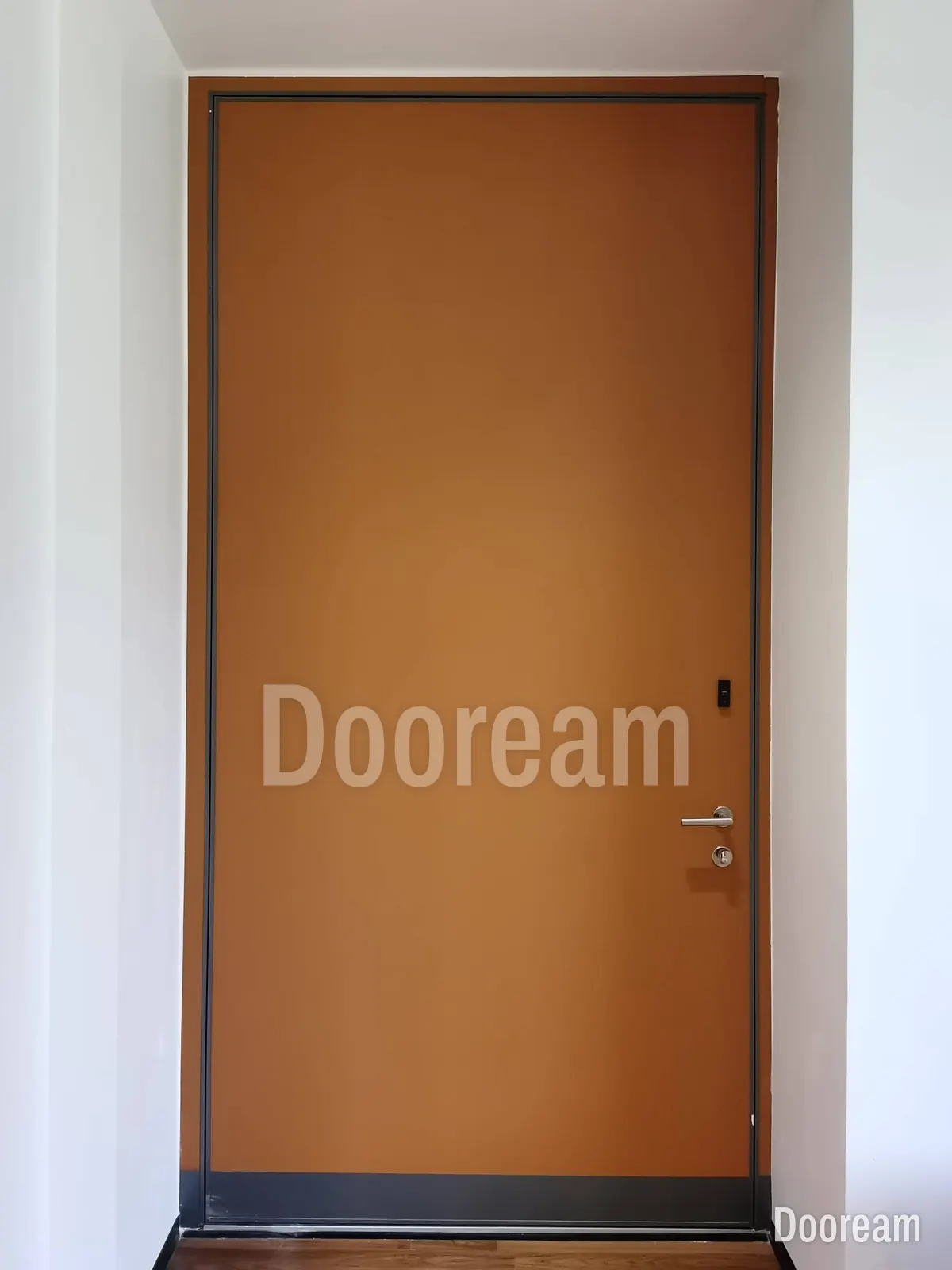
Short answer: a door blocks only as much noise as its weakest path, usually a gap, a seal, a glass panel or the frame joint rather than the leaf. Sound reduction is rated as Rw (ISO 717-1) in most of the world and as STC or OITC (ASTM) in North America. Near a road or an airport, ask for Rw + Ctr or OITC, which give weight to low-frequency traffic noise. Every 10 dB less sounds about half as loud. “Soundproof” is not a rating.
What do Rw, STC and OITC mean?
Each is one number, in decibels, for how much sound a whole door stops in a lab test; higher is quieter. The lab measures the loss in one-third-octave bands and fits a standard reference curve to the results. The three ratings differ in the frequencies they cover and the noise they suit.
| Rating | Rating standard | Lab test | Frequencies | Suits |
|---|---|---|---|---|
| Rw (C; Ctr) | ISO 717-1 | ISO 10140-2 | 100–3,150 Hz | General; Ctr adjusts for urban traffic |
| STC | ASTM E413 | ASTM E90 | 125–4,000 Hz | Speech and indoor noise |
| OITC | ASTM E1332 | ASTM E90 data | 80–4,000 Hz | Road, rail and aircraft noise outdoors |
Rw is often written with its two spectrum terms. Saint-Gobain lists an insulating glass unit of 4 mm glass, a 16 mm cavity and 6 mm glass as Rw 34 (−1; −4): C is −1 and Ctr is −4, so against urban traffic it gives Rw + Ctr = 30 dB. OITC exists because transport noise, in ASTM’s words, “contains strong low-frequency sound”.
What do the numbers mean in practice?
A 10 dB drop sounds about half as loud, say the US Federal Highway Administration and CSIRO. A 3 dB change is barely perceptible and 5 dB is readily perceptible. So a door rated 42 is clearly quieter than one rated 32, while 32 against 34 is hard to hear.
Targets are set for rooms, not doors. The UK’s BS 8233:2014 suggests 35 dB LAeq,16h by day in living rooms and bedrooms, and 30 dB LAeq,8h in bedrooms at night. In the US, FAA guidance treats a home near an airport as affected when the indoor level is DNL 45 dB or more and, where federal money is used, designs treatments for at least 5 dB of noise level reduction.
An entrance door usually opens into a hall, not a bedroom. In CSIRO’s words, “the path with the least attenuation” decides the result. So aim to match the windows on the same facade: a door far better than them is wasted, and one much worse becomes the weak path.
Why is the door leaf rarely the weak point?
Because sound goes round it. “Even small openings can compromise the acoustic performance of an otherwise effective sound insulator,” says CSIRO. Canada’s National Research Council found that cracks “may drastically reduce” noise reduction, and that even a well-weatherstripped opening window typically rates 3 to 5 STC points below the same window fixed shut.
Check these paths, roughly in order of how often they leak:
- The bottom of the leaf. An automatic drop seal lowers onto the floor as the door closes. ASSA ABLOY rates its Planet KT at up to 48 dB with a 7 mm floor gap “with optimal sealing”: the seal’s figure, not a door’s. The Construction Specifier advises closing sound-rated door bottoms onto a solid, flat threshold such as marble or aluminium; see threshold design.
- Head and jambs. One continuous gasket, unbroken at the corners, and two lines on an exposed door. See entrance door seals and, for the pivot side, how pivot doors are sealed.
- The frame-to-wall joint. Filled right through and sealed on both faces. Arbonia, a German door maker, says a door reaches its declared value only with correct adjustment of “the floor seal, hinges and connection joints”.
- Glass panels. Usually lighter than the leaf; see below.
- Letter plates and pet flaps. FAA sound insulation surveys record “mail slots” and “pet doors” as openings. Use a post box outside.
- Seal contact. A seal that is not pressed shut leaks sound as it leaks air. Multipoint locks hold a tall leaf on its seals at several points.
Does a heavier door block more noise?
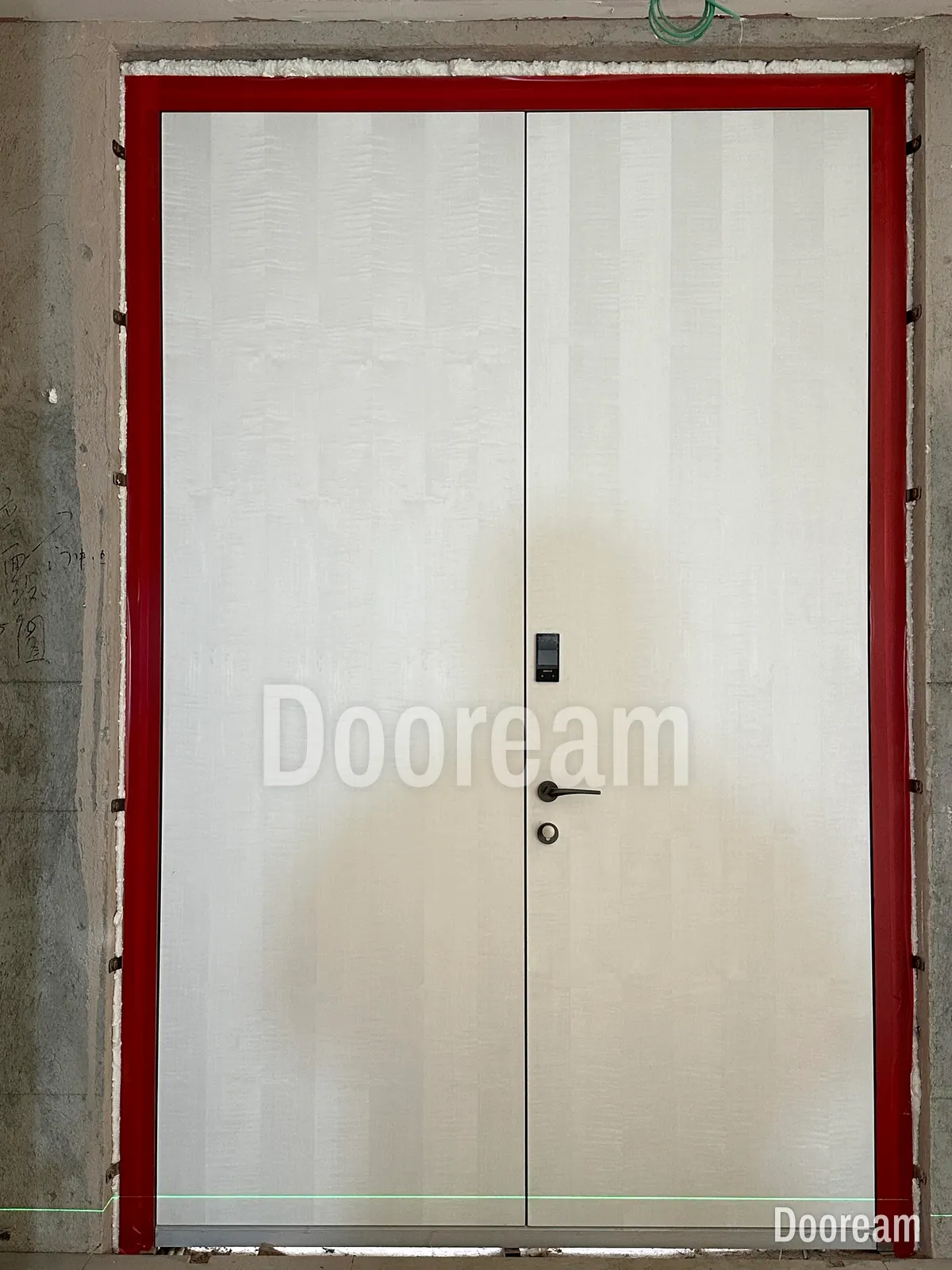
Yes, but with diminishing returns. In Saint-Gobain’s data, 4 mm float glass rates Rw 30 and 8 mm glass Rw 33: double the weight, about 3 dB more. Stiffness works against mass. Every panel has a coincidence frequency where sound passes easily; for glass it is about 12,500 divided by the thickness in millimetres, around 2,100 Hz for 6 mm.
Composite leaves are harder to predict. Researchers at the German Aerospace Center note that honeycomb sandwich panels combine low mass with high stiffness, which tends to increase sound transmission. In a door the steel sheets and faces add mass, so the result depends on the whole build and must be tested. FAA guidance improves a door with more mass or a second door.
Which glass makes a glazed door quieter?
Laminated glass with an acoustic interlayer, and unequal panes in an insulating unit. Saint-Gobain lists a 6 mm float pane at Rw 32, a 6.8 mm laminated pane at 33 and a 6.8 mm acoustic laminated pane at 35. Its insulating units with an acoustic laminated pane and a 6 mm float pane reach Rw 38 to 39.
Unequal thicknesses keep the coincidence dips of the two panes apart. Cavity width matters less: Saint-Gobain’s 4 mm and 6 mm unit stays at Rw 34 to 35 from a 6 mm to a 24 mm cavity. The National Research Council warns that a light metal frame can limit a good window. See glass in entrance doors and insulated glass in entrance doors.
Why does a door perform worse on site than in the lab?
Because the lab removes the other paths. ISO 10140-2 labs are built to block flanking sound, and the standard says results do not predict field performance unless flanking and site conditions are allowed for. On site, sound also travels through walls, floors and the frame joint.
Arbonia puts the usual gap between lab and installed values at 4 to 5 dB. Westag’s door guidance, following German practice, sets the site value Rw,R at the lab value Rw,P minus 5 dB.
What should you specify for each setting?
Start from the room target and the windows, then choose the door. The targets below are starting points to agree with your acoustician, not limits; of these, only DIN 4109 sets a number for the door itself. Where a rating is needed, the door maker must show it in a lab report for the same build.
| Setting | Typical target | What to specify |
|---|---|---|
| Apartment door to a shared corridor | DIN 4109: 27 dB on site into a hall, 37 dB straight into a living area (lab 32 and 42) | Lab report to ISO 10140-2; drop seal; sealed frame joint; no letter plate |
| Villa on a quiet street | Usually none | Continuous seals; drop seal on a flat threshold; sealed frame joint |
| Villa or apartment on a busy road | Match the windows’ Rw + Ctr or OITC | Two seal lines; acoustic laminated, unequal-pane glass; a lobby or inner door |
| Under a flight path | Set by the acoustician; FAA programmes use DNL 45 dB indoors as the threshold | OITC or Rw + Ctr from a lab report; a second door or vestibule |
| Seafront | No standard target; measure surf and wind at night | Seals that stay pressed in gusts; drop seal; laminated glass; see pivot doors and wind |
How do you specify and install a quieter door?
Use this list on the drawings, and again on site:
- Agree the metric, Rw (C; Ctr), STC or OITC, and whether it is a lab or site value.
- Ask for the lab report: lab, standard, date, door size, glass, seals and threshold as tested. The rating covers only that build.
- Match the door glass to the windows on the same facade.
- Check that seals run unbroken round every corner, with two lines on exposed doors.
- Specify the drop seal model, the floor gap it needs and a flat, hard threshold.
- Detail the frame-to-wall joint: filled through, sealed on both faces.
- Leave out letter plates and pet flaps.
- Use a multipoint lock to hold the leaf on its seals.
- Where noise is severe, plan a lobby or inner door.
- After installation, adjust the drop seal, look for daylight round the closed leaf from a dark hall, and test on site if the contract needs it.
How does this work with Dooream?
Our leaves are layered, from the outside in: face panel, galvanised steel sheet, aluminium profile frame with an aluminium honeycomb core, galvanised steel sheet, inner face. Our thermal-break construction, with PA66 polyamide insulating strips in the aluminium profiles, reaches a U-value of 1.0 W/m²K in our test report, and any of our designs can be built with it. We do not have an acoustic test report, so we quote no Rw, STC or OITC figure for our doors. If a project needs one, testing can be arranged, usually at the buyer’s cost. Send your acoustician’s requirements with the opening, and have them check the seals, threshold and glass on the drawing before you approve it. Your local installers fit the door from our installation drawings, with our remote guidance. Send the opening through our architects page or contact page.
Sources, checked November 2026: ISO, ISO 717-1:1996 (sample); Standards Council of Canada, ISO 10140-2:2021 scope; ASTM, E1332-22 (OITC); The Construction Specifier (Katie Daniel), effective sound control of doors; Montana State University, determination of STC (ASTM E90 and E413); Saint-Gobain Glass, acoustics glossary, sound reduction of glazing and factors influencing glazing performance; US Federal Highway Administration, highway traffic noise guidance; CSIRO, noise in buildings; Bracknell Forest Council, noise criteria (BS 8233:2014); FAA, AC 150/5000-9B, residential sound insulation; J.D. Quirt, National Research Council Canada, CBD-240, sound transmission through windows; ASSA ABLOY, Planet KT drop seal; Arbonia, sound insulation requirements for doors; Westag, Schallschutz; Radestock, Haase and Monner, German Aerospace Center, transmission loss of honeycomb sandwich panels.
Quick answers
What is a good sound rating for a front door?
There is no single number. Germany's DIN 4109 asks for 27 dB on site for an apartment entrance door that opens into a hall, and 37 dB where it opens straight into a living area; the lab value must be about 5 dB higher. Near a busy road or a flight path, ask for Rw + Ctr or OITC, and aim to match the windows on the same facade.
What is the difference between Rw, STC and OITC?
All three are single numbers worked out from a lab test. Rw is rated to ISO 717-1 over 100 to 3,150 Hz, from tests to ISO 10140-2, and its Ctr term adjusts it for traffic noise. STC is rated to ASTM E413 over 125 to 4,000 Hz, from ASTM E90 tests. OITC, to ASTM E1332, covers 80 to 4,000 Hz and is built for road, rail and aircraft noise.
What actually makes a front door quieter?
Closing the gaps first. That means a continuous seal at the head and jambs, an automatic drop seal closing onto a flat threshold, a filled and sealed joint between frame and wall, and no letter plate. If the door has glass, use laminated acoustic glass and unequal pane thicknesses. Extra weight helps less than people expect.