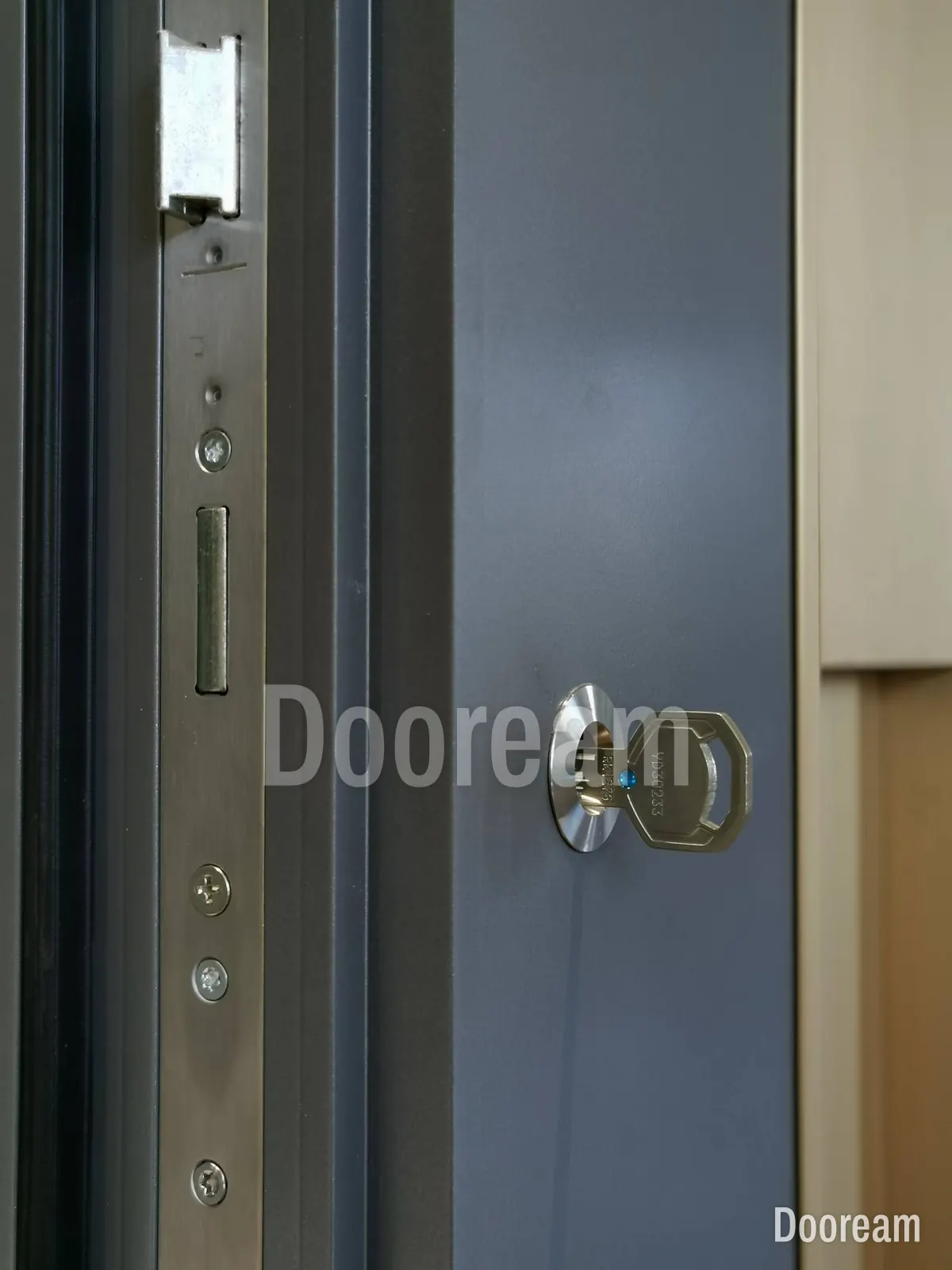
Short answer: an armoured front door has steel built into the leaf, a lock that bolts at several points, protection on the hinge side and a strong frame fixed into the wall. No standard we know of defines the word, so “armoured” tells you how a door is built, not how well it resists attack. Only a test of the complete door shows that.
What does “armoured” mean on a front door?
No standard or law we know of defines “armoured”. In the trade it means a build: steel in the leaf, a multipoint lock, fixed bolts on the hinge side and a steel frame anchored into the wall, usually with decorative panels on both faces. Standards such as EN 1627 classify tested doors; they do not define the word.
A typical example is the Italian porta blindata (“reinforced door” in Larousse’s translation). One Italian maker describes a model tested to EN 1627 class 3 like this:
| Part | One Italian class 3 armoured door |
|---|---|
| Leaf structure | 1.5 mm galvanised steel sheet, folded and stiffened with two steel omega profiles; a 3 mm plate behind the lock |
| Lock | Four central bolts projecting 40 mm, plus a latch; one double bolt near the top and one near the bottom, each projecting 30 mm |
| Cylinder | European profile cylinder behind an anti-drill protector |
| Hinge side | Three concealed hinges, adjustable in three directions, and five fixed bolts against lifting |
| Frame | 2 mm steel frame on a 1.8 mm galvanised steel sub-frame, fixed into the wall with eight metal anchors |
| Faces | Veneered panels, 6 mm outside and 18 mm inside |
| Leaf weight | 70 kg |
Its class 3 comes from a test of the whole door, not from the list of parts.
What is inside an armoured door leaf?
Steel that makes it hard to break through the leaf, something that keeps the leaf stiff, and the faces you see. The Italian door above uses folded steel sheet with steel stiffeners. Ours is a layered sandwich, built from the outside in:
- Front panel. The face you see. Most of our faces are carved aluminium; we also make cast aluminium, sintered stone, glass, wood and copper.
- Galvanised steel sheet. The zinc coating keeps moisture off the steel; where the coating is damaged, the zinc corrodes first and protects the steel next to it.
- Aluminium profile frame with an aluminium honeycomb core. Honeycomb is used as a sandwich core because it adds stiffness and strength for little weight.
- A second galvanised steel sheet. Steel on the inner side of the core too.
- Inner panel. The face on the inside of the house.
Steel makes the leaf heavy, so ask for the weight of the whole leaf before the hinge or pivot is chosen; see pivot door size and weight.
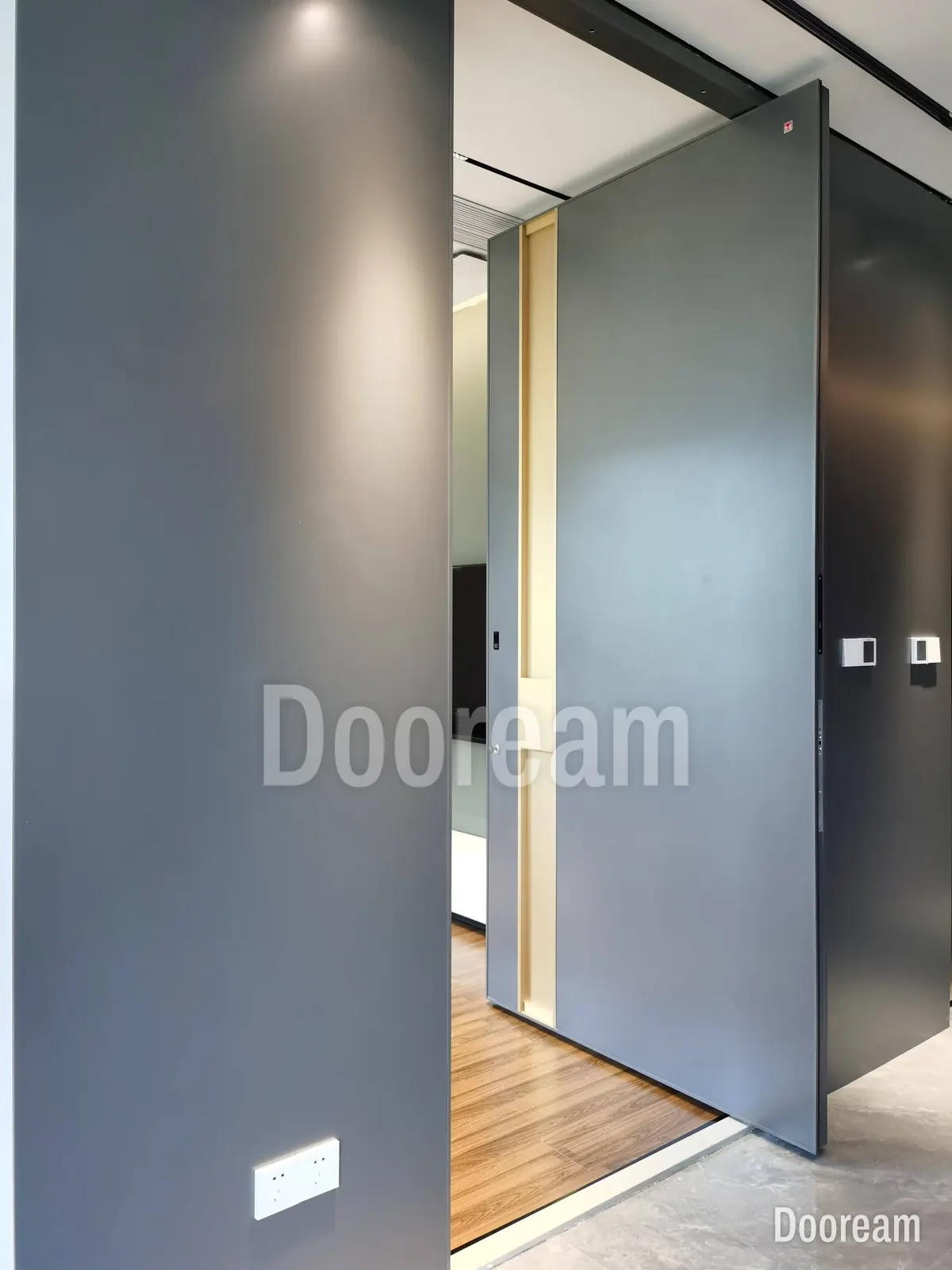
Which parts decide how well a door resists attack?
The steel in the leaf is only part of the answer. An attacker does not need to break through a good leaf if the cylinder, the hinge side or the frame gives way first. Check these five parts, and the rule that ties them together:
- The lock and its locking points. Count the bolts and see where they engage: along the lock edge and, on a tall leaf, near the top and bottom too. Ask how far each projects into the frame: 40 mm for the central bolts of the Italian door above, against a minimum of 1 in (25 mm) for a deadbolt in US police guidance.
- The cylinder. A euro cylinder can be snapped in two or drilled. Ask for snap and drill protection, and a cylinder that does not stick out of the door or handle. UK police advise a cylinder rated TS 007 3-star or Sold Secure SS312 Diamond, and German police recommend a protective handle set over a simple rosette.
- The hinge side and anti-lift protection. If the hinge pins can be removed or the hinges forced, a door locked on one edge can be levered out on the other. Fixed bolts on the hinge edge are there to stop this when the door is closed; the Italian door has five. For exposed hinges on outward-opening doors, US police advise non-removable pins or a locking pin. On our pivot doors the FritsJurgens hinge is built into the leaf, with only small plates at the floor and ceiling; still ask how the pivot side is held when the door is closed.
- The frame and its fixing into the wall. When a leaf is forced, the frame and its fixings take the load; the Italian door’s steel sub-frame has eight metal wall anchors. EN 1627 sets a minimum wall thickness and strength that rises with the class, and German police advise that a tested door reaches its class only if it is installed to the maker’s instructions, with an installation certificate. In timber-framed houses, US police advise fixing the strike plate with four to six 3 in (76 mm) screws into the structural framing.
- Glass. A pane in or beside the door can be broken to reach the handle or thumb-turn inside; US police guidance flags glass within 40 in (about 1 m) of a lock. Glazed doors tested to EN 1627 need security glass of a minimum EN 356 class that rises with the resistance class, for example P5A for RC3 and P6B for RC4, except in the N classes.
- The weakest link. A door is only as strong as its weakest part, and that is where an attacker goes. A steel leaf with an unprotected cylinder, or a good lock in a frame held by a few screws, is a weak door.
How does an armoured door compare with steel, wood and aluminium doors?
Judge security by the test report, not the type. The labels overlap: some aluminium door systems have been certified to EN 1627 classes such as RC 2, and some doors sold as armoured, ours included, have no EN 1627 rating. Otherwise, the types usually differ like this:
| Armoured door | Steel security door | Solid wood door | Standard aluminium door | |
|---|---|---|---|---|
| Typical build | Steel inside, decorative panels on both faces | Steel sheet leaf and frame | Solid or engineered timber | Aluminium profiles with a panel or glass |
| Security | Built to resist forcing; how well depends on the tested door | Depends on the sheet, lock, hinges and frame | Depends on thickness, lock and frame; US police ask for solid-core exterior doors at least 44 mm (1¾ in) thick | Depends on the system; some are certified, for example to RC 2 |
| Weight | Heavy, from the steel | Heavy | Heavy if solid; varies with species and thickness | Light |
| Insulation | Depends on the core, seals and frame; steel conducts heat | Steel conducts heat, so it needs an insulated core | Timber itself insulates well | Conducts heat even faster than steel; profiles and panel must be insulated |
| Design freedom | High: the faces are panels, chosen separately from the steel | The steel is the face: pressed patterns, paint or printed finishes | High: carving, mouldings, many species; very large leaves move more | Medium: flat or grooved panels and glass |
| Maintenance | Depends on the faces; steel inside should be galvanised or coated | Keep the coating intact, or it rusts | Swells and shrinks with moisture; the finish needs care | Low: wash it; the coating carries the colour |
For scale: aluminium is about a third as dense as steel (about 2.7 against 7.86 g/cm³), so a 1 mm sheet weighs about 2.7 kg per m² in aluminium and 7.9 kg in steel. Structural softwood conducts heat at about 0.10–0.14 W/m·K, steel at about 45 and aluminium at about 216.
How can you check a security claim?
Ask for the test report. Only a test of the complete door, with its frame, lock, hinges, glass and fixing, shows how well it resists attack: in Europe EN 1627, with classes from RC1 N to RC6, and in North America ASTM F476, graded from 10 to 40.
Check that the report covers the model, size, glass and lock you are buying. “Armoured”, “steel-reinforced” and “anti-theft” are descriptions, and a rated lock or cylinder is a good part, not a rated door. What each class tests is in door security ratings explained.
Do smart locks make an armoured door more secure?
Not on their own. A smart lock changes how the door is opened, by fingerprint, face, PIN, card or app. The bolts still hold the door shut, so judge them as in point 1 above, and check the backup: a mechanical key, or a way to power the lock from outside if its battery runs flat.
On a pivot door, also plan how a wired lock gets power into the leaf. See smart locks on large and pivot doors.
How does Dooream build its armoured doors?
Every leaf has the five layers listed above, with galvanised steel on both sides of the core. We fit KFV, G-U and Wintech smart locks; see our locks page. We do not hold an EN 1627 rating, so we quote no resistance class or time; if your project needs one, we can arrange a lab test, usually at the buyer’s cost. Your local installers fit the door from our installation drawings, with remote guidance from us. Our thermal-break doors have PA66 polyamide insulating strips in the aluminium profiles; this construction reaches a U-value of 1.0 W/m²K in our test report, and any of our designs can be built with it. Send the opening and your security brief through our architects page or contact page.
Sources, checked November 2026: Larousse, Italian–English dictionary, "blindato"; Scrigno, technical file for armoured doors (PRAHA model); Galvanizers Association, barrier and sacrificial protection; Hexcel, HexWeb honeycomb; Oxnard Police Department and California Attorney General's Crime and Violence Prevention Center, home security hardware; East Cambridgeshire District Council, lock snapping; West Yorkshire Police, euro-cylinder advice; German police crime prevention (KPK), Türen und Tore; FritsJurgens, invisible hinges; BauLinks (Teckentrup), Resistance Class (RC) replaces Widerstandsklasse (WK); Vetrotech Saint-Gobain, burglar resistance of glazed building elements; ift Rosenheim, RC 2 certificate for Schüco AD UP 75 and 90 aluminium doors; Klöckner Metals, aluminium density; American Wood Council, thermal conductivity of wood; Oklahoma State University Extension, dimensional changes in wood; ASTM, F476-23 scope; National Research Council Canada, NBC note on ASTM F476; Ontario Building Code, explanatory note A-9.7.5.2.(2) (online copy).
Quick answers
What is an armoured front door?
A front door built to resist forcing, with steel in the leaf, a multipoint lock, fixed bolts on the hinge side and a steel frame anchored into the wall, usually behind decorative panels on both faces. No standard or law we know of defines the word, so it describes the build, not a tested resistance.
What makes an armoured door secure?
The whole door, not the steel alone. Check the lock and its locking points, the cylinder, the hinge side, the frame and its fixing into the wall, and any glass, because an attacker goes for the weakest of these. Only a test of the complete door, such as EN 1627 in Europe or ASTM F476 in North America, shows how well it resists.
How are Dooream doors built, and do they have a security rating?
Each leaf has five layers. From the outside in they are a front panel, a galvanised steel sheet, an aluminium profile frame with an aluminium honeycomb core, a second galvanised steel sheet and an inner panel. We fit smart locks from KFV, G-U and Wintech. We do not hold an EN 1627 rating. If a project needs a test, we can arrange one with a lab, usually at the buyer's cost.