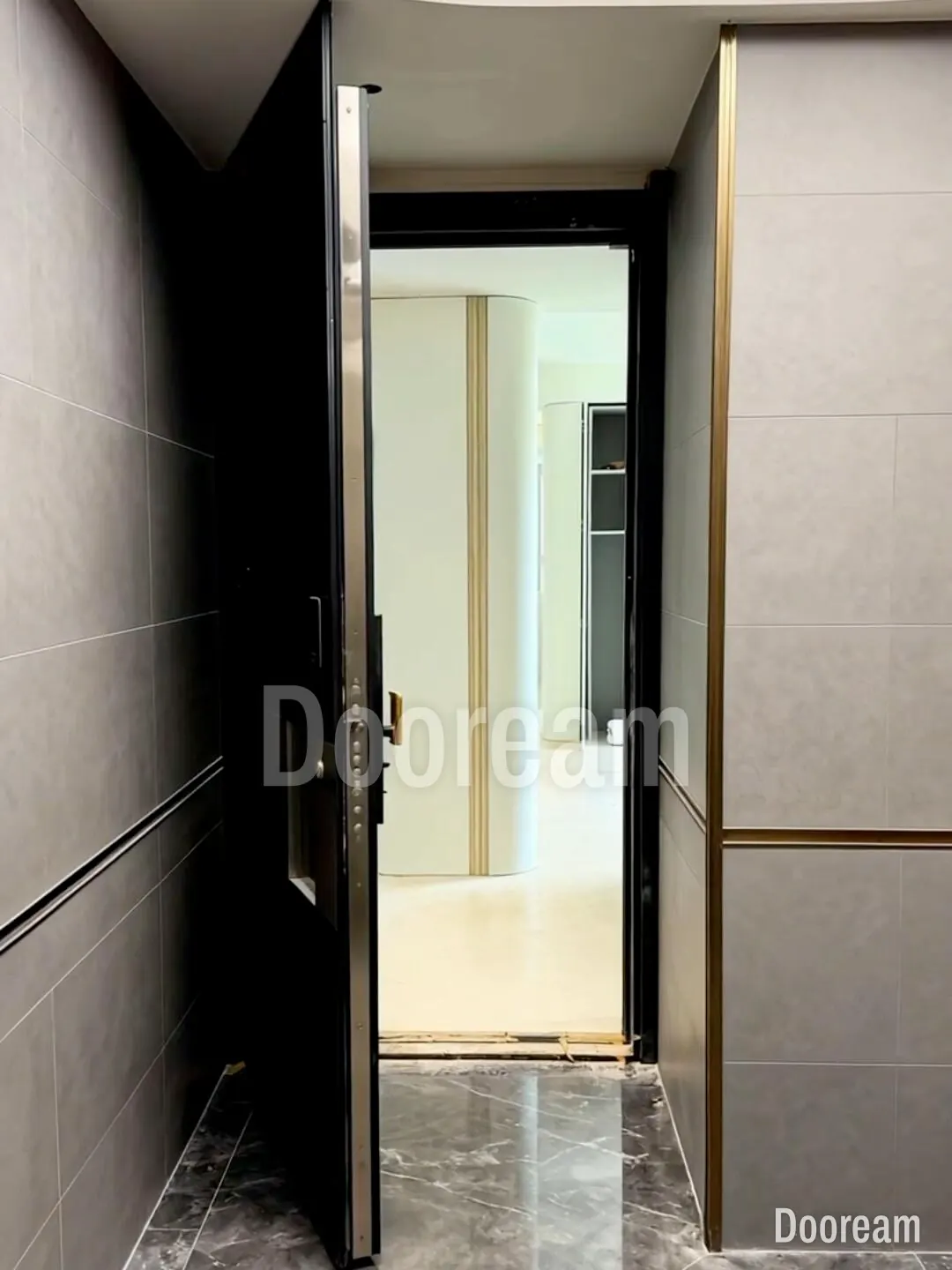
Short answer: judge an armoured door maker by what it can show you about the leaf, not by what it calls the door. Get a section drawing with every layer and thickness, then check it against a part-built leaf on live video, a sample, the finished weight and the steel certificates. If you need a security class, ask for a test of the complete door. Finding names and telling a factory from a trader: see finding a door manufacturer in China.
How do you judge an armoured door manufacturer in China?
By evidence about the leaf. “Armoured” is a description, not a test result, so two doors sold under the word can hold very different amounts of steel. A good maker answers in millimetres and kilograms, shows the inside of a leaf on camera and says plainly which tests it holds. We do not rank makers; this is how to rank them yourself.
The word carries no guarantee in China either. Reporting on Beijing market regulator tests in April 2025, Beijing News warned that “armoured doors” (装甲门) and similar products that do not state compliance with GB 17565-2022 may look like security doors, but their security is not guaranteed.
What should an armoured leaf be made of?
Steel that is hard to cut or bend, a core that keeps the leaf stiff and flat, a lock that bolts into the frame at several heights, protection on the hinge or pivot side, and a frame fixed firmly into the wall. What each part does is in what is an armoured front door; this is what to ask for, in numbers.
| Part | Ask for | Notes |
|---|---|---|
| Steel sheets | Number of sheets, thickness, steel grade, galvanising and coating mass | Under EN 10346, Z275 means at least 275 g/m² of zinc, both sides together, typically about 20 µm per side. GB 17565-2022 asks for face sheets of 0.8 to 3.0 mm nominal, from level 1 to level 5 |
| Leaf frame | Material, wall thickness, how the sheets are fixed to it | It carries the lock |
| Core | The material, shown in a sample | Aluminium honeycomb adds stiffness and strength for little weight. Mineral fill such as stone wool, paper honeycomb, foam or timber: ask what each adds and see it in the sample |
| Lock reinforcement | A steel plate at the lock, and its thickness | GB 17565-2022 requires at least 2.0 mm nominal, of Q235 steel or stronger |
| Locking points | Number, type, height and throw of each point | See multipoint locks explained |
| Hinge or pivot side | Model, rated leaf weight, anti-lift detail | Attackers lever this side too (how burglars attack) |
| Frame and fixing | Material, wall thickness, depth, anchor type and spacing | See weight and wall fixing |
How do you check each claim from a distance?
Get each claim in writing first, as a drawing and a specification. Then check it four ways: a sample you can measure, a live look inside a leaf in production, the weight of the finished leaf, and the documents for the steel and hardware. Each check catches a different shortcut.
- Section drawing. Every layer from outside to inside, with material and thickness, plus the plate at the lock, the locking points on an elevation and the frame with its fixings. Put it on the approved shop drawing, so it becomes part of the contract.
- Cut sample. A corner cut from a real leaf, or a scaled sample with the real construction. Measure each sheet with callipers and look at the core.
- An open leaf in production. Photos, then a live video call, of a leaf before its faces go on: each layer named, callipers on a sheet edge, a magnet on each layer. A magnet shows where carbon steel is, not how thick it is, and proves nothing on stainless steel: annealed grades such as 304 and 316 are generally non-magnetic. Full shot list: what to ask on a video factory tour.
- Weight. Carbon steel has a density of about 7.85 g/cm³, so a 2 mm sheet weighs about 15.7 kg per m². Two such sheets across a 1,200 × 2,400 mm leaf (2.88 m²) come to about 90 kg before the core, frame, faces and lock. A leaf lighter than its claimed steel does not contain it. Ask for it to be weighed on camera, and for the weight on the packing list.
- Documents. Under EN 10204, a type 3.1 inspection certificate from the steel mill gives test results, validated by the mill’s inspection representative, independent of its manufacturing department; a type 2.1 is only a declaration, without results. Check the thickness, grade and coating mass on it. For the lock, get the maker, model and data sheet; for the hinge or pivot, its rated leaf weight.

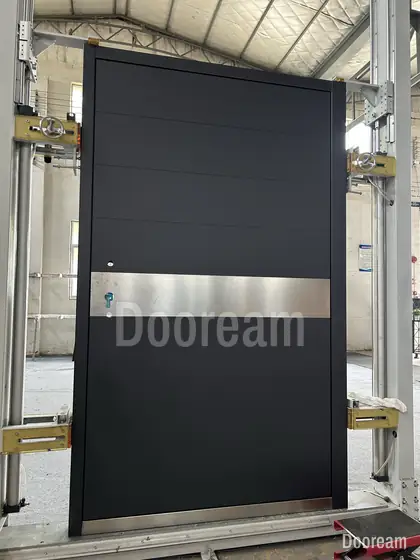
What does a test certificate prove, and what does it not?
A burglar-resistance certificate proves that a door of one design, with its frame, lock, hinges, glass and fixing, resisted a set attack for a set time in a lab. It does not prove that your door, at your size, with your face and lock, in your wall, was built the same way.
- EN 1627:2021 replaced the 2011 edition and has eight classes, RC 1 N to RC 6. It says building hardware cannot be classified under it, has a normative annex on the field of application (the sizes and variants a class covers), and does not apply to walls.
- GB 17565-2022 is China’s mandatory standard for burglary-resistant security doors, in force since 1 January 2024. Its five levels depend on how long the door’s weakest point resists forced opening: at least 6 minutes at level 1, 30 at level 5. The level should be marked, recessed, on the leaf or frame.
- Test or certification. A test report shows one sample passed once. Under DIN CERTCO’s scheme for EN 1627 products (2012 edition), a certificate also needs a factory inspection, the maker’s own production control and yearly surveillance; certificates run five years and holders are listed online.
A certificate does not cover a size outside its field of application, another lock, cylinder or glass, a weaker wall, fire or thermal performance, or a company it does not name. Ask the lab on the report to confirm the number. Classes are compared in door security ratings explained and armoured or steel security door.
How do you verify each claim?
| Claim | How to verify | A weak answer |
|---|---|---|
| “2 mm galvanised steel” | Callipers on a cut sample or sheet edge; the weight check; thickness and coating mass on the mill certificate | “Thick steel”, “anti-rust” |
| “Aluminium honeycomb core” | The core shown in a part-built leaf or cut sample | The core is never shown |
| “Multipoint lock” | Each point’s height on an elevation; lock data sheet; all bolts thrown on camera | A count with no drawing |
| “Anti-lift hinge side” | Hinge-side bolts or the pivot detail, on the drawing and on camera | “Our hinges are strong” |
| “Anchored steel frame” | Frame section; fixing plan with anchor type and spacing | No fixing plan |
| “RC 3” or “EN 1627” | Classification report naming maker, model, class, edition and lab; confirmed by the lab; your door in its field of application | A lock or cylinder certificate |
| “GB 17565 level 4” | Test report for that model; the level marked on the leaf or frame | No mark, or another company’s name |
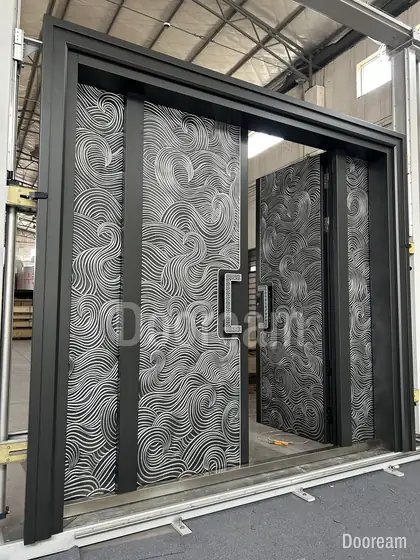
Which red flags should take a maker off your list?
- Thicknesses that change between messages.
- A leaf lighter than the steel it is said to contain.
- No section drawing, or one left off the shop drawing.
- No leaf ever shown before its faces are fitted.
- A part, model or company certificate offered as a door rating, or a report the lab will not confirm.
- Full payment before production; see checking a factory before a deposit.
Checklist: what to ask every armoured door maker
- Section drawing: every layer, material and thickness.
- Steel: grade, thickness, coating mass, type 3.1 mill certificate.
- Core material, shown in a sample.
- Lock: maker, model, points and their heights, lock plate.
- Hinge or pivot: model, rated weight, hinge-side protection.
- Frame: material, wall thickness, depth, fixing plan.
- Finished leaf weight.
- A part-built leaf on live video.
- Test evidence for the complete door, or a plain “none”.
- Photos, video and inspection before shipment.
How does this work with Dooream?
Dooream is the export brand of Zhejiang Jingyi Door Industry Co., Ltd., a family door factory in Wuyi County, Jinhua, Zhejiang. We make custom aluminium armoured entrance doors to the buyer’s drawing, from one door: offset pivot doors up to 4,000 × 8,000 mm, double and unequal double doors up to 3,000 × 6,000 mm, and single doors. Every leaf has five layers, from the outside in: front panel, a 2 mm galvanised steel sheet, an aluminium profile frame with an aluminium honeycomb core, a second 2 mm galvanised steel sheet and the inner panel. The standard mechanical lock is a 9-point steel multipoint lock; smart locks come from KFV, G-U or Wintech. Frames are steel or aluminium with a 2 mm wall, 125 mm deep as standard; the depth can be made to suit the wall. We hold no EN 1627 or other security rating; where a project needs one, lab testing can be arranged for that order, usually at the buyer’s cost. We send photos and video of every finished door before shipment, and you or your inspector can check it at our factory. Video tours run Monday to Saturday, 14:00–18:00 China time; ask for one, or for the section drawing, on our contact page.
Sources, checked November 2026: Beijing News, 9 batches of security doors fail Beijing market regulator tests (18 April 2025); Code of China, GB 17565-2022 contents; Chinese Standard, GB 17565-2022; EVS, EVS-EN 1627:2021; iTeh Standards, SIST EN 1627:2021 preview; DIN CERTCO, certification scheme for burglar-resistant products to DIN EN 1627; SSAB, zinc coating; thyssenkrupp, hot-dip coated sheet product information; Van Leeuwen, EN 10204 inspection documents; Project Materials, density of metals; Australian Stainless Steel Development Association, magnetic effects of stainless steels; Hexcel, HexWeb honeycomb.
Quick answers
Who are the best armoured front door manufacturers in China?
We do not rank makers, ourselves included. Judge each one by evidence, which a good maker gives in millimetres and kilograms. Ask for a section drawing with every layer and thickness, a part-built leaf on live video, the leaf weight, steel and lock documents, and a test report for the complete door if your project needs a class. Dooream, the export brand of Zhejiang Jingyi Door Industry Co., Ltd. in Wuyi, Zhejiang, makes custom aluminium armoured entrance doors with two 2 mm galvanised steel sheets in each leaf, and holds no security rating.
How can I check what is inside an armoured door without visiting the factory?
Get a section drawing with every layer and thickness, then check it four ways. Look at a cut or scaled sample. Watch an open leaf in production on live video, with callipers and a magnet on each layer. Check the finished leaf weight, and read the steel mill certificate. A 2 mm steel sheet weighs about 15.7 kg per m², so the weight shows whether the claimed steel can be there.
Does an EN 1627 or GB 17565 certificate prove that my door is secure?
It proves that a door of one design resisted the test, at the size, lock, glass and fixing tested. Check that the report names the maker, the model and the class, that your door falls within its field of application, and that the lab confirms the report. Dooream holds no EN 1627 or other security rating; testing can be arranged for an order, usually at the buyer's cost.