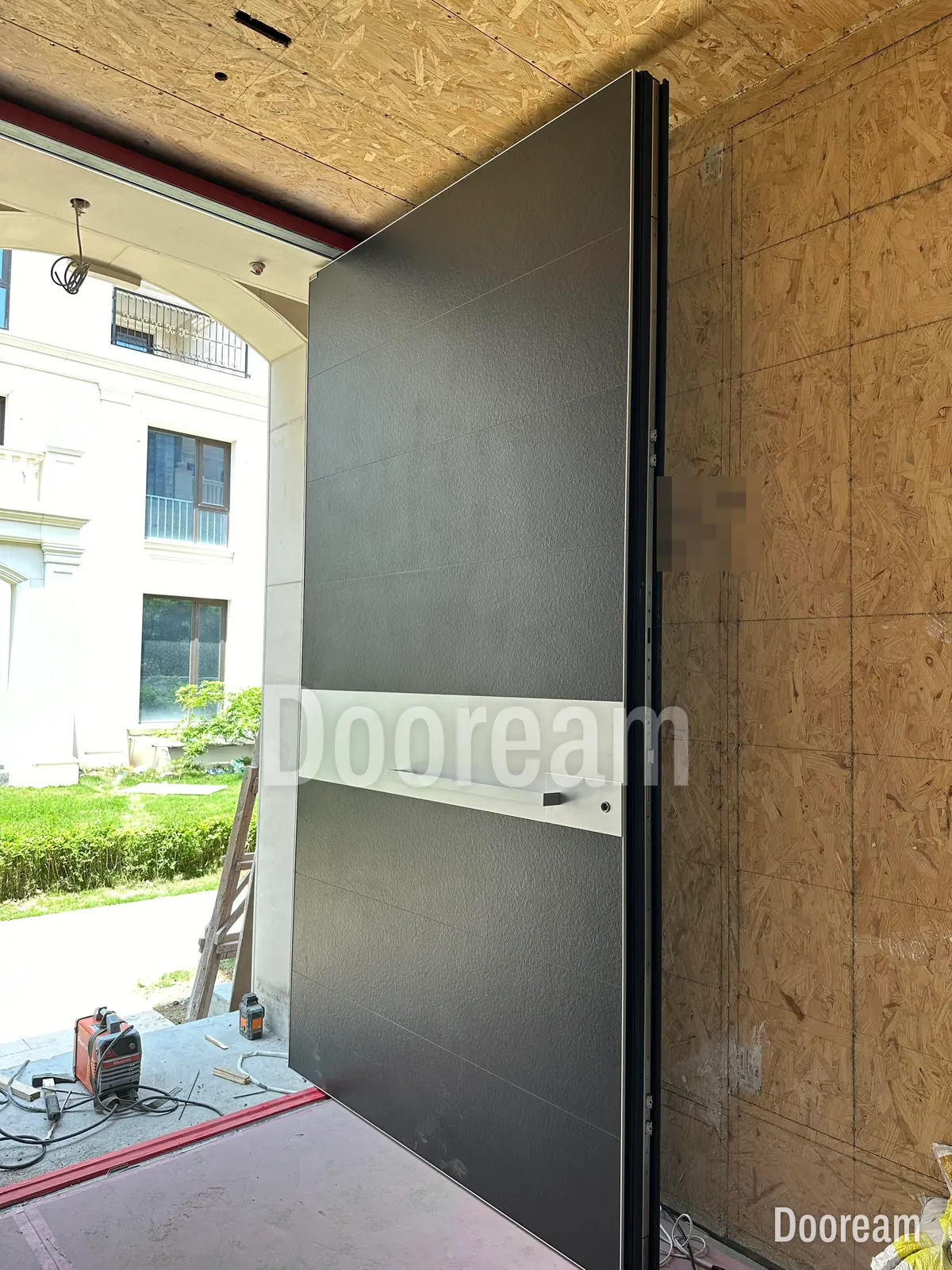
Short answer: Dooream makes aluminium pivot entrance doors up to 4,000 mm wide and 8,000 mm tall, to drawing, from one door. Before you approve a drawing from any maker, ask about the leaf weight against the pivot’s rated load, flatness over the height, the forces on the head and floor, the crate against the container, and the lift on site.
Who makes pivot doors 4 metres tall or more?
We do. Dooream is the export brand of Zhejiang Jingyi Door Industry Co., Ltd., a family door factory in Wuyi County, Zhejiang, China. We make aluminium pivot entrance doors up to 4,000 × 8,000 mm, to drawing, from a single door. They are offset pivots, on pivot hinges, most often FritsJurgens. Whichever maker you talk to, ask the questions below.
What limits the size of a pivot door?
Five things, most of them outside the factory. The leaf’s weight must stay within the pivot’s rated load at that width. The leaf must stay flat over its height. The floor and head must take the pivot’s forces. The crate must fit a container or travel as out-of-gauge cargo, and the site must be able to lift it.
| Size limit | Why it limits size | What to ask the maker |
|---|---|---|
| Leaf weight against the pivot’s rating | Weight grows with area; ratings fall as the leaf gets wider | Leaf weight in kg on the drawing; pivot model and its rating at your width |
| Flatness over height | The same curvature gives a larger bow on a taller leaf | Allowed bow in mm; locking points along the edge |
| Frame and fixing | The floor carries the leaf; the head holds it upright | Forces at floor and head; frame section; fixings |
| Crate against container | A 40 ft high-cube door opening is 2,340 × 2,597 mm | Crate outside size and gross weight |
| Out-of-gauge acceptance | Open tops and flat racks are accepted booking by booking | Lifting and lashing points |
| Road and site | Wide or tall loads need permits; heavy leaves need lifting gear | How the leaf leaves the crate and is stood up |
How heavy is a 4-metre pivot leaf?
Multiply the leaf area by the weight per square metre of the exact construction. As an example only, we assume 50 kg/m², a figure for the arithmetic rather than a specification; the shop drawing gives the real leaf weight. On it, a 2,000 × 5,000 mm leaf weighs 500 kg, the top of FritsJurgens’ System M+ classes.
Our arithmetic, also assuming a pivot point 100 mm from the edge:
| Leaf W × H | Area | Weight | Load on the floor pivot | Sideways force at each pivot |
|---|---|---|---|---|
| 1,500 × 4,000 mm | 6 m² | 300 kg | About 2.9 kN | About 480 N |
| 2,000 × 5,000 mm | 10 m² | 500 kg | About 4.9 kN | About 880 N |
| 2,500 × 6,000 mm | 15 m² | 750 kg | About 7.4 kN | About 1.4 kN |
| 4,000 × 8,000 mm | 32 m² | 1,600 kg | About 15.7 kN | About 3.7 kN |
The sideways force is weight × (half the leaf width − pivot point) ÷ leaf height, the method in our guide to offset and centre pivots. At an assumed 75 kg/m², every figure rises by half. Faces add weight fast: aluminium plate weighs about 2.7 kg/m² per millimetre of thickness and steel sheet about 7.85 kg/m², from densities of about 2,700 and 7,850 kg/m³.
FritsJurgens lists System M+ in classes from AA (20–79 kg) to G (up to 500 kg). Its class chart plots door weight against the distance from the pivot point to the far edge of the door, so a wider leaf can need a higher class. Heavier leaves need heavier pivots; see hinges for heavy entrance doors and pivot door size and weight.
The floor under the pivot takes the whole load, and the head takes the sideways force through a header fixed to structure (floor-to-ceiling pivot doors). Send both figures to your structural engineer.
Why does height make flatness harder?
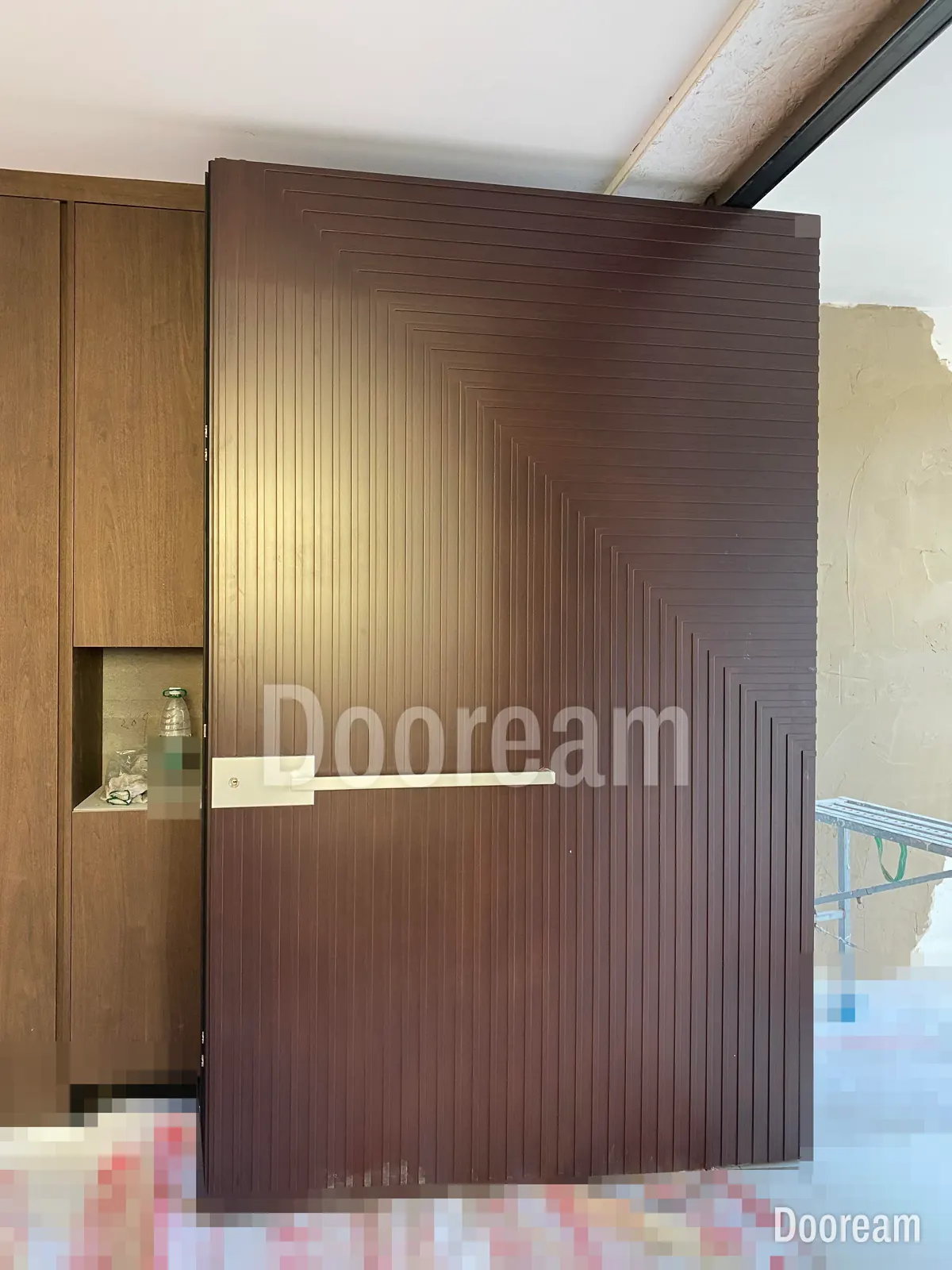
For the same curvature, the bow at mid-height grows with the square of the height. Our arithmetic: a leaf that bows 2 mm over 2,400 mm would bow about 12.5 mm over 6,000 mm and about 22 mm over 8,000 mm. Sun on a dark face with a cool inside is the usual cause; see tall front doors, bowing and warping. Agree the allowed bow in millimetres, how it is measured, and how many locking points hold the lock edge.
Will an oversized pivot door fit in a shipping container?
Only if its crate passes the container door. Hapag-Lloyd lists its 40 ft high cube as 12,032 × 2,350 × 2,700 mm inside, with a door opening of 2,340 × 2,597 mm. So the crate’s short side decides: under 2,340 mm, it can lie flat and run almost the full 12 m; under 2,597 mm, it can stand on edge.
A crate larger than the door opening both ways, such as one for a 4,000 mm leaf, needs other equipment and more planning:
- Open top: Hapag-Lloyd’s 40 ft open-top high cube has a roof opening of 2,192 × 11,552 mm, so a crate standing on edge can be lowered in by crane. If it rises above the walls, it is out-of-gauge.
- Flat rack: a floor and two end walls, used mainly for heavy, over-height and over-width cargo.
- Booking: Hapag-Lloyd plans special cargo shipment by shipment, from the goods, packaging, dimensions, total weight, lifting and lashing points, and photos or drawings.
- Ports: Maersk’s Middle East Operational Update 55 (18 November 2026) suspended out-of-gauge bookings to and from Iraq, Kuwait, Qatar, Bahrain, Aqaba, and the Saudi ports of King Abdullah, Dammam and Al Jubail. Jeddah, Salalah, Khor Fakkan, and Jebel Ali and Abu Dhabi via Fujairah were open on a limited basis.
- Road: Directive 96/53/EC sets normal EU vehicle limits of 2.55 m wide and 4.00 m high, so a crate for a 4,000 mm leaf, flat or on edge, travels under abnormal-load rules. Check your own country’s limits.
Routes and transit times are in shipping doors from China.

What does the site need for delivery and lifting?
A planned lift, booked before the door ships. The 1,600 kg leaf in our example needs a crane or telehandler, not a team of carriers. Check the route from road to opening against the crate, a firm set-down area, and a clear floor in front of the opening where the leaf can lie flat and be tilted up. Vacuum lifters need a smooth face; a carved relief may give them nothing to seal on. See how to install a pivot door.
Which questions should you ask a maker of oversized pivot doors?
- What will the leaf weigh in kg, and is that on the drawing?
- Which pivot will you fit, what is its rated load at this width, and what if the weight exceeds it?
- Is it an offset or a centre pivot, and where is the axis?
- How is the leaf kept flat, and what bow is allowed, in millimetres?
- How many locking points hold the lock edge, and where?
- What forces go into the floor and the head, in newtons?
- What is the frame section, and where are the fixings?
- What are the crate’s outside dimensions and gross weight, and which container does it need?
- Where are the lifting and lashing points?
- How is the leaf taken out of the crate and stood up?
- Which installation drawings and support do you give our installer?
- How long is production after drawing approval, and will we see photos and video before shipment?
What drawings and site information does the maker need?
Enough to draw the door to your building, not to a catalogue. Send the structural opening with floor levels from one datum, the head and floor build-up, and what the structure is. Add the facts that decide transport: the destination port, the road in and where a crane can stand. The basics are in what to send a door manufacturer.
- Plan and elevation: width and height at several points, both diagonals, and the wall build-up.
- Head section: the structure, and how far your engineer expects it to move.
- Floor section: build-up, any underfloor heating, and finished levels inside and outside.
- Opening direction, pivot side and swing, seen from outside.
- Orientation and exposure, and any canopy or recess.
- Lock type and the cable route for a wired smart lock.
- Destination port, delivery address, road limits, crane position, set-down area and route to the opening.
- Programme: when the opening, head and floor will be ready.
How does this work with Dooream?
We make pivot doors up to 4,000 × 8,000 mm to drawing, from one door, including Lattice, Grain Band, Malachite, Contour and Black Warrior. They are offset pivots, on pivot hinges, most often FritsJurgens. For a leaf heavier than a pivot’s rated load, we fit heavy-duty pivots from other makers, chosen from the leaf weight on the shop drawing. Production takes 35–45 days after drawing approval and deposit. We sell EXW, so your forwarder books the container or flat rack. Your local installers fit the door from our installation drawings, with our remote guidance. Send drawings through our page for architects or contact us.
Sources, checked November 2026: Hapag-Lloyd, 40' standard high cube, 40' open top high cube and Think big, special cargo (09/2018); GDV Transport Information Service, flatrack containers; Maersk, operational status (Middle East Operational Update 55, 18 November 2026); FritsJurgens, System M+ technical documentation and System M+; Engineering ToolBox, metals and alloys, densities; Council Directive 96/53/EC, Annex I, maximum dimensions.
Quick answers
Who makes pivot doors 4 metres tall or more?
Dooream, the export brand of Zhejiang Jingyi Door Industry Co., Ltd. in Wuyi County, Zhejiang, China, makes aluminium pivot entrance doors up to 4,000 mm wide and 8,000 mm tall, to drawing, from one door. Production takes 35–45 days after drawing approval and deposit, and the doors are sold EXW.
How heavy is a pivot door 4 metres tall or more?
It depends on the construction, so ask for the leaf weight on the drawing. As an example only, at an assumed 50 kg/m², a figure for the arithmetic rather than a specification, a 2,000 × 5,000 mm leaf weighs 500 kg, the top of FritsJurgens' System M+ classes, and a 4,000 × 8,000 mm leaf weighs 1,600 kg.
Will an oversized pivot door fit in a shipping container?
Only if its crate passes the container door. Hapag-Lloyd gives the door opening of its 40 ft high cube as 2,340 × 2,597 mm. A bigger crate needs an open-top container or a flat rack, booked as out-of-gauge cargo, which some routes accept only on a limited basis.