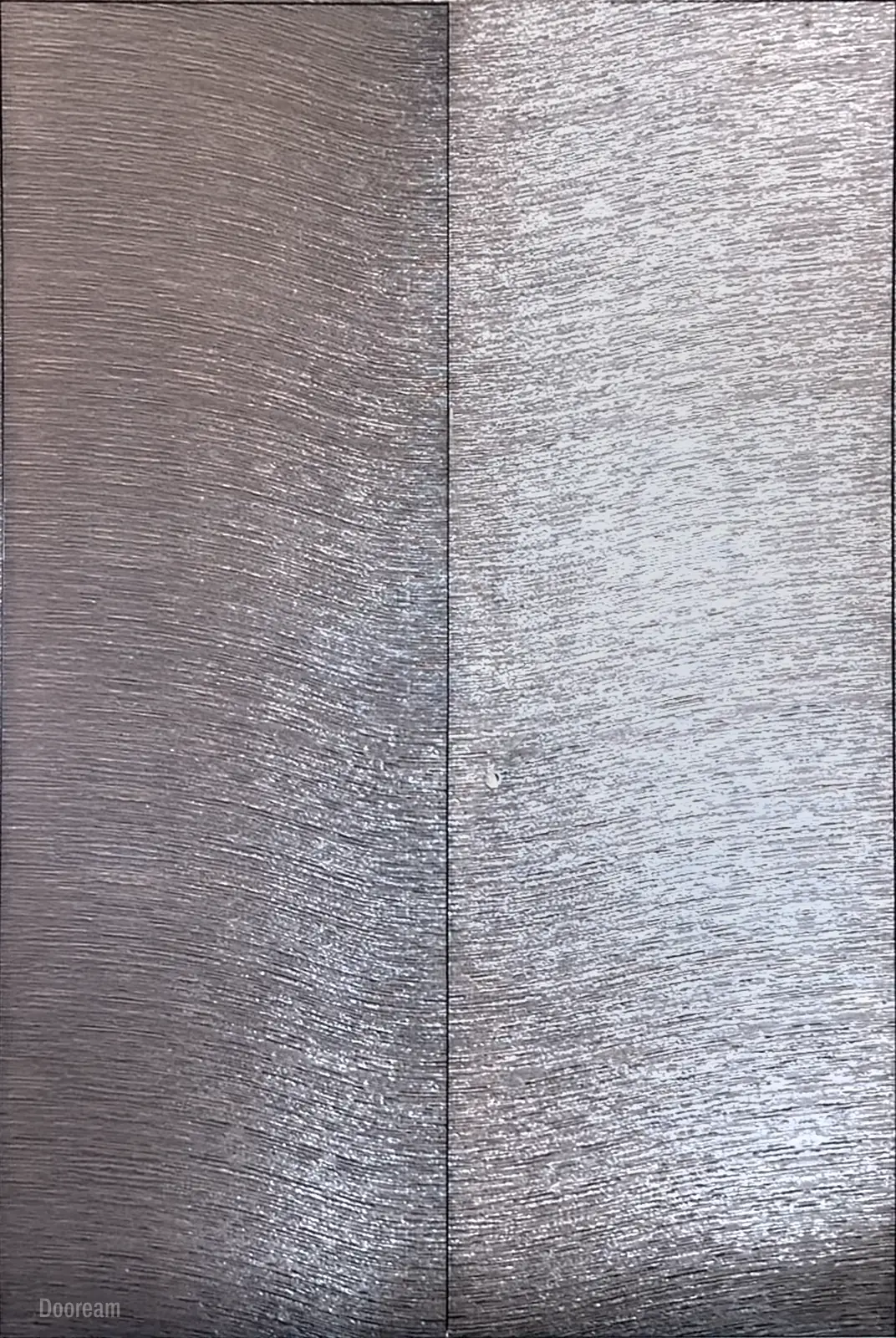
Short answer: ask for a finish sample on the real face, a scaled sample built with the real construction and, where scale or feel decides, a full-size door. Add hardware and glass samples where they must match the building. Each proves something narrow, so judge it under agreed light, sign and date it, and keep it as the reference for production.
Which samples should you ask for, and what does each prove?
A sample is evidence for one question. A small finish sample answers “which colour, gloss and texture?”, a scaled sample “how is it built?” and a full-size door “how does it look and work at true scale?”. Ask for the samples that answer your open questions, and record what each settled.
| Sample | What it proves | What it does not prove |
|---|---|---|
| Flat finish sample | Colour, gloss and texture of one coating on one material | How the colour reads over relief; a match between batches |
| Carved or cast relief sample, such as 20 × 20 cm | Relief depth, edge sharpness, colour in the recesses, hand finishing | The pattern across a 3 m leaf; joints between panels |
| Scaled sample with the real construction | The layers, the leaf edge, how the face is fixed, the frame section | Flatness, sealing, security or thermal performance of the full door |
| Full-size door | Pattern at true scale, weight, swing, gaps, the lock in use | That the next leaf, in another size and batch, will match |
| Hardware sample | Finish, size, grip, how the lock is worked | Corrosion grade, cycle life |
| Glass sample | Tint, pattern, the reflection of a coating | The colour of the full unit in place; its safety or security class |
What does a small finish or carved sample prove?
What you can see and touch on that piece: colour, gloss, texture, relief depth, how crisp the edges are and how colour gathers in the recesses. It does not show how the pattern reads across a full leaf, or that every panel will match. It proves the finish, not the door.
- Make it the real thing: the same face material, coating, carving or casting and colours. Check it in raking light (CNC carving checklist, relief and light).
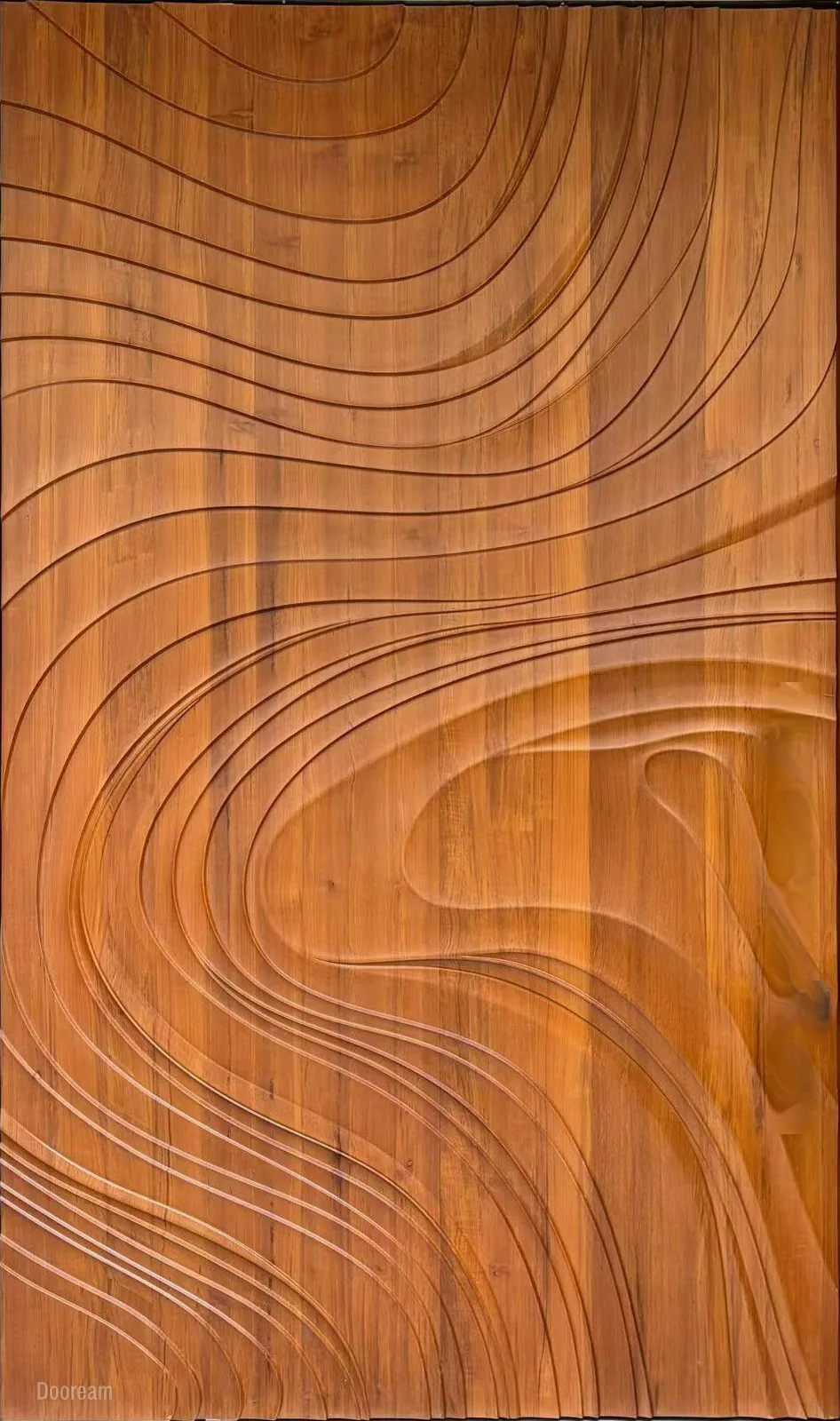
- Mind the scale. A 20 × 20 cm piece holds a few lines of a pattern; for the whole, tape a full-size print into the opening.
- Ask for a range on metallic and hand-worked finishes. Axalta says a metallic powder’s look depends on spraying distance, part orientation and stroke direction, and advises one batch per job, with master samples as references. Two or three pieces show the range.
- Natural materials vary. On natural shell, as on our Shell door, a sample shows the material, not the pieces on your leaf.
How do you judge a finish sample?
In two stages. First in steady, controlled light beside the reference, to check it is the colour you specified. Then outdoors, upright, facing the way the door will face and from the distance it is seen, to check it is the colour you want.
- Name the colour by system and code, such as RAL or NCS, plus gloss and texture. RAL’s binding RAL Classic references come in semi-matt (840-HR) and high gloss (841-GL), so a number alone does not fix the sheen (door colours).
- Compare in controlled light. ISO 3668 compares paint colours by eye in a booth at 1,000 to 4,000 lux, lit to approximate CIE Illuminant D65, Illuminant A or FL 11; its 2017 edition dropped natural daylight as too variable. It excludes metallic and other effect coatings unless lighting and viewing are agreed first.
- Check under a second light. The CIE calls colours metameric when they are spectrally different but measure the same in one specified colour system: they can match in one light and part in another. View the door sample with the stone, timber or frames it must match, in daylight and under the entrance lights.
- Tilt it and step back. A brushed or metallic finish can turn from dark to pale with the angle, as at the top of this page; Axalta advises inspecting metallic parts from about 3 to 5 m, where cloudy patches show.
- Judge gloss by eye on relief. ISO 2813 measures gloss at 20°, 60° or 85° on non-textured coatings on flat surfaces, so measure a flat part or compare by eye.
What does a scaled sample with the real construction prove?
How the door is built, which a finished leaf hides: the layers from outside to inside, the leaf edge, how the face is fixed, the frame profile and, where included, the seal and lock positions. It suits architects and developers comparing factories, but says little about how a full-size leaf behaves.
- Name every layer and compare it with the quote; construction is where door quotes stop being comparable.
- Look at the edges and fixing: how the face meets the edge profile, how corners close, how the face is fixed; have the fixing written on the drawing.
- Match the options. If the doors will have a thermal break, have the sample built with one, so the strips show in the frame section.
- Then see your own leaf, part-built, on a live video tour.
When is a full-size sample door worth it?
When the decision depends on true scale or feel: a pattern that must read from the gate, a heavy leaf whose swing and lock the client wants to try, or a project with many identical doors. For dealers, a full-size door is also showroom stock, covered in our showroom sample doors guide.
On a development with repeated doors, approve the first production door as the benchmark before the rest are made. In the AIA A201-2017 general conditions, samples “establish standards by which the Work will be judged”; a full-size benchmark does that for gaps and hardware too.
What should hardware and glass samples show?
Hardware samples should show the real finish on the real base metal, the size and grip, and how the lock is worked. Glass samples should show tint, pattern or coating at the real build-up. Neither proves performance: corrosion grade and safety class come from tests and markings.
- Hardware. View the pull, lock trim and any visible pivot plate beside the face sample. Simonswerk lists the EN 1670 corrosion grades as 24 to 480 hours of salt spray; ask for the grade in writing (pull handles).
- Glass. Pilkington’s Optiwhite brochure says laminating exaggerates any tint in the glass, so a single pane can look clearer than the laminated glass in the door. Vitro advises viewing samples outdoors under overcast sky, turned through several angles, then a full-size mock-up (glass in entrance doors).
What can no sample prove?
Anything that belongs to the complete door in its opening: the flatness of a large leaf, air and water tightness, security, thermal performance and long-term weathering. These are shown by the drawing, by tests on complete doors where the project needs them, and by checking the finished door before crating.
- Flatness: EN 1530 sets flatness tolerance classes for door leaves; agree a class or a figure per metre (tall doors).
- Sealing: EN 1026 tests the air permeability of completely assembled doorsets (seals).
- Security: EN 1627 classifies the burglar resistance of pedestrian doorsets as products (security ratings). Our doors have no EN 1627 rating; testing can be arranged, usually at the buyer’s cost.
- Thermal performance depends on the whole door, frame and glazing (U-values).
- The finished door is checked against the approved sample in a pre-shipment inspection; before any deposit, check the factory.
How do you record a sample approval?
In writing, on the sample and on the drawing. A signed, dated and numbered sample, with a note of what it approves, becomes the reference that production and the delivered door are checked against. An unsigned sample in a drawer settles nothing in a dispute.
Approval checklist:
- Reference number, also written on the drawing and finish schedule
- Surface covered: outside face, inside face, frame, edges, hardware or glass
- Material, coating, colour system and code, gloss, texture, number of colours
- Accepted range for metallic, hand-worked or natural finishes
- Viewing conditions used: light source, outdoors, distance, angles
- What it approves and what not, such as “colour and gloss only”
- Signed and dated by both sides; one of a matched pair kept by each
- Stored out of sunlight; used at the pre-shipment check and for site touch-up
- For a construction sample: each layer named and matched to the quote
- Items no sample covers, with how each will be shown: drawing, test or inspection
How does this work with Dooream?
We make complete doors only, to drawing, from one door. We offer a 20 × 20 cm carved and coloured sample; a scaled sample built with the real construction (from outside in: face, galvanised steel sheet, aluminium profile frame with aluminium honeycomb core, galvanised steel sheet, inner face); and full-size sample doors, which dealers buy at the normal price and get back as a 5% rebate on later orders until repaid. Any of our designs can be ordered with our thermal-break construction, with PA66 polyamide insulating strips in the aluminium profiles. Before shipment we send photos and video of the finished door, and you can inspect it at the factory. Production takes 35–45 days after drawing approval and deposit. Start on our architects page or contact page.
Sources, checked November 2026: ISO, ISO 3668:2017, Visual comparison of colour of paints (iTeh preview: booth light, illuminance, scope); CIE e-ILV, metameric colour stimuli and metamerism; ANSI Webstore, ISO 2813:2014, Determination of gloss value at 20°, 60° and 85°; RAL, FAQ, RAL 840-HR and RAL 841-GL; Axalta, instructions for metallic powder coatings; K. O'Beirne, CSI, shop drawings and submittals (2020), quoting AIA A201-2017 §3.12.3; Simonswerk, finishes and EN 1670 categories; Pilkington, Optiwhite brochure; Vitro Architectural Glass, how to view a glass sample; BSI, EN 1530, door leaves, flatness tolerance classes; SIS, SS-EN 1026:2016 scope and SS-EN 1627:2021 scope.
Quick answers
Which samples should I ask for before ordering a custom entrance door?
A finish sample on the real face, carved or cast if the door is; a scaled sample built with the real construction, to see the layers, edges and how the face is fixed; and a full-size door when the pattern, weight or lock must be judged at true scale. Add hardware and glass samples where they must match other parts of the building.
What can a door sample not prove?
The flatness of a large leaf, air and water tightness, security and thermal performance. These belong to the complete door, so they are shown by the drawing, by tests on complete doorsets where the project needs them, and by checking the finished door before it is crated.
How should a sample approval be recorded?
Sign and date the sample, give it a reference number and write on it what it approves. Put that reference on the drawing and the finish schedule. Keep one of a matched pair on each side, out of sunlight, as the reference for production and for checking the delivered door.