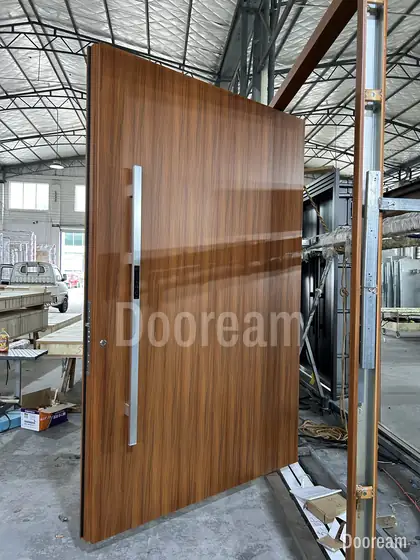
Short answer: put one full-size pivot door and one double or unequal double door on the floor, in the types and sizes your clients buy most, each with a working smart lock. Show the rest of the range with face samples, a scaled sample door and video. Size the display doors to your room and to a common opening, so they can be sold later.
Which doors should a dealer put on the showroom floor?
Two working doors and a wall of samples cover most showrooms. A pivot door shows the size and swing that villa owners come in for. A double or unequal double door covers the openings most houses have. Face and finish samples show everything else, without a third full-size door taking floor space.
- The pivot door. Choose a height your clients’ openings usually have, not the biggest you can buy; the demonstration is a large leaf moving under one hand (pivot door size and weight).
- The double door. An unequal double has a wide everyday leaf and a narrow one that opens for furniture (which to choose). Facet Light, with folded dark facets and built-in light lines, is one. Give it a face that contrasts with the pivot door’s, such as flat or printed against deep relief.
- The sample wall. Show each face family you sell, side by side:
- carved relief, such as Contour: flowing contour lines carved across a warm wood-tone face;
- cast relief beside carved, so clients see the differences in cast vs carved faces;
- sintered stone, which Black Warrior has on the inside;
- wood-look print, like the wood-grain panels of Grain Band, ideally beside real timber (5D prints);
- colours, from the ivory leaves of Ivory Wave to the matte black panels of Malachite.
How big should a display door be for your room?
Usually a normal size. The display door has to fit under your ceiling with its frame and head, stand on a floor that takes its weight at one point, and get into the building in its crate. Match a common opening in your market, so the door can be sold to a client later.
- Ceiling height. The leaf, its frame and the support above the top pivot must all fit, with room to work. If your clients build entrances of 6 m or more, show a door of normal height and a scaled sample for the tall ones.
- Floor loading. A pivot leaf stands on its bottom pivot, so its whole weight goes into the floor at one point. In FritsJurgens’ System M+, for example, the heaviest class, F–G, is for leaves of 350 to 500 kg. On an upper floor, a raised access floor or a timber floor, ask a structural engineer first.
- A pivot door without a building. On FritsJurgens hinges, the floor plate is recessed into the floor and pinned, and the top pivot pin fits into a plate in the ceiling or head. So a freestanding display needs a fixed floor point exactly below a rigid head that cannot sway or tip: a short display wall with a head beam, or a steel portal frame fixed to the slab. Never hang the head from a suspended ceiling.
- Swing space. The leaf swings out on both sides of the pivot, so leave clear floor on both faces, away from escape routes.
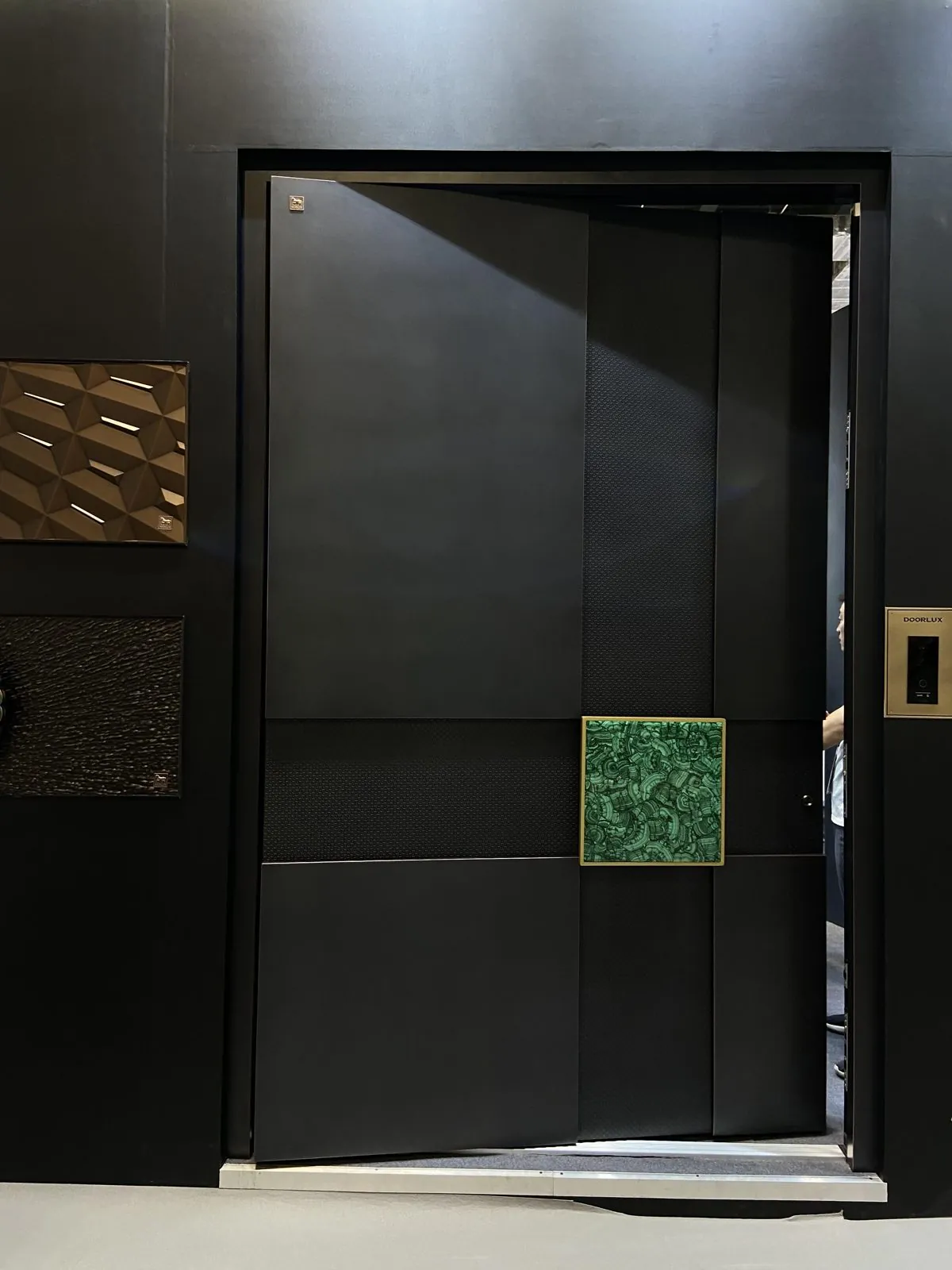
Full-size door, scaled sample or face samples: what does each show?
Each option answers a different question. A full-size door answers “how does it feel?”, a scaled sample “how is it built?”, a face sample “what will my door look like up close?”, and video “what else can you make?”. Most showrooms need all of them, in different amounts.
| Option | Shows | Cannot show | Enough for |
|---|---|---|---|
| Full-size door | Swing, weight, lock, seals, the face at true scale | Other faces; doors taller than your room | Villa owners, who need one; two is plenty |
| Scaled sample door with the real construction | The layers, the frame, how the face is fixed | The feel of a heavy leaf | Architects and developers; villa owners only beside a full-size door, not instead of one |
| 20 × 20 cm face sample | Relief depth, edges, colour, texture in the hand | How a pattern reads across a 3 m leaf | Choosing a face and colour once the type is settled |
| Finish chips | Colour and gloss | Relief and texture | Choosing a colour for a face already seen |
| Video and photos | Designs you do not stock, installed doors, the factory | Touch and true colour | Clients who cannot visit (video factory tours) |
Small samples can mislead on colour. ISO 3668, the standard method for comparing paint colours by eye, uses artificial light in a standard booth and says metallic and other special-effect coatings need the lighting and viewing conditions agreed first. Check metallic samples under your lights and in daylight, and keep the one each client approves.
How does a display door pay back?
Through the orders it helps close, not through its own sale. Villa owners rarely commit to a large door from a photo. Once they have opened one, felt the weight and tried the lock, the question moves from whether to which, and the sale gets shorter.
- It sells the type. A client who opens your pivot door often orders a pivot door, in another face and size.
- It prevents disputes. The client has seen the real finish, gaps and lock before signing.
- It trains your installers before the first client door (dealer guide), and brings architects in with their clients.
- It costs floor space, tied-up money, handling wear and designs that date. Some factories credit part of later orders against it, so your orders repay it.
How do you get a pivot display door delivered and working?
Treat it as a small installation project. The crate has to reach the room, the pivot needs a fixed floor point and a rigid head, and a smart lock needs power. Settle all three before the door ships, then install it with the installer who will fit your clients’ doors.
- Check the route in. Get the crate size and gross weight before you order; measure the showroom door, corridors and any lift, and plan the unloading. Wide leaves matter at sea too: Hapag-Lloyd gives a 40-foot high-cube container’s door opening as 2,340 × 2,597 mm, so ask your forwarder before you fix the size (crating and shipping).
- Build the support, with the pivot point taken from the installation drawing (floor preparation).
- Plan the lock’s power. A battery smart lock needs no cable. A wired lock needs a power supply and a cable through the top pivot; on FritsJurgens System M+, the Class G top pivot has a Ø7.5 mm cable entry. Have an electrician put the socket in the head or behind the display wall (smart locks on pivot doors).
- Install and film it: opening, closing and unlocking, for clients who cannot visit.
When should you refresh the display?
When it stops matching what you sell. Change samples often and full-size doors rarely: a face sample is easy to replace, a full-size door is a project. Add face samples as the factory adds designs; replace a full-size door when its type or face no longer leads your sales.
- Sell the old door. A display door sized to a common opening can go to a client as ex-display. Agree the warranty first: a factory warranty usually runs from shipment, not from your sale.
- Keep approved samples as the reference for repeat orders, and update the video whenever the floor changes.
What should you agree with the factory before ordering display stock?
Anything that could cause a dispute later: what is made, how it stands and is powered, how it is packed, what it costs, how any display credit works, who may use the photos, and when the warranty starts. Put it in writing, with the drawing, before you pay the deposit.
- Door types, sizes and faces, chosen for your room and a common opening
- Matching face and finish samples, signed, one kept by each side
- Drawings for the display wall or frame: pivot position, head, floor fixing
- Lock model, battery or wired, supply voltage and plug type
- Your logo plate, if you sell under your own brand (OEM guide)
- Crate size, gross weight and packing your port accepts
- Display terms: the price, how any credit on later orders is shown on each invoice, when it ends, and what happens if you sell the display door
- Rights to photos and video of the display doors
- Warranty start date; spare keys, batteries, seals and touch-up paint
- Production time, payment stages, and when protection for your city can be discussed
To compare factories’ offers on the same basis, see how to compare door quotes.
How does this work with Dooream?
We sell complete doors only, each made to drawings, from one door. For showrooms we offer a 20 × 20 cm carved and coloured face sample, a scaled sample door made with the real construction, and full-size sample doors. Showroom sample doors are bought at the normal price, then we refund 5% on each later order until the showroom doors are paid back. At about 200 doors a year, a dealer can discuss protection for their city. We can make the doors under your own brand (OEM). Production takes 35–45 days after drawing approval and deposit; payment is 50% deposit and 50% before shipment. See our dealers page.
Sources, checked November 2026: FritsJurgens, System M+ (weight classes, top pivot, cable entry) and Floor plates; ISO, ISO 3668:2017, Visual comparison of colour of paints; Hapag-Lloyd, 40' standard high cube container.
Quick answers
Which doors should a dealer put in a showroom first?
One full-size pivot door and one double or unequal double door, in the types and sizes your clients buy most, each with a working smart lock. Around them, show the range with face samples, a scaled sample door that shows the construction, and video of designs you do not stock.
Is a scaled sample door enough instead of a full-size display door?
For architects and developers it often is, because it shows the real construction. Villa owners usually want to open a full-size door, feel its weight and try the lock before they commit, so a scaled sample works best beside a full-size door, not instead of one.
How do dealers pay for showroom sample doors from Dooream?
Showroom sample doors are bought at the normal price, then we refund 5% on each later order until the showroom doors are paid back. Production takes 35–45 days after drawing approval and deposit; payment is 50% deposit and 50% before shipment.