Short answer: a “5D wood-grain” aluminium door has a face that is powder coated, then printed with a picture of wood, usually by sublimation: heat drives ink from a printed film into the coating. “3D”, “4D” and “5D” are sales names, not test classes. Compared with timber it does not swell, rot or need refinishing, and it is far lighter than stone. But it cannot be sanded back, and its life in the sun depends on the base powder and the film, tested together.
What is a 5D wood-grain aluminium door?
It is an aluminium entrance door whose face carries a printed wood pattern inside its coating. The metal is powder coated in a base colour, a printed film is drawn tight over it, and heat turns the ink to vapour that enters the coating. The grain is part of the coating, not a sticker.
How sublimation works:
- Coat. The aluminium is pretreated and powder coated with a powder made for sublimation; AkzoNobel, for example, sells a separate range for it.
- Wrap. A film printed with the pattern is wrapped round the part, or laid over a flat sheet.
- Vacuum. Air is drawn out so the ink touches the coating everywhere.
- Heat. The part goes into an oven, or a heated press for flat sheets. Decoral recommends that the metal reaches 200 °C.
- Peel. The film comes off and the pattern stays in the coating.
Temperature matters. In Decoral’s tests the ink went through the full 108 µm coating at 200 °C, but only 54 µm at 180 °C and 19 µm at 160 °C, so a large leaf must heat evenly to print evenly. QUALIDECO, the QUALICOAT label for decorated aluminium, also covers powder-on-powder, a top powder over a base powder. AkzoNobel says sublimation can apply almost any pattern, wood grain being the most popular, so a stone or marble look is made the same way from a different film.
What do 3D, 4D and 5D mean?
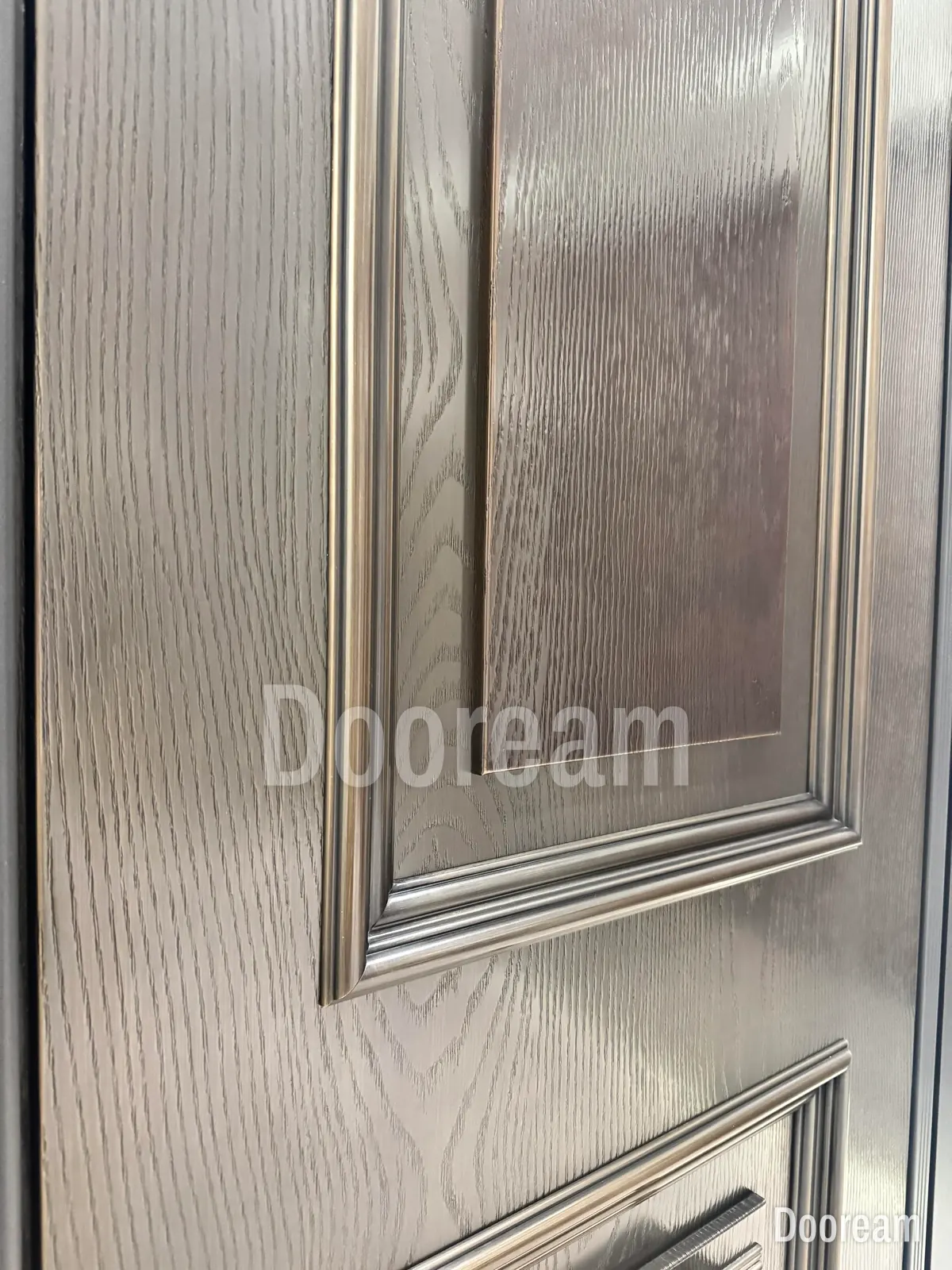
Nothing fixed. They are sales names, and we know of no standard that defines them. QUALIDECO sorts decorated finishes into class 1 and class 2 by weathering, not by “D” numbers. Suppliers use the numbers for different things: a sharper print, a textured base you can feel, or grain over a carved or bent surface. Ask what is meant, then judge the sample.
- Feel. Some ranges put the grain on a textured base so it reads by touch; DECO in Australia, for example, offers its wood-grain powders as textured, smooth gloss or slip-resistant. Run your hand over the sample.
- Repeat. A print is a photograph that repeats. Ask the repeat length, and look for the same knot twice on a tall leaf.
- Edges and grooves. Ask how edges, returns and any carved or cast relief are covered.
How long does a printed finish last in strong sun?
As long as the base powder and the film last together, and they are tested as a pair. QUALIDECO class 1 decorations are approved after 1 year of Florida exposure and class 2 after 3 years. A plain Qualicoat Class 3 powder is assessed after 10 years. So a top-class powder does not make the print top class.
- Base coat. Under QUALIDECO a sublimation powder needs its own approval for sublimation, and the film maker needs a licence. A Qualicoat class or AAMA result for the plain powder describes the powder, not the printed finish.
- Pairing. A coater quoted by IPCM reaches QUALIDECO class 1 by combining super-durable films with Qualicoat Class 2 powders: a class 2 powder, a class 1 print.
- Light colours fade first. The same article says standard films on light backgrounds lose colour quickly under UV, while dark bases partly hide it.
- Heat. Dark wood tones run hot in full sun; see front door colours and finishes for strong sun.
How does printed aluminium compare with wood and stone?
| Printed aluminium | Solid timber | Timber veneer | Film wrap | Natural stone | Sintered stone | |
|---|---|---|---|---|---|---|
| Weight | 4 mm sheet about 10.8 kg/m² | Varies by species | Set by the core | Set by the profile | 20–30 kg/m² per 10 mm | 14 kg/m² at 6 mm, 29 at 12 mm (Neolith) |
| Sun | Set by powder and film; light prints fade first | Unfinished, yellows or browns within about 2 months, then greys | As timber; thin layer to protect | RENOLIT quotes up to 10–20 years, by film and climate | Varies by stone; ask for data | No colour change in Neolith’s UV test |
| Water | Does not absorb | Swells, shrinks, can rot | Core and edges must stay sealed | Plastic film, PVC or acrylic | ASTM limits: granite 0.40%, marble 0.20% | 0.1% or less (Neolith) |
| Upkeep | Wash | Repaint or restain every 2–8 years | As timber, with more care | Wash | Marble and limestone etch with mild acids | Wash |
| Scratches, repair | A scratch through the coating cannot be blended in; touch-up cannot reprint grain | Sand and refinish | Light sanding only | Ask the maker | Can be honed and polished | Ask the maker |
Aluminium weighs 2.70 g/cm³. The Natural Stone Institute gives natural stone a specific gravity of 2 to 3, and warns that marble and limestone are attacked even by lemon juice. For steel, bronze and fibreglass, see front door materials compared.
Where does a wood look suit a villa, and where is stone better?
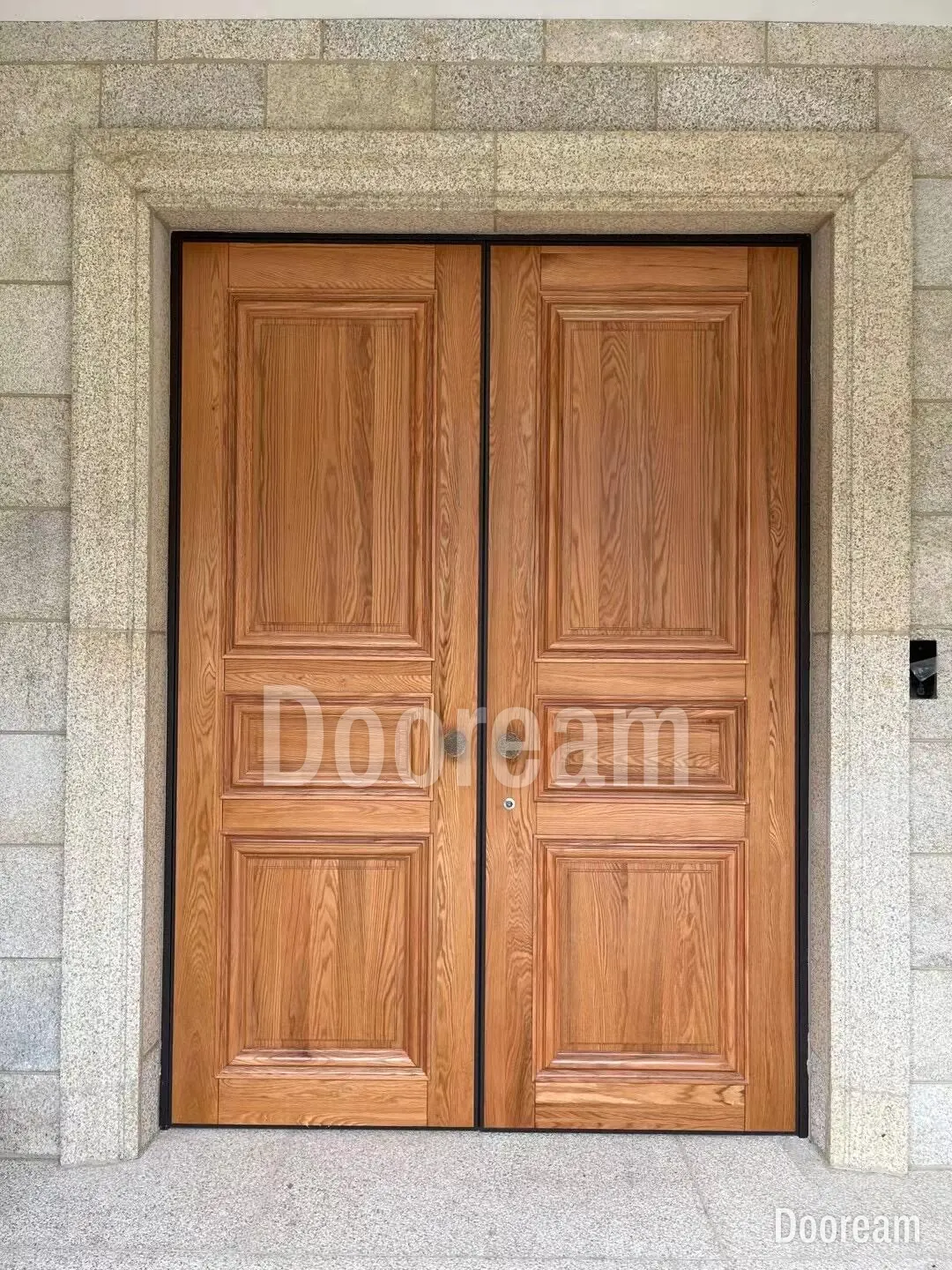
Wood tones suit cool, hard façades: pale limestone, granite, white render, dark stone or dark cladding. Warm brown against grey granite, as in the photo at the top, is the classic pairing. Under a deep canopy real timber is an option; in full sun or rain a printed aluminium face keeps the look without refinishing.
A stone look is chosen to make the door disappear into a stone wall, or to carry an interior’s marble onto the inside face. Here the real material often wins, because a print is judged beside the real wall. Sintered stone is the lighter route: at 6 mm, Neolith weighs 14 kg/m², against 20–30 kg/m² for every 10 mm of natural stone. On a pivot door, check the leaf weight against the hinge rating.
How do you match the colour across leaves, frame and cladding?
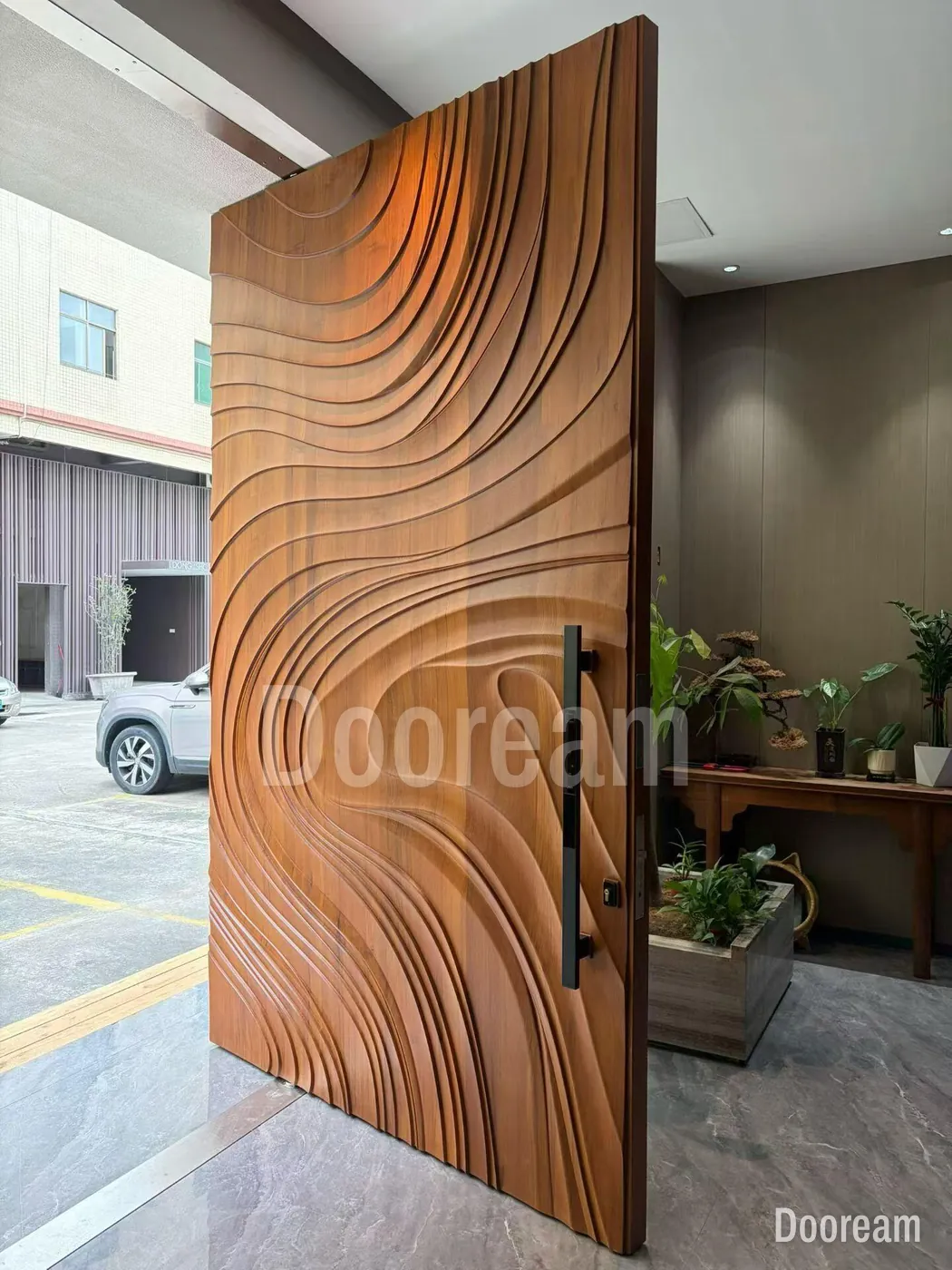
A print’s colour is the ink plus the base colour under it, so one film looks different on two bases. QUALIDECO groups its standard class 1 decorations this way: walnut and oak on a brown base, pine and oak on a beige base.
- One run. Print both leaves, the frame and any matching panels from the same powder batch and film batch.
- Grain direction. Mark it on the drawing for every part: vertical, horizontal, or continuous across a pair.
- Frame. Match it to the grain’s darkest tone, or choose a plain contrasting colour.
- Real timber nearby. A print will not match real wood cladding exactly; approve both samples side by side.
How do you approve a sample?
Follow our colour guide, then for a print:
- Ask for it on the real face, powder and film, not a paper swatch.
- Write the powder code, film code and decoration class on the back.
- View it outdoors beside the façade. QUALIDECO checks flaws at about 60° from 3 m, and outdoor parts on site from 5 m.
- Rake light across it to see whether the grain is flat or textured.
- Check an edge and any groove.
- Sign, date and keep it to check the delivered door.
How do you clean a printed finish?
As a good powder coat: lukewarm water, a mild pH-neutral detergent, a soft cloth, then rinse. No solvents and no abrasives. Decoral recommends a powder layer of 70–90 µm, and the grain lives inside it, so a scouring pad that only dulls a plain colour can wear the pattern away. Full routine: cleaning an aluminium front door.
Checklist for specifying a wood-look door
- Method: sublimation, powder-on-powder or film wrap.
- Base powder: name, code, and its Qualicoat class or AAMA specification.
- Film: maker and pattern code; repeat length.
- Printed finish: QUALIDECO class or a weathering report on the powder and film together.
- Texture and gloss: smooth or textured grain.
- Grain direction for each part; how edges and grooves are finished.
- One batch for leaves, frame and matching panels.
- Shade for dark tones in full sun.
- Signed sample, kept on site.
- Care and repair: cleaning instructions and the touch-up method.
- Warranty: whether it covers the coating, the print, or both.
How does this work with Dooream?
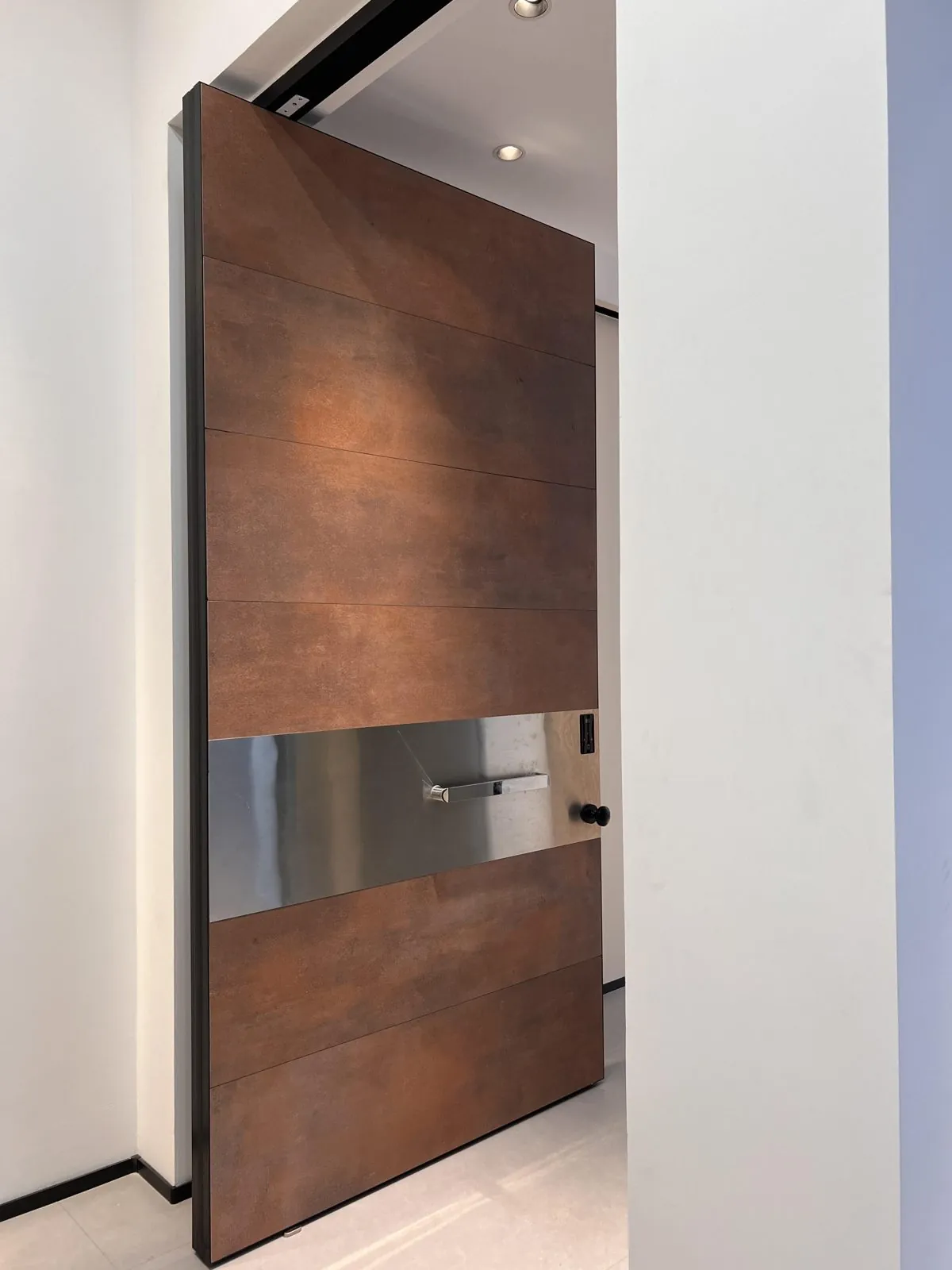
Our Grain Band has a finish we list as a 5D wood-grain print, on warm brown panels split by a brushed metal band; like any “D” number it is a name, so judge it on a sample. Contour is listed with brushed metallic paint or a wood-grain transfer. Most of our doors are finished in PVDF paint. We do not offer a printed stone effect; for a stone look we use sintered stone as a face material, as on the inside of Black Warrior, with a fluted walnut band. Our faces are mostly carved aluminium, also cast aluminium, sintered stone, glass, wood and copper. We can send a 20 × 20 cm sample of the face, and every door has a two-year warranty from shipment. If your specification calls for a decoration class or a test on the printed finish, say so through our architects page or contact page; a third-party test can be arranged, usually at the buyer’s cost.
Sources, checked November 2026: QUALICOAT, QUALIDECO specifications, appendix to the QUALICOAT Specifications 2026; AkzoNobel, decoration powder coatings; Decoral System, quality book; IPCM, super durable sublimation films for aluminium; FCA Magazine, why Florida test for architectural powder coating; DECO Australia, DecoWood aluminium finishes; RENOLIT, about RENOLIT EXOFOL films; Cassens and Feist, US Forest Service, finishing wood exteriors; Neolith, technical data sheet; Natural Stone Institute, the importance of testing when specifying natural stone; Royal Society of Chemistry, aluminium.
Quick answers
What is a 5D wood-grain aluminium door?
An aluminium door whose face is powder coated and then printed with a wood pattern, usually by sublimation. A printed film is pulled tight over the coated metal under vacuum and heated, and the ink passes into the coating. "3D", "4D" and "5D" are sales names, not test classes; QUALIDECO, the QUALICOAT label for these finishes, has only class 1 and class 2.
How long does a printed wood-grain finish last in strong sun?
As long as the base powder and the film last together, which is why they are tested as a pair. QUALIDECO class 1 decorations are approved after 1 year of Florida exposure and class 2 after 3 years, while a plain Qualicoat Class 3 powder is assessed after 10 years. Light prints fade first. Ask for the class or test report of the printed finish, not just the powder.
Is printed aluminium better than real wood or stone for a villa door?
For a large door in sun or rain it is usually more practical. It does not swell, rot or need refinishing like timber, which needs new paint or stain every 2 to 8 years outdoors, and it is far lighter than stone. But it cannot be sanded back, and a scratch through the coating cannot be blended in. For a true stone look, sintered stone is lighter than natural stone.