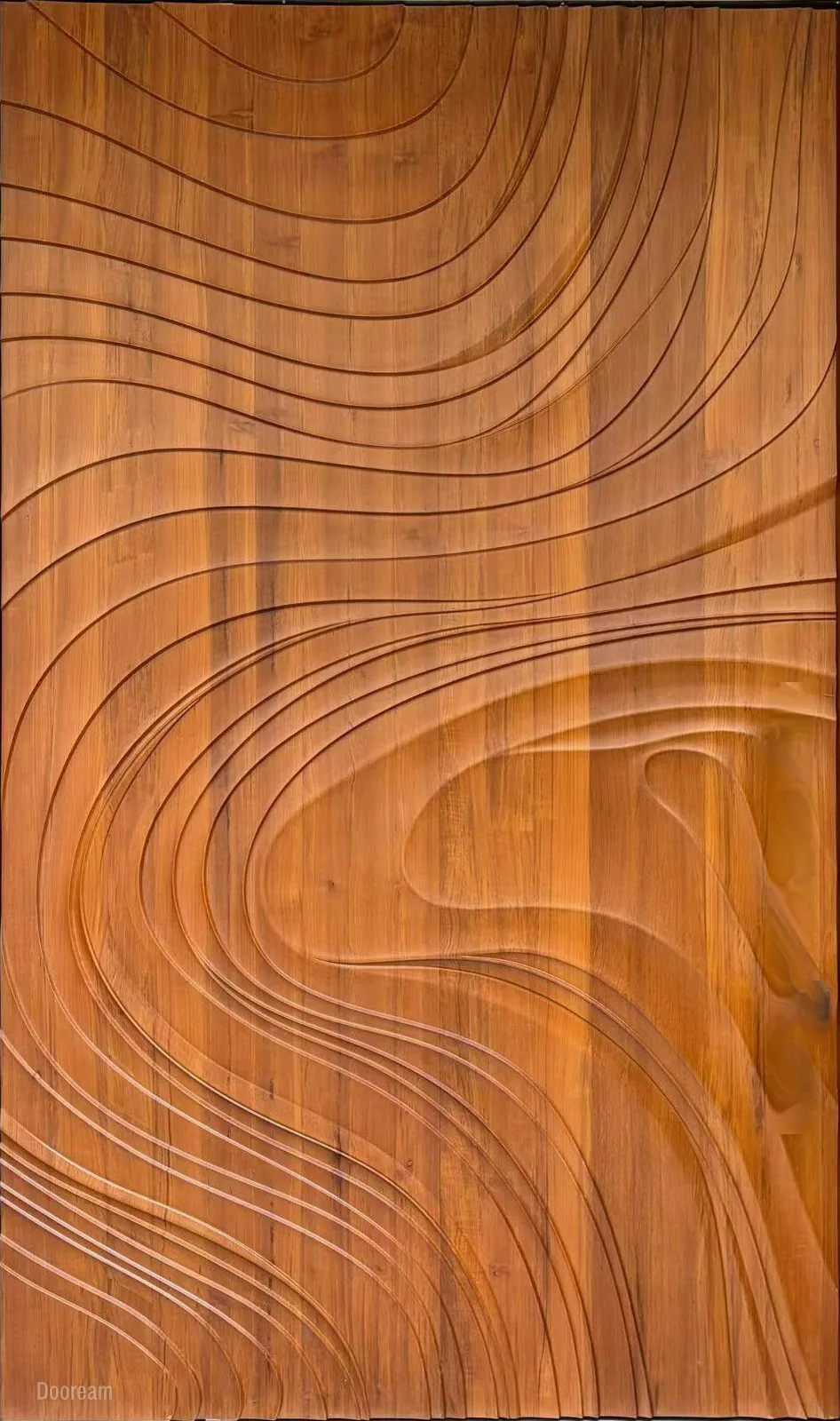
Short answer: factories create a wood look on aluminium entrance doors in three ways: heat-transfer sublimation film, textured or multi-layer “5D” printing, and CNC-carved relief finished in architectural paint or transfer colour. All three avoid timber’s swelling, rot and frequent recoating, yet they read very differently up close and age by their underlying coating system.
How are wood-look aluminium entrance doors made?
Three production routes cover nearly all wood-look aluminium doors: heat-transfer sublimation into powder coat, textured or multi-layer “5D” wood-grain printing, and CNC-carved aluminium relief finished in paint or transfer colour. They differ in coating chemistry, surface depth, and whether the grain exists only as ink or as real three-dimensional form.
- Heat-transfer sublimation film. Pretreated aluminium receives a thermosetting base powder (governed in Europe by EN 12206-1:2021 and QUALICOAT). Vacuum-wrapped printed film is heated so ink enters the cured powder as vapour; see our 5D wood and stone print guide for the oven process.
- 5D wood-grain print. “5D” is a trade name, not an ISO or QUALIDECO grade. Factories use it for textured base powders, multi-tone transfer films or powder-on-powder coats that cut sheen and add subtle touch.
- CNC-carved wood grain. A router mills flutes or contours into solid aluminium plate (how CNC-carved doors are made, cast vs carved faces), finished in fluorocarbon (PVDF) paint, brushed metallic wood tones or transfer grain.
| Property | Transfer print | 5D print | CNC-carved grain | Solid timber |
|---|---|---|---|---|
| Feel | Flat powder film | Light texture, low glare | Milled ridges in metal | Natural timber pores |
| Close view (1–2 m) | Uniform sheen; repeats | Finer tone; repeats | Real raking shadow | True grain variation |
| Street view (5–15 m) | Warm wood tone | Warm tone, soft glare | Shifting shadow lines | Warm tone; joinery depth |
| Weathering standard | QUALIDECO Class 1 (1 yr) / 2 (3 yr) | Pair class or lab test | Up to AAMA 2605 PVDF (10 yr) | Recoat every 2–8 yrs |
| Edges and grooves | Film can blur in corners | Best on shallow profiles | Paint coats crisp corners | Joints move with moisture |
| Scratch repair | Cannot reprint grain | Cannot reprint grain | Local paint touch-up | Sand and refinish |
| Upkeep | Mild soap wash | Mild soap wash | Wash; rinse grooves | Periodic sanding and stain |
How does each wood-look method read up close versus from the street?
Viewing distance separates all three finishes. From the street or gate at 5 to 15 m, the eye merges fine pores into one warm tone, and only carved relief casts shadows that shift across the day. At the doorstep, within 1 to 2 m, flat sublimation betrays its sheen first while carved metal holds up under raking light.
EyeWiki puts ideal resolution near 1 minute of arc, about 0.29 mm per metre. At 10 m, fine grain merges into flat tone, so street presence relies on contrast against the wall, panel seams and real shadow depth (carved relief depth and light).
Up close on the step, three cues separate finishes:
- Raking light. Sideways light (the National Gallery’s raking light) exposes flat transfer sheen across knots that cast no shadow. Textured 5D bases cut glare; CNC-carved ridges cast real shadow.
- Pattern repeat. Film repeats every roller length, showing duplicate knots on leaves over 3 m. Horizontal joints, brushed bands or angled facets break up repeats.
- Touch. Smooth metal beside a wood photograph feels artificial near the pull; textured bases soften the gap, while carved grooves read clearly as sculpted metal.

How do wood-look aluminium finishes compare with solid timber in sun, heat and coastal air?
Exposed timber moves with humidity, greys in sun and needs recoating every 2 to 8 years. Wood-look aluminium stays stable and never rots, with outdoor life governed by coating chemistry and pretreatment rather than the wood pattern. In severe UV and salt air, PVDF-painted carved aluminium outlasts sublimation prints.
The US Forest Products Laboratory Wood Handbook and Cassens and Feist (USDA AH-647) note that bare exterior timber browns within months before greying and swells 30 to 100 times more across the grain than along it, causing sticking and bowing on tall leaves (front door materials compared, bowing and warping).
Compare aluminium coating benchmarks:
- Sublimation and 5D prints. QUALIDECO approves base powder and film as a pair: Class 1 after 1 year of subtropical outdoor exposure and Class 2 after 3 years, alongside xenon-arc testing to ISO 16474-2. IPCM notes light wood prints on pale bases fade faster under UV than darker walnut tones.
- PVDF paint on carved grain. Pigmented fluorocarbon unlocks higher weathering tiers. Under FGIA/AAMA specs summarised by Southern Aluminum Finishing and Knotwood, AAMA 2604 requires 5 years of subtropical outdoor exposure and 3,000 hours of salt spray, while AAMA 2605 70% PVDF requires 10 years (ΔE within 5, at least 50% gloss retention) and 4,000 hours of salt spray (coastal door finishes).
- Salt air and heat. Within 5 km of the sea, QUALICOAT Seaside doubles minimum etching from 1 g/m² to 2 g/m². Because aluminium expands roughly twice as much per degree as steel, dark tones in full sun benefit from shade (canopies and overhangs, front door colours).
Because bare aluminium conducts heat far faster than wood, insulation relies on the core, seals and thermally broken frame (thermal breaks).
When is real wood still the better choice, and when should you avoid it?
Real solid or engineered timber still fits deeply recessed porches, covered lobbies and modest leaf sizes where the owner welcomes patina and routine maintenance. Avoid exposed solid timber on west-facing or coastal elevations, in intense arid sun, or on pivot and double doors above 3 m where moisture swing and UV wear down finishes fast.
A clean compromise is a mixed build: weatherproof wood-look aluminium outside, paired with real timber panelling on the sheltered interior face. For exposed coastal sites, see coastal villa front door materials.
How should you specify and check a wood-look aluminium door sample?
Never write only “5D wood-grain aluminium” in a specification. State the exact surface method, the coating standard and pretreatment, grain direction across each panel, and edge coverage. Then inspect a physical sample made on the actual face material, held upright in real daylight at doorstep and street distances before signing off production.
Follow this eight-point specification and sample checklist:
- Name the method. State transfer sublimation, textured multi-layer print, or CNC-carved relief with PVDF paint or transfer grain.
- Request system proof. Ask for the QUALIDECO class (1 or 2) or ISO 16474-2 data on the powder-and-film pair, or AAMA 2604/2605, QUALICOAT or EN 12206-1 targets for painted metal.
- Add coastal pretreatment. Within 5 km of salt water, specify deeper etching (QUALICOAT Seaside) and verify hardware corrosion grades.
- Fix grain direction and repeat. Mark vertical, horizontal or faceted grain on every part and confirm pattern repeat length.
- Inspect edges and grooves. Check how film or paint wraps tight corners, shadow gaps and lock stiles without blurring.
- View the sample at two distances. Stand it upright outdoors at 1.5 m in raking light, then at 5 to 10 m (door samples).
- Lock one coating batch. Leaves, frames and matching panels must share one base-powder batch and film lot.
- Confirm care and touch-up. Printed grain cannot be blended invisibly after deep scratches; agree washing rules upfront (door maintenance).
How does this work with Dooream?
Dooream is the export brand of Zhejiang Jingyi Door Industry Co., Ltd., a family-run door factory in Wuyi County, Jinhua, Zhejiang, China. We make complete custom aluminium armoured entrance doors only, from one door, with OEM available: single, double and unequal double up to 3,000 × 6,000 mm, and offset pivot up to 4,000 × 8,000 mm.
Every leaf uses our layered build (outside to inside): carved or cast aluminium face (also aluminium sheet, sintered stone, glass, wood or copper), galvanised steel sheet, aluminium profile frame with aluminium honeycomb core, galvanised steel sheet, and inner face. Offset pivot doors use pivot hinges, most often FritsJurgens, with KFV, G-U or Wintech smart locks.
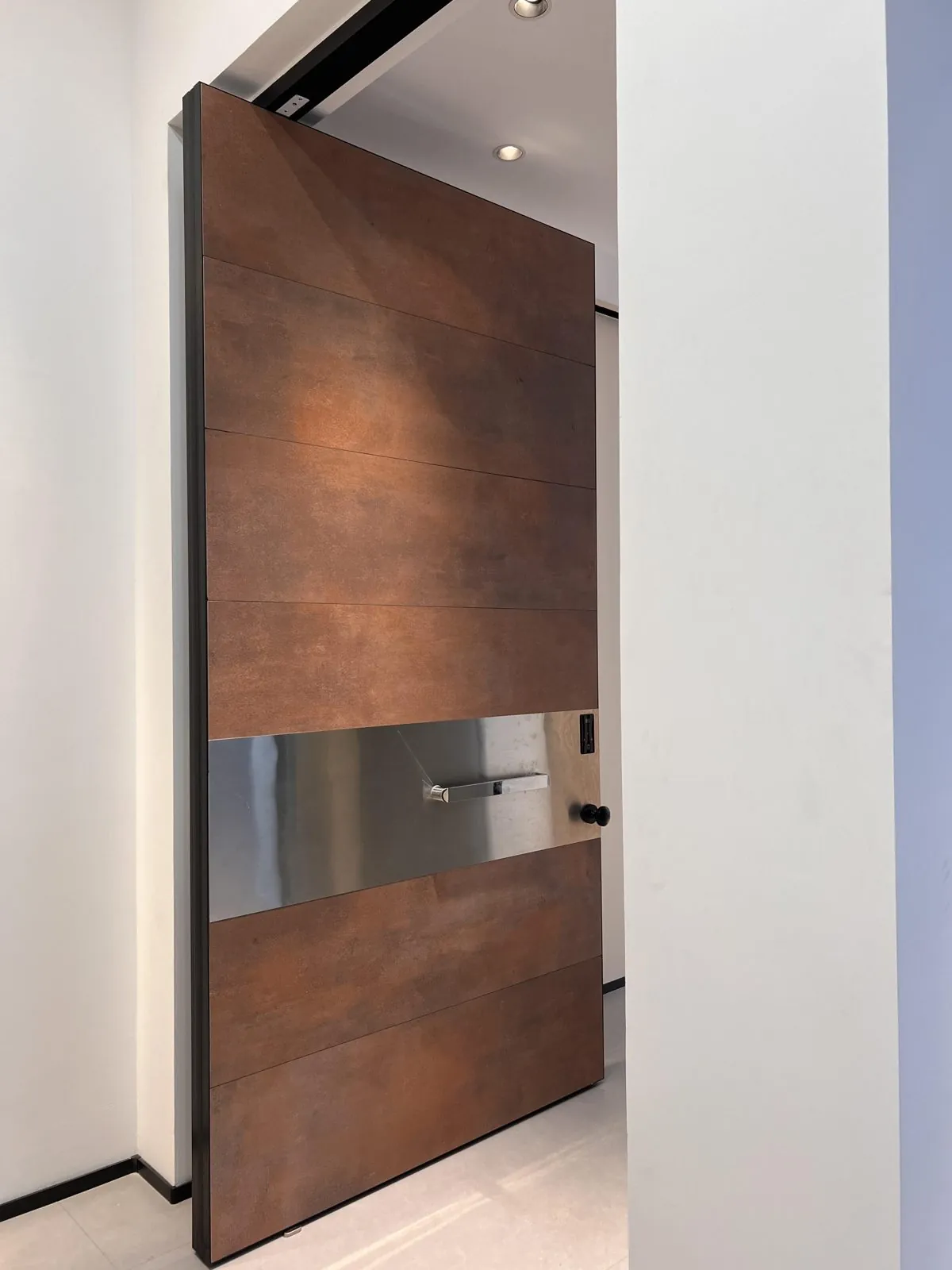
- Grain Band: an offset pivot door with warm brown aluminium sheet panels listed with a 5D wood-grain print, split by a brushed metal handle band.
- Contour: an offset pivot door with a CNC-carved aluminium face in sweeping contour grooves, finished in brushed metallic paint or wood-grain transfer.
- Real wood indoors: an aluminium exterior can pair with timber indoors, as on the fluted walnut interior band of Black Warrior.
Our thermal-break construction, with PA66 polyamide insulating strips in the aluminium profiles, can be used with any of our designs. We don’t publish a U-value for it; if your project needs one, we can arrange a test for your order, usually at the buyer’s cost. We hold no EN 1627 or fire-rated certifications; third-party tests can be arranged, usually at the buyer’s cost.
Orders are quoted EXW Wuyi (50% deposit, 50% before shipment), with 35–45 days production and a 2-year warranty from shipment. We supply 20 × 20 cm face samples before production, and local installers fit using our drawings and remote guidance. Start via our architects page or contact page.
Sources, checked November 2026: QUALICOAT, QUALIDECO specifications, appendix to the QUALICOAT Specifications 2026 and QUALIDECO portal; AkzoNobel, decoration powder coatings; Decoral System, quality book; IPCM, super durable sublimation films for aluminium; Southern Aluminum Finishing, painting guidelines and AAMA specifications; Knotwood, AAMA 2603, 2604 and 2605 comparison; Glass Times, Qualicoat Seaside class; Cassens and Feist, US Forest Service, finishing wood exteriors; US Forest Products Laboratory, Wood Handbook, chapter 3, physical properties and moisture relations of wood; EyeWiki (American Academy of Ophthalmology), visual acuity testing in adults; The National Gallery, raking light.
Quick answers
What is the difference between transfer print, 5D print and carved wood grain on an aluminium door?
Heat-transfer sublimation drives ink from a printed film into a base powder coat on a flat or gently contoured panel. '5D' is a trade name rather than a test standard, used for textured or multi-layer wood prints with lower glare and finer detail. Carved wood grain mills real grooves or relief into solid aluminium before coating, so physical shadow carries the look.
Do wood-look aluminium doors look convincing up close as well as from the street?
From 5 to 15 m at the street or gate, all three read as warm timber tones, though only carved wood grain casts changing shadows through the day. At arm's length on the step, flat sublimation reveals pattern repeats and even sheen, textured 5D print adds touch and cuts glare, and CNC-carved grain holds up best in raking light.
How does a wood-look aluminium door hold up in sun and coastal air compared with solid timber?
Aluminium avoids the swelling, cracking and frequent recoating that exposed timber needs every 2 to 8 years. Outdoor life is set by the coating system, not the timber look: QUALIDECO Class 2 sublimation systems pass 3 years of subtropical outdoor exposure, whereas AAMA 2605 fluoropolymer paint over carved aluminium is tested to 10 years and 4,000 hours of salt spray.