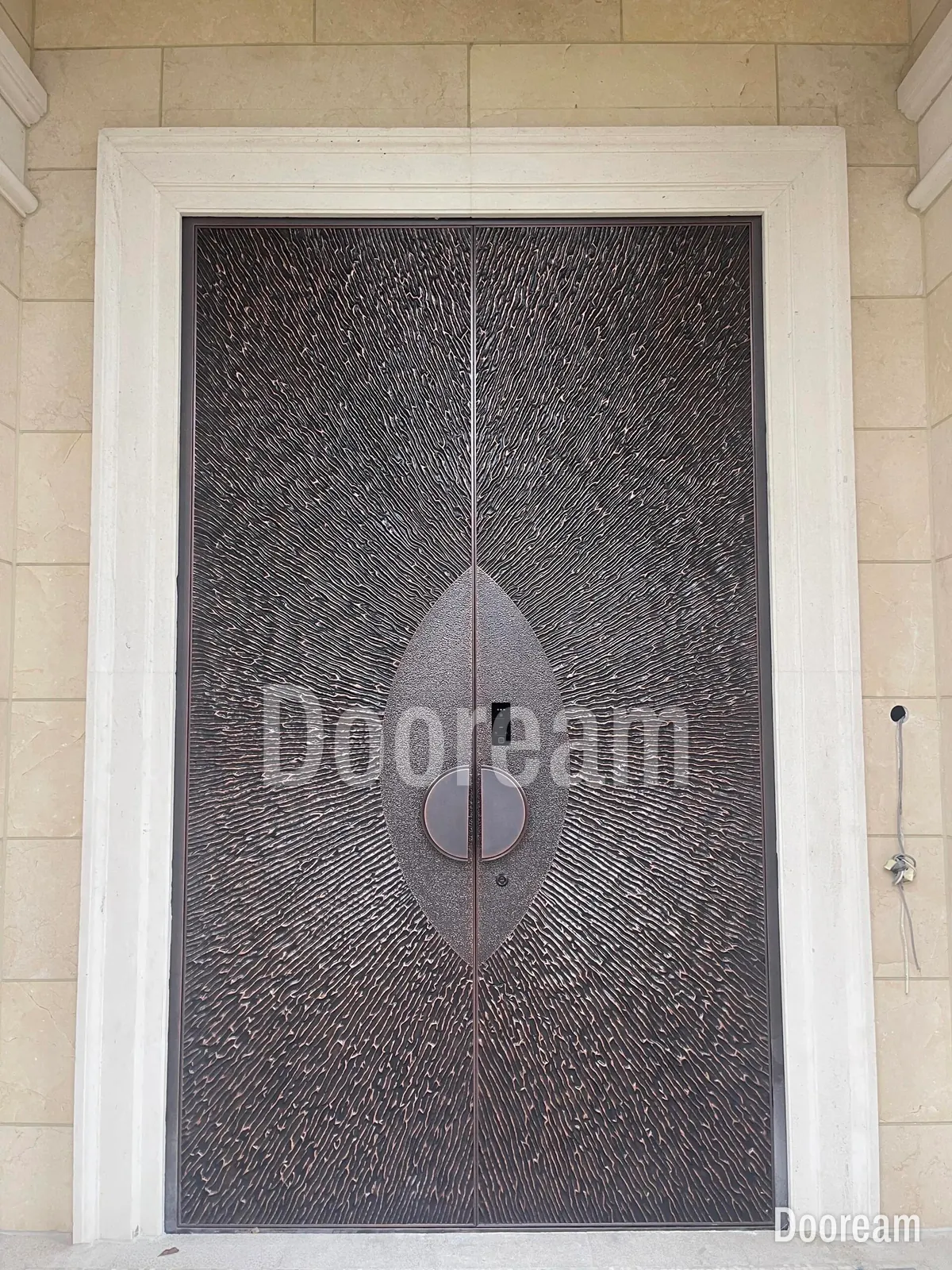
Short answer: most “wrought iron” doors sold today are mild steel. Compared with them, cast aluminium wins near the sea, on weight and on upkeep, and an insulated armoured aluminium door beats a typical steel-and-glass grille door on insulation. Steel or real wrought iron wins for an open forged grille, for heritage work and where any local smith must be able to repair the door.
Is a “wrought iron” door really made of wrought iron?
Rarely. Historic Environment Scotland’s Engine Shed says wrought iron has not been made since the 1960s and is only available as recycled material. It adds that “wrought iron” is often used by mistake for ornamental mild steel, and that “wrought steel” would be more accurate. So a new “wrought iron” door is usually mild steel.
The metals differ. Engine Shed says wrought iron resists corrosion better than mild steel. The Government of Ireland’s guide to repairing ironwork calls mild steel the most common substitute, notes its inferior corrosion resistance, and warns that fabricators’ replicas can lose design detail. Ask which metal, which steel grade and which protection.
How do cast aluminium and “wrought iron” doors compare?
The table compares a cast aluminium armoured door with a typical new “wrought iron” door: a mild steel frame and grille with glass behind. Frame, lock, glass and fitting matter as much as the metal. For bronze and other materials, see cast aluminium or bronze and materials compared.
| Cast aluminium armoured door | “Wrought iron” door, usually mild steel | |
|---|---|---|
| Corrosion | Thin oxide layer; chlorides attack it | Rusts wherever the coating breaks |
| Protection near the sea | Tested coating, washed regularly | Hot-dip galvanising under paint or powder |
| Metal weight, per mm and per m² | 2.7 kg | 7.85 kg |
| Thermal conductivity of the metal | 160 W/m·K, typical alloy | 50 W/m·K |
| Insulation, whole door | Set by core and thermal break | Mostly set by the glass; often poor |
| Security | Steel sheets inside; the test decides | Strong bars; glass near the lock is the weak point |
| Design | Solid face: deep, rounded relief, repeatable | Open grille: forged scrolls, glass behind |
| Routine upkeep | Washing; touch up chips | Inspection, rust spotting, repainting |
| Repair | Coating repair; a broken casting is recast | Weld, forge or replace bars almost anywhere |
| Relative cost | High for a one-off, as a new pattern needs a mould; less when repeated | Low for stock steel; high for hand-forged work |
What happens to each metal near the sea?
Steel rusts; aluminium oxidises. The Royal Society of Chemistry notes that, unlike iron, aluminium forms a microscopically thin oxide layer that protects its surface from further corrosion. The US General Services Administration (GSA) calls it thin, tough and largely protective, but says aluminium resists chlorides poorly. So both metals need a coating near the sea.
Steel. The Irish guide notes that expanding rust bends and distorts ironwork. The durable answer is hot-dip galvanising with paint or powder on top, a duplex system. The American Galvanizers Association (AGA) puts its life at 1.5 to 2.3 times the sum of the two coatings alone, and 1.4 to 1.6 in extreme marine settings. ISO 12944 grades sites from C1 to C5; in Hempel’s summary, coast with low salt is C3 and coast with lots of salt C5.
Aluminium. Choose a PVDF, powder or anodised finish tested for the site; see coastal door finishes.
Mixed metals. The GSA says aluminium corrodes where it touches iron or unpainted steel, but is compatible with galvanised steel. In a steel sub-frame, use galvanised steel and isolate every contact.
How much heavier is a steel door, and what does it change?
About three times, volume for volume. The Royal Society of Chemistry gives 2.70 g/cm³ for aluminium and 7.87 g/cm³ for iron; structural steel is about 7,850 kg/m³. Each millimetre of metal, per square metre, weighs 2.7 kg in aluminium and 7.85 kg in steel. The Australian Aluminium Council says aluminium can weigh a third as much as steel of the same size and shape.
That weight, plus any glass, goes into:
- Hinges or a pivot, rated for the whole leaf at its width; see hinges for heavy doors and pivot door size and weight.
- Wall fixings, which must hold the frame without sagging over the years.
Which insulates better?
Steel, metal for metal; the insulated door, door for door. BRE’s BR 443 (2019) gives 50 W/m·K for mild steel and 160 W/m·K for a typical aluminium alloy. But a typical iron door is steel bars and glass, and Bath & North East Somerset Council lists single glazing at 5 to 5.6 W/m²K, against 1.5 for double low-E glazing with argon.
So on a steel door, ask about the glass (insulated glass), the seals and the frame. Solid steel running from outside to inside carries heat out, but thermally broken steel systems exist: a 2014 trade report on one such steel door system gave Ud values of up to 1.0 W/m²K, using a glass-fibre-reinforced isolator.
An armoured aluminium door insulates through its core and a thermal break, not the metal; see door U-values explained. Our thermal-break construction, with PA66 polyamide insulating strips in the aluminium profiles, reaches a U-value of 1.0 W/m²K in our test report, and any of our designs can be built with it.
Which is more secure?
Neither, because of the metal alone. Resistance comes from the whole door: frame fixing, locking points, hinge side and glass. An armoured door hides steel sheets behind its faces; an iron door relies on bars and glass. Either way, ask for a test report on the door itself.
On an iron door, check whether broken glass and a wide grille gap would let a hand or tool reach the inside handle, and any opening glass panel. See armoured door or steel security door and glass in entrance doors.
How do the designs differ?
Forged scrollwork is drawn in bars, heated, hammered, twisted and joined, with glass behind; its strength is light through the grille. A cast face is a solid sculpted surface. The mould carries deep, rounded relief, even undercuts, and repeats it exactly from door to door.
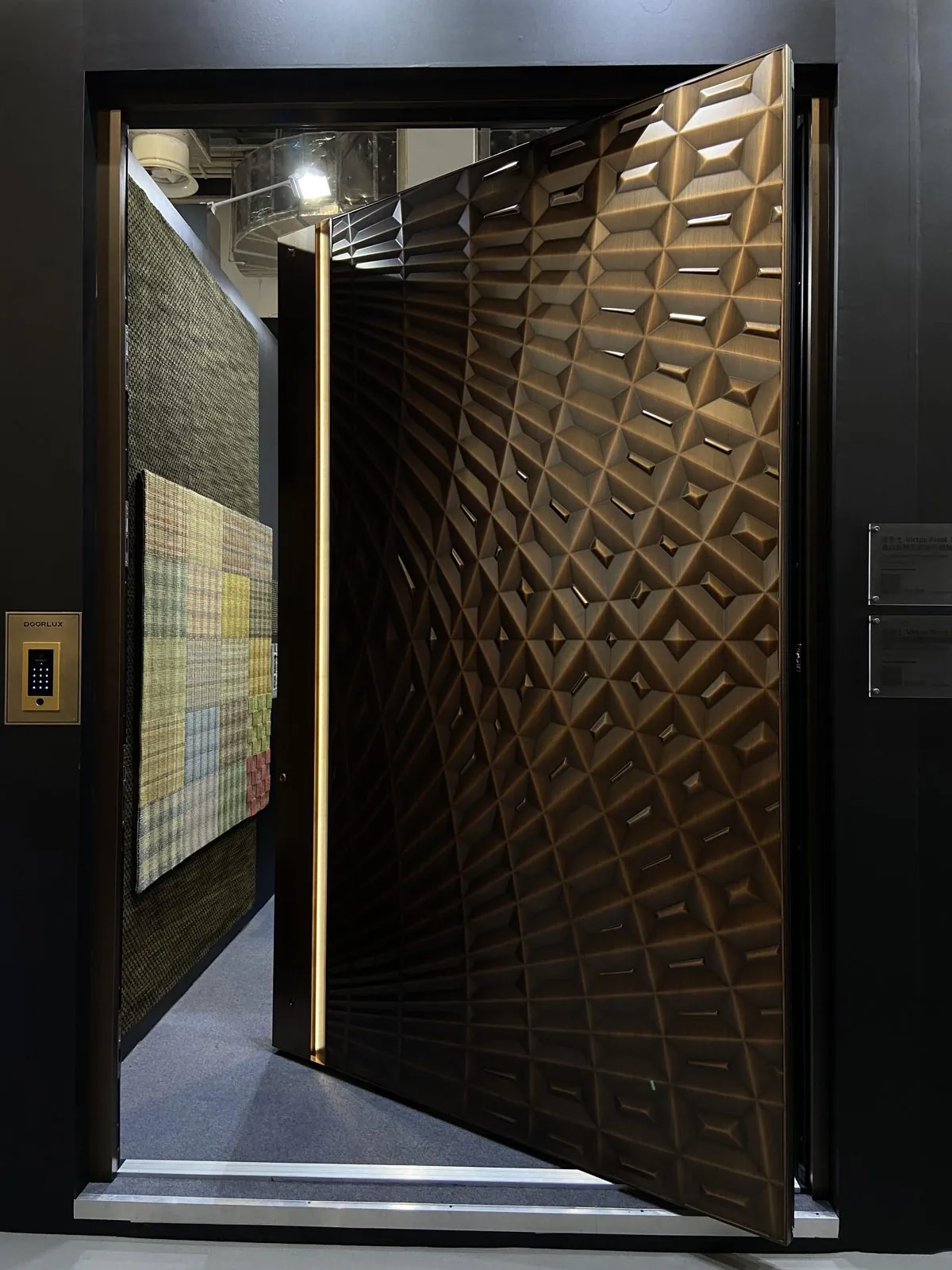
A cast door brings light in through glazed openings or light lines, not a grille, so it cannot copy the see-through look of forged bars. Choose the look first, then the metal; see cast or CNC-carved faces.
What upkeep and repairs does each need?
Iron and steel need watching and repainting; coated aluminium needs washing. The Irish guide says ironwork should be checked every year and cleaned and painted at least every five years, and Engine Shed says to remove corrosion as soon as you spot it. For aluminium, see aluminium front door maintenance.
For steel paint systems, ISO 12944 sets durability ranges: low up to 7 years, medium 7 to 15, high 15 to 25 and very high over 25. The Institute of Corrosion stresses that this is the time to first major maintenance, not a guarantee. Over the life of a door, each repainting adds to the cost of steel; washing costs little.
Repair favours steel. A welder or smith almost anywhere can cut out a bar and weld in a new one. But welding means removing the zinc at the weld, and heat damages the coating nearby; the AGA’s three repair methods under ASTM A780 (zinc-rich paint, thermal-spray zinc, zinc solder) do not equal the original hot-dip coat. Real wrought iron should ideally be forge-welded, the Irish guide says. A broken aluminium casting is replaced by a new one from the pattern or mould, so ask the maker to keep it.
When is wrought iron or steel the better choice?
When the brief calls for what only iron does well:
- Heritage work. Repairing or matching original ironwork, where conservation advice favours wrought iron and forge welding.
- An open grille. The owner wants light and a view through forged bars, not a solid face.
- Local repair. A remote site where any smith must be able to fix the door.
- A dry inland site, with an owner who will repaint on schedule.
- A stock size and a tight budget, where a standard steel door usually costs less than a custom leaf.
Checklist: cast aluminium or iron for this villa?
- Metal: wrought iron, mild steel or aluminium, in writing.
- Site: distance from the sea; ISO 12944 category.
- Coating: galvanising plus paint or powder for steel; a tested finish for aluminium.
- Weight: full leaf weight, and a hinge or pivot rated for it.
- Insulation: a U-value for the whole door, glass included.
- Glass: type, and distance from the lock.
- Security: a test report for the door as supplied.
- Upkeep: a written schedule, and who repaints or washes.
- Repair: a local repairer, and whether the pattern or mould is kept.
- Mixed metals: how aluminium is isolated from steel.
How does this work with Dooream?
We do not make iron or steel doors. We make aluminium armoured entrance doors with carved or cast aluminium faces. From outside to inside: face panel, galvanised steel sheet, aluminium profile frame with aluminium honeycomb core, second galvanised steel sheet, inner panel. Lattice has a cast face in dark bronze-coloured fluorocarbon paint. We hold no EN 1627 rating; lab testing can be arranged, usually at the buyer’s cost. Production takes 35–45 days after drawing approval and deposit. Send your opening through our architects page or contact page.
Sources, checked November 2026: Historic Environment Scotland, Engine Shed, iron; Government of Ireland, Iron: The Repair of Wrought and Cast Ironwork (2009); Royal Society of Chemistry, aluminium and iron; US General Services Administration, aluminum: characteristics, uses and problems; Australian Aluminium Council, properties of aluminium; Eurocode Applied, steel design properties; BRE, BR 443, conventions for U-value calculations (2019); Bath & North East Somerset Council, double glazing U-values; Glass on Web, Janisol HI steel windows and doors (2014); American Galvanizers Association, duplex systems, synergistic effect and recoating after welding galvanized steel; Institute of Corrosion, setting coating specifications for environment and durability; Hempel, how to specify for corrosion protection.
Quick answers
Is a wrought iron door really made of wrought iron?
Rarely. Historic Environment Scotland says wrought iron has not been made since the 1960s and is only available as recycled material, and that the term is often used by mistake for ornamental work in mild steel. Most new "wrought iron" doors are mild steel, so ask for the steel, the galvanising and the paint or powder system.
Which is better near the sea, cast aluminium or an iron door?
Usually coated aluminium. Aluminium forms a thin protective oxide layer, while mild steel rusts wherever its coating breaks, so a steel door near the sea needs hot-dip galvanising under its paint or powder coat. Both still need a coating chosen for the site and regular washing, and aluminium must be kept apart from unpainted steel.
Does an iron door insulate better than an aluminium one?
The metal does: BRE's BR 443 gives 50 W/m·K for mild steel and 160 W/m·K for a typical aluminium alloy. The door usually does not, because an iron door is mostly steel bars and glass, and single glazing has a U-value of about 5 to 5.6 W/m²K. An insulated, thermally broken door of either metal does far better.