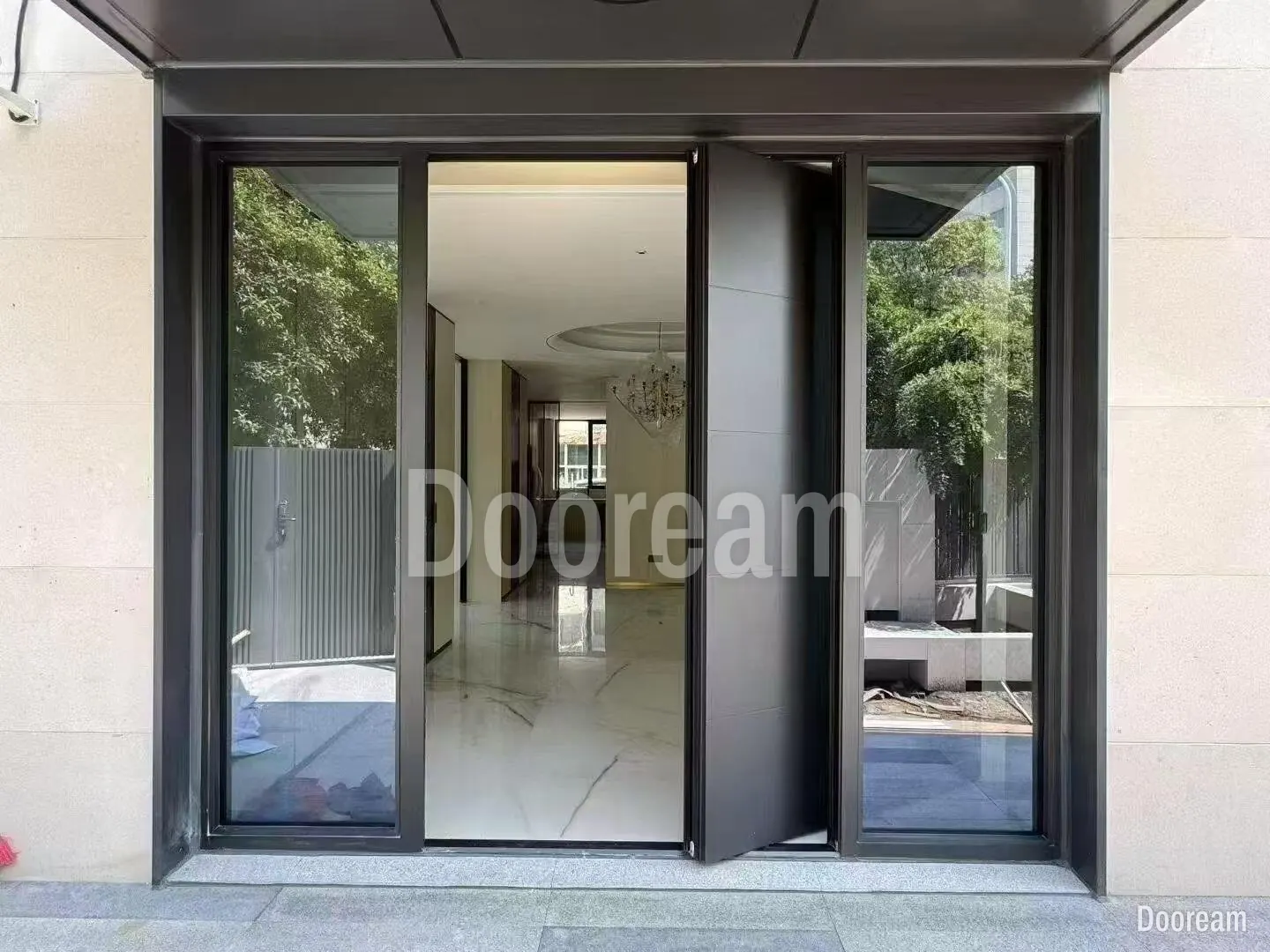
Short answer: glass in a front door is safe for people when it is safety glass, toughened or laminated, classed to EN 12600. It is secure only where it is laminated security glass classed to EN 356, because a broken toughened pane leaves an open hole. The weak points are panes a hand can reach the lock through, so specify laminated glass there, held by beads on the inside.
Where does glass go in an entrance door, and where is it weakest?
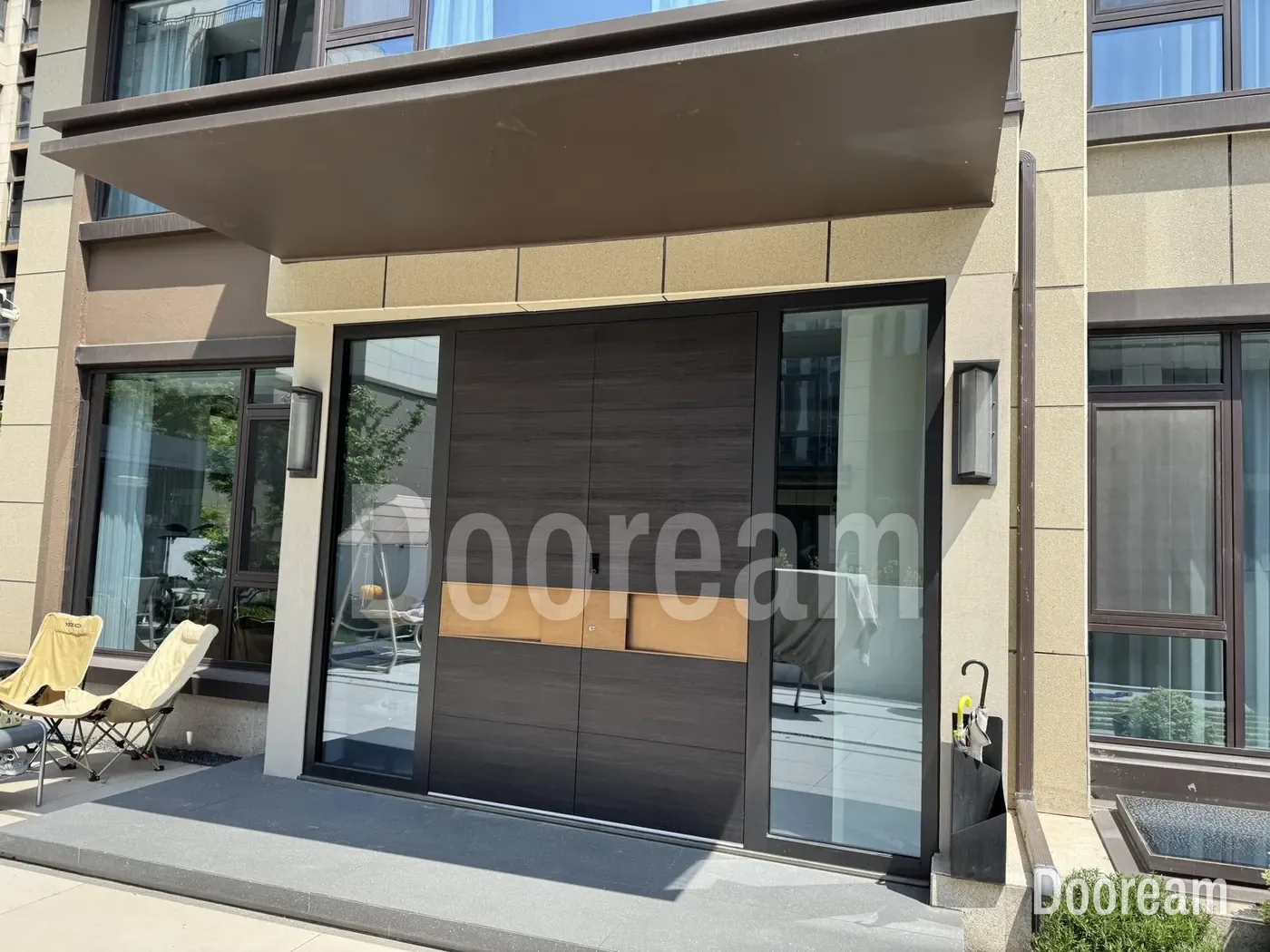
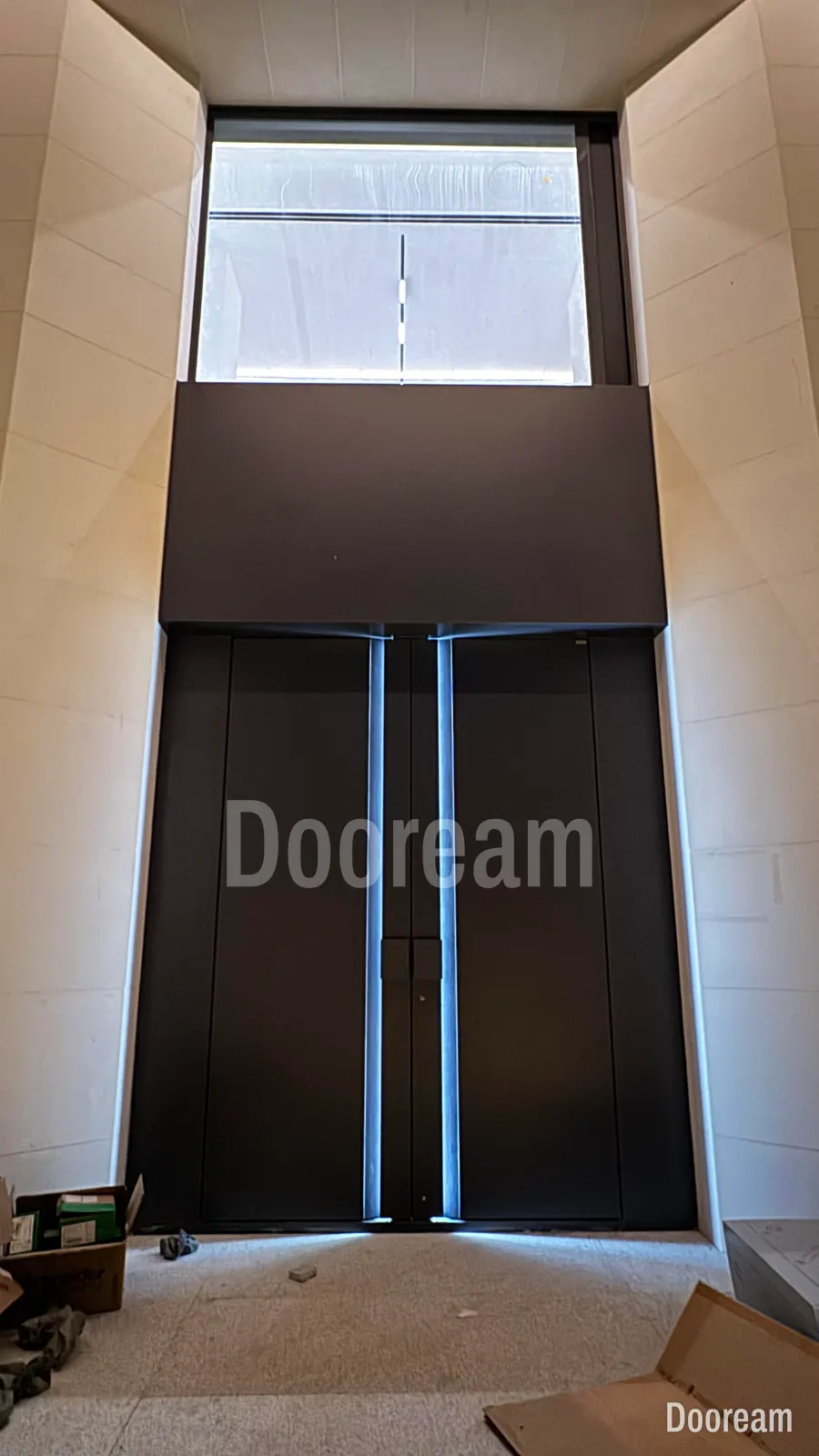
Glass can sit in five places: a vision panel in the leaf, a sidelight on the lock side, a sidelight on the pivot or hinge side, a transom above, and a large fixed pane beside a pivot leaf. The weak points are the panes a burglar can break and then reach the inside handle, thumb-turn or key through.
- Vision panel in the leaf. Usually within reach of the lock.
- Lock-side sidelight. The classic weak point: break, reach in, turn the thumb-turn.
- Pivot-side sidelight. Further away; on a narrow leaf, measure the reach.
- Transom. Usually out of reach.
- Fixed glass beside a pivot leaf. Often full height and wide: a safety question first.
- Double doors. The lock is at the meeting stiles, a leaf width from the side glass; see grand double front doors.
Scotland’s 2022 domestic technical handbook says access to door locks by breaking glazing “in or adjacent to a door leaf” should be prevented with laminated glass or a similarly robust material. England’s Approved Document Q (2015) asks, for bespoke doorsets, for EN 356 class P1A wherever broken glazing would let someone release the lock by hand or arm. If the inside handle opens the lock without a key, reaching it is enough; see multipoint locks explained.
Is safety glass the same as security glass?
No. Safety glass is classed by how it breaks when a person falls against it (EN 12600). Security glass is classed by how long it resists a deliberate attack (EN 356). Toughened glass is safety glass only. Laminated glass is safety glass, and with a heavy enough build-up it is security glass as well.
Toughened (tempered) glass is heat-treated to as much as four to five times the strength of annealed glass, says the Glass and Glazing Federation. It breaks into many small, generally blunt pieces and cannot be cut or drilled afterwards. A rare nickel sulphide inclusion can make it break on its own; heat soaking to EN 14179 cuts that risk, and the standard accepts no more than one breakage per 400 tonnes. Specify it heat-soaked for large panes.
Laminated glass is two or more panes bonded with a plastic interlayer. When it breaks, the pieces stay on the interlayer and the pane stays in place.
| Glass | Breaks how | Stops reach-through? | Typical use |
|---|---|---|---|
| Annealed (float) | Large, sharp pieces (EN 12600 type A) | No | Only where local rules allow, such as small panes |
| Toughened | Small, blunt pieces; pane falls out (type C) | No | Outer pane of an insulated unit; high transoms |
| Laminated, PVB | Cracks; pieces stay on the interlayer (type B) | Yes, for its EN 356 class | Vision panels, lock-side sidelights |
| Laminated, ionoplast | As PVB, but stays stiffer when broken | Yes, as tested | Large fixed panes, panes held on fewer edges |
| Insulated unit, toughened out, laminated in | Outer crumbles; inner holds | Yes, by the inner pane | A sound default |
What do the EN 12600 pendulum classes mean?
EN 12600 swings a 50 kg twin-tyre pendulum into an 876 × 1938 mm pane from 190 mm (class 3), 450 mm (class 2) and 1200 mm (class 1), so class 1 is the toughest. The result reads α(β)φ: two class numbers under the standard’s two pass rules, and a letter for how the pane broke.
Type A breaks like annealed glass, into sharp pieces; type B like laminated glass, held together; type C like toughened glass, into small, relatively harmless pieces. A laminated pane that resists the 1200 mm drop is 1(B)1.
Where do building rules require safety glass at a door?
Codes treat glass in a door, and glass close beside it at low level, as places where people may fall against it. England’s Approved Document K calls them critical locations, where glass must break safely, resist impact or be shielded. The US International Residential Code calls them hazardous locations.
- England, Approved Document K (2013 edition), K4. Critical locations include glazing in a door within 1500 mm of floor level, glazing within 300 mm of a door’s edge and 1500 mm of the floor, and other glazing below 800 mm. Glass there should meet EN 12600 class 3 (BS 6206 class C), or class 2 (BS 6206 class B) in a door or door side panel with a pane wider than 900 mm.
- United States, IRC R308.4. Glazing in swinging doors is a hazardous location, and so is glazing within 24 in (610 mm) of either side of a closed door, in its plane, with its bottom edge under 60 in above the floor. See our shop drawing checklist.
- Australia and elsewhere. See AS 2047 and imported entrance doors, or check the national code.
What do the EN 356 security classes mean?
EN 356 tests glass against manual attack on an 1100 × 900 mm pane. Classes P1A to P5A drop a 4.11 kg steel ball, 100 mm across, and the ball must not pass through. Classes P6B to P8B count the hammer and axe strokes it takes to cut a 400 × 400 mm opening.
| EN 356 class | Test | Minimum for EN 1627:2021 class |
|---|---|---|
| P1A | 3 drops from 1.5 m | – |
| P2A | 3 drops from 3 m | RC1 |
| P3A | 3 drops from 6 m | – |
| P4A | 3 drops from 9 m | RC2 |
| P5A | 9 drops from 9 m | RC3 |
| P6B | 30–50 strokes | RC4 |
| P7B | 51–70 strokes | RC5 |
| P8B | More than 70 strokes | RC6 |
EN 356 does not link a class to a use, notes the test lab Tecnalia; the rule, the insurer or the door test does. EN 1627:2021 sets no glazing class for RC1 N and RC2 N, though a national provision may. For those and RC1, other glass may replace the tested pane only if the retention system stays identical. A glass class does not rate the door; see door security ratings explained and what is an armoured front door.
PVB or ionoplast: what is the difference?
The interlayer is the plastic sheet that holds laminated glass together after it breaks. PVB (polyvinyl butyral) is the conventional one, soft and flexible. Ionoplast, sold as SentryGlas, is much stiffer: its maker Kuraray says up to 100 times the rigidity of conventional PVB and five times the tear strength.
PVB suits most vision panels and sidelights. Ionoplast suits large fixed panes beside a pivot door and panes held on fewer than four edges, because a stiffer interlayer holds a broken pane’s shape. Security still comes from the whole build-up as classed to EN 356.
In an insulated glass unit, which pane should be laminated?
Put the laminated pane on the inside and a toughened pane outside. An attacker breaks the outer pane first and then meets the laminated one, which stays in the frame and keeps the hole closed. Both panes break safely. Approved Document Q asks for only one P1A pane in a double or triple glazed unit.
If the glass or door has a test report, copy its build-up and pane order exactly.
Put the glazing beads on the inside. Beads hold the glass in the frame. Outside beads can be prised off and the unit lifted out unbroken, whatever its class. For a flush outer face, ask how the pane is held.
What should the glazing specification say?
For each pane, the schedule should give its position, size, distance from the lock, safety class, security class, build-up, bead side, privacy finish and the evidence behind each class. Copy this list into the door schedule, one line per pane:
- Position: vision panel, sidelight left or right (seen from outside), transom, or fixed pane beside a pivot leaf.
- Size: visible glass size, and the bottom edge’s height above finished floor.
- Distance from the lock: nearest glass edge to the lock, inside handle, thumb-turn and smart-lock inside unit. Within an arm’s reach, specify security glass.
- Safety class: EN 12600 class and the code clause it answers.
- Security class: EN 356 class, such as P1A under Approved Document Q, or the class EN 1627:2021 sets for the door’s RC class.
- Build-up, outside to inside: outer pane (toughened, heat-soaked or not), cavity, inner pane (laminated, PVB or ionoplast), coatings.
- Bead side: inside; if not, how the glass is secured.
- Privacy: clear, acid-etched, sandblasted or translucent interlayer, and which face. It hides the thumb-turn but adds no strength.
- Evidence: the glass maker’s classification report for each build-up, and the whole-door report if a door class is specified.
How does this work with Dooream?
Glass is one of the face materials we make, alongside carved and cast aluminium, sintered stone, wood and copper. Every door is built to the buyer’s drawing, so mark each pane on it as listed above. We do not hold an EN 1627 rating and do not make fire-rated doors. Where your jurisdiction requires a tested class for the glass or the door, check the requirement and ask for test evidence; we can arrange a lab test, usually at the buyer’s cost. See our page for architects or send us the opening.
Sources, checked November 2026: GOV.UK, Approved Document K, 2013 edition (section 5); Eden District Council, safety glazing; GOV.UK, Approved Document Q, 2015 edition; British Woodworking Federation, Approved Document Q text; Quest Hardware, Document Q bespoke doorset requirements; Scottish Government, building standards technical handbook 2022, domestic, 4.13 security; North Carolina Office of State Fire Marshal, IRC R308.4.2, glazing adjacent to doors; Village of Ruidoso, residential glazing requirements; Pressglass, safety glass and EN 12600; Tecnalia, classification of anti-intrusion glass; Scheuten, Multisafe impact-resistant glass; Toughglaze, EN 356 test leaflet; iTeh, SIST EN 1627:2021 preview (Table 1); Kuraray, SentryGlas; Glass and Glazing Federation, Data Sheet 4.4, toughened glass; Saint-Gobain, NiS in heat-soaked glass (2023).
Quick answers
Is glass in a front door safe?
It is safe for people when it is safety glass, toughened or laminated, classed to EN 12600, because it breaks in a way unlikely to cause injury. It is secure only where it is laminated security glass classed to EN 356, because a broken toughened pane leaves an open hole and the lock within reach.
What is the difference between toughened and laminated glass in a door?
Toughened glass is heat-treated to as much as four to five times the strength of annealed glass and breaks into many small, blunt pieces, leaving an open hole. Laminated glass is two or more panes bonded with a plastic interlayer; when it breaks, the pieces stay on the interlayer and the opening stays closed.
Which glass class goes with an RC2 or RC3 door?
Table 1 of EN 1627:2021 sets EN 356 class P4A for RC2 and P5A for RC3, with P2A for RC1, P6B for RC4, P7B for RC5 and P8B for RC6. RC1 N and RC2 N have no glazing requirement, though a national provision may set one.