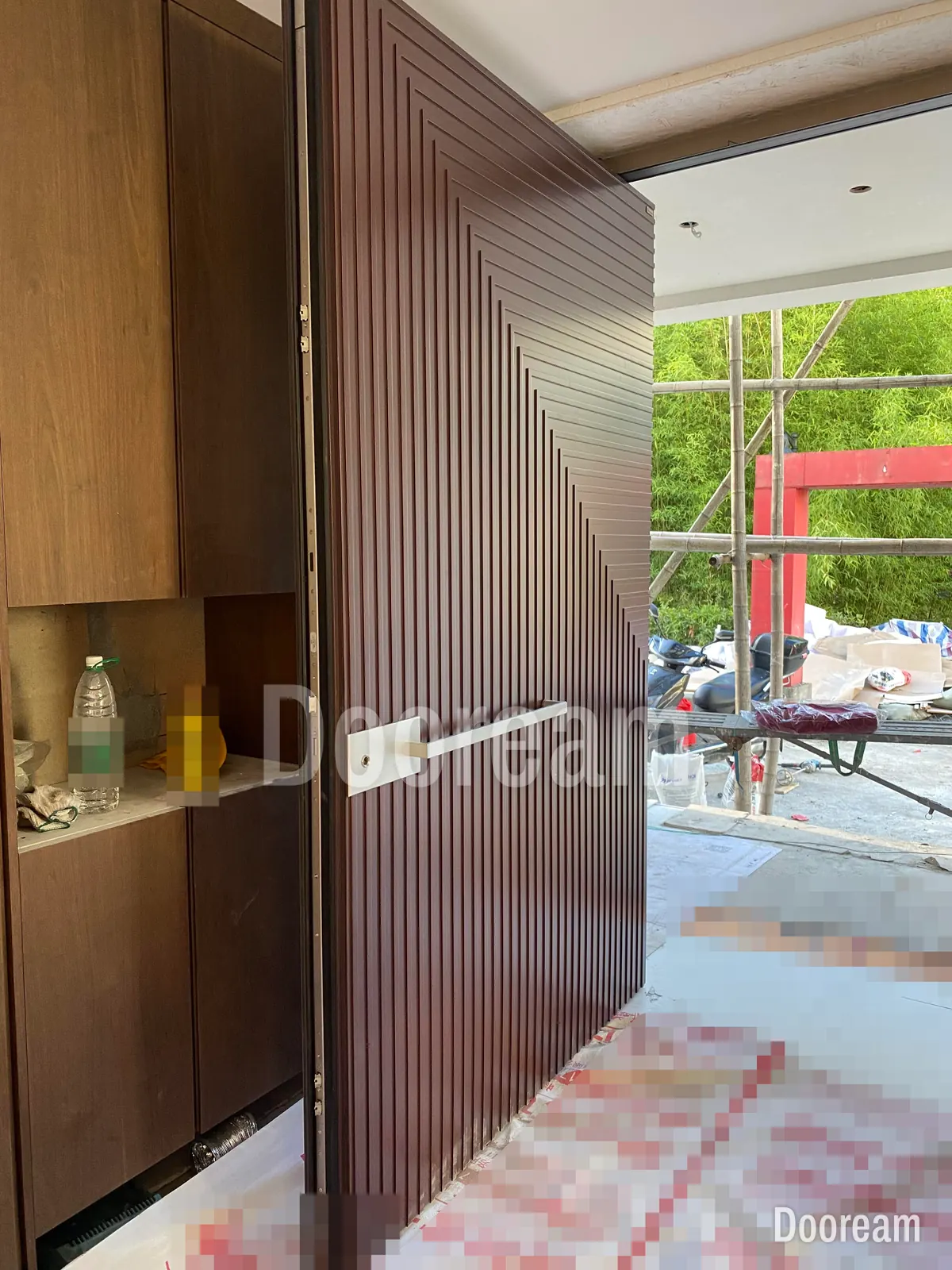
Short answer: a pivot door takes glass in three ways: a full-glass leaf in a slim frame, vision strips, or glazed panels in a solid leaf. Glass weighs about 2.5 kg/m² per millimetre, so a laminated double-glazed unit adds about 36 kg per square metre, all carried by the pivot hinge. For a walnut look, use real timber where it is sheltered and a wood-grain print on aluminium in sun and rain.
What are the ways to put glass in a pivot door leaf?
There are three families: the whole leaf as glass in a slim frame, narrow vision strips running up a solid leaf, and glazed panels set into a solid leaf, from one eye-level window to a grid of small panes. They differ in weight, privacy and security, and in how much work the leaf’s frame has to do.
| Glass layout | Typical use | Weight impact (example below) | Privacy | Notes |
|---|---|---|---|---|
| Full-glass leaf | Glass-fronted modern entrance | About 120 kg in a 1.4 × 3.0 m leaf | Low unless obscured | The frame does all the stiffening |
| One vision strip | A line of light in a solid leaf | About 20 kg for 200 × 2,800 mm | Good | Near the pivot, it keeps weight and glass away from the lock |
| Several strips | A rhythm matching flutes or grooves | Grows with glass area and frame | Good if obscured | More edges to seal and drain |
| Glazed panel | An eye-level or upper window | About 26 kg for 600 × 1,200 mm | Set by height and glass | Out of reach of the thumb-turn, or laminated |
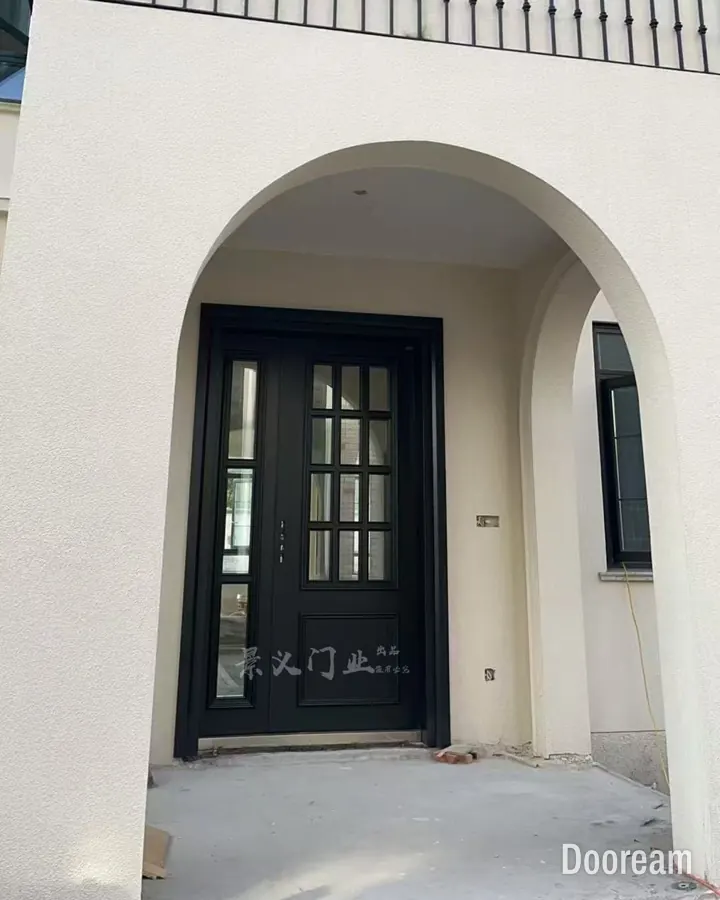
| Grid of small panes | Classical or industrial fronts | As a panel, plus glazing bars | Bars break the view | Bars must line up with the face pattern |
For glass beside the leaf, see sidelights and transoms.
How much weight does glass add to a pivot door?
Glass weighs about 2.5 kg per square metre for every millimetre of thickness: float glass has a density of 2,500 kg/m³, says AGC’s data sheet. Aluminium is barely denser at 2.70 g/cm³ (Aalco), so a glazed zone is rarely lighter than the solid leaf it replaces.
A worked example, our arithmetic, for one common build-up (not a specification):
- Unit: 6 mm toughened glass outside, a 16 mm cavity, and 8.76 mm laminated glass inside (two 4 mm panes and a 0.76 mm PVB interlayer). About 31 mm thick.
- Per square metre: 15.0 kg for the 6 mm pane, 20.0 kg for the two 4 mm panes, and 0.8 kg of PVB at 1.07 g/cm³ (Kuraray’s Trosifol data): about 36 kg/m².
- Full-glass leaf: 1.4 × 3.0 m with a 100 mm frame all round leaves 3.36 m² of glass: about 120 kg.
- Triple glazing: a third 6 mm pane and a second cavity add 15 kg/m²: about 171 kg of glass, in a unit about 53 mm thick.
- Net change: subtract the solid construction the glass replaces.
Weight far from the pivot axis loads the hinge and top pivot more, so heavy glass is best near the pivot. Check the total leaf weight against the hinge class in how big and how heavy a pivot door can be.
Which glass gives privacy in a glazed pivot leaf?
Obscured glass keeps the light and blurs the view: fluted or reeded patterned glass, acid-etched or sandblasted glass, or laminated glass with a translucent interlayer. In a leaf, also decide which face carries the treatment and which way a pattern runs.
- Fluted or reeded glass. Pilkington grades its patterned Texture Glass from privacy level 1 (least obscuration) to 5 (greatest), toughened or laminated depending on the design. AGC’s glazing guidelines want any non-standard pattern direction on the drawing and the order, so mark the flutes on every pane. Vertical flutes can echo a fluted face such as our Black Warrior.
- Acid-etched or sandblasted glass. AGC says its etched Matelux finish becomes less visible where the etched side gets wet, and recovers when dry; it can be toughened and laminated, but the etched side should not face the interlayer.
- Translucent interlayers: privacy and a pane that holds together when broken.
How does glass change the security and insulation of a pivot door?
Security. Glass is the weak point unless it is laminated and held by beads on the inside. A strip near the lock edge puts the thumb-turn within reach; on a pivot leaf, a strip near the pivot axis sits furthest from the lock. See safety and security glass.
Insulation. Each glazed zone brings its own U-value and a colder edge. Guardian gives its ClimaGuard 1.0+ a centre-of-glass Ug of 1.0 W/m²K in a 4-16-4 argon double unit and 0.5 in triple glazing, before edges and frames count. See insulated glass in entrance doors and door U-values.
Can a walnut or wood-look pivot door have glass?
Yes. Real walnut, solid or veneered, can frame glass, but rain running off a pane collects on the bottom rail and the joints below it, where timber usually starts to deteriorate. Real timber therefore suits a deep canopy or the inside face. In full sun and rain, a walnut-grain print on aluminium keeps the look without refinishing.
- Real timber. The US National Park Service’s brief on wooden windows says deterioration usually begins at horizontal surfaces and joints where water collects. Keep glazing seals sound and bottom beads drained.
- Wood-print aluminium. The grain is in the coating, and the glass sits in metal that does not swell. Ask how beads and pane edges are printed; see 5D wood-grain prints vs real wood.
- Both. Print outside, real walnut inside. Our Black Warrior has sintered stone and a fluted walnut band on its inside face.
- Frame colour. A dark bronze or black frame reads as a line cut into the grain; a grain-tone frame hides it.
How stiff must the frame of a tall glazed leaf be?
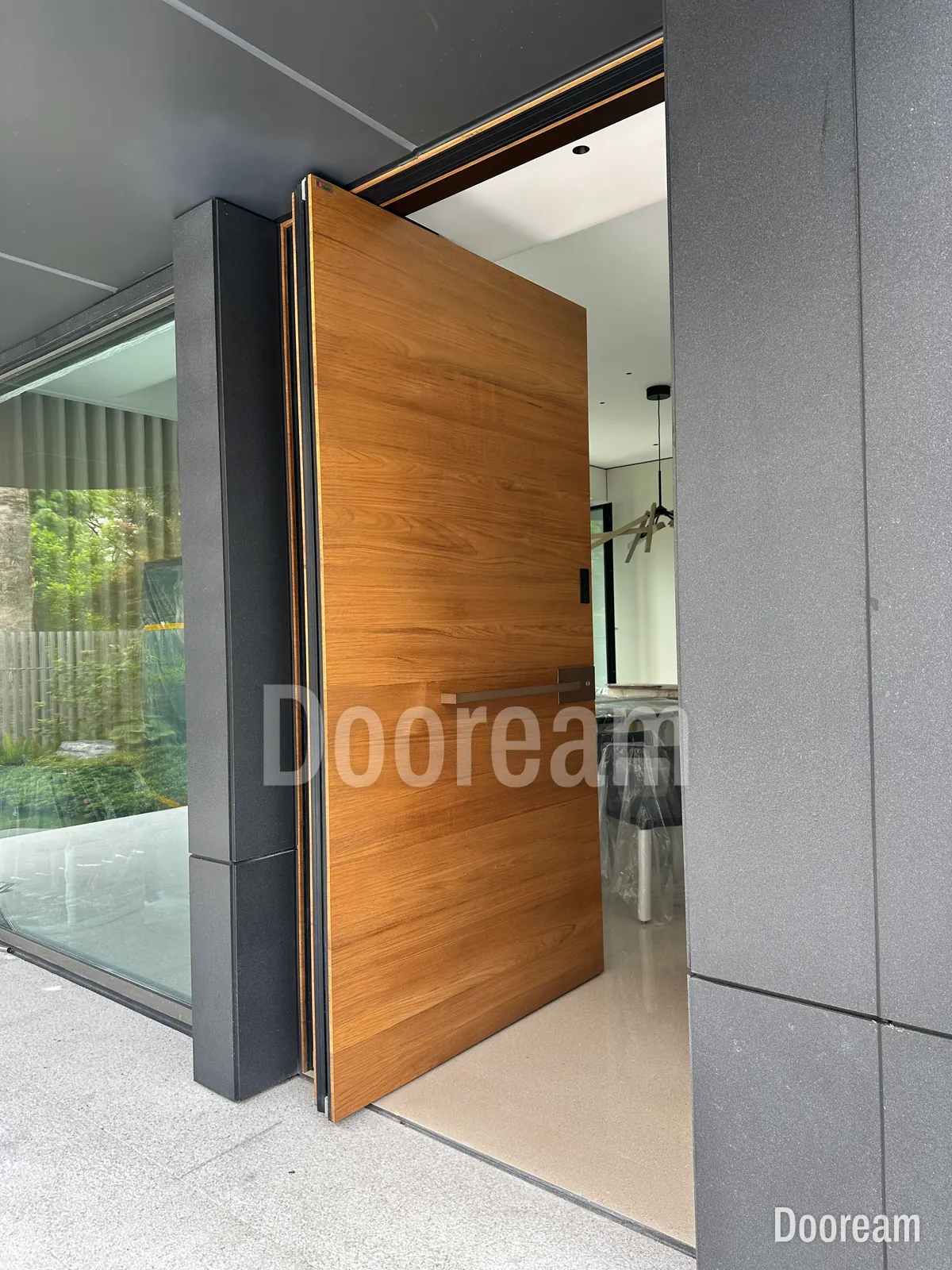
Stiff enough to keep the glass flat and the leaf’s gaps even. Glass is about as stiff as aluminium, 70,000 N/mm² (AGC) against 69,500 for the common extrusion alloy 6063 (Aalco), but it breaks where aluminium would bend. A full-glass leaf has no core to help.
- Glazing limit vs door limit. AGC’s 2025 glazing guidelines limit edge-support deflection to 1/200 of the edge length under maximum load: 14 mm on a 2,800 mm edge (our arithmetic). A pivot leaf’s seals and gaps tolerate far less, so agree a tighter figure; see bowing and warping and pivot doors and wind.
- Setting blocks. The vandaglas Eckelt guidelines say blocks carry the glass weight through the frame to the points an opening leaf hangs from, and the leaf must not twist or lose square. No block closer than 20 mm to a glass corner. Ask for the blocking drawing.
- Altitude. An insulated unit is sealed at the air pressure where it is made. Eckelt asks to be told at order when the site is over 800 m above sea level; AGC asks for the installation altitude, as pressure equalisation may be needed.
How do you clean a glazed pivot door, and what if it mists between the panes?
Pilkington advises a clean cloth and a clear, non-abrasive cleaner such as soapy water, and on patterned, etched or sandblasted glass a stiff bristle or nylon brush to clear residue from the texture. AGC says etched glass should be wet-cleaned across its whole surface. Mist between the panes means the edge seal has failed, and the unit must be replaced.
- Plan for replacement. Inside beads let a unit come out without taking the leaf down. Keep each pane’s size and build-up on the as-built drawing, so a local glazier can match it.
- Mist on the surface is condensation; see front door condensation.
What should the drawing say for a glazed pivot leaf?
Use this design checklist, one line per pane:
- Layout: each pane’s visible size and position from the pivot axis and finished floor.
- Reach: distance to the lock, inside handle and thumb-turn.
- Build-up, outside to inside, with safety and security classes.
- Privacy: finish, which face, pattern direction.
- Fit: unit thickness against leaf depth; beads inside.
- Weight: glass, total leaf, and the hinge chosen.
- Stiffness: deflection limit and flatness, in millimetres.
- Blocking drawing.
- Altitude, if over 800 m.
- Wood look: timber or print, grain direction, frame colour.
- Whole-door U-value with the glass, if required.
- Care: cleaning and unit replacement.
How does this work with Dooream?
Glass is one of the face materials we make, alongside carved aluminium (most of our doors), cast aluminium, sintered stone, wood and copper. We make pivot doors up to 4,000 × 8,000 mm on FritsJurgens pivot hinges, as complete doors only, to your drawing, from a single door. Ask us for the leaf weight with the glass, and the hinge it needs, before you approve the drawing. Our thermal-break construction, with PA66 polyamide insulating strips in the aluminium profiles, reaches a U-value of 1.0 W/m²K in our test report, and any of our designs can be built with it; glazing changes a door’s U-value, so check the figure your project needs. We hold no EN 1627 rating; if a tested class is required, a lab test can be arranged, usually at the buyer’s cost. See our page for architects or send us the opening.
Sources, checked November 2026: AGC, Planibel technical data sheet (density, Young's modulus); Aalco, aluminium alloy 6063 data sheet; Kuraray, Trosifol Clear on NBS Source; Guardian Glass, ClimaGuard 1.0+; AGC, glazing guidelines, version 01, September 2025; vandaglas Eckelt, general glazing guidelines (07.2024); Pilkington, Pilkington Texture Glass and window FAQs; AGC, Matelux brochure; J. H. Myers, US National Park Service, Preservation Brief 9, the repair of historic wooden windows.
Quick answers
Can a pivot door have glass in it?
Yes. The leaf can be a full-glass leaf in a slim frame, a solid leaf with one or more vision strips, or a solid leaf with glazed panels. Each adds weight, changes privacy and security, and needs a frame stiff enough to keep the leaf flat, so the glass is designed with the leaf, not added later.
How much weight does glass add to a pivot door?
Glass weighs about 2.5 kg/m² for every millimetre of thickness. A double-glazed unit with a 6 mm toughened pane and an 8.76 mm laminated pane weighs about 36 kg/m², so a 1.4 × 3.0 m full-glass leaf carries about 120 kg of glass and a 200 × 2,800 mm strip about 20 kg. Check the total leaf weight against the pivot hinge's weight class.
Can a walnut pivot door have glass?
Yes. Real walnut suits a sheltered entrance or the inside face, because rain running off glass collects on bottom rails and joints, where timber usually starts to deteriorate. In full sun and rain, a walnut-grain print on aluminium keeps the look next to the glass without refinishing.