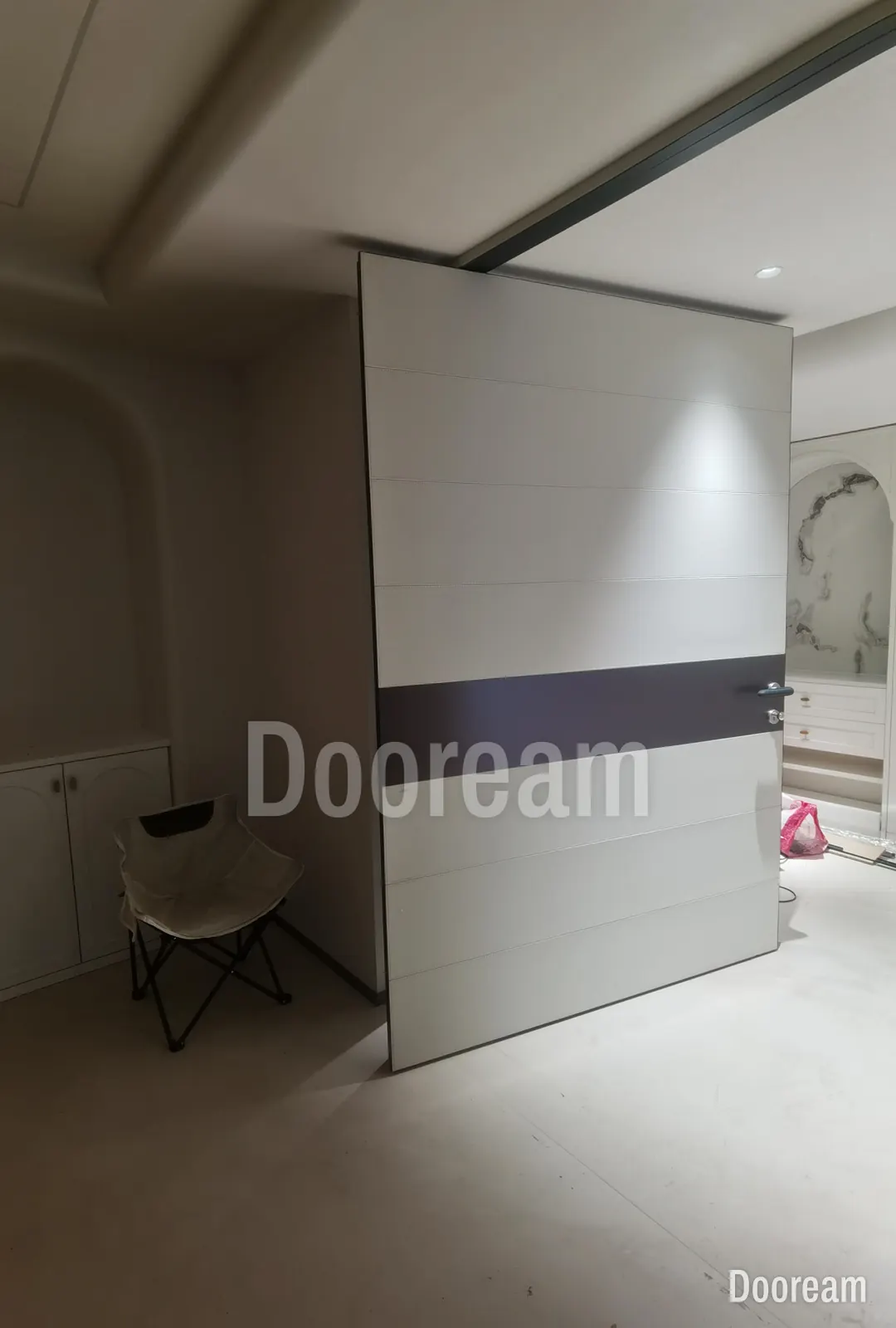
Short answer: for most entrance doors, offset. An axis near one edge gives the widest passage, lets the long part open inwards against a stop and keeps the lock at the far jamb. A centre-hung axis gives two half-width passages and sends half the leaf outside, but puts almost no sideways force on the head; it suits interiors and wide, light leaves.
What is the difference between an offset and a centre-hung pivot door?
Both turn on a vertical axis between a floor pivot and a top pivot. The difference is where that axis sits across the leaf. FritsJurgens calls the distance from the pivot-side edge to the axis the pivot point. Offset means a small pivot point, near one edge; centre-hung means half the leaf width.
- Offset: the long part swings one way, a short strip the other. FritsJurgens’ 2026 System M+ documentation lists pivot points of 40 mm (fixed), from 70 mm, or from 130 mm (Top pivot Reversed).
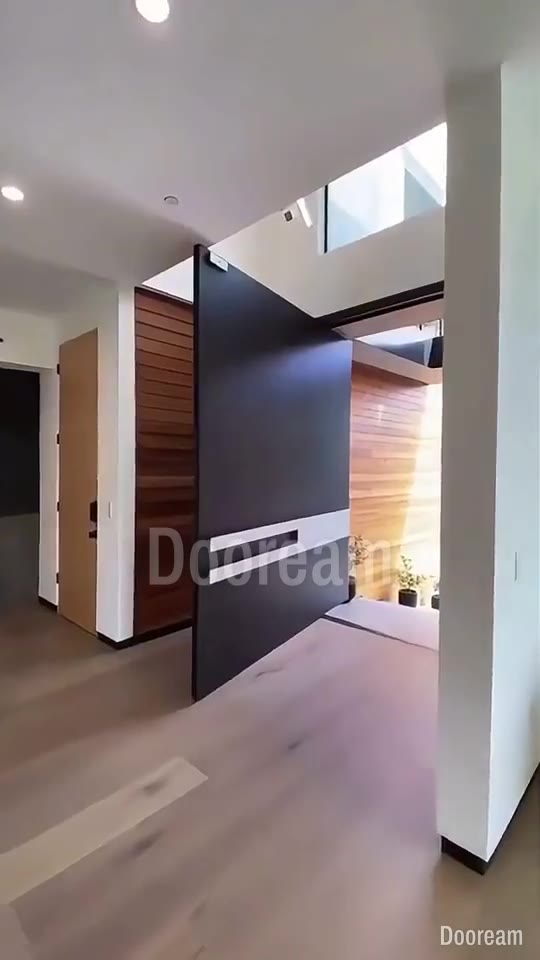
- Centre-hung: half swings in, half out; open, the leaf stands mid-opening like a fin. FritsJurgens’ 70 mm top pivot “can be placed in any position between 70 mm and the center of the door”.
On plan, in words: “D01, opens inwards; seen from outside, axis 83 mm from the left jamb; the 70 mm strip left of it swings outwards”, or “D02, centre-hung, axis 700 mm from each jamb; right half opens inwards” (door handing). The Gap Calculator’s “pivot offset” input is unrelated: it is for bookcase doors, very thick doors or a drop seal.
How much clear opening does each give at 90°?
Offset gives far more: in our 1,400 mm example, 1,277 mm on the wide side against two 660 mm passages centre-hung. The method is FritsJurgens’: side gaps from the leaf’s turning radius, 2 mm tolerance included, and the axis from the frame as pivot point plus side gap.
- Side gap (our arithmetic) = √(pivot point² + (half thickness)²) − pivot point + 2 mm, rounded. It matches FritsJurgens’ example (1,000 mm opening, 60 mm leaf, 70 mm pivot point: 8 mm gaps). For our 80 mm leaf at 70 mm: √(4,900 + 1,600) − 70 + 2 = 12.6, so 13 mm.
- Passages at 90°, axis at mid-thickness: axis from frame − half thickness, and opening − axis from frame − half thickness.
For a 1,400 mm finished opening and an 80 mm leaf:
| Axis | Side gaps | Leaf | Axis from frame | Wide passage | Narrow passage |
|---|---|---|---|---|---|
| Offset, 70 mm pivot point | 13 mm (12.6) | 1,374 mm | 83 mm | 1,277 mm | 43 mm |
| Centre-hung, 697 mm | 3 mm (3.1) | 1,394 mm | 700 mm | 660 mm | 660 mm |
A 900 mm everyday passage needs 900 + 83 + 40 = 1,023 mm offset, but 2 × (900 + 40) = 1,880 mm centre-hung. The U.S. Access Board’s ADA guide gives a 32 in (813 mm) minimum, from the stop to the face of the door open at 90°; our widths are before pulls (measuring an opening).
How much swing space does each need inside and outside?
An offset leaf sweeps deep on one side, a sliver on the other; a centre-hung leaf half as deep, on both. Our arithmetic, radius to the far corner: offset 1,305 mm and 81 mm, about 1.34 m² at 90°, nearly all inside; centre-hung 698 mm each side, about 0.77 m², half outside.
- Mats: the leaf clears the floor by 11 mm, or 7 mm on a Flush floor plate (FritsJurgens); recess thicker mats.
- Steps: a centre-hung leaf needs a level landing outside, as deep as its radius.
- Columns, planters, lights, glass, furniture: keep them out of both arcs, drawn to the furthest angle; System M+ self-closes from up to 125°.
How do offset and centre-hung doors seal?
A single-acting leaf of either kind closes against stops on both faces: one side of the axis against a stop outside it, the other against a stop inside it. Along the head and threshold the stop must change face at the axis, where the leaf barely moves. That swap is the hardest point to seal.
- Offset: the swap sits in a corner, 83 mm from the pivot jamb; nearly all the threshold keeps one stop face.
- Centre-hung: it sits mid-threshold, under the walking line, with half the upstand on each face.
- Double-acting: no stops, only brushes or fins in plain gaps; fine indoors.
FritsJurgens recommends a single rebate for sheltered entrances, a double rebate for exposed façades, inward opening, a Flush floor plate and a pivot drop seal, and says “the rebate detail must account for the turning seam” (sealing).
What happens to lateral force and leaf weight?
When the leaf’s centre of weight is away from the axis, the top and bottom pivots push sideways in opposite directions to hold it upright, and the head must take that. FritsJurgens states that with the system in the middle of the door there is no extra lateral force on the floor and ceiling.
Our arithmetic: force at each pivot = weight (N) × (half leaf width − pivot point) ÷ leaf height, which reproduces FritsJurgens’ 2021 table (500 kg, 500 × 2,400 mm, 91 mm: 4,905 × 159 ÷ 2,400 = 325 N). For a 1,400 × 3,000 mm opening, a 2,987 mm high leaf and an assumed 300 kg (2,943 N):
| Axis | Lever | Force at each pivot | System M+ class |
|---|---|---|---|
| Offset, 70 mm | 617 mm | About 608 N | F (1,304 mm to far edge) |
| Centre-hung | 0 mm | About 0 N | E (697 mm to far edge) |
Classes come from FritsJurgens’ weight table, by weight and axis-to-far-edge distance. But for the same passage a centre-hung leaf is about 1.9 times as wide, so in the same construction 1.9 times as heavy. Check a real leaf in the Lateral Force Calculator (size and weight).
Which hold positions and swing modes are possible?
Single-acting opens one way, “enforced by an external stop such as the door frame” (FritsJurgens); double-acting opens both ways. An offset leaf can be either; revolving needs the axis in the middle and no stops. System M+ self-closes, holds softly at 90° (and −90° double-acting) and does not revolve; Fx (solid hold every 90°) and One (no holds) do.
Where do the lock and keeps go?
On an offset door the lock sits in the long part’s free edge, with a keep in the lock jamb for every locking point; the short side sits at the pivot jamb. FritsJurgens names lifting the leaf off its floor plate as the main weak point, and three-point locks on both sides as the most effective countermeasure.
- Offset: add bolts from the short edge into the pivot jamb, or head and floor.
- Centre-hung: both edges are free, about 700 mm from the axis, moving opposite ways; lock both, with keeps in both jambs, on opposite faces.
FritsJurgens’ pivots hold no EN 1627 certificate; a rating belongs to the tested door. We hold none; testing can be arranged, usually at the buyer’s cost (multipoint locks).
How does wind act on each?
Even pressure on a closed offset leaf tries to turn it; on a centre-hung leaf the halves cancel. Our arithmetic: moment = pressure × height × (long side² − short side²) ÷ 2, about 2.5 N·m per pascal for our 70 mm leaf.
But gusts are uneven, half a centre-hung leaf opens outwards, and FritsJurgens warns that wind pressure can exceed the 90° hold on outward-opening doors (pivot doors and wind).
How do they look?
Offset reads as a door, with a thin strip on the far face when open; put the pull near the free edge, where leverage is greatest. Centre-hung reads as a turning wall, a fin between two equal passages: it suits symmetrical façades and wide, near-square leaves, not tall narrow ones. Never put a pull over the axis.
Offset or centre-hung: how do they compare?
Offset wins on clear width, sealing, opening direction and locking; centre-hung wins on sideways force and symmetry. Figures from our examples: 1,400 mm finished opening, 80 mm leaf, 70 mm pivot point when offset, assumed 300 kg.
| Offset | Centre-hung | |
|---|---|---|
| Clear width | 1,277 mm + 43 mm | 2 × 660 mm |
| Opening for a 900 mm passage | 1,023 mm | 1,880 mm |
| Sweep at 90° | 1,305 mm one side, 81 mm other | 698 mm both sides |
| Sideways force | 608 N | 0 N, in theory |
| Stops change face | Near the pivot jamb | Mid-threshold |
| Opening direction | Long part can open inwards | Half always opens outwards |
| Locking | Lock edge plus pivot edge | Both edges |
| Best for | Most exterior entrance doors | Interiors, wide light leaves |
For two leaves, see double pivot doors.
How do you decide?
For an entrance door the first four usually settle it; the rest belong on the drawing.
- Exterior and exposed? Start from offset.
- Clear width for each axis, before pulls.
- Both arcs: mats, steps, columns, glass.
- Must it open inwards? Centre-hung cannot fully.
- Rebate type, and where the stops change face.
- Edges to lock, and keeps for each.
- Leaf weight, lateral force and hinge class.
- Single-acting, double-acting or revolving; hold positions.
- Door or fin; pull positions.
- Axis, arcs, stops and gaps on one drawing (technical drawings).
How does this work with Dooream?
We make pivot doors up to 4,000 × 8,000 mm on FritsJurgens pivot hinges; our Contour door is an offset pivot. Send the opening plan with the axis you want; we draw the leaf, gaps, stops and clear widths for you to check, or confirm what can be built. Production takes 35–45 days after drawing approval and the deposit; your local installers fit the door with our installation drawings and remote guidance. See for architects or contact us.
Sources, checked November 2026: FritsJurgens, System M+ technical documentation (04/2026), product catalogue (04/2026), Gap Calculator, exterior pivot doors, door dimensions and technical documentation 2021.02 (lateral force table); U.S. Access Board, guide to the ADA Standards, chapter 4: entrances, doors and gates.
Quick answers
What is the difference between an offset and a centre-hung pivot door?
Where the axis sits across the leaf. On an offset door it is near one edge, so the long part opens one way and a short strip the other. On a centre-hung door it is in the middle: half the leaf swings in, half swings out, and the open leaf splits the opening into two equal passages.
Which gives the wider clear opening?
Offset, by far. In our worked example, a 1,400 mm finished opening with an 80 mm leaf gives 1,277 mm on the wide side with a 70 mm pivot point, against two passages of 660 mm centre-hung. A 900 mm passage needs about 1,023 mm offset, or about 1,880 mm centre-hung.
Is a centre-hung pivot door a good choice for a front door?
Usually not. Half the leaf always opens outwards, the stops change face in the middle of the threshold, both edges need locking, and the leaf must be nearly twice as wide for the same passage. It does put almost no sideways force on the head, and it suits interiors and wide, light leaves.