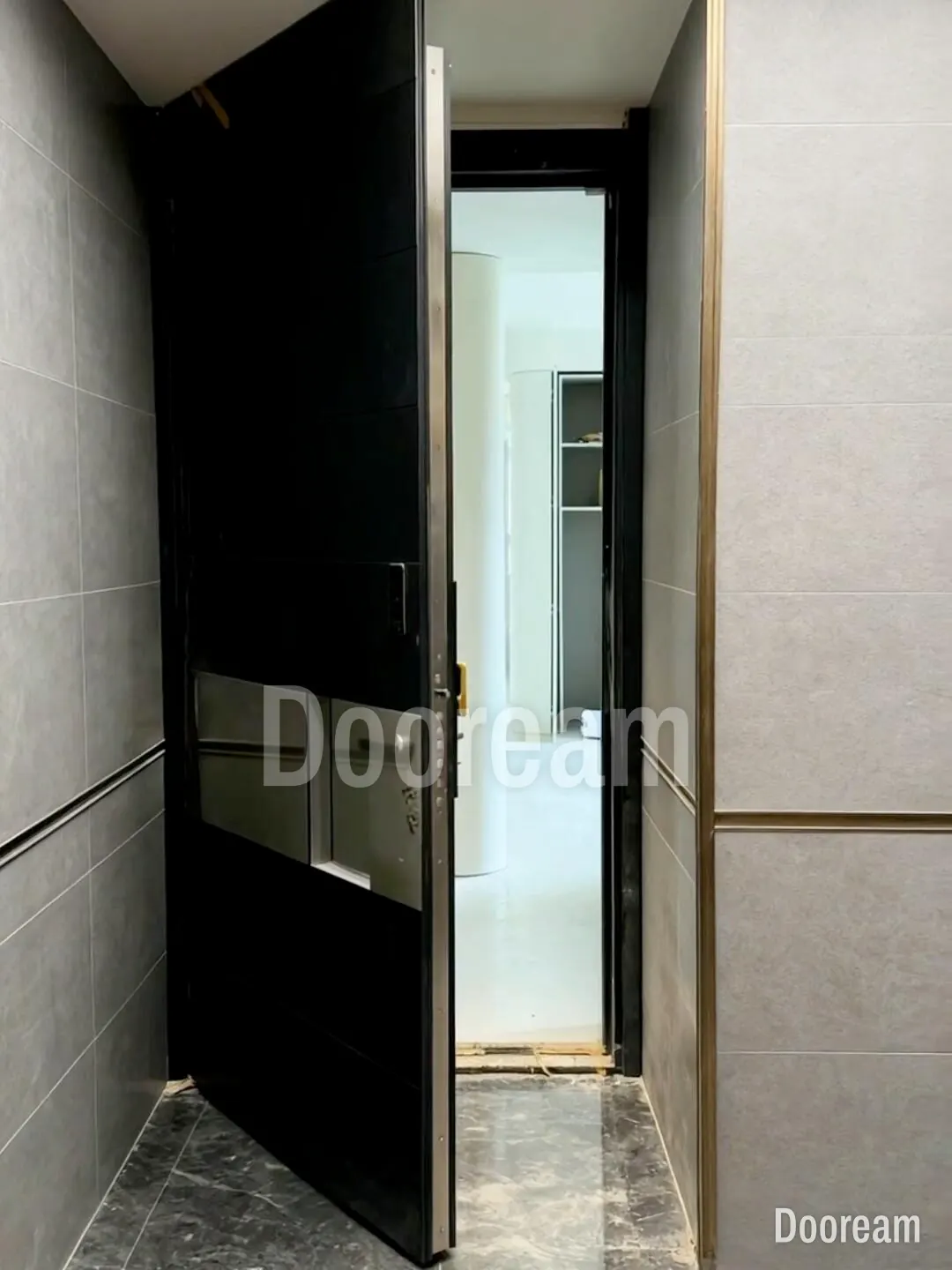
Short answer: a pivot door locks at its free edge: a multipoint lock throws bolts into keeps in the lock jamb, usually with shoot bolts into the head and the floor. The difference from a hinged door is the pivot side, which has no hinges or hinge bolts, only a top and a bottom pivot, so it needs bolts or anti-lift measures of its own. Power for a smart lock comes through the top pivot, a door loop or a contact transfer.
How does a pivot door lock?
At its free edge, a pivot door locks like a hinged door: a lock case at handle height drives bolts along the edge into keeps in the frame. The other edge differs. A hinged leaf is held along its hinge side; a pivot leaf only by a floor pivot and a top pivot, set in from the edge.
- No hinge-side bolts. A hinged security door often has hinge bolts, pins in the hinge edge that engage as it closes; ASSA ABLOY says its P125 hinge bolts resist “attempts to remove the door from its frame”. A pivot edge has nothing like that.
- The pivot-side gap. As the leaf turns, its corners swing past the pivot jamb, so the gap there is set by the turning radius. In our offset vs centre-hung example, an 80 mm leaf with a 70 mm pivot point needs about 13 mm there. A bolt engages its throw minus the gap: 20 mm of throw leaves 7 mm in the keep.
- Offset or centre. On an offset pivot the lock edge is far from the axis. On a centre-hung leaf both edges are free and move opposite ways, so both need locking.
FritsJurgens calls “the ability to lift the leaf off the floor plate” the primary vulnerability of a pivot door, and says “three-point locks on both sides of the door are the most effective countermeasure”. It also recommends a metal spacer ring round the top pivot’s mounting pin, closing the gap that lets the leaf be levered upward.
Where does each locking point engage?
Along the lock edge, into the head and into the floor, plus any bolts on the pivot side. Every point needs a keep opposite it, fixed through the frame into the structure and adjustable. Ask for each point, its type and its height on the drawing (multipoint locks explained).
| Locking point | On the leaf | Engages | What it does | Check |
|---|---|---|---|---|
| Latch | Lock case, handle height | Lock jamb keep | Holds the door shut, unlocked | Closing force reaches it |
| Main bolt | Lock case | Lock jamb keep | Locks at handle height | Throw and keep depth |
| Hooks, round bolts or cams | Along the lock edge | Keeps up the lock jamb | Hold the edge onto its seals; resist prying | Adjustment |
| Top shoot bolt | Top of the lock edge | Head keep | Holds the top corner | Head deflection; access |
| Bottom shoot bolt | Bottom of the lock edge | Floor or threshold keep | Holds the bottom corner | Water, grit, floor level |
| Pivot-side bolts | Short edge, or near the axis | Pivot jamb, head or floor | Resist lifting and prying | Throw against the gap |
| Spacer ring | Round the top pivot pin | Top pivot | Closes the gap that lets the leaf lift | Thickness to suit |
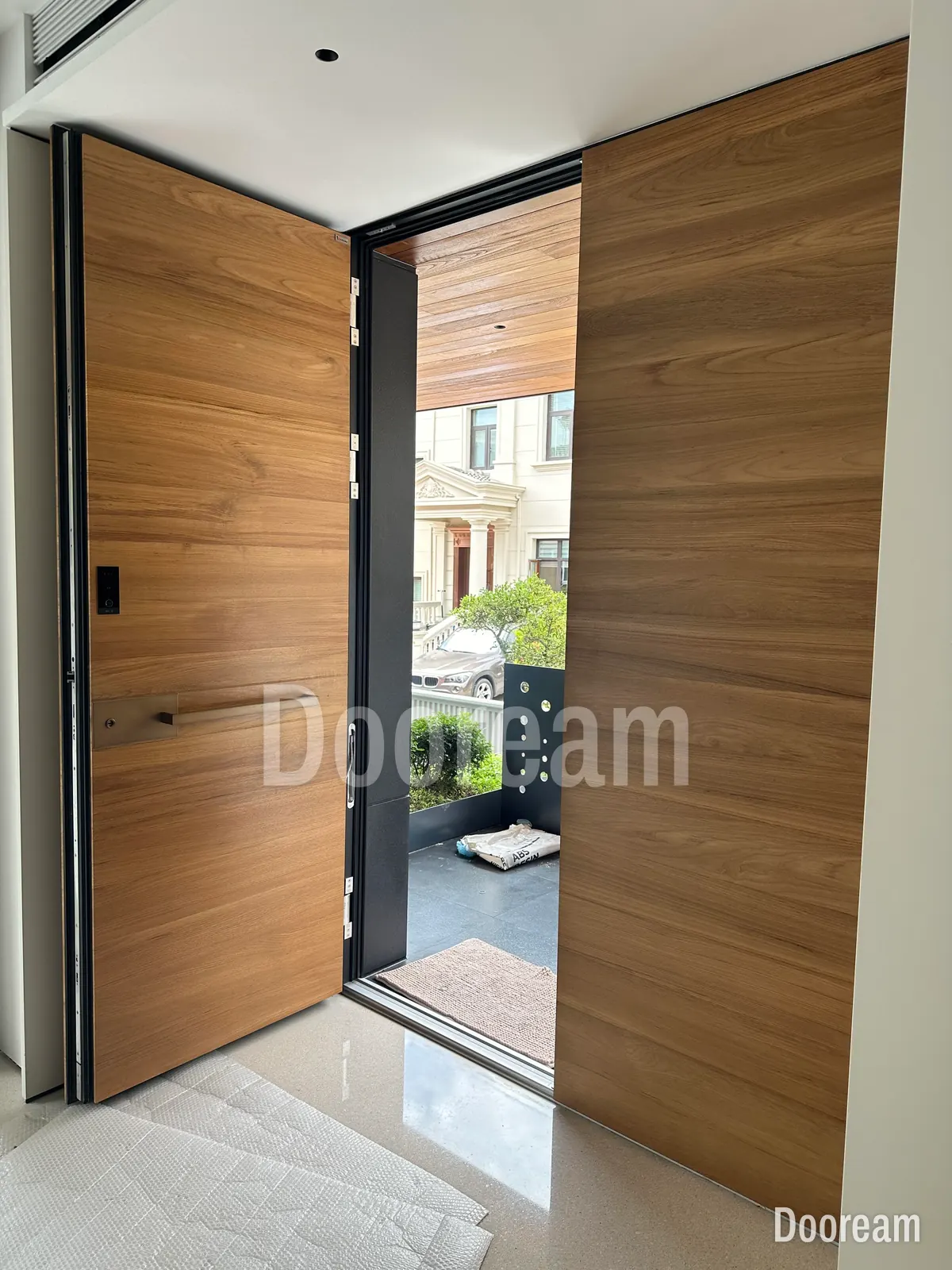
What can go wrong at the floor and head keeps?
The floor keep is the hardest point to keep working. It sits in the doorway under the lock corner, where water, sand and grit collect. Where one gear drives every point, a blocked floor keep can stop the whole lock finishing its throw.
- Dirt. Ives’ DP1 dust-proof strike, made for flush bolts, has a spring-loaded plunger that “keeps the strike hole clean and free of debris” and returns to floor level when the bolt is withdrawn. Its hole is 3/4 in (19 mm) across and 1-1/8 in (29 mm) deep.
- Water. Ask whether the keep can drain, or whether the bolt can land in a threshold profile on the dry side of the seal.
- Level. The keep sits in the finished floor, at the level of the floor plate. Fix the floor build-up before the door is made (floor preparation).
The head keep sits in the head profile, which also takes the top pivot’s sideways force. If the head deflects, the top bolt binds or misses. Keep it reachable: a keep behind a closed ceiling cannot be adjusted.
How do offset pivots and long leaves affect alignment?
On an offset pivot the lock edge is the far end of a leaf that turns about a line near its other edge, so small movements at the pivots show up larger there. A tall leaf adds its own bow, and the building moves with the seasons. The keeps must adjust.
- Sideways force. The top pivot pushes on the head to keep the leaf upright: about 600 N for an assumed 300 kg leaf in our offset example. A head that gives tilts the axis and moves the lock edge.
- Bow. Sun on one face and cool air on the other make a leaf curve. Along a 3 to 8 m edge that opens gaps at the top and bottom (tall doors and bowing); points near the ends hold it onto its seals.
- Seasons and settlement. Leaf, frame and building move between summer and winter, and a new slab can settle. Check the lock after the first of each season; a key that is hard to turn means a bolt is rubbing on its keep.
Manual or automatic multipoint?
A manual lock locks only when someone turns the key or lifts the handle; an automatic one throws its bolts every time the door closes. On a self-closing pivot, an automatic lock means a door that shuts is a door that is locked.
- Key-operated. On KFV’s key-operated locks, all locking elements “can be operated by a double turn of the key”.
- Automatic, magnetic. On KFV’s AS 3500, the hook bolts “are only activated by a magnetic trigger”.
- Automatic, mechanical. On G-U’s SECURY Automatic-DR, pulling the door shut triggers the latchbolts, which throw the bolts mechanically, without magnets.
- Motorised. KFV’s optional A-opener motor turns the AS 3500 and AS 3600 into electromechanical locks that an access system can open.
The trigger works only if the leaf closes fully: check that the pivot’s closing force beats the seals and wind.
How does power reach a motorised or smart lock?
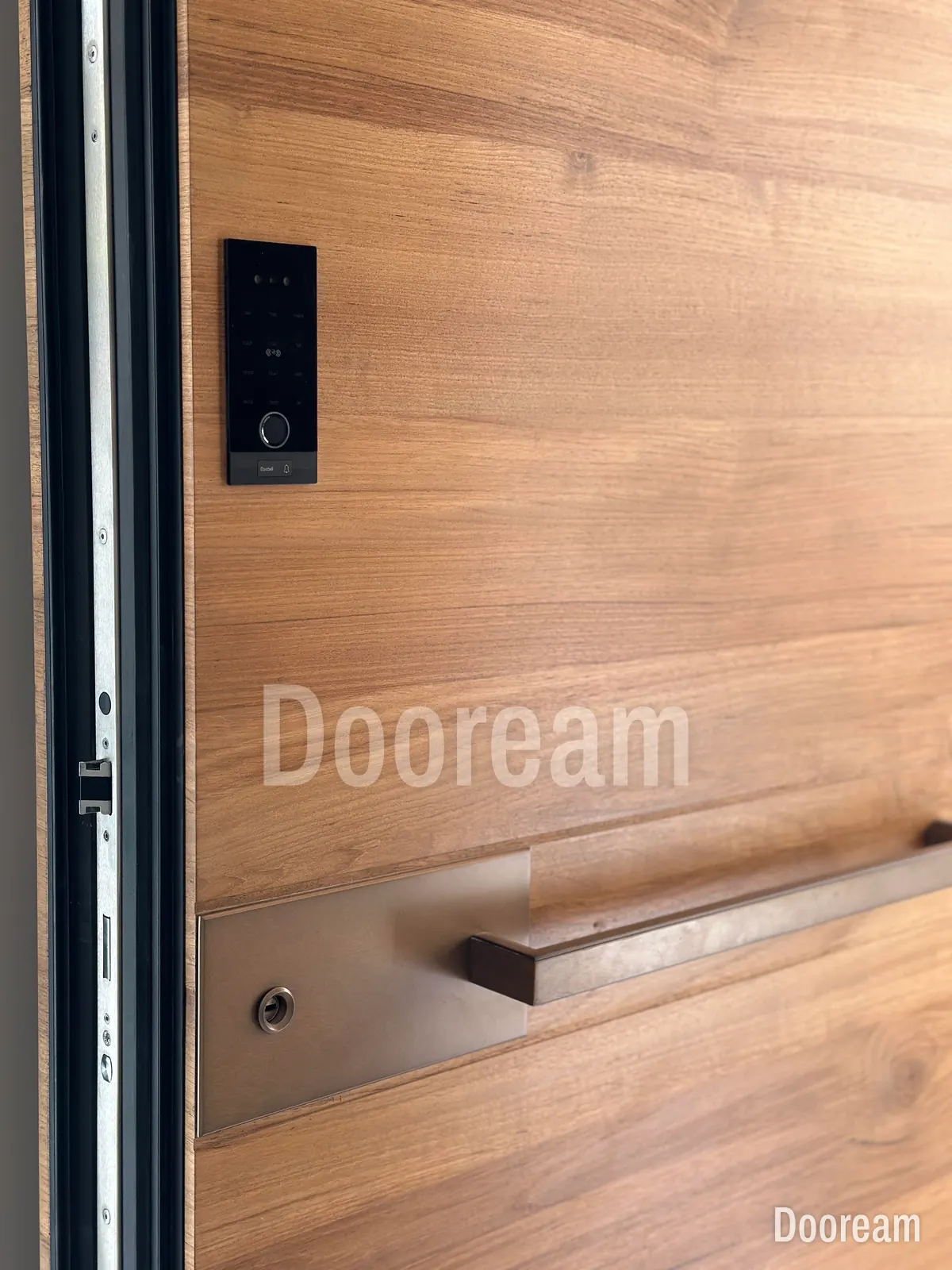
A battery lock needs no cable. A wired lock needs power carried into a leaf that turns, and a pivot door offers three routes: the top pivot, a door loop or a contact transfer. Choose one before the head, ceiling and floor are finished (technical drawings).
| Route | How it works | What to check |
|---|---|---|
| Top pivot | On FritsJurgens System M+, the Class G top pivot carries a Ø7.5 mm cable entry; FritsJurgens specifies TP-70 or TP-R Class G top pivots with a cable grommet for electrification | The lock’s cable fits 7.5 mm; conduit and access above the head |
| Door loop | Flexible armoured conduit from frame to leaf; ASSA ABLOY’s is 500 mm long, surface-mounted, for indoor use | Inside face; a position that clears the swing |
| Contact transfer | Contacts mortised into frame and leaf; on ASSA ABLOY’s effeff power transmitter, spring contacts touch when the door is closed | How the lock behaves while the door stands open |
For a pair of leaves, see smart locks on double doors.
Does the pivot hinge’s hold-open or latching lock the door?
No. A hydraulic pivot controls how the leaf moves; the lock holds it shut. FritsJurgens System M+ closes on its own, can hold the leaf at 90°, and its Latch Control adds “an additional acceleration in the last few degrees, so the door closes firmly into the latch or lock”.
That last stage matters: seals push back as the leaf closes (sealing pivot doors), and a leaf that stops short is neither latched nor locked. A leaf held at 90° is simply open.
Pivot door security checklist
- Which lock, with how many points, of which types, at what heights?
- Bolts into the head and floor, and where their keeps go.
- How the pivot side resists lifting: bolts, a three-point lock, a spacer ring.
- Each bolt’s throw against the gap it crosses.
- Keeps fixed through the frame into the structure, and adjustable.
- A floor keep that resists dirt, drains and sits at the finished level.
- Manual or automatic; does the leaf close fully?
- The power route, battery life, and a mechanical way in with a good cylinder, fitted flush (cylinders and key security).
- A security class only from a test of a complete door like yours (door security ratings).
How does this work with Dooream?
Our pivot doors are offset pivots on pivot hinges, most often FritsJurgens. Our standard mechanical lock is a 9-point steel multipoint lock; smart locks come from KFV, G-U or Wintech. Lattice and Grain Band are shown with KFV locks, Contour with a Wintech fingerprint smart lock. Our doors hold no security rating; testing can be arranged, usually at the buyer’s cost. Send your opening through our contact page, or see for architects.
Sources, checked November 2026: FritsJurgens, System M+ (top pivots, cable entry, hold positions, Latch Control) and exterior pivot doors (lifting, three-point locks, spacer ring, electrification); ASSA ABLOY, P125 hinge bolts, door loop, 500 mm and effeff power transmitter; Ives (Allegion), dust proof strikes; SIEGENIA, KFV automatic multi-point locks AS 3500, AS 3600 and KFV key-operated multi-point locks; G-U, GU SECURY Automatic-DR.
Quick answers
How does a pivot door lock?
A multipoint lock in the free edge throws bolts into keeps in the lock jamb, usually with shoot bolts up into the head and down into the floor. There are no hinges along the pivot edge, so that side needs its own plan. FritsJurgens names lifting the leaf off its floor plate as the main weak point, and three-point locks on both sides of the door as the most effective countermeasure.
How does power get to a smart lock on a pivot door?
A battery lock needs no cable. A wired lock gets power through the top pivot, a door loop or a contact transfer. On FritsJurgens System M+, the Class G top pivot carries a Ø7.5 mm cable entry for wiring through the door. Choose the route before the head and ceiling are closed.
Does the pivot hinge lock the door?
No. A hydraulic pivot such as FritsJurgens System M+ closes the door on its own, can hold it at 90°, and speeds up in the last few degrees so the door closes firmly into the latch or lock. The lock does the locking. A self-closing pivot with an automatic multipoint lock locks the door every time it shuts.