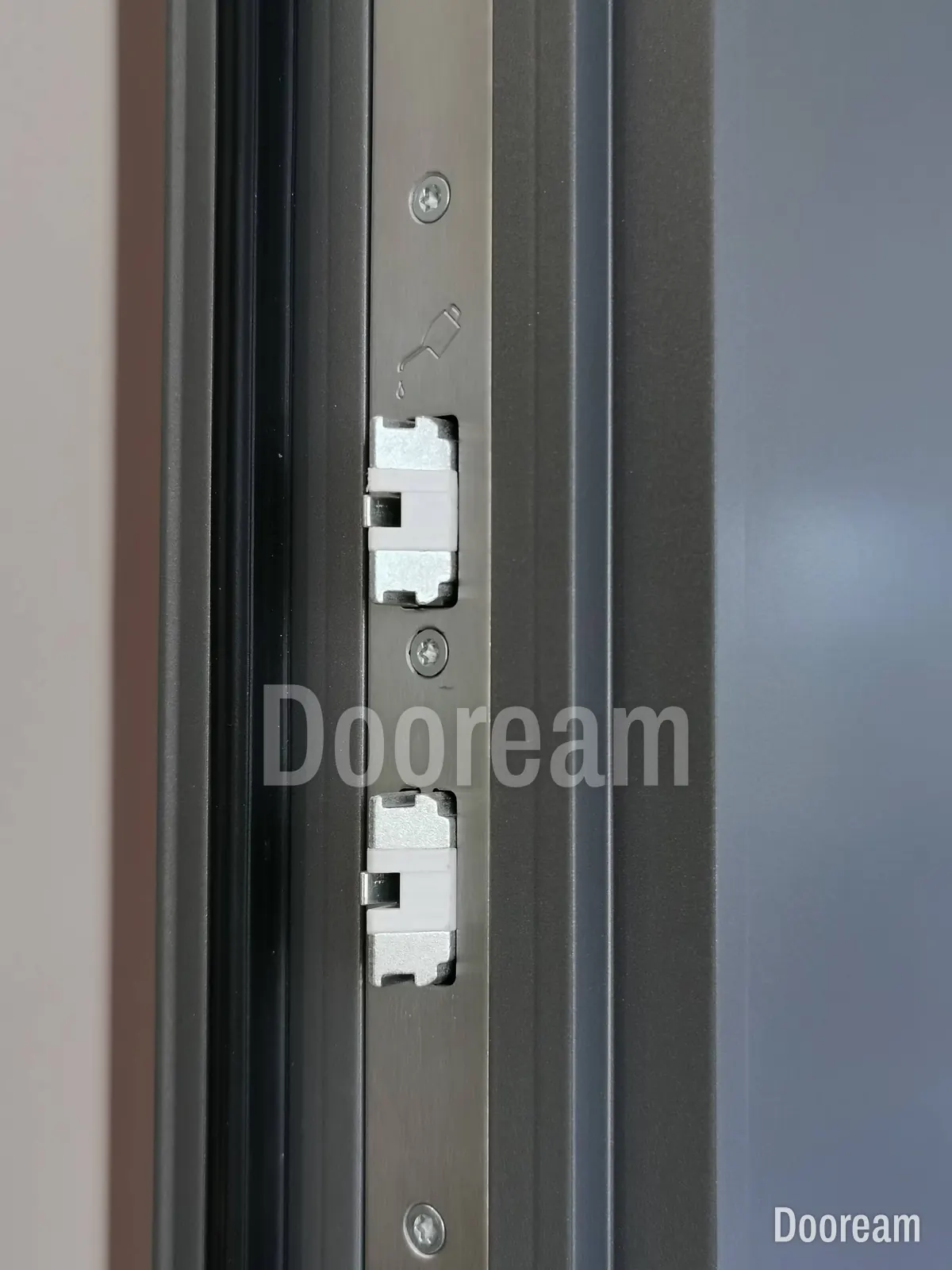
Short answer: a multipoint lock bolts a door at several heights at once. A gearbox at handle height drives bolts, hooks or cams along the edge, each engaging a keep in the frame. How many points a door needs depends on its height and stiffness, the seal pressure, the security aim and any second leaf. The lock alone gives the door no security class.
What is a multipoint lock?
A multipoint lock is a door lock with one central lock case, the gearbox, at handle height, and extra locking points along the edge of the leaf. A rod behind the faceplate links them, so the handle, key or motor moves them together. Each point engages a keep, or strike plate, in the frame.
A single lock holds the leaf at one height, so above and below it the leaf can bow and leak; points along the edge prevent that and share an attack between keeps.
What does each locking element do?
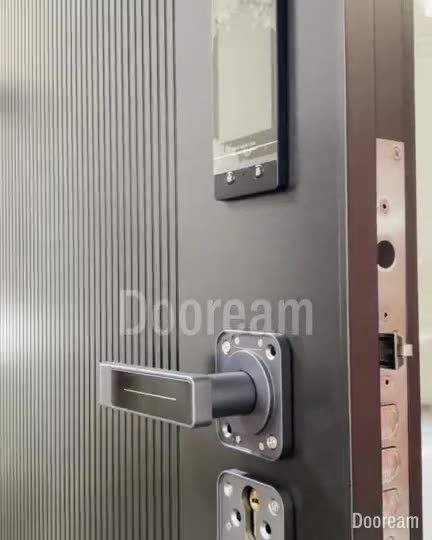
The gearbox usually holds a latch and a deadbolt; the points along the edge use one or more of the other elements below. Names vary, so ask what each element on your lock is, where it sits and what it engages.
| Element | How it engages | What it does |
|---|---|---|
| Latch | Springs out; the handle pulls it back | Holds the door shut when unlocked |
| Deadbolt | Thrown by the key; 20 mm on G-U’s SECURY locks | Locks the door at handle height |
| Hook bolt | Hooks behind the keep | Resists prising leaf and frame apart; G-U’s are designed not to drop onto the keep if the door sags |
| Roller cam | A roller moved along the edge into a keep | Pulls the leaf onto its seals; G-U’s are adjustable for seal pressure at the top and bottom |
| Mushroom cam or pin | A mushroom-headed stud moved into a security keep | Stops leaf and frame being pulled apart; Winkhaus says contact pressure is easy to adjust |
| Swing bolt | Swings out about 35 mm, from above or below, into a steel keep | Resists prising open and pushing in at the lock |
| Top and bottom shoot bolts | Slide into head and floor | Hold the far corners; on a passive leaf, the main hold |
How is a multipoint lock operated?
There are four ways: lift the lever and turn the key, turn the key alone, let the lock throw its bolts as the door closes, or open it with a motor. The choice decides whether every point is thrown each time the door shuts.
- Lever and key. Lifting the handle throws the hooks, pins or rollers; the key throws the deadbolt. Until then, Fuhr notes, the door opens from both sides.
- Key only. The key drives every point; KFV and MACO describe two full turns, and KFV warns that one turn does not fully lock the door.
- Automatic. The bolts throw as the door closes; on KFV’s AS 3500, magnets in the keeps set them off. G-U’s SECURY Automatic throws its latch bolts 20 mm; the handle opens it from inside, the key from outside.
- Motorised. A motor moves the bolts, so a reader, keypad, intercom or app can open the door. It needs power in the leaf (12 V DC on Fuhr’s autotronic); for cables and backup, see smart locks on large and pivot doors.
How many locking points does a front door need?
There is no single right number. Makers build the same lock with different numbers of points and faceplate lengths, and the right count follows from the height and stiffness of the leaf, the seal pressure, the security aim and, on a double door, how the second leaf is held.
- Height and stiffness. A point holds the leaf near itself; corners far from any point can bow (tall front doors and bowing).
- Seal pressure. Locking pulls the leaf onto its seals, KFV notes; points near the top and bottom keep the pressure even.
- Security aim. More points share an attack, but the weakest part decides (what makes an armoured door secure).
- A second leaf. The active leaf locks into the passive one, whose bolts then hold both.
Examples:
| Maker and lock | Range |
|---|---|
| G-U SECURY Automatic | 2, 3, 4 or 6 automatic latch bolts, plus the main lock |
| G-U SECURY SH | 2 or 4 hook bolts, spread evenly along the door |
| Winkhaus easyLock | Up to 4 extra points with mushroom-head pins |
| Fuhr multisafe 855 | Flat faceplates 2,170 or 2,400 mm long for aluminium and steel doors; extensions for doors up to 4,000 mm high |
| KFV key-operated locks | Extension pieces, each adding a locking element |
Ask for the number, type and height of every point on your drawing.
How are pivot and double doors locked?
A pivot door has no hinges along its side: it turns on pivots at the floor and the head, set in from the edge. Between them, the pivot side is held only by any locks of its own, so the lock edge, with points near the top and bottom, does most of the work.
FritsJurgens, a pivot hinge maker, names lifting the leaf off its floor plate as a pivot door’s main weak point, and calls multipoint locks on both sides the most effective answer. Ask how your door holds the pivot side and prevents lifting.
On a double or unequal double door, flush bolts hold the passive leaf at its top and bottom, into the head and usually the floor, and the active leaf locks into keeps on its edge. Ask how those bolts are thrown and how the meeting edge is held; see single, double or unequal double.
Which standards cover the lock, and which the door?
Locks are tested as products; doors are classified as assemblies. In Europe, EN 15685 covers mechanically operated multipoint locks, EN 12209 other mechanical locks and EN 14846 the electrics of electromechanical locks; in the US, ANSI/BHMA A156.37 covers multipoint locks. A class such as RC3 belongs to a tested door.
| Standard | Covers | Rates |
|---|---|---|
| EN 15685:2024 | Mechanically operated multipoint locks and their keeps | The lock |
| EN 12209:2024 | Other mechanically operated locks and their keeps | The lock |
| EN 14846:2008 | Electrics of electromechanical locks | The lock |
| ANSI/BHMA A156.37-2025 | Multipoint locks, graded by operational, strength, cycle and security tests | The lock |
| EN 1627:2021 | Burglar resistance of doorsets, windows and shutters | The tested door |
EN 1627 says building hardware cannot be classified on its own. A lock tested “in various security classes” with door systems, as G-U puts it, tells you about those doors, not yours; FritsJurgens says the same of its pivots. See door security ratings explained.
What about the cylinder?
The cylinder is the part the key turns, and the part an attacker can reach from outside. In Europe it is graded under EN 1303, revised in 2026, for key-related security and resistance to attacks such as drilling and twisting. Ask for its grade, snap protection and a flush fit.
How do you keep a multipoint lock working?
Keep it aligned, lightly greased and in use. A handle that is stiff to lift, or a key that is hard to turn, often means the leaf has dropped or moved and the bolts are rubbing on their keeps: have it adjusted before anything is forced.
- Yearly check. KFV and Fuhr ask for all moving and locking parts to be checked at least yearly; MACO’s yearly check also sets the locking points’ contact pressure.
- The maker’s lubricant, sparingly. KFV allows only spray grease without solvents or resins; Fuhr, acid-free multi-purpose grease and no oil. MACO’s dose is about a pinhead.
- Regular use. MACO asks for the hardware to be worked at least monthly, against “dormant wear”.
- No force. KFV says never to work handle and key together; Fuhr says its lock is not made to straighten a warped door.
- Early adjustment. If bolts drag or the latch misses, Fuhr says to check the installation and reset tight keeps; MACO and Fuhr leave this to a specialist.
- Motor faults. Fuhr says to fix security faults at once, meanwhile using the lock mechanically, motor off.
What should you ask a door maker about the lock?
- Which lock, by maker and model, and is it on the shop drawing?
- How many points, of which types, at what heights, and are there bolts into the head and floor?
- Lever, key, automatic or motor? What if the power fails?
- Pivot door: how are the pivot side and floor plate secured against lifting and levering?
- Double door: how is the passive leaf bolted and the meeting edge held?
- What are the keeps made of, how are they fixed, and can they be adjusted?
- Which cylinder, at which EN 1303 grade?
- Which standard was the lock tested to? Check what your jurisdiction requires, and for a class ask for the test report of a complete door like this one.
- Which lubricant, how often, and who adjusts the lock after installation?
How does this work with Dooream?
We fit the hardware the buyer chooses and test it in our workshop before the door is crated: KFV smart locks (KFV is the door-lock brand of the German SIEGENIA Group), G-U locking systems including BKS and Werock, and Wintech smart locks. Our locks page shows the GU-SECURY Automatic self-locking multipoint lock and a G-U flush bolt set for the second leaf of a double door; each door page lists the lock it is usually shown with. Every door has a two-year warranty from shipment. Send your opening through our contact page.
Sources, checked November 2026: EVS (Estonian Centre for Standardisation), EN 15685:2024 multipoint locks, latches and locking plates, EN 12209:2024 mechanically operated locks and locking plates and EN 14846:2008 electromechanically operated locks; ANSI Webstore, ANSI/BHMA A156.37-2025 multipoint locks; iTeh Standards, EN 1627:2021 scope and EN 1303:2026 scope; G-U, GU SECURY Automatic, GU SECURY SH, GU-SECURY X planning document and bolt locks; KFV (SIEGENIA), operating instructions, key-operated multi-point locks and AS 3500 assembly instructions; Fuhr, multisafe 856, multisafe 855 and autotronic 834/836 manual; MACO, operating and maintenance instructions for door locks; Winkhaus, easyLock; BauNetz Wissen, Schwenkriegel (swing bolt); FritsJurgens, exterior and front pivot doors.
Quick answers
What is a multipoint lock?
A door lock with one central lock case, or gearbox, at handle height that drives extra bolts, hooks or cams along the edge of the leaf through a rod behind the faceplate. Each point engages a keep in the frame, so the leaf is held at several heights instead of one.
How many locking points does a front door need?
There is no single right number. It depends on the height and stiffness of the leaf, the seal pressure, the security aim and whether a second leaf has to be held. Makers sell the same lock with different counts; G-U, for example, offers its SECURY Automatic with 2, 3, 4 or 6 automatic latch bolts besides the main lock.
Does a multipoint lock give a door an RC security class?
No. EN 1627 classes belong to a complete door that has been tested, and the standard says building hardware cannot be classified on its own. A lock can be tested as a product, to EN 15685 in Europe or ANSI/BHMA A156.37 in the US, but that does not rate the door it is fitted to.