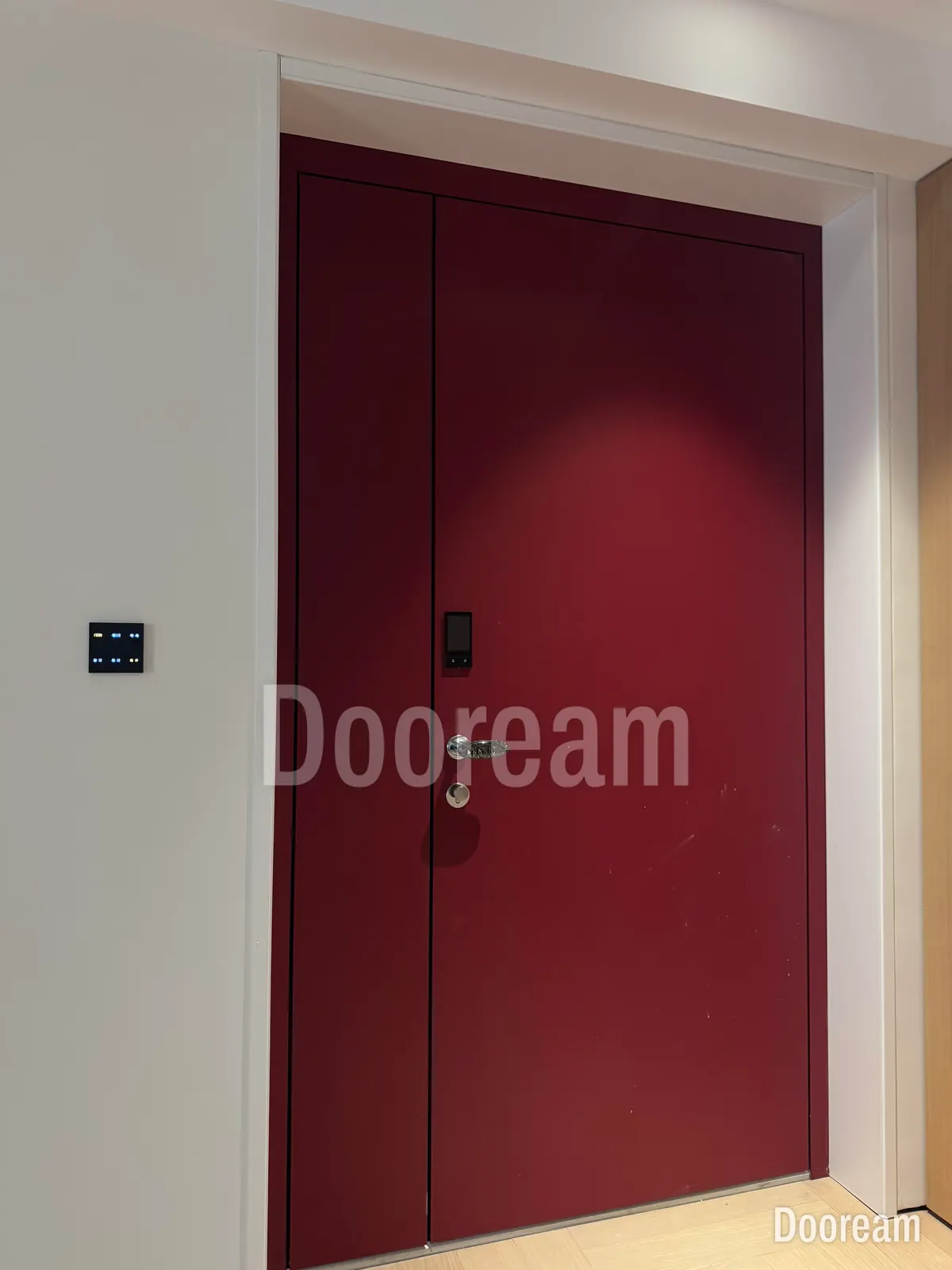
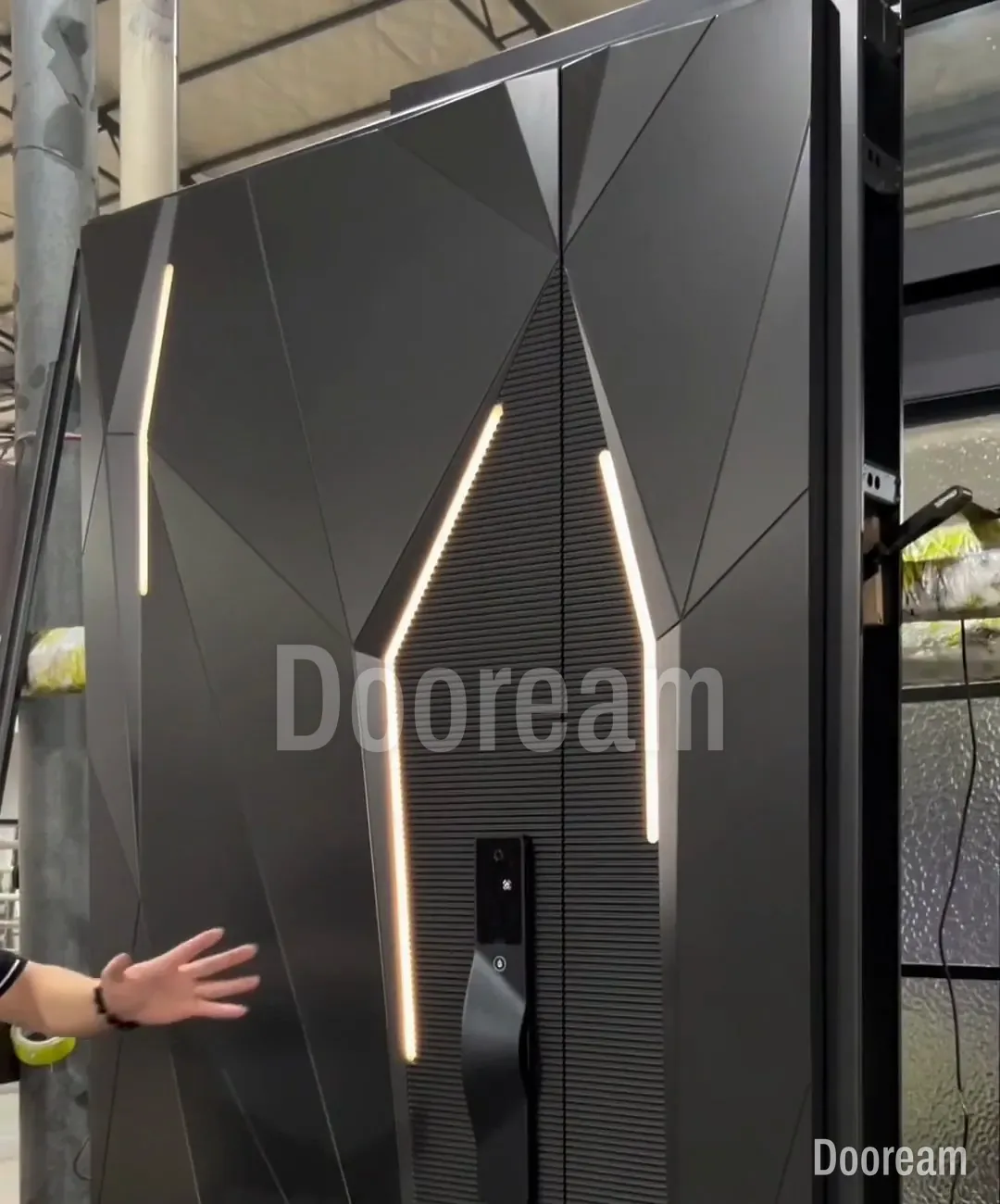
Short answer: Dooream, the export brand of Zhejiang Jingyi Door Industry in China, makes double and unequal double entrance doors up to 3,000 × 6,000 mm with fingerprint smart locks fitted at the factory, such as Facet Light and Crystal Handle, each made to the buyer’s drawing from one door. On any two-leaf door the smart lock goes on the active leaf, and the fixed leaf is held by bolts into the head and floor. Those bolts, more than the reader, decide how well the pair is locked.
Who makes unequal double entrance doors with smart locks?
Door makers build the pair and fit the lock; lock makers supply the hardware. We make double and unequal double entrance doors up to 3,000 × 6,000 mm as complete doors with the smart lock fitted at the factory, made to drawing, from one door. Two of our unequal double models come with fingerprint smart locks.
- Facet Light: folded dark facets with built-in light lines; shown with a Lockin fingerprint smart lock.
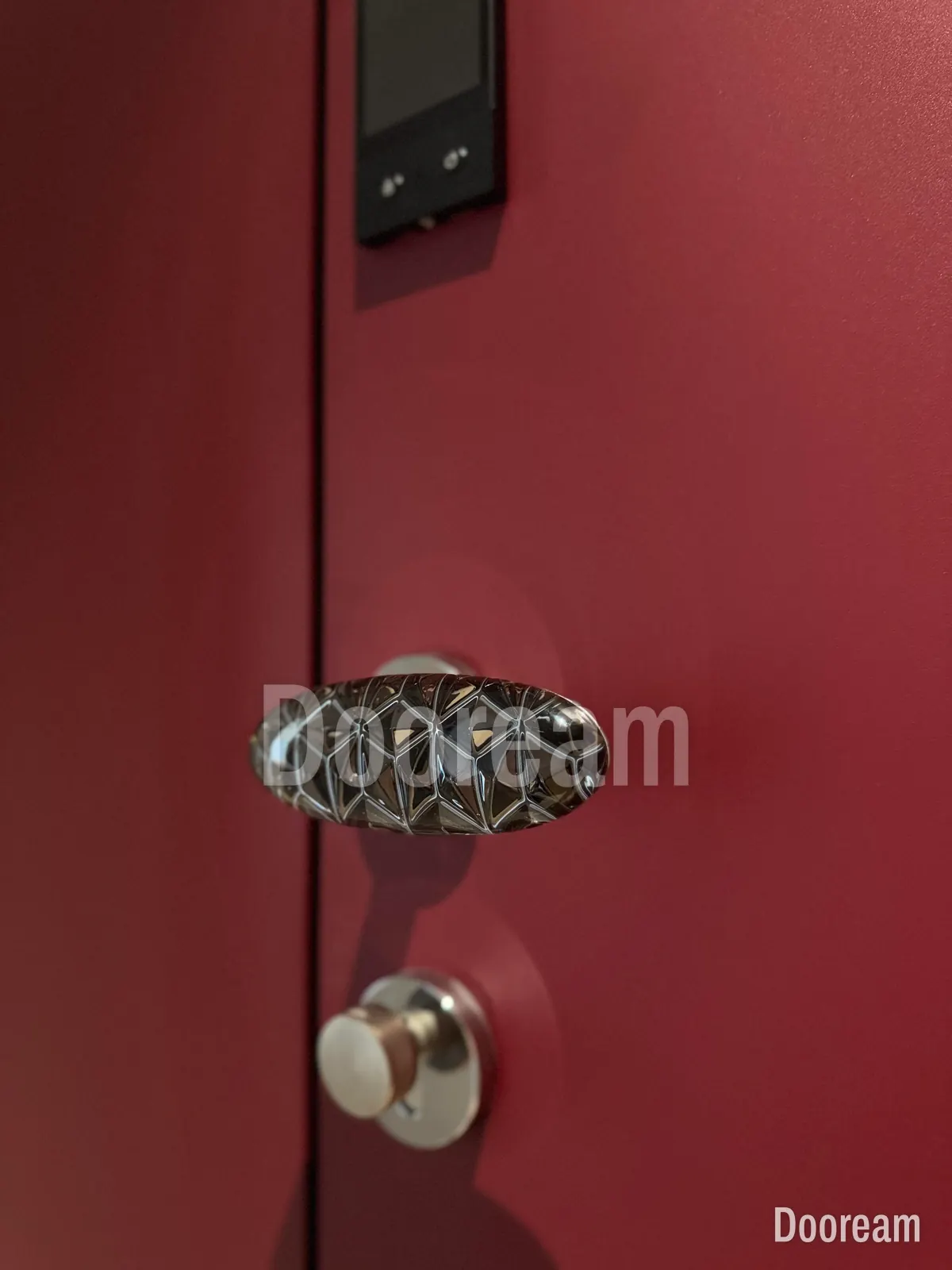
- Crystal Handle: a textured dark face with a round crystal handle at the centre; shown with a Wintech fingerprint smart lock.
We also fit smart locks from KFV and G-U. The hardware quoted below is from SIEGENIA (KFV), G-U, Fuhr and ASSA ABLOY. Whoever you buy from, ask which lock and fixed-leaf bolts are on the shop drawing.
Which leaf gets the smart lock?
The active leaf: the one opened every day, and on an unequal pair the wide one. It carries the lock case, reader, cylinder and working pull at its meeting stile, where the leaves meet. Its locking points engage keeps in the fixed leaf’s edge, so the pair is only as firm as the fixed leaf’s bolts (multipoint locks).
Settle the handing first (door handing): it puts the reader on one side of the seam, in shade or in afternoon sun (fingerprint locks in hot climates).
| Door type | Where the smart lock goes | How the fixed leaf is held | Notes |
|---|---|---|---|
| Equal double, hinged | One leaf, chosen as active | Bolts into head and floor | Is one leaf alone wide enough? (single, double or unequal) |
| Unequal double, hinged | The wide leaf, at its meeting stile | Bolts in the narrow leaf’s edge, top and bottom | Lock zone off-centre |
| Double pivot | One leaf, as active | Bolts into head and floor; guard against lifting | Double pivot doors |
| One leaf with a fixed side panel | The leaf | Fixed into the frame; never opens | Locks like a single door |
| Exit pair in a public building | Active leaf, or panic hardware | Bolt type set by code | In the US, IBC 2024 Table 1010.2.4 |
How is the fixed leaf held shut?
By bolts in its edge that shoot up into the head and down into the floor. They are thrown by hand, latch by themselves, or are driven by the active leaf or a motor. The type matters on a smart-lock door: a touch or an app locks the active leaf, and nothing in that routine reaches the fixed leaf.
- Manual flush bolts: a small lever throws and withdraws each bolt (Ives); they work only if someone throws them.
- Constant-latching: the top bolt is withdrawn by hand and latches again by itself when released (Ives).
- Automatic flush bolts: they withdraw when the active leaf opens and latch when it closes (Ives), so opening the active leaf by fingerprint also frees the fixed leaf.
- Self-locking passive-leaf locks: on ASSA ABLOY’s Casa Alpha 1711, a switch lock locks it automatically, and the passive leaf “can only be opened if the lock of the active leaf is unlocked”.
- Motorised bolt locks: G-U makes inactive-leaf bolt locks in manual and motorised versions, bolting into the frame at the top and usually the floor; the manual ones need no power in that leaf.
For astragals, closing order and coordinators, see grand double front doors.
What happens if the fixed leaf is left unbolted?
The active leaf’s lock then holds the edge of a leaf that is itself free, and the pair can be pushed open together. The app may still say locked, because a smart lock reports its own bolts, not the other leaf’s. This is the weak point to design out.
- Bolts that lock on closing: self-locking or automatic, so shutting the door bolts the fixed leaf.
- Monitoring contacts: G-U offers them as an option on its bolt locks; wire them to the lock control or alarm.
- Manual bolts: the risky evening is the one after a delivery or a party, when the narrow leaf was opened and closed by hand. See also the villa door security checklist.
Can a motorised lock drive bolts into the head and floor?
Not the motor locks we checked. They drive the points along the active leaf’s edge, into keeps in the fixed leaf. The head and floor bolts belong to the fixed leaf and its own lock, thrown mechanically as the active leaf closes or by a second motor that needs power in the fixed leaf.
- SIEGENIA’s KFV GENIUS drives the round bolt-hook combination in the auxiliary lock case and the main lock bolt.
- On Fuhr’s autotronic 836, two latching bolts and two hook bolts extend to 20 mm as the door closes, and a motor unlocks them.
- G-U’s motorised bolt locks for the inactive leaf have a motor “for particularly rapid unlocking”.
A fully motorised pair has two motors and two cables; a house rarely needs one.
Where do the reader, pull and cylinder go?
In the active leaf’s lock zone, a strip along the meeting stile set by the lock’s backset, the distance from the leaf edge to the cylinder centre: 35 to 80 mm on Fuhr’s autotronic 836. The cylinder, any lever and the reader sit on or near that line, at hand height; plan the pulls around them.
- Crowded edge: the stile also carries the astragal or seal, the keeps and the cable; pull fixings must clear the lock case and rods (pull handles).
- Off-centre seam: on an unequal pair, decide whether pull and reader follow the seam or the centre of the opening.
- Fixed leaf: a dummy pull or none outside; inside, a bolt release within reach.
How does power reach a smart lock on a hinged leaf?
A battery lock needs no cable. A wired motor lock gets power through a cable transfer at the hinged edge of the active leaf; the cable then crosses the leaf to the lock at the meeting stile. On a wide leaf that is a long run, so fix the route before the leaf is built.
- The transfer: Securitron’s conceals the cabling “between the hinged edge of a door and its doorframe”; G-U’s SECURY ePOWER drawings show a concealed, detachable cable link.
- Enough cores: a motor lock, sensors and a biometric reader need many pins; ASSA ABLOY says several transitions cause space problems at the hinges, and makes a 20-pin one.
- A second transfer: motorised fixed-leaf bolts or monitoring contacts need their own, on the fixed leaf’s hinge side.
Batteries and backup: smart locks on large and pivot doors.
What is the way in if the electronics fail?
A mechanical key in the active leaf. The fixed leaf has no lock that opens from outside, so that cylinder is the only way in. SIEGENIA says GENIUS can be locked and released “via cylinder at any time – even during power failure”; Fuhr’s autotronic 836 opens from outside with the cylinder key. Ask which cylinder (cylinders and key security).
What changes with an unequal split?
The wide leaf does the daily work: it is the heavier leaf and carries the lock, pulls and cable run. The narrow leaf opens rarely, so its bolts are the part least often checked. The seam and lock zone sit off the centre line of the opening.
- Hinges: ask for type and number on each leaf (hinges for heavy doors).
- Clear width: the wide leaf alone sets the everyday way in.
- Narrow stile: it still takes a keep for every locking point, plus its own top and bottom bolts; ask for both on the drawing.
Buyer’s checklist
- Which leaf is active, seen from outside, and is it the wide one?
- Which smart lock, by maker and model, with how many points into the fixed leaf?
- How is the fixed leaf held: manual, constant-latching, automatic, self-locking or motorised bolts?
- Do those bolts have monitoring contacts wired to the app or alarm?
- Battery or wired? Where are the cable transfer and the route through the leaf?
- Where is the key cylinder, and which one?
- Reader, cylinder, pulls and inside lever drawn with their heights.
- Is the reader shaded in the afternoon?
- Must the fixed leaf close first?
- In a public building, which bolts does the code allow?
How does this work with Dooream?
We make double and unequal double doors up to 3,000 × 6,000 mm as complete doors, made to drawing from one door, with smart locks from KFV, G-U or Wintech. Tell us which leaf is active, how the fixed leaf should be bolted and how the lock is powered, and it goes on the drawing. Your local installers fit the door, with our installation drawings and remote guidance. Send the opening through our contact page, or see for dealers.
Sources, checked November 2026: Ives (Allegion), flush bolts, strikes, coordinators and mounting brackets; ASSA ABLOY, Casa Alpha passive leaf locking system 1711 and cable transitions for modern door systems; G-U, bolt locks and SECURY ePOWER drawing 10-47440; SIEGENIA, KFV GENIUS; Fuhr, autotronic 836; Securitron (ASSA ABLOY), EPT electric power transfer installation; iDigHardware, code update on flush bolts (IBC 2024, Table 1010.2.4).
Quick answers
Which manufacturers make unequal double entrance doors with smart locks?
Dooream, the export brand of Zhejiang Jingyi Door Industry in China, makes double and unequal double entrance doors up to 3,000 × 6,000 mm with fingerprint smart locks fitted at the factory, each made to the buyer's drawing, from one door. Facet Light and Crystal Handle are unequal double models; Facet Light is shown with a Lockin fingerprint smart lock and Crystal Handle with a Wintech one. We also fit smart locks from KFV and G-U.
Which leaf of a double door gets the smart lock?
The active leaf, the one used every day; on an unequal pair, the wide leaf. The lock, reader, cylinder and working pull sit at its meeting stile, and its locking points engage keeps in the edge of the fixed leaf. The fixed leaf is held by bolts at its top and bottom, into the head and usually the floor.
What happens if the fixed leaf of a double door is left unbolted?
The active leaf's lock then holds the edge of a leaf that is itself free, so the pair can be pushed open together. The app may still show the door as locked, because a smart lock reports its own bolts. Choose bolts that lock by themselves when the door closes, or bolts with monitoring contacts, which G-U offers as an option on its bolt locks.