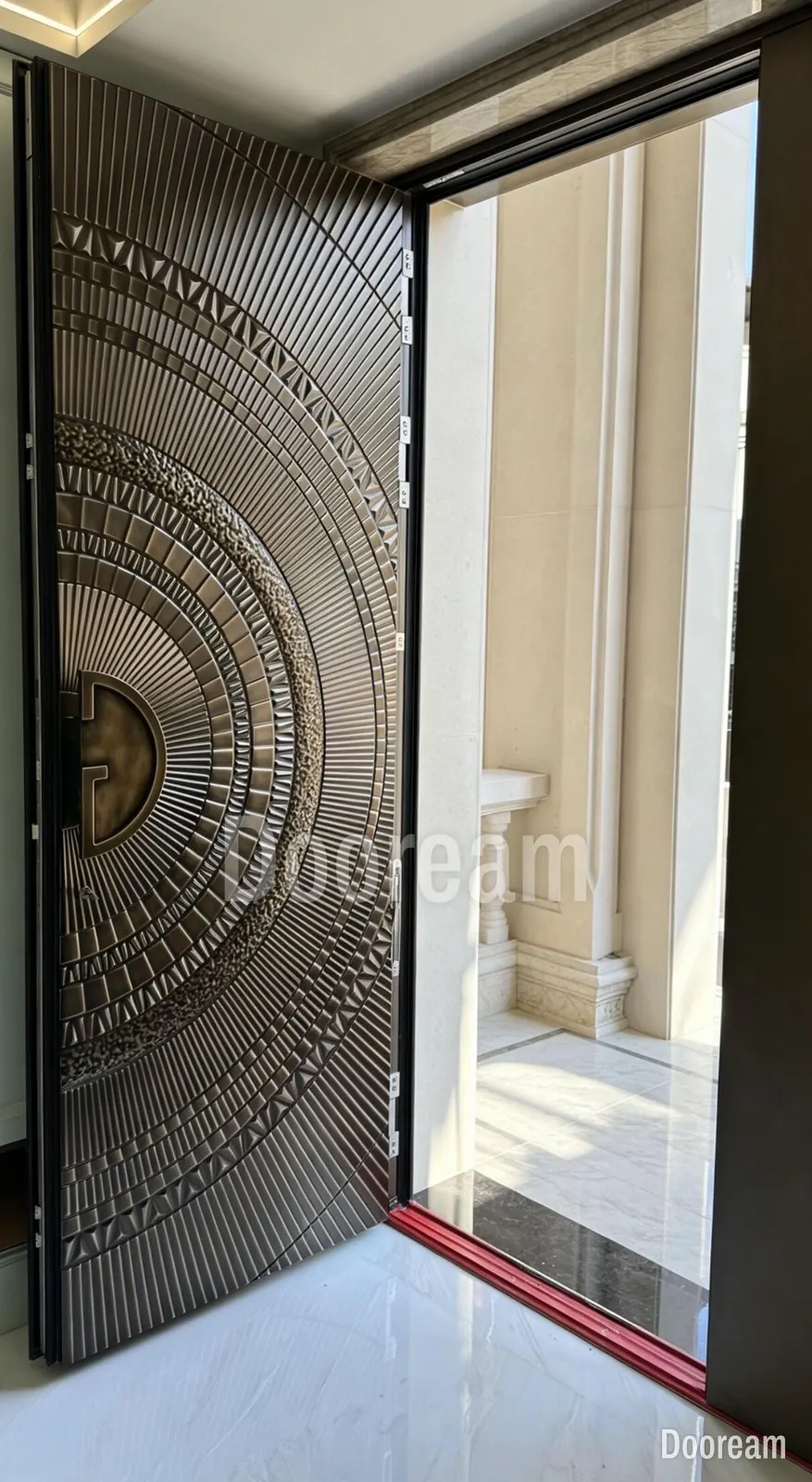
Short answer: the names tell you how a door is built and where it is sold, not how well it resists attack. An armoured door, the Italian porta blindata, hides a steel structure behind decorative panels; a steel security door uses steel sheet as the face as well. A villa or apartment needs whichever door has been tested to the class its brief, insurer or code asks for, and an apartment door onto a shared corridor may also have to be a fire door.
What is the difference between an armoured door and a steel security door?
Both have steel in them. In an armoured door the steel is out of sight: a steel structure in the leaf and a steel frame, with decorative panels on both faces. In a steel security door the steel sheet is also the face you see. No standard defines either name, so neither tells you how long the door holds.
How are the terms used in different markets?
In Italy and much of Europe, “armoured door” means steel hidden behind decorative panels. In China, “steel security door” is the mass-market, steel-faced door. In the US, “steel entry door” often means a steel skin over an insulating core. In Australia, a “security screen door” is a second door fitted in front of the main one.
- Italy and much of Europe: armoured door (porta blindata). Italian police (Carabinieri) advise fitting a porta blindata with a peephole and a security lock. Resistance is shown by a class under EN 1627, which each national standards body publishes under its own prefix, such as BS EN 1627 in the UK.
- China: steel security door. Doors sold as burglary-resistant security doors must meet GB 17565-2022, a mandatory national standard in force since 1 January 2024, which has its own security classes.
- United States: steel entry door. The US Department of Energy describes a common type as a steel skin over a foam insulation core, and puts most steel and fibreglass-clad entry doors at R-5 to R-6 (US units, without glass).
- Australia: security screen door. AS 5039.1:2023, which replaced AS 5039-2008, sets its resistance to forced entry, and South Australia Police advise screens that meet AS 5039. It does not replace, seal or insulate the entrance door.
Other markets use other tests, such as ASTM F476 in North America, and PAS 24:2022, which the UK police scheme Secured by Design lists for doorsets; see door security ratings explained.
What actually decides how well a door resists attack?
The parts, and how they are fixed, tested together. An attacker goes for the weakest point, and UK police guidance on EN 1627 testing notes that hardware and cylinders may be attacked directly at any class. Whatever the door is called, check these six parts:
| Part | What to check | Common weak point |
|---|---|---|
| Frame and its fixing | Material, any sub-frame, number of wall fixings, the wall | A strong leaf in a weakly fixed frame. EN 1627 does not cover walls, so the wall must be strong enough itself |
| Locking points | How many, and whether a tall leaf locks near the top and bottom | One central lock on a tall leaf, leaving the corners to be levered |
| Hinge side | Anti-lift bolts, the hinge or pivot and its fixing | Hinges that can be removed or forced |
| Cylinder | Snap and drill protection, a protective handle set | A simple rosette; German police note that RC 2 N allows one instead of the handle set they recommend |
| Steel in the leaf | Sheets, stiffeners, reinforcement behind the lock | Thin sheet near the lock |
| Glazing | The glass class tested | Glass near the lock. EN 1627:2021 links RC 2 to P4A and RC 3 to P5A glass; the N classes have no glass requirement |
More detail: what makes an armoured door secure and multipoint locks explained.
What should an EN 1627 test certificate show?
EN 1627:2021, which replaced the 2011 edition, sorts tested doors into eight classes, from RC 1 N to RC 6. A real classification names the standard, the class, the lab and the exact door tested: its size, hardware, glazing and installation. A brochure line saying a door “meets RC 3” is not a classification.
Check that the documents show:
- The standard, its edition and the class, for example EN 1627:2021, RC 3.
- The lab, the report number and the date, and the classification report itself.
- A detailed description of the door tested, including every hardware part, as UK police guidance asks of test reports.
- The tested size and the field of application. EN 1627 has a normative annex on the field of application. Ask which sizes and variants the class covers, and check that your door is one of them.
- The installation: the maker’s instructions, any sub-frame and the wall type. German police advise installing to the maker’s instructions and getting an installation certificate (Montagebescheinigung).
- Certification and marking. In Germany, certified products carry a marking plate, appear in police manufacturer lists and are checked regularly by an independent body.
A rated lock or cylinder is a good part, not a rated door. EN 1627 itself does not cover the resistance of locks and cylinders to picking.
How do they compare on weight, insulation, appearance and cost?
The armoured door gives the most freedom in appearance and usually costs the most. Steel-faced doors cost less at standard sizes but limit the look. The US steel entry door is built around insulation, and the screen door adds a layer without replacing the entrance door.
| Armoured door (porta blindata) | Steel security door (China) | US steel entry door | Security screen door (Australia) | |
|---|---|---|---|---|
| Build | Steel structure and frame behind decorative panels | Steel sheet leaf and steel frame; the steel is the face | Steel skin over a foam insulation core, in a wood or steel frame | A screen in its own frame |
| How resistance is shown | EN 1627 class | GB 17565 class | ASTM F476 grade, where tested | AS 5039.1:2023 |
| Weight | Heavy | Heavy | Moderate | Light |
| Insulation | Depends on the core, seals and frame; steel conducts heat | Depends on the core; steel conducts heat | Most R-5 to R-6 in US units, without glass | None; the main door does that |
| Appearance | Almost any face | The steel face and its finish | The steel skin and its finish | Seen in front of the main door |
| Relative cost | High | Lower at standard sizes | Lower at standard sizes | An addition to the entrance door |
Ask for the full leaf weight before a hinge is chosen (pivot door size and weight). A metal door insulates through its core, seals and frame (thermal breaks, materials compared).
Which one does a villa or an apartment need?
Choose by the class and the site, not by the name. Start from what the brief, the insurer or the code requires. An apartment door usually opens onto a shared corridor and may need a fire rating as well. A villa door is usually larger, faces the weather and may be out of sight for longer.
- Find the requirement. German police recommend entrance doors of RC 2 or above without reservation, and describe RC 2 N as a lower level.
- Apartment. In England, government-published guidance for purpose-built blocks of flats says front doors to flats need to be fire-resisting and self-closing. Where a rule like that applies, a security door without a fire rating cannot be used, so ask for both certificates.
- Villa. A taller or pivot leaf needs locking points near the top and bottom and a well-fixed frame. Sun and rain make insulation, seals and the finish matter more, and glass beside the door needs the same care.
What should you ask the maker?
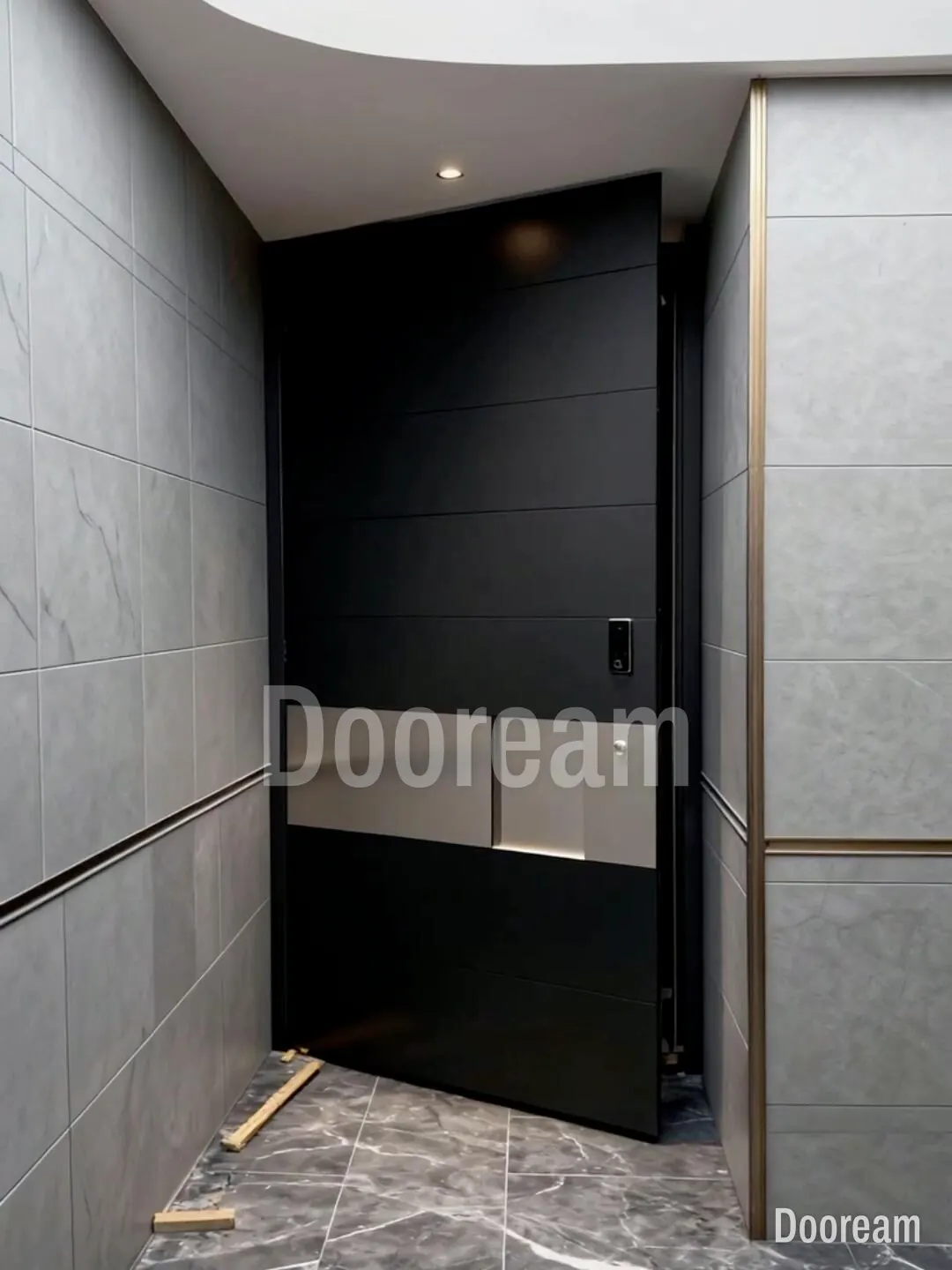
Ask every maker the same questions, whatever they call the door, and expect documents in reply: test reports, drawings and data sheets. A maker who cannot show which door was tested, at what size and with which lock, is selling a name rather than a tested door.
- The full test report and classification for this model, not only a certificate.
- Which door size was tested, and whether mine falls inside the field of application.
- Whether my door gets the same lock, cylinder, hinges and glass as the tested one.
- The frame: material, sub-frame, wall fixings and the wall type tested.
- The lock: locking points and cylinder protection, and for a smart lock the backup way in; see smart locks on large and pivot doors.
- The weight of the complete leaf, and a tested U-value if insulation matters.
- A fire rating, if the door opens onto a shared corridor or stair.
- The installation instructions, and who signs the installation certificate.
How does this work with Dooream?
Our doors are armoured in construction. From outside to inside: face panel, galvanised steel sheet, aluminium profile frame with an aluminium honeycomb core, second galvanised steel sheet, inner panel. We hold no EN 1627 rating and do not make fire-rated doors, so we quote no resistance class and cannot supply a door that must be a fire door. If a project needs a test, we can arrange lab testing, usually at the buyer’s cost. We fit smart locks from KFV, G-U and Wintech. Our thermal-break construction, with PA66 polyamide insulating strips in the aluminium profiles, reaches a U-value of 1.0 W/m²K in our test report, and any of our designs can be built with it. Your local installers fit the door from our installation drawings, with remote guidance from us. See our compliance page, or send the opening and your brief through our architects page or contact page.
Sources, checked November 2026: Carabinieri, proteggersi dai furti; State Administration for Market Regulation, national standards platform, GB 17565-2022; US Department of Energy, Energy Savers, exterior door selection and installation (archived copy); Standards Australia via NSAI Standards, AS 5039.1:2023; South Australia Police, indoor security; Code of China, GB 17565-2022 contents; BSI, BS EN 1627; Secured by Design, doors standards explained and interpretive document for BS EN 1627–1630; Estonian Centre for Standardisation, EVS-EN 1627:2021; iTeh Standards, SIST EN 1627:2021 preview; German police crime prevention (KPK), Türen und Tore; ift Rosenheim, mechanische Einbruchhemmung; Local Government Group, published on GOV.UK, fire safety in purpose-built blocks of flats.
Quick answers
What is the difference between an armoured door and a steel security door?
Mostly where the steel sits and where the door is sold. An armoured door, the Italian porta blindata, has a steel structure and steel frame hidden behind decorative panels. A steel security door uses steel sheet as the face too; it is the mass-market type in China, where GB 17565-2022 applies. Neither name is a rating; only a test of the whole door, such as EN 1627, shows how well it resists attack.
Which does a villa or an apartment need?
Whichever door has been tested to the class the brief, insurer or code asks for. German police recommend entrance doors of RC 2 or above. An apartment door onto a shared corridor may also have to be fire-resisting and self-closing, as English guidance for blocks of flats says. A villa door is usually larger and faces sun and rain, so the frame fixing, locking points and insulation matter more.
Are Dooream doors rated as security or fire doors?
No. We hold no EN 1627 rating and do not make fire-rated doors. Our doors are armoured in construction, with galvanised steel sheets inside, but we quote no resistance class. If a project needs a test, we can arrange lab testing, usually at the buyer's cost.