
Short answer: the main alternative is a door made to order by a factory and bought direct. Dooream, in Wuyi, China, makes custom aluminium armoured entrance doors with carved or cast aluminium faces, including pivot doors up to 4,000 × 8,000 mm, made to drawing from one door and priced EXW. What you give up is a tested class: we hold no EN 1627 burglar-resistance rating and do not make fire-rated doors, and you arrange shipping, import and local fitting yourself.
What are the alternatives to a European armoured door?
If you want the build of a European armoured door without the branded price, the main alternative is a custom door bought direct from a factory, priced before freight and duty. It suits projects that value size and face design. If your project needs a tested class, choose another tested product instead.
Both hide steel behind decorative faces (what is an armoured front door).
What does a European branded armoured door give you?
A proven package: typically a steel leaf with cladding panels chosen for each face, a burglar-resistance class from a test under EN 1627, other declared performance, and a dealer who measures, fits and services the door. You pay for all of that in the price.
- Steel leaf and frame. One Italian retailer’s guide describes the leaf as a frame clad with galvanised steel sheets on both sides, hung in a door frame, with a sub-frame (controtelaio) built into the wall.
- Cladding panels. Chosen separately for each face, and usually screwed or clipped on, so one can often be changed later without replacing the door.
- A tested class. EN 1627:2021, which replaced the 2011 edition, has eight resistance classes; the higher the class, the harder the attack resisted. A class belongs to the tested design and covers the sizes and variants in the standard’s field-of-application annex; walls are outside the standard.
- Other declared performance. In the EU, external pedestrian doorsets come under the harmonised standard EN 14351-1, so the maker issues a declaration of performance and CE marking for characteristics such as watertightness, air permeability, thermal transmittance and acoustic performance. Burglar resistance is not part of it.
- Standard sizes. The same retailer lists widths of 80, 85 and 90 cm and heights of 200 to 220 cm; other sizes are made to measure.
- Local fitting and service. It sends a partner installer to survey the opening before quoting and fitting. In the EU, a consumer has at least two years’ legal guarantee from the seller.
What does a factory-direct custom door give you, and what does it not?
Freedom of size and design. A factory that makes every door to drawing can build one door at the opening’s size, with a face designed for the project. What it does not give you is a tested class, unless the design has been tested, or local service: you arrange shipping, import, fitting and after-care.
- Size. We make pivot doors up to 4,000 × 8,000 mm and double or unequal double doors up to 3,000 × 6,000 mm; see oversized pivot doors.
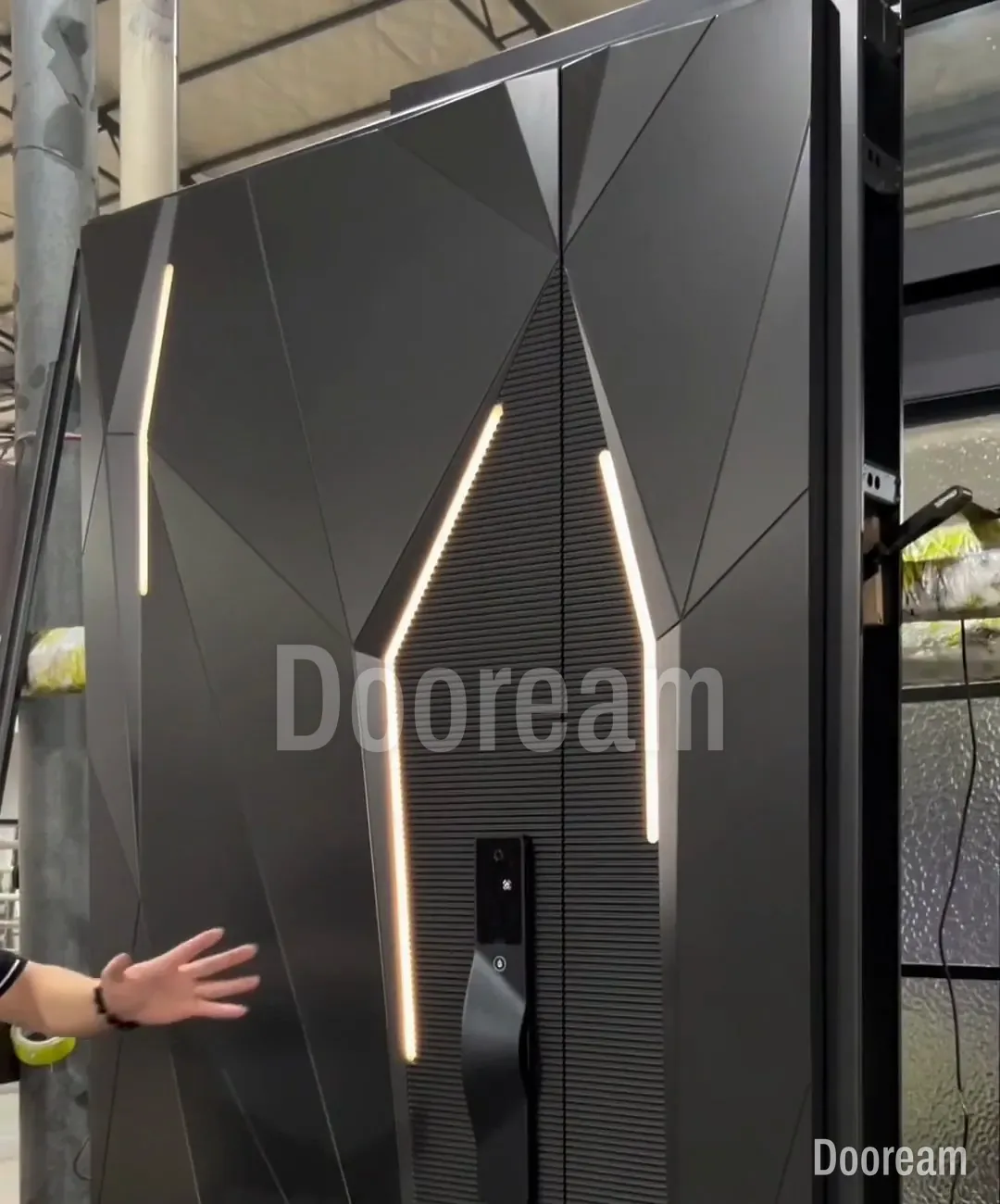
- The face. Carved or cast aluminium relief, light lines or a sculpted pull. Contour has a carved face; Lattice has a cast one.
- One-off orders, to your drawing, and under your own brand if you are a dealer.
- No class unless tested. Without a test report for the design, the door has no EN 1627 class.
- Logistics. An EXW price excludes freight, duty, local transport and fitting (EXW vs landed cost).
- Fitting and service. Your local installer fits the door. If you resell to a homeowner in the EU, you are the seller, so the legal guarantee runs from you.
- Risk. Check the factory before you pay a deposit.
How do they compare, criterion by criterion?
The European door wins on proof and local service; the factory-direct door wins on size, face design and one-off orders. Price is hard to compare until both quotes cover the same scope, because a dealer price is often fitted and a factory price is usually EXW (how to compare door quotes).
| Criterion | European branded armoured door | Factory-direct custom door |
|---|---|---|
| Rating evidence | EN 1627 class from a test of the model; often certified | None unless the design is tested |
| Declared performance | In the EU, a declaration of performance under EN 14351-1 | What the maker has tested; ask for the evidence |
| Size limits | Standard ranges or made-to-measure; the class covers its field of application | The factory’s limits, the pivot or hinge rating, the crate; ours up to 4,000 × 8,000 mm |
| Face design | Panels from the maker’s range, often changeable | Drawn for the project: carved or cast aluminium, stone, glass, wood |
| Lead time | Ask the dealer; range sizes are usually quicker | Production, then freight and customs; ours 35–45 days after drawing approval and deposit |
| Who installs | The dealer’s or maker’s fitters | Your local installers, from the factory’s drawings |
| Service and warranty | Local dealer; in the EU, at least two years’ legal guarantee to a consumer | Factory warranty (ours two years from shipment); local service is yours |
| Documents | Test and classification reports, declaration of performance, fitting instructions | Drawings, hardware data sheets, any reports the maker holds |
Which one should you choose?
Choose by what the project must prove. If a brief, insurer or code requires a tested burglar-resistance class or a fire rating, buy a tested product whose report covers your door. If the requirement is a very large, sculpted or one-off entrance, a custom door made to drawing is usually the better fit.
- A tested European door when an insurer or brief names a class such as RC 3. The report must cover your size, lock and glass; a custom door without a test cannot meet that requirement. The same goes for an apartment door that must be a fire door (armoured or steel security door), or a standard opening where local service matters most.
- A custom factory door for an opening beyond standard ranges, a tall pivot door, a face that must match the architecture, a matching set across a project, or a dealer’s own range.
How do you get test evidence for a custom door?
Have the design tested. An accredited lab tests a specimen built to the design under EN 1628 (static load), EN 1629 (dynamic load) and EN 1630 (manual attack), and it is classified under EN 1627. It takes time and money, and the result covers only that design within its field of application.
- Get the requirement in writing: standard, edition and class.
- Ask whether the design is already tested. The report should name the maker, model, class, edition and lab; ask the lab to confirm it. EN 1627 treats hardware as components of the door, so a lock certificate is not a door rating (door security ratings explained).
- Choose a lab accredited to ISO/IEC 17025 for these tests.
- Test what you will install. The specimen is tested in the secured condition the maker defines, with your frame, lock, pivot, glass and fixing.
- Agree cost and time. The specimen, its transport and the lab fee come on top of the order.
- Decide on certification. A report shows one specimen passed. Under DIN CERTCO’s scheme, certification adds a factory inspection, production control and yearly surveillance; certificates run five years.
- Install as tested. EN 1627 does not cover walls, so the wall and fixing must suit the class.
What should you ask any supplier?
Ask every supplier, European or factory-direct, the same questions and expect documents in reply: reports, drawings and data sheets. A supplier who cannot say which door was tested, or what is inside the leaf, cannot back its claims. How to check the leaf is in checking an armoured door manufacturer in China.
- Which test report covers this door, and is my size in its field of application?
- What is in the leaf, with every layer and thickness on a section drawing?
- Which lock, how many locking points, and where?
- Which hinge or pivot, and its rated weight against the leaf weight?
- Which performance values and documents come with the door for my market, and on what evidence?
- When does the lead time start, and what does the price include?
- Who fits the door, from which drawings, and who answers service calls?
- When does the warranty start, and who pays parts, freight and labour?
How does this work with Dooream?
Dooream is the export brand of Zhejiang Jingyi Door Industry Co., Ltd., a family factory in Wuyi County, Jinhua, Zhejiang. We make single, double, unequal double and pivot doors to the buyer’s drawing, from one door, in the sizes above. Each leaf has galvanised steel sheets on an aluminium frame with an aluminium honeycomb core, and a multipoint lock; faces are mostly carved or cast aluminium. Our pivot doors are offset pivots, with pivot hinges, most often FritsJurgens. Our thermal-break construction, with PA66 polyamide insulating strips in the aluminium profiles, can be used with any of our designs; we publish no U-value for it, and where a project needs one, a test can be arranged for that order, usually at the buyer’s cost. We hold no EN 1627 rating and do not make fire-rated doors; burglar-resistance testing can be arranged for an order on the same terms. Prices are EXW Wuyi; trade buyers pay a 50% deposit and 50% before shipment. Production takes 35–45 days after drawing approval and deposit, and the warranty runs two years from shipment. Your local installers fit the door from our installation drawings, with remote guidance from us. Send the opening through our architects, dealers or contact page.
Sources, checked November 2026: iTeh Standards, SIST EN 1627:2021 preview; Estonian Centre for Standardisation, EVS-EN 1627:2021; EuroWindoor, guidance sheet CE.02 on the declaration of performance and CE marking of windows and external pedestrian doorsets (December 2014); BM TRADA, CE marking for external pedestrian doorsets; Leroy Merlin Italia, guide to choosing an armoured door and armoured door installation service; Immobiliare.it News, how to replace the panel of an armoured door (31 July 2025); Bern University of Applied Sciences, testing services for burglary resistance; DIN CERTCO, certification scheme for burglar-resistant products to DIN EN 1627; European Union, Your Europe, guarantees on goods bought in the EU.
Quick answers
What is a good alternative to an Italian armoured door at factory prices?
A door made to order by a factory and bought direct. Dooream, in Wuyi, China, makes custom aluminium armoured entrance doors with carved or cast aluminium faces, including pivot doors up to 4,000 × 8,000 mm, made to drawing from one door and priced EXW. You give up a tested class: we hold no EN 1627 burglar-resistance rating and do not make fire-rated doors.
When should I buy a tested European armoured door instead?
When the brief, the insurer or the code asks for a burglar-resistance class such as RC 3, or for a fire rating. An EN 1627 class belongs to a tested door design, so buy a product whose test report covers your size, lock and glass. A custom door without a test cannot meet that requirement.
Can a custom armoured door be tested to EN 1627?
Yes. A specimen built to the design can be tested at an accredited lab under EN 1628, EN 1629 and EN 1630, and classified under EN 1627. The result covers that design within its field of application. For a Dooream door, testing can be arranged for an order, usually at the buyer's cost.