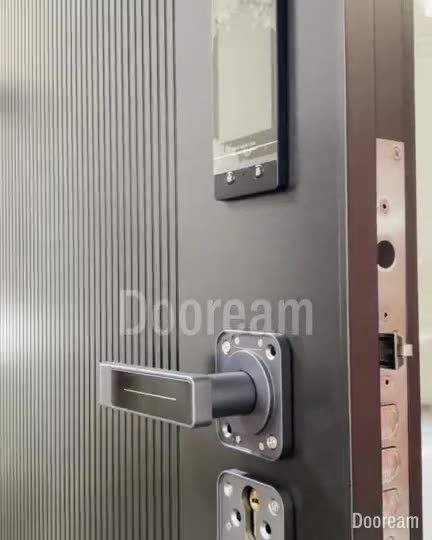
Short answer: a security rating tells you that a complete door, with its frame, locks and fixings, resisted a defined attack in a named test. In Europe that is EN 1627 (classes RC1N to RC6), in North America ASTM F476 (grades 10 to 40) or AAMA 1304, and in China GB 17565 (levels 1 to 5). "Armoured" is a description of the build, not a test result. We do not currently hold an EN 1627 rating.
What do the EN 1627 resistance classes mean?
EN 1627 classifies burglar-resistant doors, windows and shutters. A door is tested with a static load (EN 1628), a dynamic load (EN 1629) and a manual attack by a tester with a set tool kit (EN 1630). The higher the class, the more tools and the longer the attack.
| Class | Attacker and tools (summary) | Working time in manual test |
|---|---|---|
| RC1N | Physical force: kicking, shoulder charges, lifting | No manual tool test |
| RC2N / RC2 | Opportunist with screwdrivers, pliers and wedges | 3 minutes |
| RC3 | Adds a second screwdriver and a crowbar | 5 minutes |
| RC4 | Adds saws, hammers, chisels and a cordless drill | 10 minutes |
| RC5 | Adds power tools, such as an angle grinder | 15 minutes |
| RC6 | High-performance power tools | 20 minutes |
The “N” classes have no requirement for the glazing. For a solid entrance door that matters less; for a door with glass, check which glass class was tested.
What are ASTM F476 grades and AAMA 1304?
ASTM F476 tests the security of a complete swinging door assembly: the door, hinges, lock, strike and frame. Results are often reported as grades:
- Grade 10: minimum, for homes in low-crime areas.
- Grade 20: low to medium, for homes in average-crime areas and apartments.
- Grade 30: medium to high, for homes in higher-crime areas and small commercial buildings.
- Grade 40: high, for small commercial buildings in high-crime areas.
AAMA 1304 is a pass or fail test of forced-entry resistance for side-hinged door systems in the locked position. It is aimed at opportunistic entry and has no grades.
What is GB 17565 in China?
GB 17565 is China’s standard for anti-burglary security doors. The 2022 edition came into force on 1 January 2024 and replaced the old grades (甲, 乙, 丙, 丁) with five levels, 1 to 5. The levels are set by the attack tools and the net working time; level 4 adds resistance to power tools, and level 5 is for special sites. If a Chinese supplier quotes a GB 17565 level, ask for the test report for that door model.
What does “armoured” mean?
None of these standards defines “armoured”. The word describes how a door is built. Ours are built in layers: the face, a galvanised steel sheet, an aluminium frame with an aluminium honeycomb core, a second galvanised steel sheet and the inside face. That tells you about the construction; it does not tell you how long the door resists attack. Only a test of the whole door does.
Why does a rating cover the whole door, not one part?
A burglar attacks the weakest point: the hinge side, the frame fixing, the cylinder or the gap at the lock. So a class applies only to the combination that was tested: that leaf, frame, lock, hinges, glass and fixing into an approved wall. A lock with a high rating on a door that was not tested does not give the door that rating.
How should you specify security for a project?
- Decide the requirement. Does the insurer, the building code or the client ask for a named class? If so, write it into the specification.
- Ask for the test report and classification for the door model, not for the lock alone.
- Check the report matches the size, glazing, hardware and installation you are buying.
- If there is no rating, ask whether a test can be arranged and who pays.
We fit smart locks from KFV, G-U and Wintech, chosen by style and function on our locks page. Our testing and documents page sets out what we hold: no EN 1627 rating, no fire doors, and third-party tests arranged on request, usually at the buyer’s cost.
Sources, checked October 2026: Arbonia, burglar-resistant doors and EN 1627 classes; Thermosash, summary of resistance classes, DIN EN 1627–1630; Winkhaus, burglar resistance; ASTM, F476-23 scope; National Research Council Canada, NBC note on ASTM F476; AAMA, AAMA 1304-18 release; Code of China, GB 17565-2022.
Quick answers
What does RC3 mean on a door?
RC3 is a resistance class in the European standard EN 1627. In the manual test, a tester with tools such as screwdrivers and a crowbar must fail to get through within 5 minutes of working time. The class applies to the door, frame, hardware and fixing as tested together.
Is an armoured door the same as a certified security door?
No. "Armoured" describes how a door is built, usually with steel or other metal layers inside. It is not a test class. A security rating means a whole door assembly passed a named test, such as EN 1627, ASTM F476 or GB 17565.
Do Dooream doors have an EN 1627 rating?
No. We do not currently hold an EN 1627 burglar-resistance rating. If a project needs a test, we can arrange one with a test lab; the buyer usually pays the fee.