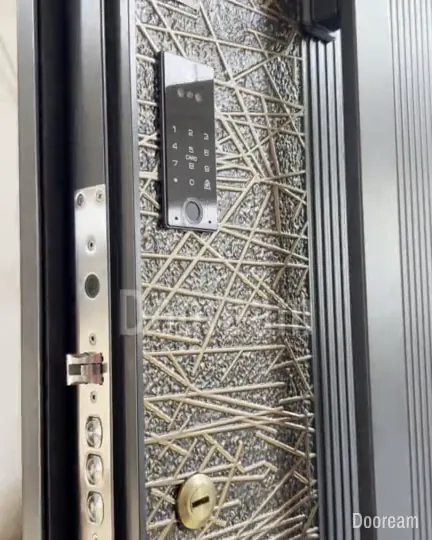
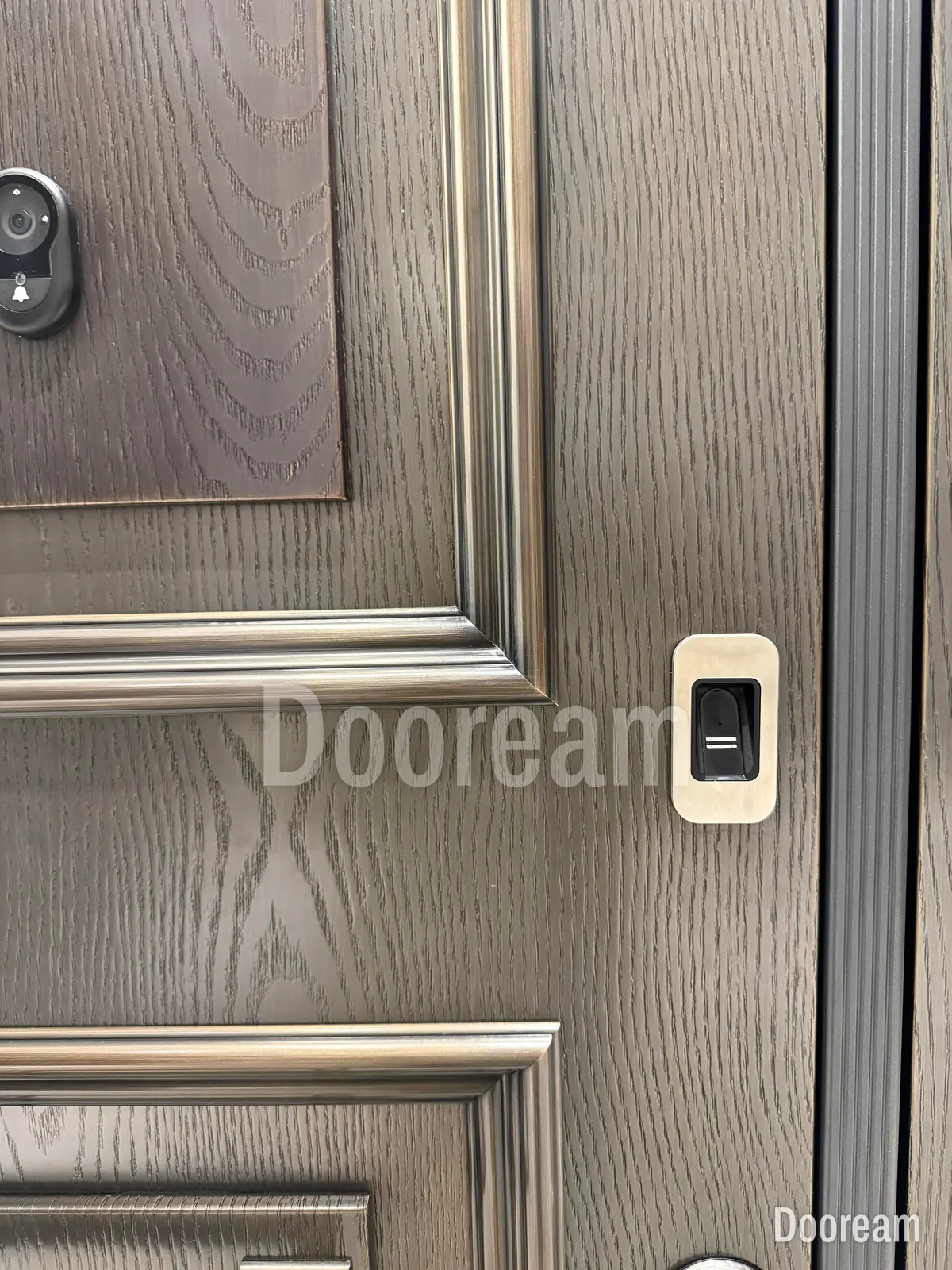
Short answer: on a thick armoured or oversized pivot entrance door, put video doorbells and IP intercoms on the fixed wall or frame surround beside the lock edge whenever possible, rather than cutting them into the moving leaf. Standard optical peepholes rarely span an armoured leaf cleanly without long extension barrels, while wall-mounted intercoms avoid moving cables, keep the camera steady and stay easy to replace. If a camera viewer or wired smart lock sits in the leaf, specify the exact cutout and cable route before manufacture.
Why do standard door viewers fail on thick armoured doors?
Standard optical peepholes are built for thin residential timber or hollow-core doors, not deep composite armoured leaves. Most off-the-shelf optical barrels run out of thread well before they reach the inside face of an insulated armoured door, and site drilling risks hitting internal steel plates, lock rods or stiffeners.
- Barrel thickness limits. Published hardware ranges from Ives (Allegion), ASSA ABLOY and Yale place most standard optical viewers in the 35–57 mm door-thickness band, with specialist thick-door optical models reaching roughly 67 mm. Digital door viewers with long threaded sleeves reach deeper — Yale’s 500-series digital door viewer, for instance, is rated for 38–110 mm leaves through a 14 mm bore — though a deep tunnel narrows any optical glass lens and complicates alignment.
- Armoured leaf layers. An armoured aluminium leaf carries outer and inner faces over two galvanised steel sheets, an aluminium perimeter frame, an internal core and vertical lock linkages. Drilling through those layers on site with a hand drill can snag steel sheet edges, damage the coated face and breach moisture seals.
- Privacy and standards. In the UK, Secured by Design guidance references DHF TS 002 for door viewers, requiring wide-angle clarity and an internal privacy cover so callers cannot look back inside. On a thick leaf, verify that any optical or digital viewer selected still sits flush without distorting the outer relief.

Door viewer, video doorbell or wired intercom: which suits a villa entrance?
Choose the device by whether it needs a permanent cable, how deep the entrance recess is, and whether the door opens directly to a street or behind a perimeter gate. Comparing the four main options early prevents late clashes between the door maker, the electrician and the access-control installer.
| Option | Typical mount | Power and data | Fits thick armoured leaves? | Main trade-off |
|---|---|---|---|---|
| Optical peephole | Moving leaf | None | Rarely above ~67 mm without custom extension | No wiring or batteries, but narrow view in deep porches and hard to reach for shorter users |
| Digital door viewer (camera + indoor screen) | Moving leaf | Internal battery (AA or rechargeable cell) | Up to ~110 mm on extended-barrel models | Factory bore keeps lines clean, but batteries need changing and screen replacement relies on the same bore size |
| Integrated smart-lock camera and bell | Moving leaf (lock zone) | Lock battery or wired lock power | Built in at the factory with the lock body | Cleanest single-cutout look, but tied to the smart-lock model and lower camera angle at handle height |
| Video doorbell or IP intercom | Fixed wall, jamb surround or pillar | Low-voltage DC, 2-wire bus or IEEE 802.3af PoE (Cat5e/Cat6) | Independent of leaf thickness | Best video angle, weather resistance and serviceability; requires wall conduit before stone or render goes on |
Where should you mount a video doorbell or intercom beside a pivot door?
Put the intercom on the lock side of the opening, mounted to the masonry wall or fixed sidelight mullion outside the swing of the leaf and the long pull handle. Never place a call station on the narrow tail side of an offset pivot door, where the short edge swings outwards into the visitor zone.
- Camera height. Intercom makers give slightly different eye-level targets measured from finished floor to camera lens: 2N recommends 135 cm for standard installations (100–120 cm where wheelchair access governs) and DoorBird recommends 145 cm for wide-angle coverage. General security guidance places private-home video doorbells in the 1.2–1.6 m band so faces and doorstep parcels stay in frame.
- Accessible button reach. Where public or accessible building rules apply, call buttons and keypads must sit lower than adult eye height. Under the US 2010 ADA Standards (Section 308), unobstructed high reach stops at 48 inches (1,220 mm) and low reach at 15 inches (380 mm); UK guidance aligned with BS 8300 and Approved Document M places entry-phone activation pads between 900 mm and 1,050 mm above finished floor, within 200 mm of the latch-side frame. Private villas are not always bound by commercial codes, so check local rules and user needs.
- Glare and deep canopies. A villa entrance under a deep canopy or recess puts bright daylight behind the visitor while leaving the porch shaded. Specify a camera with wide dynamic range (WDR), angle the wedge away from reflective stone jambs, and keep exterior wall sconces out of the direct lens field.
- Swing clearance. On an outward-opening door or an inward-opening offset pivot whose short tail kicks outside, check the plan drawing so neither the leaf nor a protruding pull handle strikes the intercom casing.
How do you route cables to devices on hinged and pivot doors?
If the project requires a hardwired motor lock, wired reader or leaf-mounted camera, plan the cable transfer before the frame is ordered and before the ceiling or lintel is closed. A standard Cat5e or Cat6 solid-core Ethernet cable (24 AWG) has an outer jacket of roughly 5.0–6.0 mm, which leaves tight clearance inside narrow pivot bores and flexible door loops.
| Routing method | Door type | Key dimension or limit | What to confirm on the drawing |
|---|---|---|---|
| Hollow top pivot | Offset pivot door | FritsJurgens System M+ Class G top pivot (TP-70 or TP-R) provides a 7.5 mm diameter cable entry with cable grommet | Exact cable jacket diameter (must pass 7.5 mm without stripping insulation), service hatch above head, bend radius |
| Concealed or surface door loop | Hinged or pivot door | Flexible armoured conduit (for example, ASSA ABLOY’s 500 mm loop with 10 mm inner bore) | Mounted on the inside face only, positioned clear of the hinge knuckle or pivot sweep |
| Spring-contact power transfer | Hinged or pivot door | Frame and leaf contacts meet only when closed (such as ASSA ABLOY effeff transmitters) | Suits locking pulses, not continuous live video streaming while the door stands open |
| Fixed wall conduit | Any door (wall-mounted intercom) | 20–25 mm rigid conduit to dry back-box behind stone or render | Keep PoE switch, transformer and lock relay inside an accessible service cupboard, never buried in the frame |
For locking power, backup batteries and fail-secure wiring on the same entrance, see what happens to a smart door lock when the power goes off and how a pivot door locks.
How should intercoms and smart locks connect without weakening security?
Keep the lock-release relay inside the building, never inside the outdoor intercom housing. An outdoor call station is exposed to tampering; if the two wires that unlock the door sit behind a surface faceplate outside, pulling the unit off the wall can bridge the strike or motor-lock trigger.
- Indoor relay or controller. Run data (PoE or 2-wire bus) from the outdoor station to an indoor network switch or security relay inside the house, then send the switched unlock command to the motorised multipoint lock (smart locks on large pivot doors).
- Weather and impact ratings. Outdoor intercoms on exposed villa entrances are typically specified to at least IP65 (dust-tight and protected against water jets) and IK08 or higher for impact resistance; coastal or desert sites benefit from IP66/IP67 enclosures and sealed cable glands matched to the exact cable diameter.
- UPS and offline entry. Put the PoE switch, intercom power supply and motor-lock backup on the same building UPS circuit, and always keep a mechanical key cylinder on the entrance door so residents can enter when network equipment or power fails.
Pre-order checklist for viewers, cameras and intercoms
Agree these eight items with the architect, electrician and door factory before approving shop drawings:
- Device location: wall/pillar intercom, integrated smart-lock camera, digital door viewer, or optical peephole.
- Exact model and datasheet: send the physical cut-out template, barrel thickness range and power specification before production starts.
- Leaf thickness check: verify any through-door viewer matches the full finished leaf thickness including carved or cast relief depth.
- Mounting height and swing check: mark lens height, button height and the full swing arc (including the narrow tail on an offset pivot) on the shop drawing.
- Cable route and bore: confirm top-pivot Ø7.5 mm pass-through, concealed door loop or wall conduit before walls and ceilings close.
- Indoor relay location: place the lock-release relay, PoE switch and power supply in an accessible dry cupboard inside the villa.
- Weatherproofing: match outdoor enclosure IP rating and cable gland size to the cable outer diameter and site exposure.
- Backup entry: confirm the mechanical key cylinder and inside thumb-turn or lever release work with zero power.
How does this work with Dooream?
Dooream (Zhejiang Jingyi Door Industry Co., Ltd., Wuyi County, Jinhua, Zhejiang, China) builds complete custom aluminium armoured entrance doors to drawing from one door — single, double and unequal double doors up to 3,000 × 6,000 mm, and offset pivot doors up to 4,000 × 8,000 mm. Our pivot doors run on pivot hinges, most often FritsJurgens, and we fit smart locks from KFV, G-U and Wintech alongside mechanical multipoint locks; where a project uses a door-mounted viewer, integrated smart-lock camera or wired lock cable route, send the device datasheet and mounting position before we issue the shop drawing so any required cutout or internal cable channel is built in at the factory. Our thermal-break construction, with PA66 polyamide insulating strips in the aluminium profiles, can be used with any of our designs. We don’t publish a U-value for it; if your project needs one, we can arrange a test for your order, usually at the buyer’s cost. We do not make fire-rated doors and hold no EN 1627 rating; local installers handle site fitting and low-voltage wiring using our installation drawings and remote guidance, backed by a two-year warranty from shipment. Share your opening and hardware schedule via our architects page or contact page.
Sources, checked November 2026: FritsJurgens, System M+ top pivots and cable entry and exterior pivot door electrification; ASSA ABLOY, door loop 500 mm and effeff power transmitter; Ives (Allegion), architectural door viewers; Yale, digital and optical door viewers; Secured by Design, Homes Guide (DHF TS 002 door viewers); US Access Board, 2010 ADA Standards Section 308 (reach ranges); 2N, IP intercom installation height guidance; DoorBird, IP video door station installation manuals; Axis Communications, network intercom IP and IK ratings.
Quick answers
Can a standard optical peephole fit a thick armoured entrance door?
Usually not without checking barrel length first. Standard optical door viewers from makers such as Ives, ASSA ABLOY and Yale are commonly made for doors around 35 to 57 mm thick, with thick-door barrels extending to roughly 67 mm. Thick armoured leaves often exceed that range, so a digital door viewer with a long extension tube (for example, up to 110 mm on Yale's digital range) or a wall-mounted video intercom is usually more practical.
Should a video doorbell or intercom be mounted on a pivot door leaf or on the wall?
Mount wired video doorbells and IP intercoms on the adjacent wall, jamb surround or gate pillar rather than the moving leaf. Keeping the unit on fixed masonry avoids routing network or low-voltage cable through a moving pivot axis, keeps the camera steady when the door opens, and allows easy servicing and future upgrades without cutting the finished door face.
How do you route cables into a pivot door leaf if a camera or smart lock needs mains power?
A wired device on an offset pivot leaf takes power through a hollow top pivot, a concealed or surface door loop, or a spring-contact power transfer. On FritsJurgens System M+, the Class G top pivot provides a 7.5 mm diameter cable entry. Confirm the cable outer diameter and pull route before the lintel, head profile and ceiling are closed.