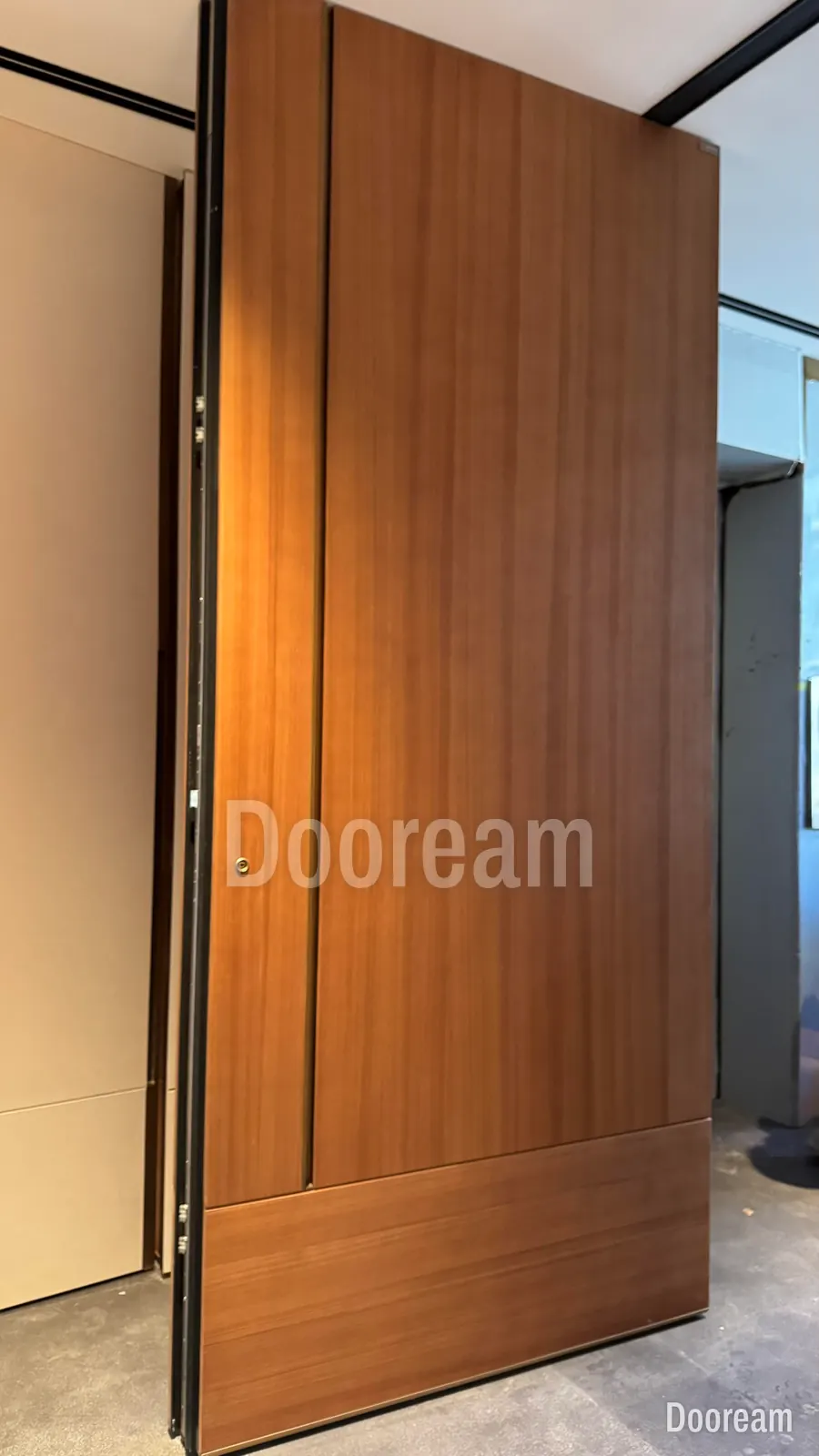
Short answer: two pivot leaves make sense when one leaf would be too wide, too heavy or too exposed, or when you want the passage in the middle. Each leaf gets its own pivot set and axis, mirrored, and the meeting edge decides the rest: a plain edge lets both leaves move in any order, a rebated one forces a closing order. Draw both sweeps, strips behind the axes included.
When are two pivot leaves better than one big leaf?
When one leaf would be too wide or heavy for the hinge and head, or too much sail in the wind. Halving the width halves each leaf’s weight and more than halves its distance from the axis, so the sideways force at each pivot falls to under a quarter.
Our arithmetic, by FritsJurgens’ methods, for a 2,400 × 3,000 mm finished opening: 60 mm leaves, 120 mm pivot point, 6 mm top gap, Flush floor plate, and an assumed 60 kg/m², not a real door’s weight.
| One leaf | Two leaves | |
|---|---|---|
| Leaf size | 2,388 × 2,987 mm | 2 × 1,191 × 2,987 mm |
| Weight at 60 kg/m² | About 428 kg | About 213 kg each |
| Sideways force at each pivot | About 1,510 N | About 333 N |
| Clear width, everyday | 2,244 mm (plus 96 mm at the jamb) | 1,047 mm with one leaf open |
| Clear width, fully open | 2,244 mm | 2,088 mm, in the middle |
Widths are at 90°, before handles, stops and seals. System M+ carries 20–500 kg “depending on door width”, so check a 2.4 m, 428 kg leaf in the FritsJurgens Selector.
One leaf is better in a narrow opening (in 1,600 mm, one open leaf of a pair leaves about 647 mm, below the minimums in single, double or unequal double), where you want no seam, and on an exposed entrance (pivot doors and wind).
Which layouts are possible, and which way does each leaf turn?
Three plan layouts cover most pairs; the axis position across the thickness is a separate choice. Describe the layout in words, seen from outside, with the axis distances, because a mirrored pair is easy to draw one way and build the other (door handing).
| Layout | Axes | How the leaves turn |
|---|---|---|
| Pair meeting at the centre | Near the outer jambs, mirrored | Long parts swing the same way, the strips behind the axes the other way, at the jambs |
| Fixed mullion, or two frames | One per leaf | Each leaf works as a single pivot door; the mullion carries keeps and seals |
| Middle placement | At the middle of each leaf | Half of each leaf swings in, half out; hardest to seal and lock |
- Range. FritsJurgens’ 70 mm bottom pivots sit from 70 mm in from the edge to the middle; the 40 mm versions are fixed. In the middle, with no offset, there is no static sideways force.
- Centre-hung or offset. Centre-hung puts the axis mid-thickness; offset moves it towards a face. FritsJurgens treats offsets as special cases and warns that a thick, offset leaf can need wide gaps.
Plain plan description: “D01, pair of pivot leaves, both opening inwards; seen from outside, each axis 126 mm from its jamb; the 120 mm strips behind the axes swing outwards; 6 mm gap on the centre line; right leaf active.”
How is the meeting edge sealed and locked?
Choose the edge first, then decide which leaf locks into which. A plain edge with an even gap lets either leaf move first. A rebate, or an astragal (an overlapping strip on one leaf), seals and stops better but makes the leaves close in a fixed order, the overlapping leaf last.
| Meeting edge | Seal | Closing order | Double-acting? |
|---|---|---|---|
| Plain, even gap | Brush or fin in the edge; drop seal below | Any | Possible |
| Rebated stiles | Compression seal in the rebate | Fixed | No |
| Astragal on one leaf | Seal behind the overlap | Fixed: the astragal leaf last | No |
FritsJurgens recommends a double rebate on exposed façades, detailed for the seam that opens as the leaf turns; at a meeting edge both sides move (sealing pivot doors).
- Active leaf: handle and lock; opens first, closes last.
- Inactive leaf: flush bolts into keeps in the head and floor; its edge carries keeps for the active leaf’s locking points, so those points are only as firm as its bolts.
- Bolts into head and floor on both leaves: FritsJurgens names lifting the leaf off its floor plate as a pivot door’s main weak point and calls three-point locks on both sides the most effective answer; on a pair, one side is the other leaf. Give the active leaf’s multipoint lock top and bottom bolts too (multipoint locks).
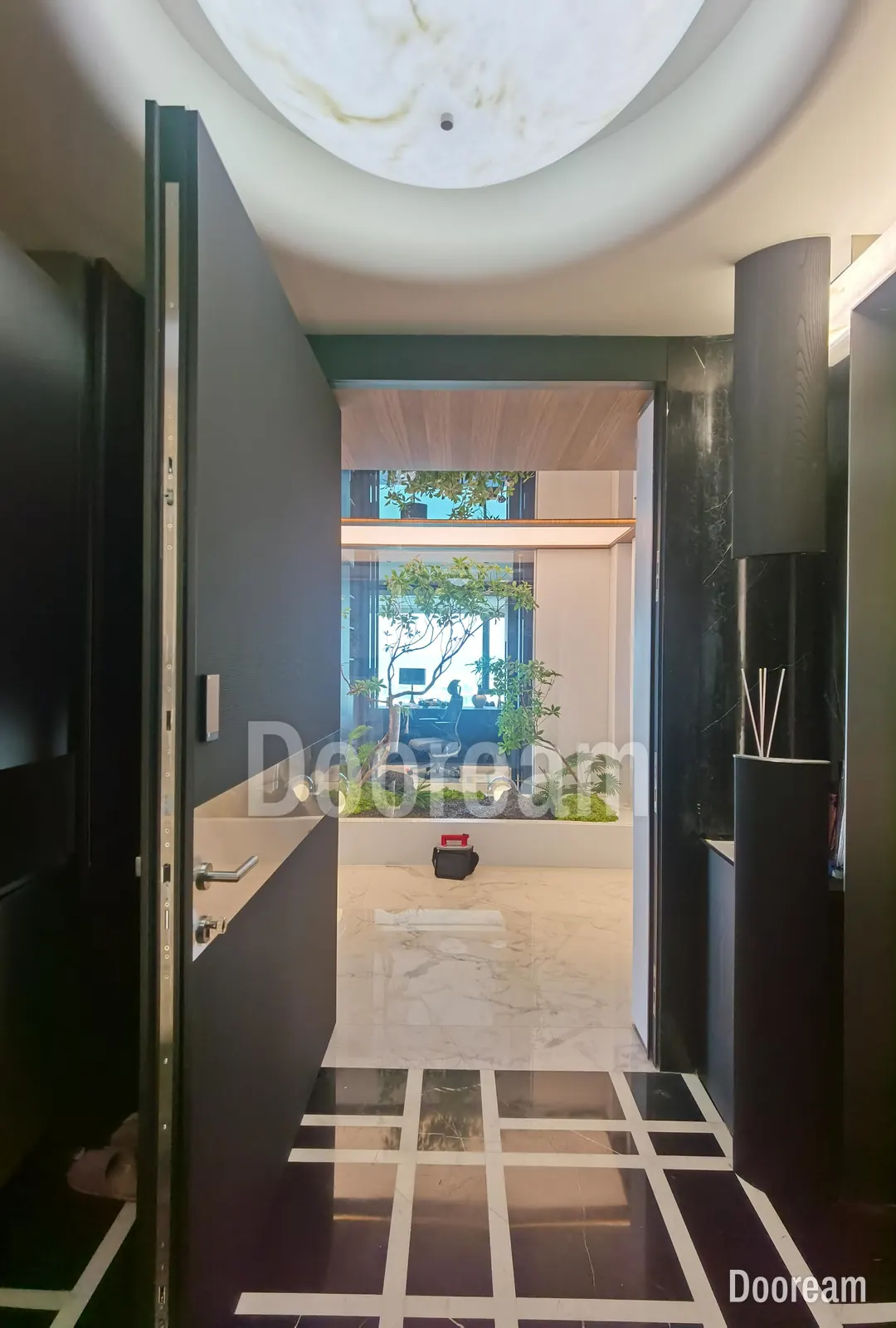
What does “concurrent operation” of adjacent pivot leaves mean?
That both leaves can open, stand open and close at the same time without touching each other or anything else. It needs clear sweeps, a meeting edge with no closing order (or a way to enforce one), hold positions and stops.
- Sweeps. Draw each leaf’s whole sweep, long part and short strip, to the furthest angle the hinge allows: System M+ self-closes from up to 125°; Systems Fx and One can revolve 360°. Past 90°, a long part swings back towards the wall beside its axis, or, with axes near the meeting edge, into the other leaf.
- Closing order. Rebated leaves “have to close in a fixed order, or the rebates in the centre hit each other” (FritsJurgens); two self-closing hinges do not guarantee it. On hinged pairs with closers a coordinator to EN 1158 does. For pivots, ask the hinge maker, use a plain edge, or keep the inactive leaf bolted and close it by hand first.
- Hold positions. System M+: a soft hold at −90° and 90°. System Fx: a solid hold at every 90°, which the leaf finds by itself within 10°. System One: none, and FritsJurgens says it is not available for double doors.
- Stops. Draw one wherever an open leaf could pass 90° into glass, a wall or the other leaf; M+ Damper Control damps opening but stops nothing.
- Wind. On an outward-opening exterior door, wind can push past the Fx 90° hold, FritsJurgens notes (pivot doors and wind).
A specification line: “Both leaves shall open together to 90°, hold, and close in any order, without either leaf, its handles or seals entering the other’s sweep at any angle the hinges allow.” Write “in any order” only with a plain meeting edge.
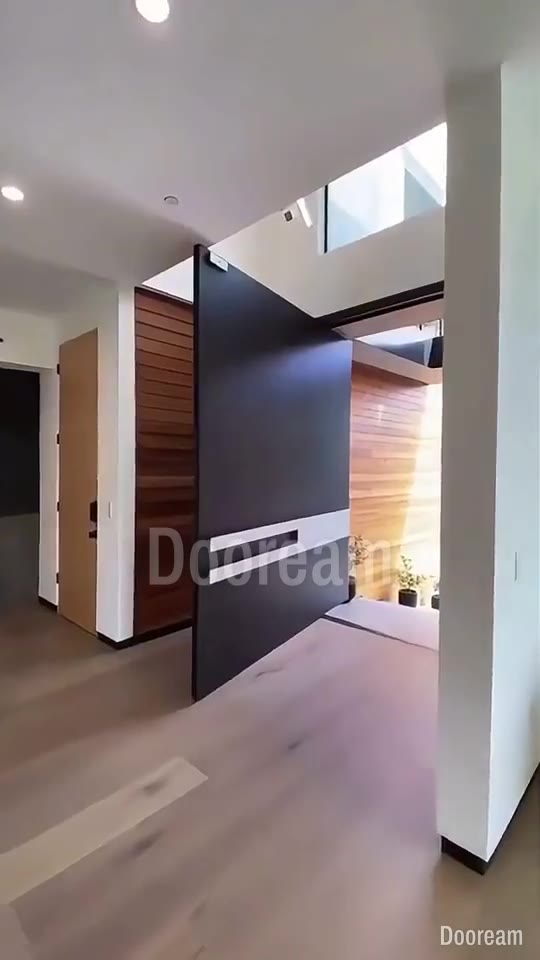
What do the floor, head and gaps need for two leaves?
Two of everything, set out from one datum: two floor plates or spring boxes, two top pivots, two sideways forces into structure. Alignment matters more than on one leaf: errors show as a step or tapered gap at the meeting edge.
- Gaps. For a pair, FritsJurgens’ Gap Calculator gives two equal leaves and three equal gaps, at both jambs and between the leaves: 2,400 mm, 60 mm leaves and a 120 mm pivot point give 1,191 mm leaves and 6 mm gaps. Each gap includes a 2 mm tolerance; do not add it again.
- Floor. Both plates at one finished level. FritsJurgens offers radially adjustable floor plates (2.5° each way); its Flush plates, used with a drop seal, cannot be adjusted after installation. Floor spring boxes: frame and box dimensions.
- Axes. Set out each leaf’s top and bottom pivot from one axis; System M+ top pivots adjust 5 mm each way. A wider gap does not correct a misaligned axis or an unlevel floor.
- Head forces. Each top pivot pushes the head towards its leaf’s far edge: along the head, in opposite directions, when a centre-meeting pair is closed; across it, together, when both stand open. Give the engineer both cases; a suspended ceiling is not a fixing point.
- Sag. The meeting edge and the top bolt keep sit at mid-span, where a head beam deflects most. FritsJurgens gives a 4–10 mm top gap and warns “beware of sagging”.
What should a 2-leaf pivot door plan detail show?
Both axes, both sweeps and the meeting edge on one drawing, dimensioned from the frame, with the meeting edge enlarged to 1:2 or 1:1. Use the same door ID and words on plan, schedule and shop drawing. The full set is in pivot door technical drawings.
- Finished opening, frame to frame, and structural opening.
- Each leaf’s width, thickness, weight, hinge system and class.
- Each axis from its jamb (pivot point plus side gap) and from the leaf edge; any offset.
- All three gaps.
- Both sweeps, long parts and strips, to the furthest angle allowed, both ways if double-acting.
- Both leaves open together, with handles; clear width between them, and with the everyday leaf alone.
- Active and inactive leaf; handing in words, seen from outside.
- Meeting-edge section: seals, gap, locking points, keeps, closing order.
- Keeps in head and floor, at finished floor level; stops and hold positions.
- Top pivot fixings, forces closed and open, allowable sag.
How does this work with Dooream?
We make single-leaf pivot doors up to 4,000 × 8,000 mm on FritsJurgens pivot hinges, and double and unequal double doors up to 3,000 × 6,000 mm. For a pair of pivot leaves, send us the plan of the opening with the axes, sweeps and meeting edge, and we will confirm what can be built. Production takes 35–45 days after drawing approval and the deposit; installation drawings come with every order, and your local installers fit the door with our remote guidance. See our page for architects or contact us.
Sources, checked November 2026: FritsJurgens, Gap Calculator, Lateral Force Calculator, System M+ technical documentation (04/2026), product catalogue (04/2026), System Fx and exterior pivot doors; SIS, SS-EN 1158 door coordinator devices.
Quick answers
Can both leaves of a double pivot door open at the same time?
Yes, if each leaf's whole sweep, including the strip behind its axis, stays clear of the other leaf, and the meeting edge needs no closing order. With a plain edge either leaf can move first; rebated leaves have to close in a fixed order, FritsJurgens notes, or the rebates hit. To stand open together, both leaves need a hold position, such as System M+'s soft hold at 90° and −90°.
What gaps does a pair of pivot leaves need?
FritsJurgens' Gap Calculator splits the finished opening into two equal leaves with all three gaps equal, at both jambs and between the leaves. Its example, a 2,400 mm opening with 60 mm leaves and a 120 mm pivot point, gives 1,191 mm leaves and 6 mm gaps, each already including a 2 mm tolerance.
How do you lock a pair of pivot doors?
Usually one leaf is active and the other is held by bolts into keeps in the head and floor. The active leaf's lock engages keeps in the other leaf's edge, which is only as firm as that leaf's bolts, so top and bottom bolts into the head and floor are what tie the pair to the building. FritsJurgens names lifting the leaf off its floor plate as a pivot door's main weak point.