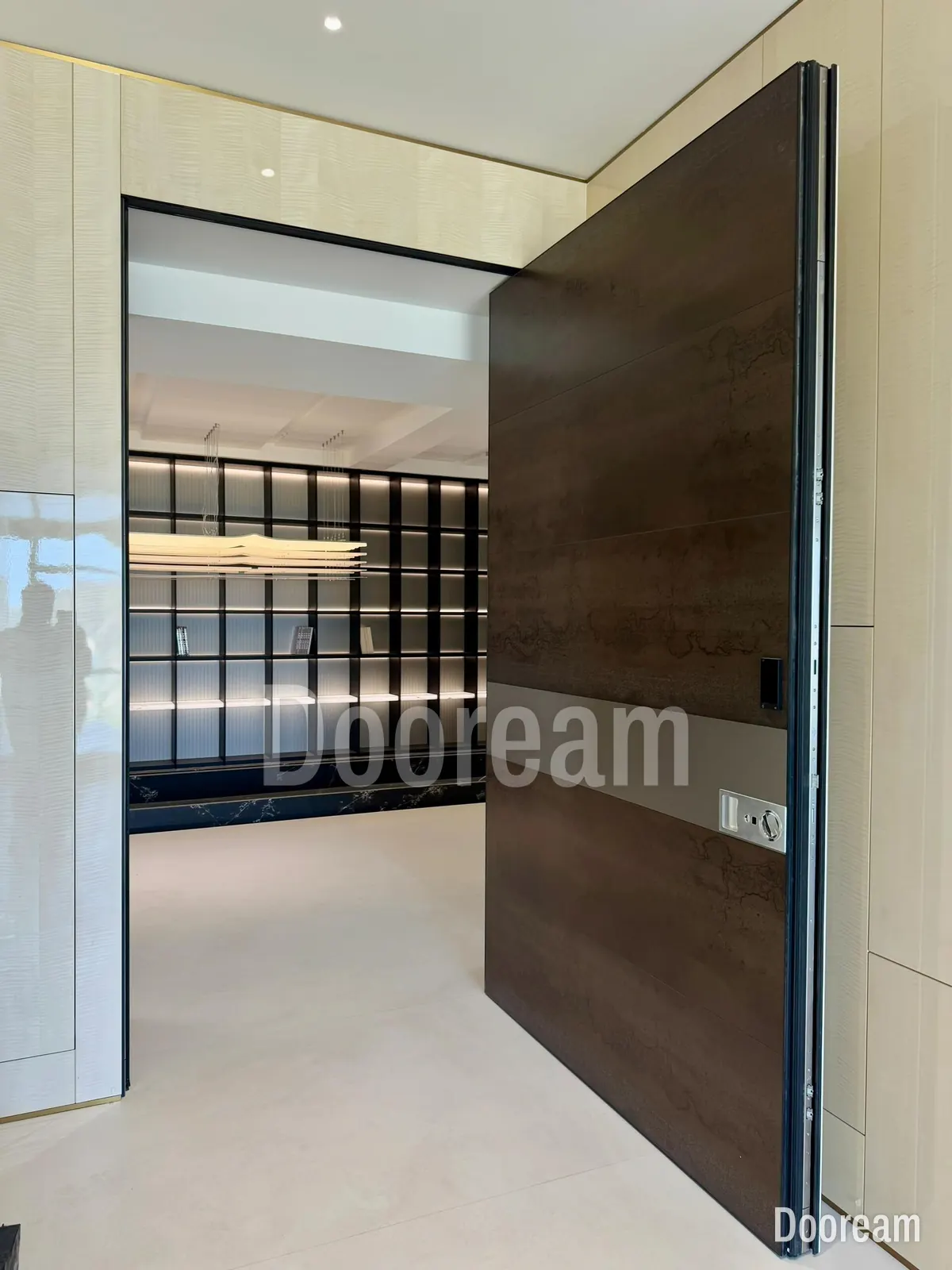
Short answer: for the main entrance, usually a pivot door: a wider passage from the same opening, a push to open, locking along its edge onto compression seals, and no track in the floor. A sliding door wins on wide openings to a garden or terrace, and where a leaf has no room to swing. We make pivot doors and hinged single, double and unequal double entrance doors; we do not make sliding doors.
Pivot door or sliding door: which suits a main entrance?
In most houses, a pivot door. It turns on a floor pivot and a top pivot (pivot pros and cons), gives a wider passage, locks along its edge and leaves the floor free of a track. A slider suits very wide garden or terrace openings, and halls with no room for a swing.
How much clear opening do you get from the same wall opening?
A pivot leaf gives nearly the full width; a two-panel slider about half, because its fixed panel stays in the opening. In our example, 1,400 mm inside the frame gives 1,277 mm with an offset pivot and 675 mm with a two-panel slider, below the 32 in (813 mm) minimum in the U.S. Access Board’s ADA guide.
Our arithmetic, inside the frame, before pulls:
| Type | Assumption | 1,400 mm opening | 2,400 mm opening |
|---|---|---|---|
| Offset pivot | 80 mm leaf, 70 mm pivot point, 13 mm side gaps | 1,277 mm | 2,277 mm |
| Two-panel slider, one fixed | 50 mm overlap at the meeting stiles | 675 mm | 1,175 mm |
| Three-panel slider, two moving | 50 mm per overlap, panels stack | 900 mm | 1,567 mm |
| Pocket slider, one panel | 100 mm left out of the pocket for the pull | 1,300 mm | 2,300 mm |
Pivot: opening − 83 mm (axis to frame) − 40 mm (half the leaf), as in offset or centre-hung pivot doors. Two-panel: (opening − overlap) ÷ 2. Overlaps and stops vary; ask each maker for the clear width.
How much space does each need around the opening?
A pivot leaf needs floor; a slider needs wall. Our arithmetic: an offset leaf in a 1,400 mm opening sweeps a radius of about 1,305 mm, about 1.34 m² at 90°; in a 2,400 mm opening, about 2,305 mm and 4.2 m². A slider sweeps nothing, but its panels have to go somewhere.
- Pocket slider: a cavity at least as long as the panel, free of pipes, cables and switches.
- Top-hung slider on the wall face: a clear wall run as long as the panel.
- Pivot: keep mats and furniture out of the arc; the short side swings the other way, over any step (thresholds and level changes).
Which is more secure?
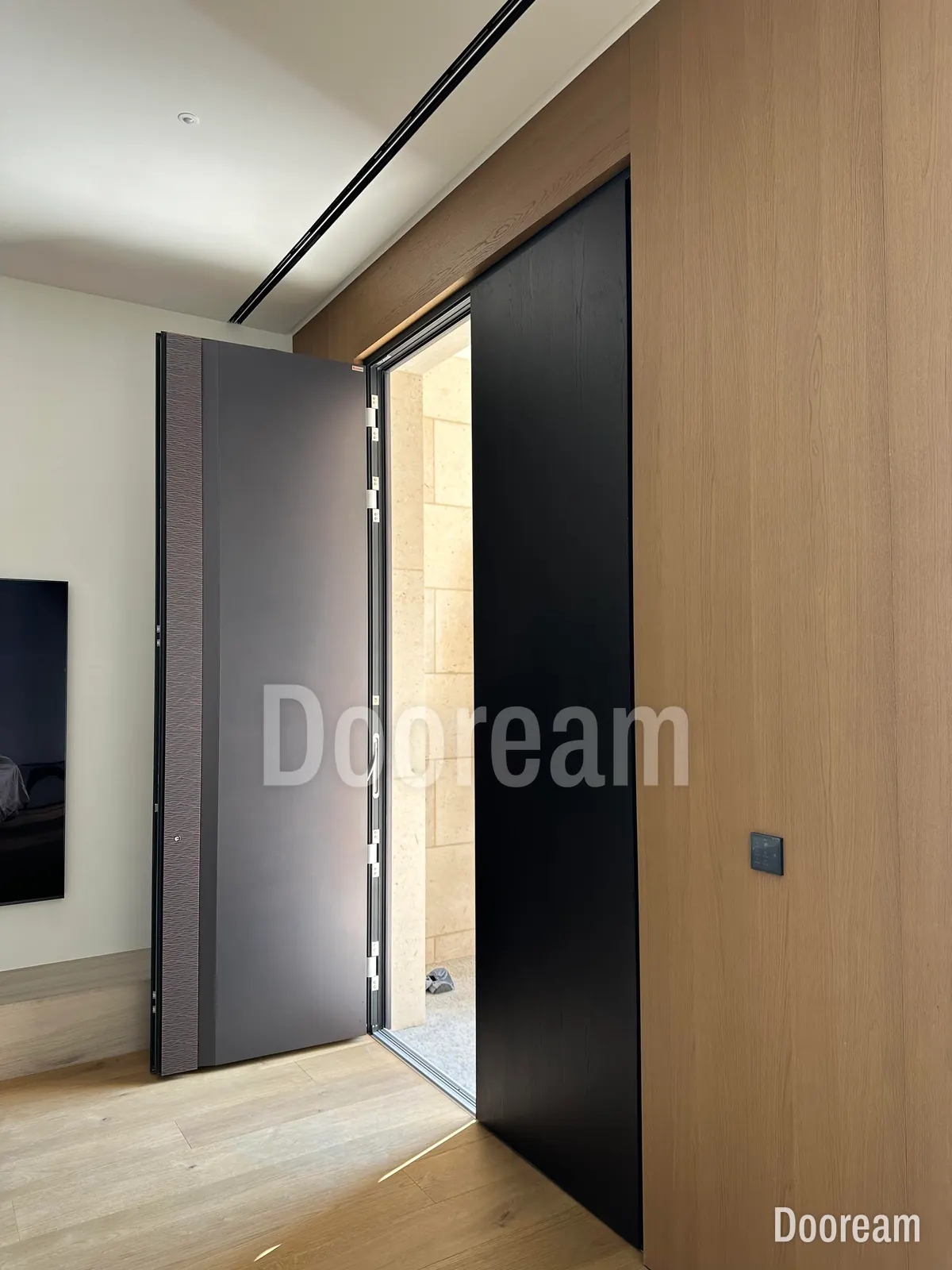
Neither type is secure by itself: locks, keeps, glass and the tested doorset decide. A pivot leaf locks along its edge into keeps in the frame, usually with a multipoint lock. A sliding panel rides on rollers, so it must also be stopped from being lifted out, and is usually mostly glass.
- Pivot: ask how the lock edge, the pivot side and the floor plate are held (multipoint locks explained).
- Sliding: UK police advise checking that sliding patio doors have an anti-lift device. Siegenia says its PORTAL HS 400 kg lift-and-slide gear reaches RC2, or RC3 with four locking bolts and three pairs of security interlocks.
- Glass: ASTM F842, the US forced-entry test for sliding door assemblies, does not evaluate the glazing.
- Classes belong to a tested doorset. We hold no EN 1627 rating; testing can be arranged, usually at the buyer’s cost.
Which seals better against air and rain?
That depends on the tested door, not the type. A pivot leaf closes onto compression seals at the lock side and head, with brush or fin seals at the pivot side (how pivot doors are sealed). A standard slider slides past its frame, so it relies on brushes. A lift-and-slide panel is lowered onto its seals.
Schlegel says its woven brush piles “control draught, dust and noise in sliding windows, doors and shutters”, and its finned version lets in less air. Architect magazine describes lift-and-slide panels “lowered onto seals that provide air and water protection”. Compare test classes:
| Standard | Classifies | Classes |
|---|---|---|
| EN 12207 (Europe) | Air permeability | 1 to 4: at 100 Pa, at most 50, 27, 9 and 3 m³/(h·m²); tested up to 150, 300, 600 and 600 Pa |
| EN 12208 (Europe) | Watertightness | 1A to 9A exposed (0 to 600 Pa), 1B to 7B partly protected (0 to 300 Pa); E750 and up above 600 Pa |
| AAMA/WDMA/CSA 101/I.S.2/A440 (North America) | Air, water, structural | Water tested at 15% of design pressure (R, LC, CW) or 20% (AW); about 0.14 kPa (3 psf) for R-PG15 |
We have no air, water or wind ratings for our doors; a test can be arranged, usually at the buyer’s cost (pivot doors and wind).
Which threshold is safer and drains better?
A pivot door needs no track: its sill can be level, with a flush floor plate and a drop seal, or have a low upstand. Every slider has a track or guide in the floor. Flush lift-and-slide tracks exist, but need a dead-flat floor, a drainage channel and regular cleaning.
- Track height: Architect magazine notes conventional tracks up to an inch (25 mm) high, against 3/16 in (5 mm) for one flush track, and says every lift-and-slide door needs a drainage channel.
- Level sliders: Siegenia offers 0 mm and 5 mm thresholds it describes as barrier-free under DIN 18040-2.
- Access: the ADA guide limits thresholds to 1/2 in (13 mm) in new construction, sliding doors included.
Where does the weight go?
A pivot leaf stands on its floor pivot; the top pivot keeps it upright, and an offset leaf pushes sideways on the head. A bottom-rolling slider, lift-and-slide included, stands on rollers in the sill track. A top-hung slider hangs from the head, so the lintel carries the panel.
- Pivot: FritsJurgens lists System M+ for doors of 20 to 500 kg; side force is worked through in offset or centre-hung.
- Lift-and-slide: Siegenia’s PORTAL HS 400 kg takes sashes up to 400 kg in openings up to 12 m wide. Architect magazine warns of a low tolerance for header deflection.
How do they compare in daily use and upkeep?
A pivot leaf opens with one push on a pull near its free edge and, on a self-closing hinge, closes itself. A slider is pulled sideways by its handle, turned first on a lift-and-slide, and stays where it is left unless it has a closer.
- Closing: FritsJurgens System M+ self-closes, with damper, speed and latch control and a hold at 90°.
- Opening force: the ADA guide sets 5 lbf (22.2 N) for accessible doors, except fire doors, latches and exterior hinged doors (no maximum).
- Automation: the ADA guide refers full-powered doors to ANSI/BHMA A156.10, low-energy and power-assisted ones to A156.19.
- Upkeep: a slider’s track gathers grit in its drainage slots, and rollers and brushes wear. A pivot door needs its floor plate, seals and lock kept in order (pivot door maintenance).
One big leaf or glass panels: how do they differ in design?
A pivot door is one solid leaf, so the face is the design: carved, cast or stone, up to the full height of the opening. A sliding door is mostly glass in slim frames, so the view is the design, with less privacy and more glazing to protect. For daylight and a solid leaf, put fixed glass beside the door (sidelights).
When is a sliding door the better choice?
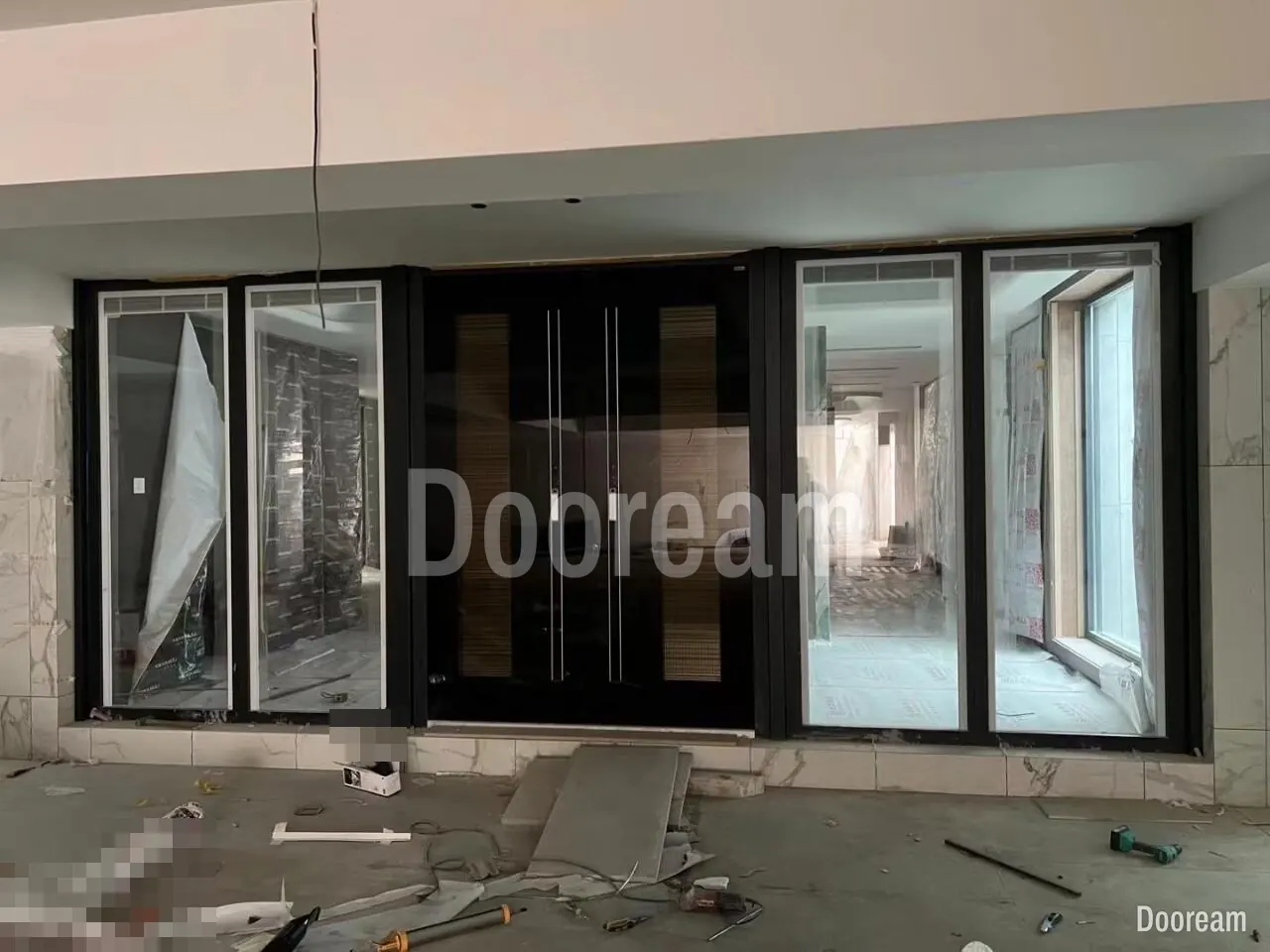
Where the opening leads to a garden, terrace or pool and is wider than one leaf should be, or where a leaf has no room to swing: a narrow hall, a stair landing, a step outside. A slider can stand open all day without blocking anything.
Pivot or sliding: how do they compare?
| Pivot door | Sliding door | |
|---|---|---|
| Clear width, 1,400 mm opening | 1,277 mm (offset) | 675 mm (two-panel), 1,300 mm (pocket) |
| Space | Floor arc | Wall run or pocket |
| Locking | Multipoint lock into frame keeps | Bolts plus anti-lift |
| Seals | Mainly compression | Brush; compression on lift-and-slide |
| Floor | No track | Track |
| Weight | Floor pivot | Sill rollers or head track |
| Daily use | Push; can self-close | Slide; stays open |
| Design | One solid leaf | Mostly glass |
| Best for | Main entrance | Garden openings, tight halls |
Pivot or sliding: a decision checklist
- Main way in, locked every night? Start from a pivot or hinged door.
- Clear width needed, and what each system gives (measuring the opening)?
- Floor for the swing arc, short side included? If not, consider a slider.
- Wall for a pocket or panel run, free of services?
- Step-free threshold required? Check the track or sill against the rule.
- Exposed? Ask for tested EN 12207/12208 or NAFS classes.
- Locking: points, keeps, anti-lift, glass?
- Can the floor or lintel take the weight?
- Self-closing, automation, smart lock?
- Who cleans the track, or adjusts the pivot and lock?
How does this work with Dooream?
We make pivot entrance doors up to 4,000 × 8,000 mm on pivot hinges, most often FritsJurgens, such as Contour, an offset pivot, and hinged single, double and unequal double entrance doors. We do not make sliding doors; a garden slider should come from a sliding-door specialist. We fit KFV, G-U and Wintech smart locks. Production takes 35–45 days after drawing approval and the deposit; your local installers fit the door with our installation drawings and remote guidance. See for architects or contact us.
Sources, checked November 2026: CEN, EN 12207:2016 air permeability classification (sample pages); BAUKOBOX, driving rain tightness (EN 12208 classes); IIBEC, water penetration resistance at terrace doors; U.S. Access Board, guide to the ADA Standards, chapter 4: entrances, doors and gates; police.uk, door security advice; ASTM, F842 forced entry resistance of sliding door assemblies; SIEGENIA, PORTAL HS 400 kg; Architect magazine, specing a lift/slide door; Schlegel, woven brush piles; FritsJurgens, System M+.
Quick answers
Is a pivot door or a sliding door better for a main entrance?
For the door used and locked every day, usually a pivot door. It gives a wider passage from the same opening, opens with one push, can close itself, locks along its edge onto compression seals and needs no track in the floor. A sliding door is the better choice for wide openings to a garden or terrace, or where a leaf has no room to swing.
How much clear opening does a sliding door give compared with a pivot door?
In our worked example, an opening 1,400 mm wide inside the frame gives about 1,277 mm with an offset pivot leaf, but about 675 mm with a two-panel slider, because the fixed panel stays in the opening. A pocket slider gives nearly the full width, if the wall beside it can take a pocket as long as the panel.
Does Dooream make sliding doors?
No. We make pivot entrance doors up to 4,000 × 8,000 mm on pivot hinges, most often FritsJurgens, and hinged single, double and unequal double entrance doors. We do not make sliding doors.