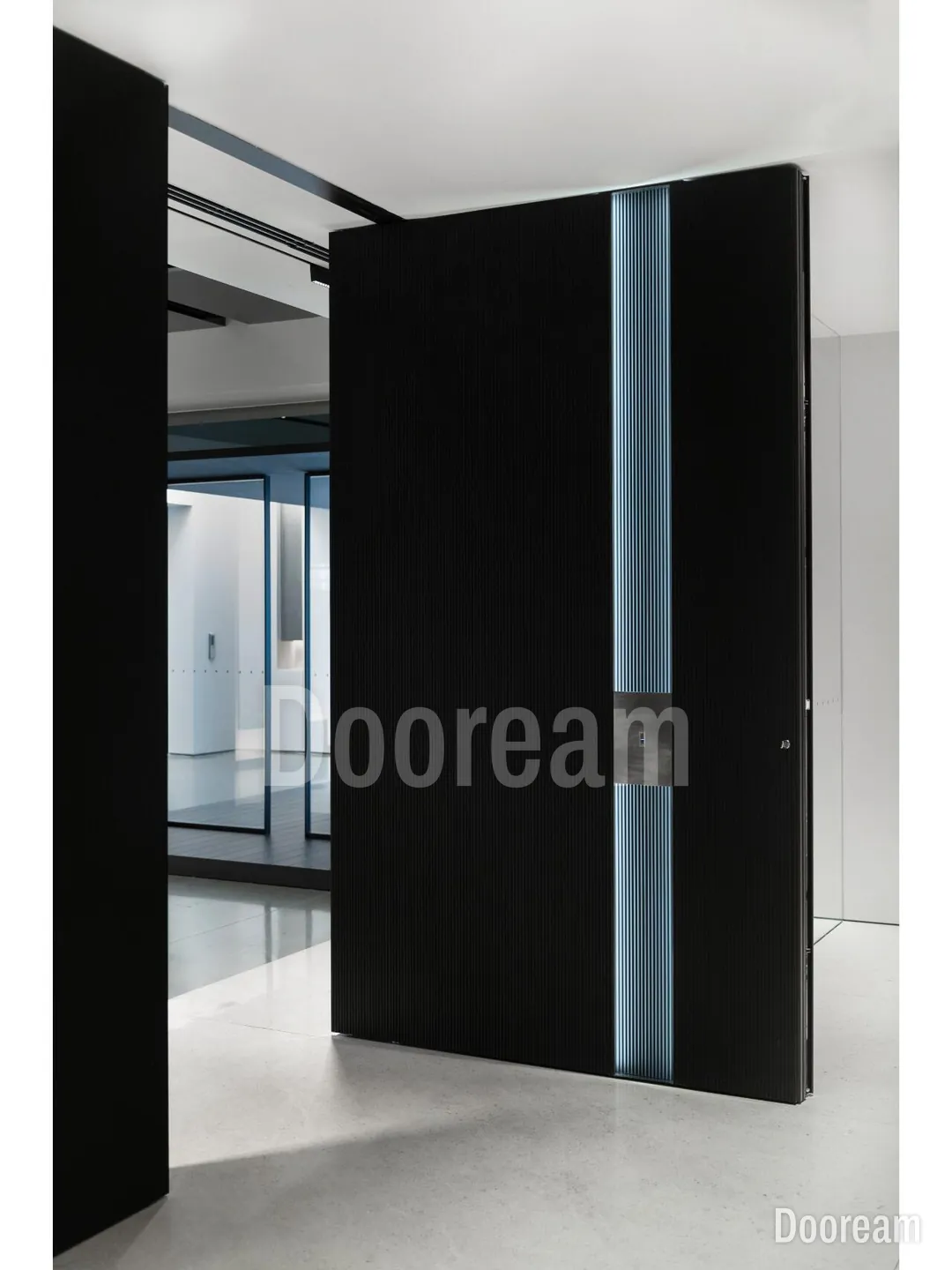
Short answer: yes, a pivot door can let in air and water if it is not sealed properly, because the leaf has to clear the frame at the pivot side, the head and the floor. A well-made pivot entrance door controls this with seals on all four sides, a drop-down seal or threshold at the bottom, and shelter from wind-driven rain. If your project needs proven performance, ask for test results or for the door to be tested.
Where do air and water get past a pivot door?
A hinged door closes into a rebate, so its edges press against a stop on every side. A pivot door turns around an axis inside the leaf, so some edges sweep past the frame rather than closing against it. The places to watch are:
- the pivot side, where the edge of the leaf passes close to the frame as it turns;
- the head, where the top pivot sits;
- the floor, where the leaf has to clear the floor finish;
- the latch side, which behaves most like an ordinary door.
How is each gap sealed?
The usual approach is a combination of:
- compression or rebate seals on the latch side and the head, where the leaf can close against a stop;
- brush or fin seals along the pivot side, which stay in contact as the leaf turns;
- a drop-down seal in the bottom of the leaf that lowers onto the floor or threshold when the door closes;
- a threshold profile that sheds water outwards.
Ask your supplier to show the seal arrangement on the drawing, side by side, before you approve it. Every pivot door is a little different, and the drawing is where gaps get closed.
Does shelter matter as much as seals?
The same door behaves very differently under a deep porch and on a flat facade facing the prevailing weather. If the entrance is exposed, plan a canopy or a recess, and tell your manufacturer which way the door faces and how exposed it is. Whether the door opens in or out also changes how water is shed at the bottom.
How is performance proven?
If a specification, certifier or insurer needs numbers, they come from laboratory tests:
| Market | Air | Water | Main standard |
|---|---|---|---|
| USA and Canada | ASTM E283 | ASTM E331 | AAMA/WDMA/CSA 101/I.S.2/A440 |
| Europe | EN 12207 classes (EN 1026 test) | EN 12208 classes (EN 1027 test) | EN 14351-1 |
| Australia | AS 2047 | AS 2047 | AS 2047, for windows and external glazed doors |
ASTM E283, for example, measures how much air passes through a door when a set pressure difference is applied across it. We do not currently publish air or water test results for our doors. If your project needs a test like this, we can arrange it with a test lab; the buyer usually pays the fee. See testing and documents.
Sources, checked October 2026: Intertek, ASTM E283; HIA, windows and external glazed doors in buildings (AS 2047).
Quick answers
Do pivot doors let in drafts?
They can, because the leaf has to clear the frame at the pivot side, the head and the floor. Seals on all four sides and a drop-down seal or threshold at the bottom control this.
How do you stop a pivot door leaking in the rain?
Combine seals on every side with a threshold that sheds water, and shelter the door with a canopy, porch or recess. An exposed pivot door that faces wind-driven rain is the hardest case.
Which tests measure air and water leakage through a door?
In North America, ASTM E283 measures air leakage and ASTM E331 water penetration, and AAMA/WDMA/CSA 101/I.S.2/A440 is the window and door standard. In Europe, EN 12207 and EN 12208 classify air permeability and watertightness. In Australia, AS 2047 applies to windows and external glazed doors.