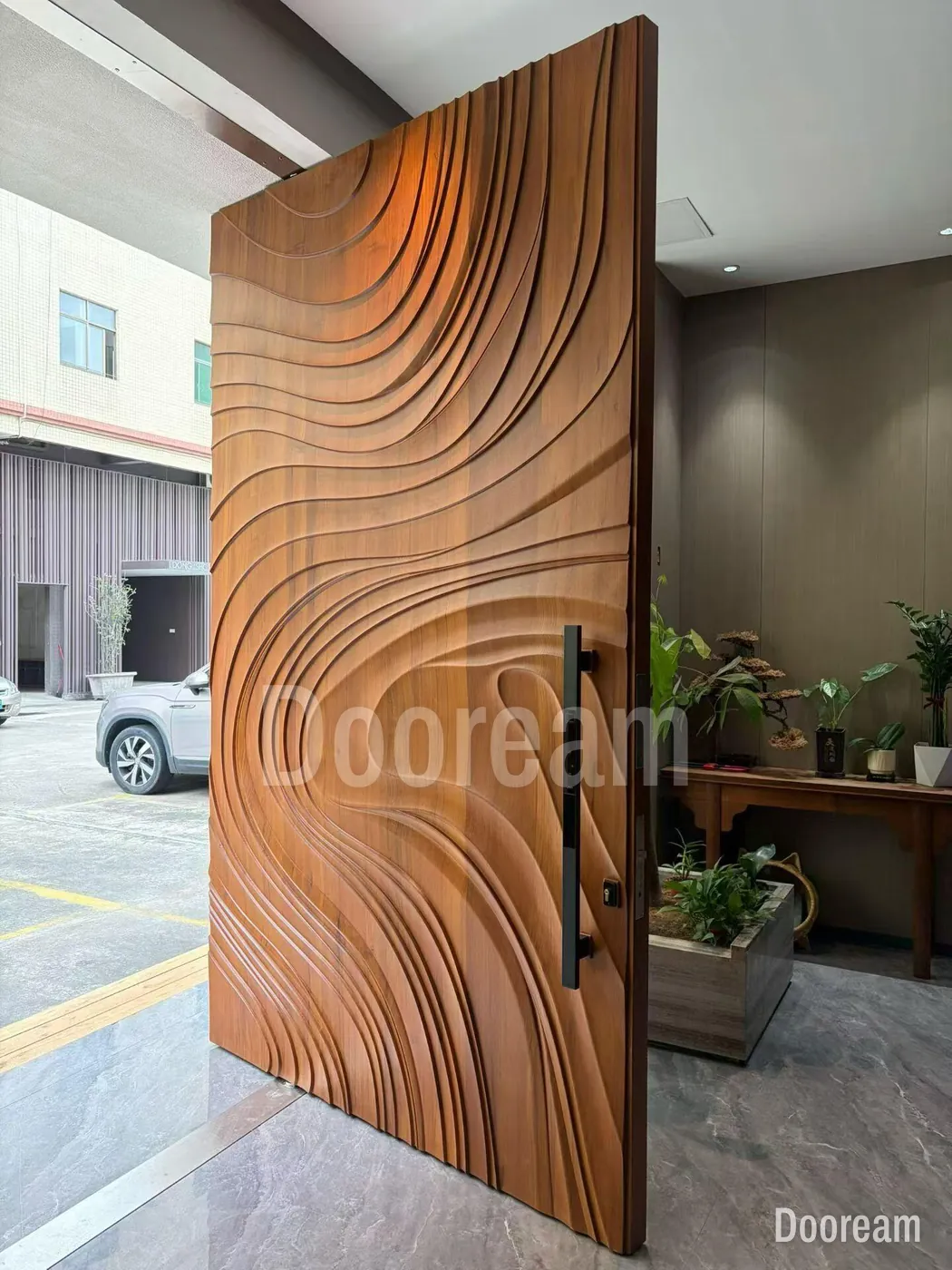
Short answer: a pivot door turns on a pivot at the floor and another at the head of the frame instead of on hinges at the side. It is the natural choice for wide, tall or heavy entrance doors and for a clean look with no visible hinges. In return it asks more of the floor, the seals and the installer, so it suits new builds and sheltered entrances better than a quick retrofit on an exposed wall.
How does a pivot door work?
The door turns around a vertical axis, between a pivot at the floor and a second pivot in the head of the frame. Some systems put a closer in a box set into the floor. With the FritsJurgens hinges we use, the mechanism sits inside the door and only a small plate is fixed to the floor, with pins about 8 mm deep. On most entrance doors the axis is set in from one edge, so when the door opens, the wide part swings one way and a narrow strip swings the other way.
The pivots we fit are made by FritsJurgens, a Dutch maker whose hinge sits hidden inside the door, with only small plates showing at the floor and the head. We choose the system to match the door’s weight and how you want it to swing, and we test it in our workshop before the door is crated. In the FritsJurgens 2022 catalogue, for example, System M+ is listed for doors of 20–500 kg, depending on door width. See locks and pivots for the systems side by side.
What do pivot doors do well?
- Size. The weight sits on the floor pivot rather than hanging from side hinges, so a pivot door can be much wider and taller than a hinged door. Ours go up to 4,000 × 8,000 mm.
- Look. There are no hinges on the face or edge, so the door reads as one clean panel. Carved, cast or stone faces show at their best this way.
- Feel. A well-chosen system makes a heavy door turn lightly. Many systems can also hold the door open at set angles and close it gently.
What do pivot doors ask of you?
- The floor. The floor plate has to sit on the finished, level floor, exactly below the top pivot. A floor-box closer also needs a recess in the floor. Either way, plan it with the floor build-up, before the tiles or stone go down.
- Sealing. A hinged door closes into a rebate on all sides. A pivot door has to clear the frame at the pivot side, the head and the floor, so it needs seals on every side. We explain the options in do pivot doors leak or let in drafts?
- Clear opening. Because the narrow strip swings the other way, the clear opening is less than the leaf width. Check this against any minimum opening your project needs.
- Wind. A large leaf on an exposed wall can be pushed by wind. Choose a system that controls closing, or shelter the door under a canopy.
- Installation. The pivot, frame and leaf have to be set out accurately. We provide installation drawings for every order and remote guidance, and your local installer fits the door.
When does a pivot door make sense, and when not?
A pivot door is a good choice when:
- the opening is wide or tall, or the face is heavy, such as stone or cast aluminium;
- it is a new build or a full renovation, so the floor can be prepared;
- the entrance is sheltered by a porch, canopy or recess.
Consider a hinged door instead when:
- the door faces strong prevailing wind and rain with no shelter;
- the floor cannot take a fixing, or is not level, exactly where the pivot has to go;
- you need the full width of the leaf as clear opening.
What should you tell your manufacturer?
Send the opening size, the finished floor level and build-up, which way the door should open, whether it opens in or out, and how exposed the entrance is. Our guide on what to send a door manufacturer lists the rest.
Sources, checked October 2026: FritsJurgens, 8 millimetres in the floor; FritsJurgens catalogue 2022, as summarised on our locks and pivots page.
Quick answers
How does a pivot door work?
Instead of hinges on the side of the frame, the door turns on a pivot at the floor and a pivot at the head of the frame. On the FritsJurgens hinges we use, the mechanism sits inside the bottom of the door and turns on a small plate fixed to the floor. The pivot is usually set in from the edge of the door, so a narrow part of the leaf swings the other way when it opens.
Are pivot doors good for large entrances?
Yes. Because the weight sits on the floor pivot rather than hanging from side hinges, pivot doors suit wide, tall and heavy leaves. We make pivot doors up to 4,000 × 8,000 mm.
What are the downsides of a pivot front door?
The floor has to be prepared for the pivot before the floor finish goes down, sealing is harder than on a rebated hinged door, the clear opening is smaller than the leaf width, and an exposed door can be caught by wind unless the pivot system controls closing.