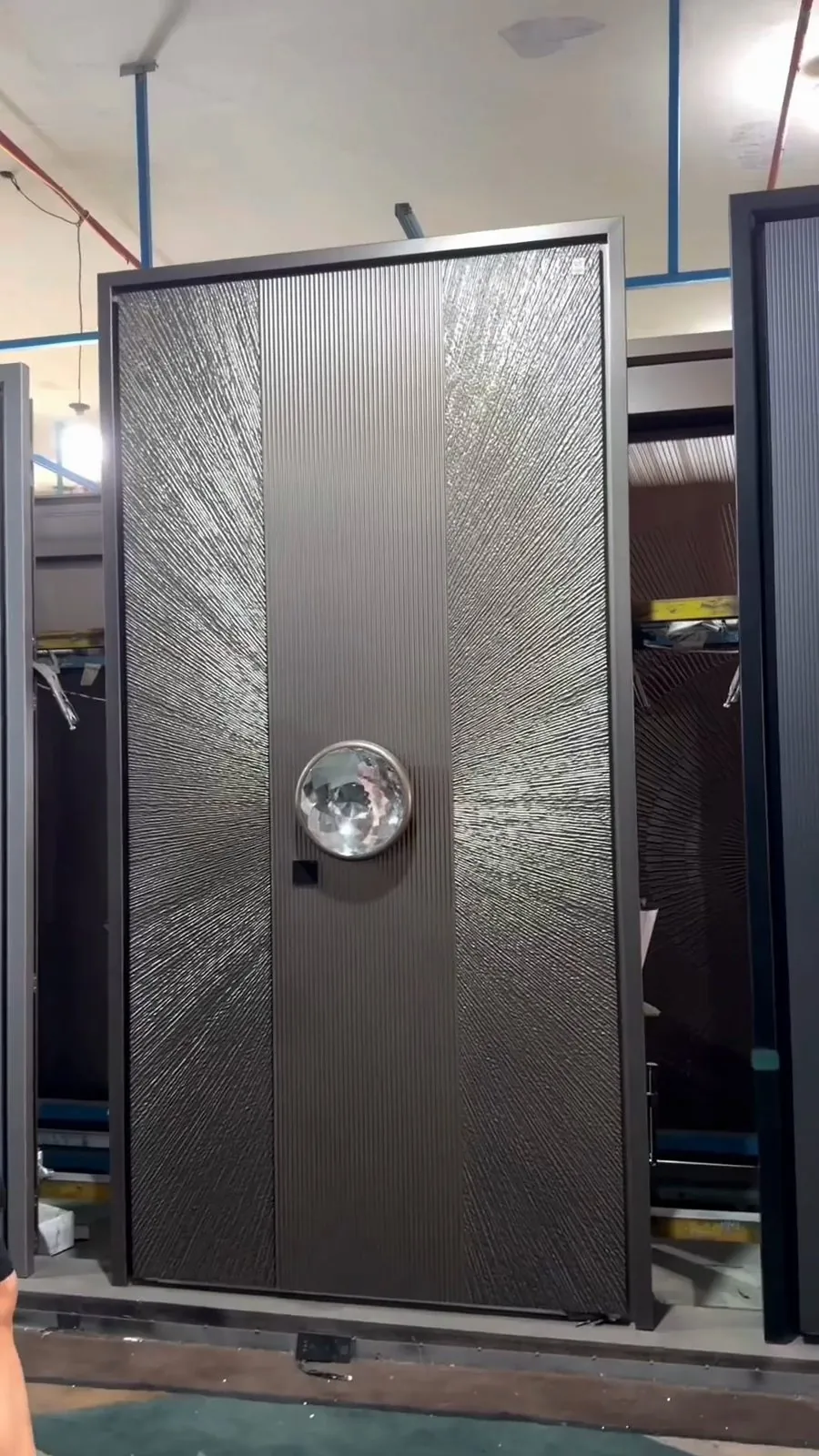
Short answer: a single pivot door gives the cleanest look and works for wide openings if the building can carry one big leaf. A double door splits a wide opening into two lighter leaves. An unequal double door, with one wide everyday leaf and one narrow leaf you open only when needed, gives a wide entrance without a heavy door to push every day. Our double doors go up to 3,000 × 6,000 mm and our pivot doors up to 4,000 × 8,000 mm.
What are the options for a wide entrance?
| Single pivot | Single hinged | Double | Unequal double | |
|---|---|---|---|---|
| Leaves | One, on a pivot | One, on side hinges | Two equal | One wide, one narrow |
| Look | Clean, no visible hinges | Classic | Symmetrical | Asymmetrical |
| Everyday leaf | The whole door | The whole door | One half | The wide leaf |
| Full opening | Less a strip at the pivot | Full leaf | Both leaves open | Both leaves open |
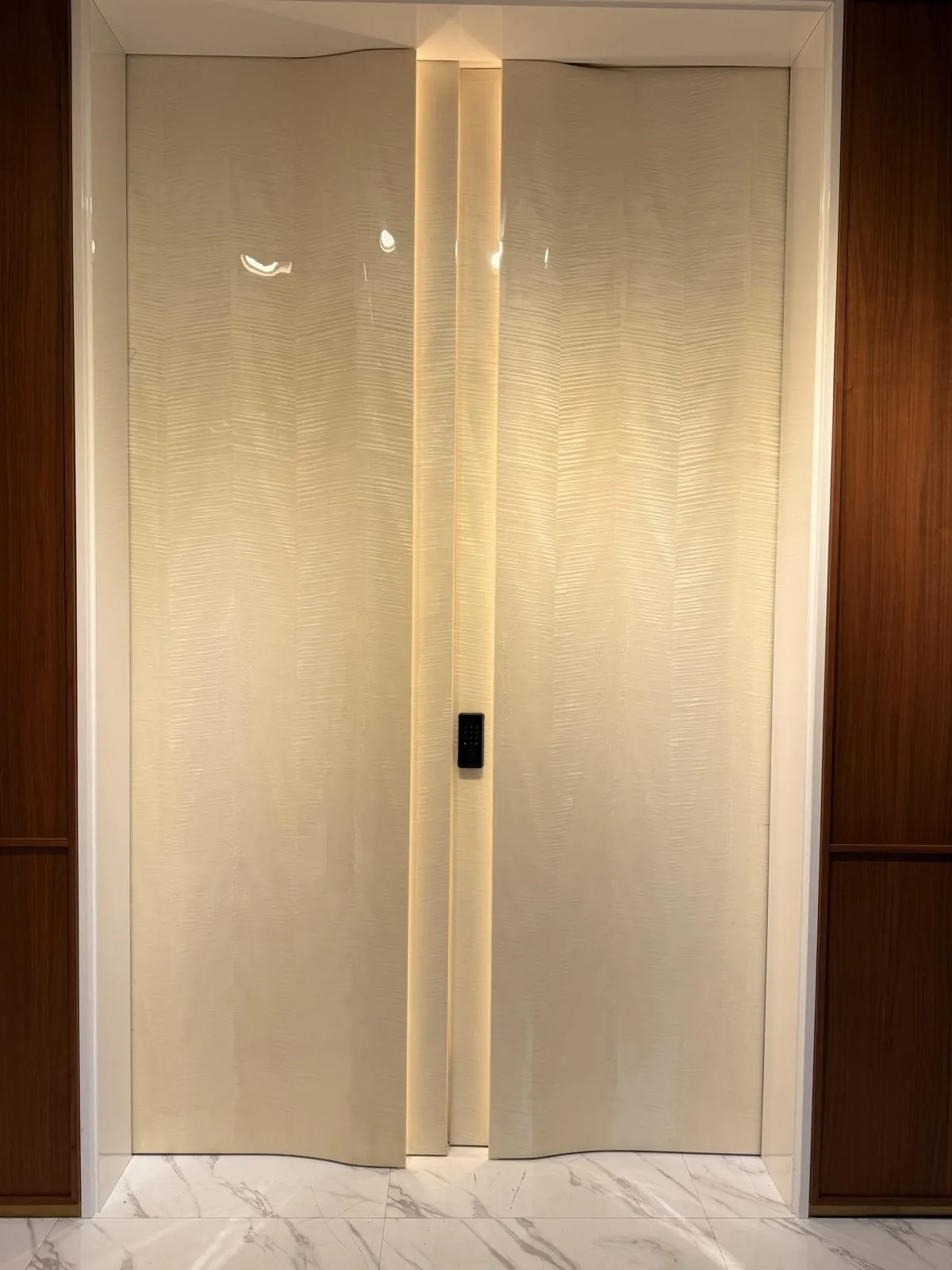
| Our examples | Contour, Black Warrior | — | Shell, Ivory Wave | Crystal Handle, Facet Light |
How much can you walk through?
What matters day to day is the clear opening: the space you can actually walk through, not the size of the leaf.
- On a pivot door, the pivot is set in from one edge, and the strip behind it swings the other way. The clear opening is noticeably smaller than the leaf.
- On a double or unequal double door, the clear opening with only the everyday leaf open is the one people use most. Check that this leaf alone is wide enough.
For accessible entrances, the 2010 ADA Standards in the US require a clear width of at least 32 inches (815 mm), measured between the face of the door and the stop with the door open at 90 degrees. On a pair of doors, at least one active leaf must provide that width on its own. In Australia, AS 1428.1 calls for a clear opening of at least 850 mm. These rules apply where building regulations require an accessible entrance, such as public and commercial buildings; for a private house they are still a useful minimum.
What hardware does each type need?
- Single pivot: the hinge has to carry the whole leaf, so the weight decides the hinge. See how big and how heavy a pivot door can be.
- Double and unequal double: each leaf hangs on its own hinges; our double doors use heavy-duty hinges, concealed on some models. The fixed leaf is held shut with bolts at the top and bottom, and the lock is fitted on the leaf you use.
- Meeting edges: where two leaves meet there is a seal and usually an overlap. Ask how that joint is sealed on an exposed entrance.
Which one should you choose?
- Choose a single pivot door if you want one uninterrupted face, the floor and head can carry it, and the entrance is sheltered.
- Choose a double door if the opening is wide, a single leaf would be very heavy, or you want symmetry.
- Choose an unequal double door if you want a wide opening for furniture and occasions, but a lighter leaf for everyday use.
Whichever you choose, send us the opening size and tell us which leaf you will use every day. Our guide on what to send a door manufacturer lists the rest.
Sources, checked October 2026: 2010 ADA Standards, 404 Doors, doorways and gates; Sydney Access Consultants, AS 1428.1 door clear opening.
Quick answers
What is an unequal double door?
A pair of doors with one wide leaf for everyday use and one narrow leaf that stays bolted shut until you need the full opening, for furniture or a crowd. It gives a wide entrance without making the everyday leaf heavy.
How wide does an entrance door need to be?
For accessible entrances, the 2010 ADA Standards in the US require a clear width of at least 32 inches (815 mm), measured with the door open at 90 degrees, and on a pair of doors at least one active leaf must provide it. In Australia, AS 1428.1 calls for a clear opening of at least 850 mm. These apply where building rules require an accessible entrance; for a private house they are a useful minimum.
What is the largest double door you make?
Our double doors go up to 3,000 mm wide and 6,000 mm tall, and our pivot doors up to 4,000 × 8,000 mm.