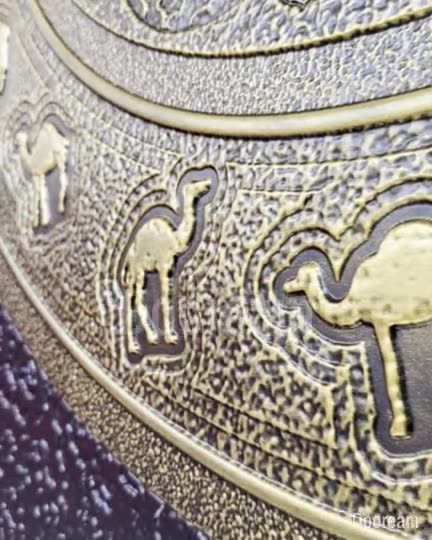
Short answer: yes. A sketch, photo, logo, coat of arms, calligraphy or CAD drawing can all become a carved or cast relief face. A vector file gives the outlines, a 3D model or depth map the heights; anything else is redrawn. You must own the artwork or hold a licence, and you approve it in stages before metal is cut.
Can a door factory carve or cast my own pattern?
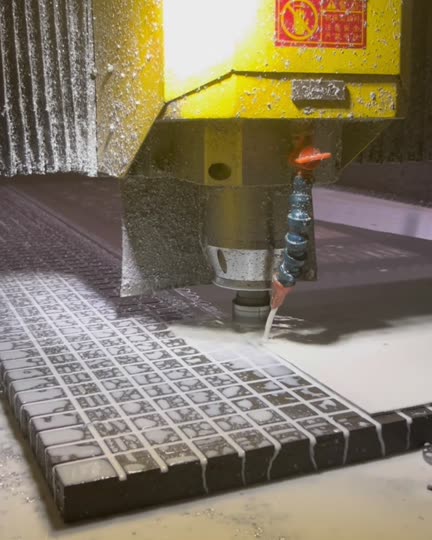
Yes, if the artwork can be drawn as a relief that suits the leaf. The maker sets it out on a drawing of the door, models its heights in 3D, then carves it from solid aluminium plate or casts it in a mould. Carving needs no mould, so it suits one-off artwork; casting pays off when a face is repeated. See how CNC-carved doors are made and cast or carved faces.
Which file should I send: vector, raster or 3D?
Send the original at the largest size you have. Vector files (DXF, DWG, SVG, AI, EPS or a vector PDF) give clean outlines at any size. Raster files (JPG, PNG) serve as references and are redrawn. A depth map or 3D model adds what neither has: height.
- Vector. Lines and curves with no pixels, which scale without losing quality (Adobe). Say the unit, and check that an AI or PDF holds paths: a PDF can also be raster.
- Raster. Built from pixels, it loses quality when resized (Adobe). A 600-pixel logo over a 1,200 mm leaf gives 2 mm per pixel: every curve becomes a staircase.
- Depth map. A greyscale image in which brightness is height: “Light areas are interpreted as raised sections; dark areas are recessed” (Carveco, a relief software maker). A photo is not one: its tones come from colour and shadow, so a dark raised leaf would carve as a hollow.
- 3D model. STL describes a surface as a triangular mesh without colour (Library of Congress), and is often what a 3D scanner produces. A face carved from the front cannot have undercuts, so overhangs are cast or simplified.
| What you send | What we can do with it | What to add |
|---|---|---|
| Sketch, or a phone photo of one | Redraw it as vector, model the heights | Size on the door; which parts stand highest |
| Photo of an existing carving | Use it as a reference for a new relief | Square-on and side-lit photos; sizes; permission to copy |
| Logo (AI, SVG, EPS, PDF, or JPG/PNG) | Use vector outlines directly; trace a JPG or PNG | The largest original; the trademark owner’s consent |
| Coat of arms or crest | Redraw it for relief | The official painting or artist’s drawing; who holds the arms |
| Calligraphy or text | Model the calligrapher’s file; set a font as outlines | Vector or high-resolution scan; the text typed; the licence |
| 2D CAD (DXF, DWG) | Set it out on the leaf as drawn | Units; layers for outlines, levels and hardware |
| Depth map, 3D model (STL, OBJ) or scan | Fit it to the leaf, check it can be made | Real size; depth as low, medium or high; undercuts marked |
How does the pattern fit on the leaf?
Set the artwork out on a full drawing of the closed opening before anyone models it. Then fix five things: the motif’s size, plain margins, hardware zones, the split line and sidelights. Each changes the artwork more than the file type.
- Scale. Line weights grow with the motif: a crest 80 mm wide with 0.3 mm lines becomes a 1,200 mm medallion with 4.5 mm lines. Shrinking is the risk. Judge lines at door size; reading distances are in carved relief depth and light.
- Margins. Keep a plain border: part of the edge hides behind the frame and seals.
- Lock and handle. Keypad, cylinder and pull pass through the face: keep their zones flat, or frame them with a band or medallion; hardware heights are in our geometric pattern guide.
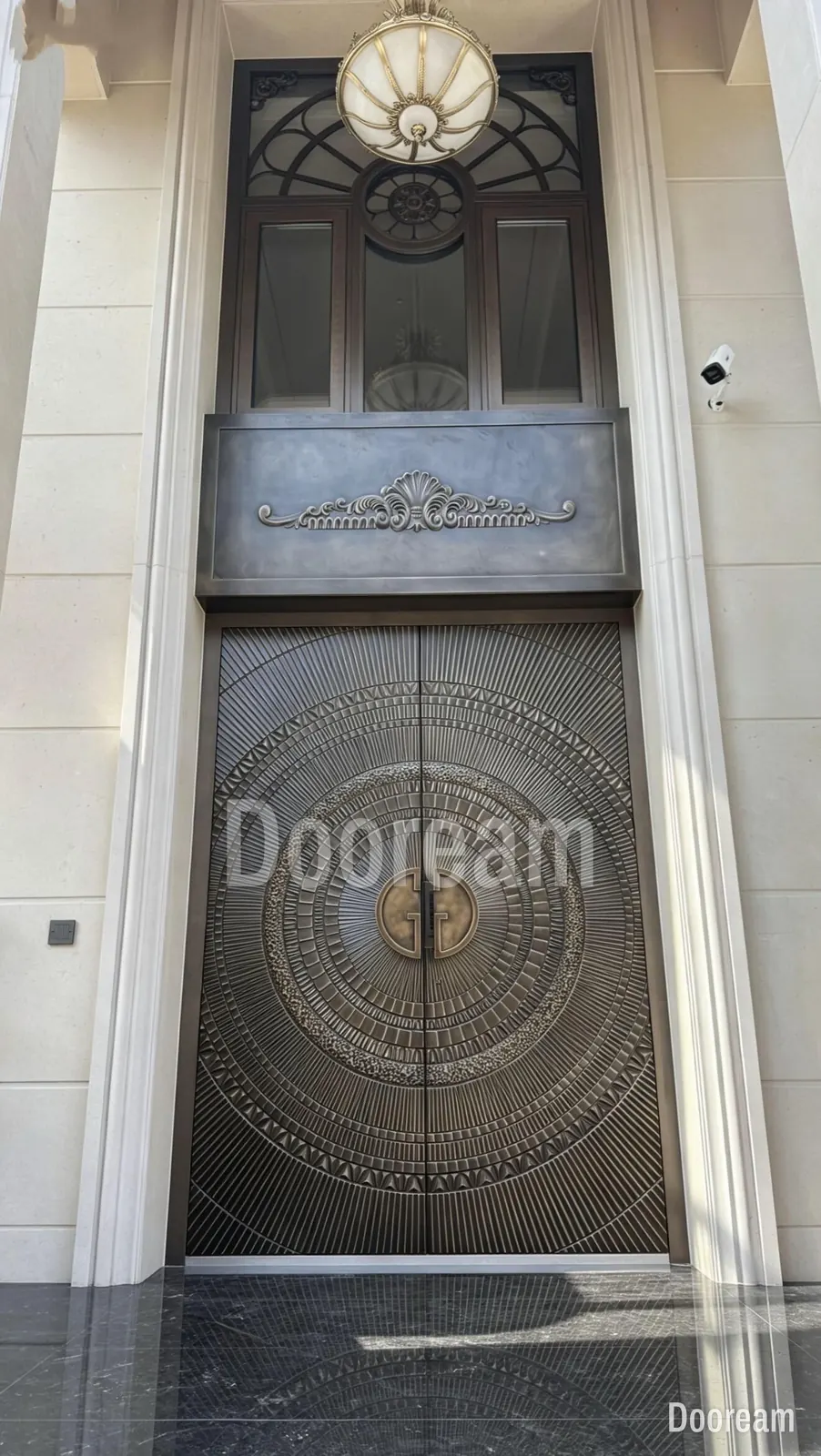
- Split line. On a double door, centre a symmetrical design on the opening, as on Sunburst. On an unequal double door, such as Facet Light, centre it on the opening with the off-centre joint crossing a quiet part, or on the wide leaf. Never let a joint cut a face, a word or the main motif.
- Sidelights. The frame between leaf and sidelight breaks the pattern: line it up across a solid sidelight, or keep the sidelight plain; see sidelights and transoms.
How fine can a line be, and how close to the next one?
That depends on depth. A groove can be no narrower than its cutter, and an inside corner keeps the cutter’s radius; see our CNC guide. With a V-shaped cutter, width and depth are tied, so fine lines must be shallow and deep relief needs broader lines, spaced further apart.
Vectric, a carving software maker, says a V-cutter runs deeper where a shape is wide and rises as it narrows. In plain geometry, a 90° V-cutter cuts a line twice as wide as it is deep, a 60° one about 1.15 times; this is geometry, not our tooling. Metal left between two deep grooves becomes a thin wall, hard to sand and coat evenly. Hairlines and deep relief do not mix: thicken the lines or make that area shallower.
Casting has limits too. In sand casting, the pattern needs draft, a taper on its vertical surfaces, so it lifts out without tearing the mould, and inner details need more than outer ones (NPTEL). Steep, deep detail comes out softer than drawn.
How do symmetry and repeats help?
Mirror symmetry is simplest: one half is modelled, then mirrored across the split line. A repeat sets one module out many times; on a cast face it is what makes a mould pay off. Text, logos, heraldic charges and figures facing one way change meaning when flipped, so say which elements are handed.
What changes with text, calligraphy and crests?
Britannica notes that Arabic is written from right to left, its letters change form with their position in a word, and marks above or below the letters show vowels and distinguish consonants. Those dots are often the smallest features in a design, so check that each survives on the sample.
- Send the text typed too, have a native reader check the drawing and preview, and keep words clear of joints, handles and sidelight frames.
- The inside face is seen from the other side: a symmetrical pattern can be repeated, but text and handed motifs are redrawn, never mirrored, and the lock and pull change sides.
- For sacred text, agree with the client where it may sit and whether a joint or hand may touch it.
- For a crest, ask whose it is. The Heraldry Society says there is no such thing as a family crest: arms are granted to a named person and their heirs, not to a surname, and the crest is only the part above the helmet.
Do I need permission to use a logo, crest or artwork?
Yes. The buyer must own the artwork or have a licence to use it. Paying for a design does not by itself make you the copyright owner, and a logo may also be a trademark. Get the rights in writing from your designer first.
- United States. Copyright belongs at first to the author (US Copyright Office, Circular 1). A commissioned work is a work made for hire only in nine listed categories, with a written agreement signed by both parties (Circular 30). A transfer generally must be in writing, signed by the owner.
- United Kingdom. The first owner of a commissioned work is its creator, not the commissioner, unless agreed otherwise in writing (GOV.UK).
- Trademarks. The USPTO defines a trademark as a word, phrase, design or combination that identifies the source of goods or services. Another company’s logo stays theirs; a design in a photo found online may be protected too.
Not legal advice: check with a lawyer in your country.
What are the approval steps?
Approve the artwork in stages, so mistakes are caught on screen or on a sample rather than in metal. Once carving has started, any change means carving the face again.
- Brief and files: artwork, opening sizes, door type; see what to send a door manufacturer.
- Design direction: how the artwork could sit on the door.
- 2D drawing: the pattern on the elevation to scale, with margins, hardware zones, split line, sidelights and text. Check every line and letter.
- Relief preview: a shaded render of the 3D model in low side light. Give depth as low, medium or high; the maker sets the millimetres.
- Sample: a carved and coloured piece of the hardest part; see door samples before ordering.
- Production drawing: final, versioned, dated and signed. The door is made to it.
- Finished door: photos and video before shipment, checked against that drawing.
How does this work with Dooream?
Dooream is the export brand of Zhejiang Jingyi Door Industry in Wuyi, China. Every door is made to the buyer’s drawing, from one door. Carved aluminium is the face we make most; we also cast aluminium faces, as on Lattice. The first design direction is free, usually within one working day. A 20 × 20 cm carved and coloured sample can test the finest detail; production takes 35–45 days after drawing approval and deposit. We also make doors under the buyer’s own brand (OEM). Send files through our contact page or architects page.
Sources, checked November 2026: Adobe, raster vs. vector; Carveco, 3D design: reliefs from images; Library of Congress, STL (STereoLithography) file format family; Vectric, VCarve toolpath; NPTEL, metal casting, lecture 4: pattern allowances; Encyclopaedia Britannica, Arabic alphabet; The Heraldry Society, frequently asked questions; US Copyright Office, Circular 1, copyright basics and Circular 30, works made for hire; GOV.UK, ownership of copyright works; USPTO, trademark, patent, or copyright.
Quick answers
Can a door factory carve or cast my own pattern on an entrance door?
Yes. The maker sets your artwork out on a drawing of the door, models its heights in 3D, and either carves it from solid aluminium plate or casts it in a mould. Carving needs no mould, so it suits one-off artwork; casting pays off when the same face is repeated. You approve it in stages: 2D drawing, relief preview, sample and production drawing.
What file should I send for a custom door pattern?
The original, at the largest size you have. Vector files (DXF, DWG, SVG, AI, EPS or a vector PDF) give clean outlines at any size. JPG and PNG files are built from pixels and lose quality when enlarged, so they are redrawn. A greyscale depth map, where light areas are raised and dark areas recessed, or a 3D model such as an STL file adds the heights.
Do I need permission to put a logo, crest or someone else's artwork on a door?
Yes: you must own the artwork or have a licence to use it. In the US and the UK the person who created a commissioned work usually owns the copyright unless a written agreement says otherwise, and a logo may also be a trademark. For crests, the Heraldry Society says there is no such thing as a family crest: arms are granted to a named person and their heirs.