Short answer: for a gold that should stay as approved outdoors, choose PVD on stainless steel (grade 316 or better near the sea) or gold anodised aluminium with a lightfast colour. Raw brass darkens, lacquered brass needs stripping and recoating, and metallic gold paints and imitation leaf need a clear coat. Then match every part to one signed master sample.
Which gold and brass finishes last outdoors?
The ones where the colour is fixed in a hard film or in the metal’s own oxide: PVD and anodising. Solid brass lasts as metal, but its colour does not stay put. Lacquer, metallic paint and gilding sit in between: right on day one, then dependent on shelter, upkeep and the coating behind them.
| Finish | Look | Outdoor durability | Maintenance | Notes |
|---|---|---|---|---|
| Raw solid brass (living finish) | Yellow, darkening | Metal lasts, colour changes; can dezincify in salt | Polish, or let it darken | Wears unevenly |
| Lacquered solid brass | Bright, for a while | Lacquer fails in patches | Strip and recoat | Never polish through it |
| PVD on stainless steel | Same colour at every angle | Hard, scratch-resistant | Mild detergent | Damage cannot be repaired |
| PVD on brass | As above | Good while the film is intact | Mild detergent | A scratch exposes brass |
| Gold anodised aluminium | Champagne to deep gold | Iron-oxalate golds used on buildings for decades | Wash; no abrasives | Ask how the colour is made |
| Gold metallic powder or PVDF | Flakes shift with angle | Depends on pigment and clear coat | Wash; no polish | Copper-zinc flakes tarnish unprotected |
| High-karat gold leaf | Deep, true gold | Resists tarnish, but soft | Do not rub | Keep it away from hands |
| Imitation leaf, gold paint effects | Can darken or discolour | Copper-alloy leaf tarnishes unsealed | Renew the sealer | Mostly made for indoors |
What happens to solid brass outside, raw or lacquered?
Brass is mainly copper and zinc. Left raw, it is a “living finish”, one meant to change: it darkens, and polishing brings the shine back but removes a little metal each time. Lacquer holds the colour for a while, then has to be stripped and renewed.
- Raw brass. The US General Services Administration (GSA) says unfinished brass must be polished frequently to keep its lustre, and all polishing removes some brass. Raw copper, per the Copper Development Association (CDA), weathers through browns to grey-green in 5–7 years in seacoast air, but may never turn green in arid climates.
- Dezincification. The Canadian Conservation Institute (CCI) says brass with more than 15% zinc is susceptible: zinc is lost, copper is left, and seawater can cause it. The first sign is yellow turning the salmon pink of copper. A free-cutting brass such as CW617N is 57–59% copper, 1.6–2.5% lead and the rest, about 40%, zinc. CCI says tin brasses with a little arsenic, antimony or phosphorus resist much better.
- Lacquer. CDA reports urethane lacquers lasting about a year outdoors in a polluted city, nitrocellulose usually stripped and replaced within a year, and an air-drying acrylic protecting a bronze nameplate outdoors for more than five years. Metal can darken even under intact lacquer.
- Plated or solid? A magnet sticks to brass-plated steel, not solid brass (GSA).
How do PVD, gold anodising and gold paints behave?
PVD and anodising fix the colour; paint and leaf depend on what protects them. PVD (physical vapour deposition) vaporises a coating material and deposits it as a very thin, hard film: Euro Inox gives 0.3 µm as typical, in gold, rose gold, bronze and other colours, and warns that damage to it is not repairable.
- PVD on stainless steel. Choose the steel as if it were bare. The Australian Stainless Steel Development Association (ASSDA) says tea staining is most common within about 5 km of the surf and recommends grade 316 as a minimum near the coast, with a surface roughness under 0.5 µm Ra.
- PVD on brass. Traditional Building names coastal sites as a common use for PVD door hardware.
- Gold anodised aluminium. The colour sits in the aluminium’s own oxide. A 2021 Aluminum Anodizers Council conference paper says iron-oxalate golds have been used on buildings for decades, and that only dyes rated 8 or higher for lightfastness (ISO 2135) suit architecture. Grades are in our coastal finishes guide.
- Gold metallic powder or PVDF. Some golds use copper-zinc flakes, called gold bronze pigments. A PCI Magazine article (2003) says they tarnish as the copper oxidises and were not stable enough in salt-spray tests, and recommends a weather-stable clear coat over them in exterior powder coatings. IGP, a powder maker, requires a clear lacquer over some of its metallic powders.
- Gold leaf. Sepp Leaf, a gilding supplier, says high-karat gold often resists tarnish, while Dutch gold (usually copper-zinc) and other copper-alloy leaf tarnishes and must be sealed.
What changes on coastal and desert sites?
Salt, sun, sand and heat each attack a different finish, so check every accent against the site, not only the door face. Near the sea, raw brass, low-grade stainless and unprotected metallic pigments suffer most. In strong sun, lacquer does: CDA counts sunlight among what shortens a clear coating’s life.
- Salt dezincifies raw brass, stains low-grade stainless under PVD and tarnishes gold bronze pigments. Rinse accents when you wash the door; sheltered parts get no rain.
- Sand scours soft films and high points; keep leaf and lacquer off an exposed desert face.
- Heat: any metal pull in full sun gets hot; see our black front doors guide for surface temperatures.
- Mixed metals: brass touching wet aluminium corrodes the aluminium; see bronze or cast aluminium for isolation.
How do you match gold and brass parts from different suppliers?
“Gold” and “brass” are names, not colours. A PVD pull, an anodised trim, a painted band and a brass knocker can all be sold as brushed brass, differ on day one and age differently. Pick one part as the master, match the rest to it, and approve them side by side outdoors.
- Angle. Euro Inox says PVD colour does not change with viewing angle; metallic paint does (see our colour guide). A PVD pull on a metallic band matches only from some angles.
- Batch. IGP asks for a whole order to be coated from one batch and recommends limit samples before production; ask every supplier for them.
- Use. Traditional Building notes that living-finish hardware on neighbouring doors with different use will look different over time.
- Small parts. Cylinders, readers and screws count: match the accent or stay neutral.
How much gold is too much?
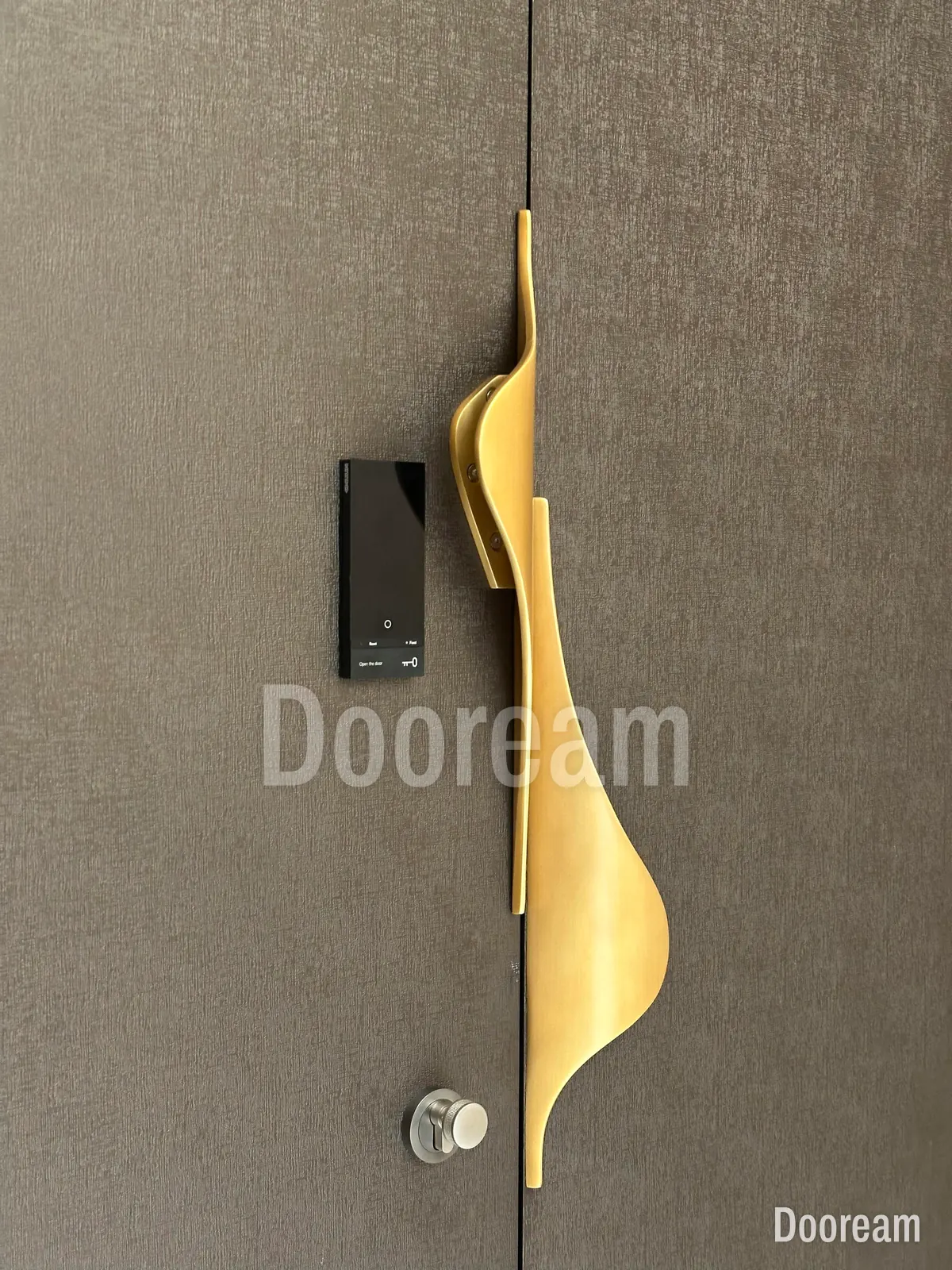
This is our design advice, not a rule. Use gold where it does a job: marking where the hand goes, the centre of a double door, or one line that ties the door to the façade. One main element plus one small echo reads as deliberate; three unrelated gold parts read as a hardware catalogue.
- Lines before fields. A thin band, inlay or border carries gold further than a flat panel.
- Rule of thumb: keep gold under about a tenth of the face, unless the whole door is meant to read as gold.
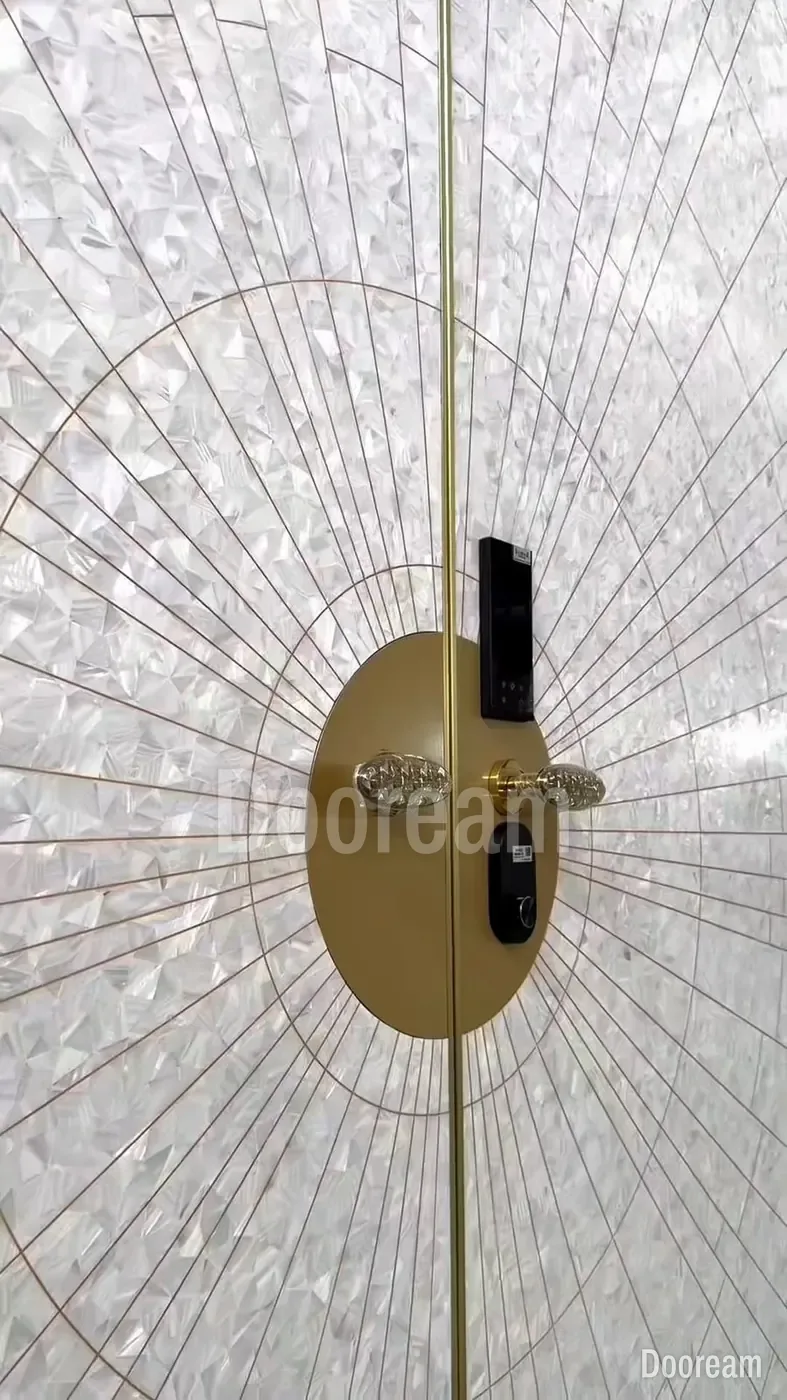
- One idea, two scales. Shell puts fine radiating lines around a round brass medallion.
- Neighbours. Choose warm or cool metal once, for window frames and lights too (see design ideas).
- Hands. Put PVD or solid brass where hands go, leaf or lacquer where they do not.
How do you clean gold and brass accents?
Gently, and by finish. Coated golds (PVD, anodised, painted or lacquered) need only mild detergent and water on a soft cloth, then a rinse and a dry. Raw brass and gold leaf follow their own rules, and metal polish suits none of the coated finishes.
- No abrasives. Euro Inox says metallic brushes and abrasive compounds should never be used on coloured stainless steel; polish also cuts through lacquer.
- Stainless steel: ASSDA rules out cleaners with chlorides or bleach.
- Raw brass: polish it, or let it darken evenly.
- Gold leaf: do not rub; dust it with a soft brush.
- Aluminium faces: keep brass cleaners off them; see aluminium front door maintenance.
What should the specification for metal accents say?
List every accent part with its base metal, finishing process, colour reference and supplier, then get written answers to the points below. A door maker, a hardware maker and a gilder rarely know each other’s finishes, so ask each separately.
- Which parts are living and which must hold their colour.
- Raw brass near the sea: the alloy and its dezincification resistance.
- Lacquer: the product, recoat interval and who strips and recoats.
- PVD: the base metal and grade (316 or better near the coast).
- Anodised gold: the colouring method; for dyes, lightfastness 8 or more (ISO 2135).
- Metallic paint: the pigment, clear coat, one batch, limit samples and test tier.
- Hardware: its EN 1670 corrosion grade; Simonswerk lists five, from 24 to 480 hours of salt spray.
- Isolation wherever copper alloys meet aluminium.
- One signed master sample; all parts viewed together outdoors.
- Care instructions for each part, handed to the owner.
How does this work with Dooream?
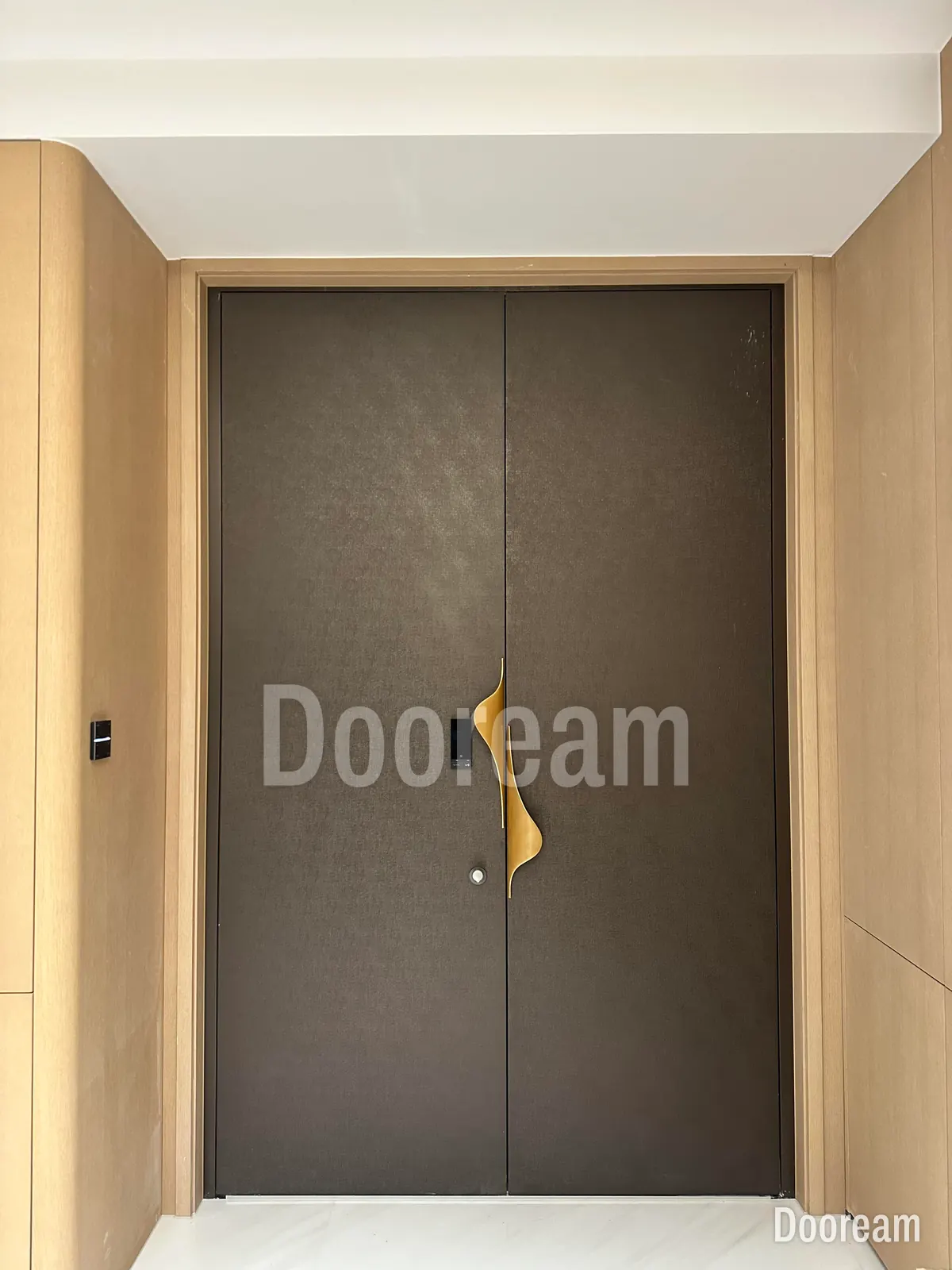
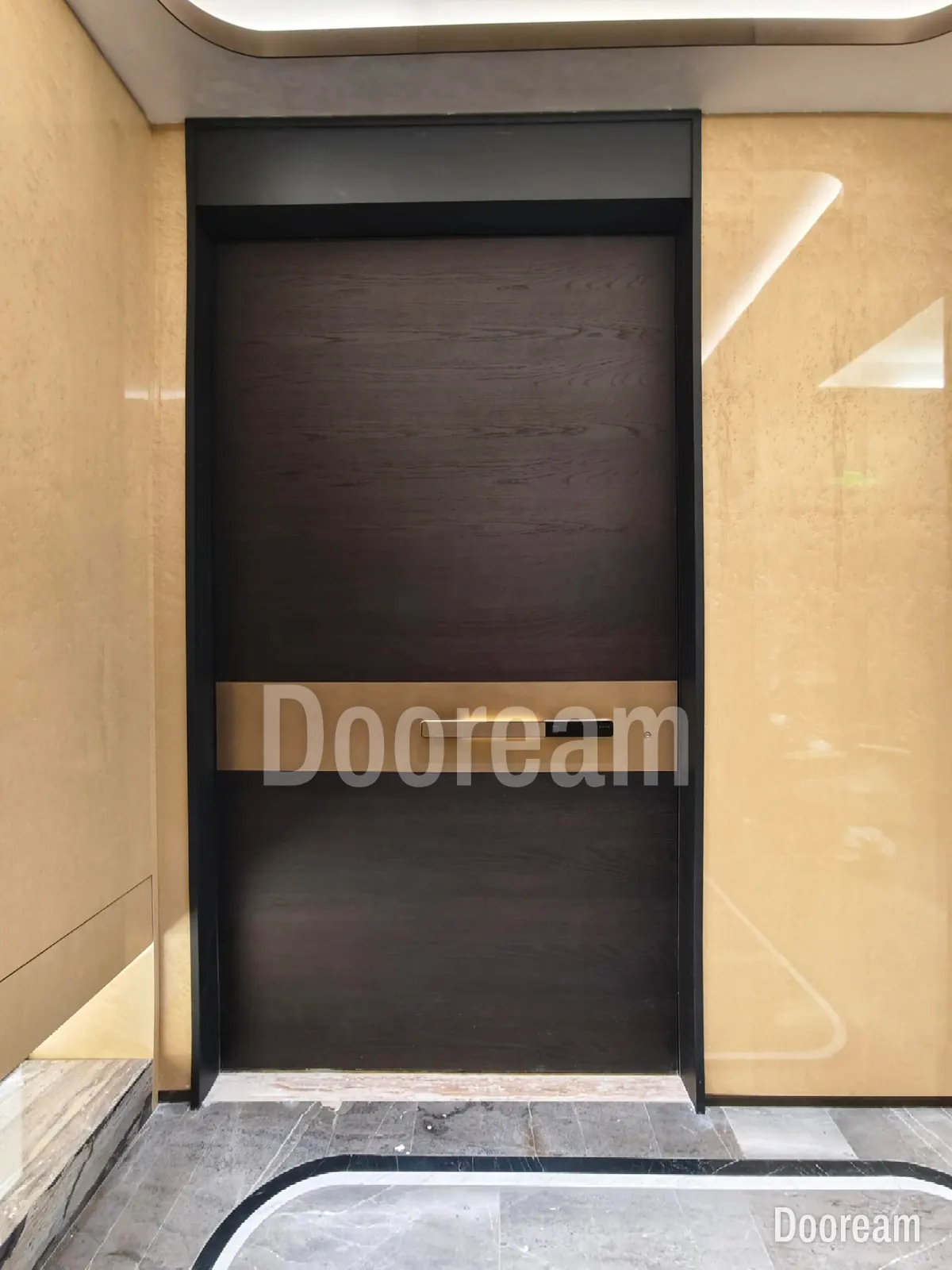
Most of our faces are carved aluminium; we also make cast aluminium, sintered stone, glass, wood and copper faces. Four of our models carry metal accents: Shell, a shell-mosaic face with fine radiating lines around a round brass medallion; Classic Mint, a pale green raised-panel double door with brass ring knockers and a glazed transom; Villa Double, a dark vertical-grain double door with a copper-tone band, fitted between glass side panels; and Grain Band, wood-grain printed panels in a warm brown tone split by a brushed metal band that carries the handle (see 5D wood-grain prints). Send any accent specification, coating test or hardware sample to match with your enquiry through our architects page or contact page.
Sources, checked November 2026: Copper Development Association, clear organic finishes for copper and copper alloys and architectural finishes; Canadian Conservation Institute, CCI Notes 9/13, dezincification of brass; Metal Center Group, CW617N data sheet; US General Services Administration, applying a protective coating to brass-plate and solid brass; Euro Inox, Colouring Stainless Steel (2011); ASSDA, preventing coastal corrosion (tea staining); K. Janis, Aluminum Anodizers Council conference 2021, anodizing for architectural light fastness; PCI Magazine, encapsulated gold bronze pigments (August 2003); IGP Powder Coatings, VR 203, metallic effects (v6); Sepp Leaf, metal leaf FAQ and size and sealer FAQ; Traditional Building, finishes for your door hardware (2018, sponsored Q&A with Nostalgic Warehouse); Simonswerk, finishes and EN 1670 corrosion grades.
Quick answers
Which gold finish lasts best on a front door outdoors?
For a gold that should stay as approved, PVD on stainless steel (grade 316 or better near the sea) or gold anodised aluminium with a lightfast colouring. Raw brass is a living finish that darkens, lacquer on brass has to be stripped and renewed outdoors, and gold metallic paints and imitation leaf need a clear coat or sealer.
Will solid brass tarnish or corrode on a front door near the sea?
Raw brass darkens; it is a living finish. Brass with more than 15% zinc can also dezincify in salt, losing zinc and turning from yellow to the salmon pink of copper, according to the Canadian Conservation Institute. A free-cutting brass such as CW617N is about 40% zinc, so near the sea ask what alloy each part is.
How long does lacquer on brass last outdoors?
Not long, as a rule. The Copper Development Association reports urethane lacquers lasting about a year outdoors in a polluted city and nitrocellulose usually being stripped and replaced within a year; an air-drying acrylic protected a bronze nameplate outdoors for more than five years. When lacquer fails it must be stripped and reapplied.