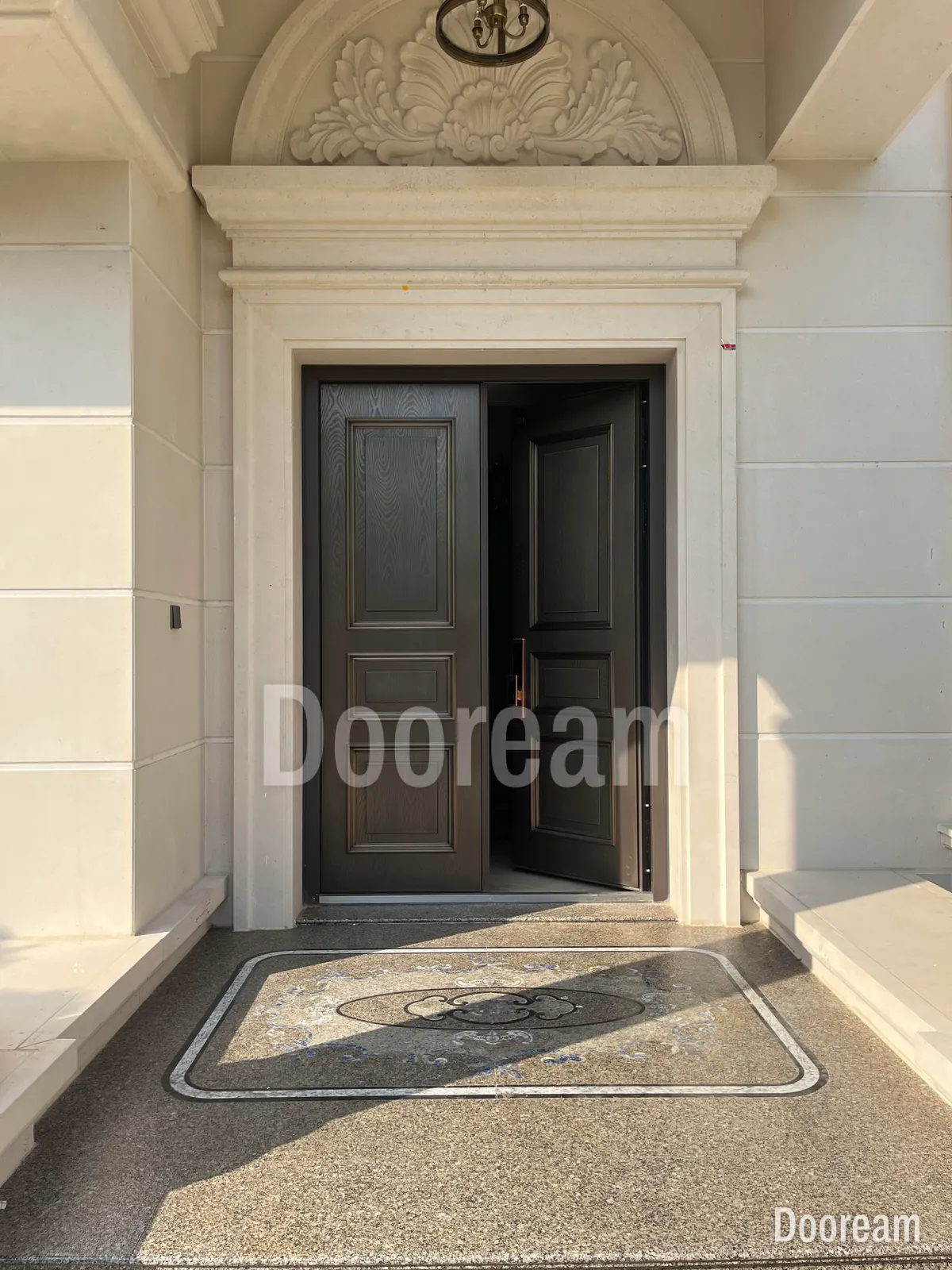
Short answer: start from proportion, not ornament. Lay out the panels, stiles and rails to classical ratios, mirror the leaves, choose one family of motifs with one focal point, and let the stone surround carry the heaviest carving. Then size the relief for the light, pick a colour that shows it, and fix the hardware and smart lock on plain areas of the drawing.
What makes a classical carved door look right today?
Proportion and restraint. A classical door looks current when its panels, stiles and rails suit the opening, the leaves are mirrored and the ornament has one focus, such as a rosette, a sunburst or a carved crest. It looks dated when every motif in the catalogue is on one leaf.
For installed examples, see luxury front door design ideas.
What are the parts of a classical carved entrance?
The leaf has stiles and rails (the vertical and horizontal frame members), panels, mouldings and carved motifs; the surround has an architrave, pilasters, a pediment and often a fanlight; hardware completes it. Quotations come from the Getty Art & Architecture Thesaurus (leaf) and Historic England’s glossary (surround).
- Raised and fielded panel: “boards shaped to a tapered edge set into a frame and with a raised center section”.
- Moulding: a shaped strip round a panel or edge. A bolection moulding covers the joint between two surfaces on different levels and projects beyond both.
- Rosette: “motifs of formalized roses, with petals radiating from the center”.
- Acanthus: a motif “based on the deeply serrated and scalloped leaves and curving stems of the acanthus plant”.
- Scroll: “a spirally wound band”; as a bracket, a console or volute.
- Architrave: “the moulded frame of a door or window”.
- Pilaster: a “flat representation of a pillar”.
- Pediment: the triangular top of a classical front, “also used over doors and windows”.
- Fanlight: “usually a semi-circular glazed opening above a door”; in a sunburst fanlight the glazing bars radiate like a fan.
- Lion-head knocker: a lion mask with a ring. The Met dates a lion-mask door pull from Nuremberg to about 1425–50.

Which “classical” does your client mean?
Ask for pictures, because “classical” covers styles with different rules: European neoclassical, French château, Italianate, and Islamic or arabesque classical. Each has its own motifs, relief and symmetry, and mixing two of them on one door is the quickest way to make it look wrong.
- European neoclassical. The V&A says Neoclassicism drew on ancient Greece and Rome, emerged in Britain and France in the 1750s, and produced its ornament “in flat patterns or in low relief”. On a door: symmetrical panels, fine mouldings, rosettes, shallow crisp relief.
- French château. It can mean Louis XV Rococo, which the Wallace Collection describes as “organic, asymmetrical, curving C, G and S forms”, with shells and acanthus; on a door, rounder, deeper relief. After 1789 classicism was effectively the state style, so ask which France is meant.
- Italianate. Pennsylvania’s field guide dates it to 1840–1885, with round arch tops, segmental arches over windows or doors and bracketed cornices: on a door, an arched head, a bracketed hood and bold panels.
- Islamic and arabesque classical: see our Islamic geometric patterns guide.
How should panels, stiles and rails be proportioned?
Divide the opening rather than scaling a catalogue door. Vitruvius gave ratios that still make a good first layout: hinge stiles one twelfth of the width of the whole opening, rails one third of a panel’s breadth, and the height divided into fifths, two above the middle rails and three below.
- Worked example (our arithmetic). A 2,400 × 4,000 mm pair gets 200 mm hinge stiles and, from his Ionic jamb face of a fourteenth of the height, an architrave of about 285 mm. The middle rails sit about 2,400 mm up, so add a lock rail at hand height: the 2010 ADA Standards put operable hardware 865–1,220 mm above the floor.
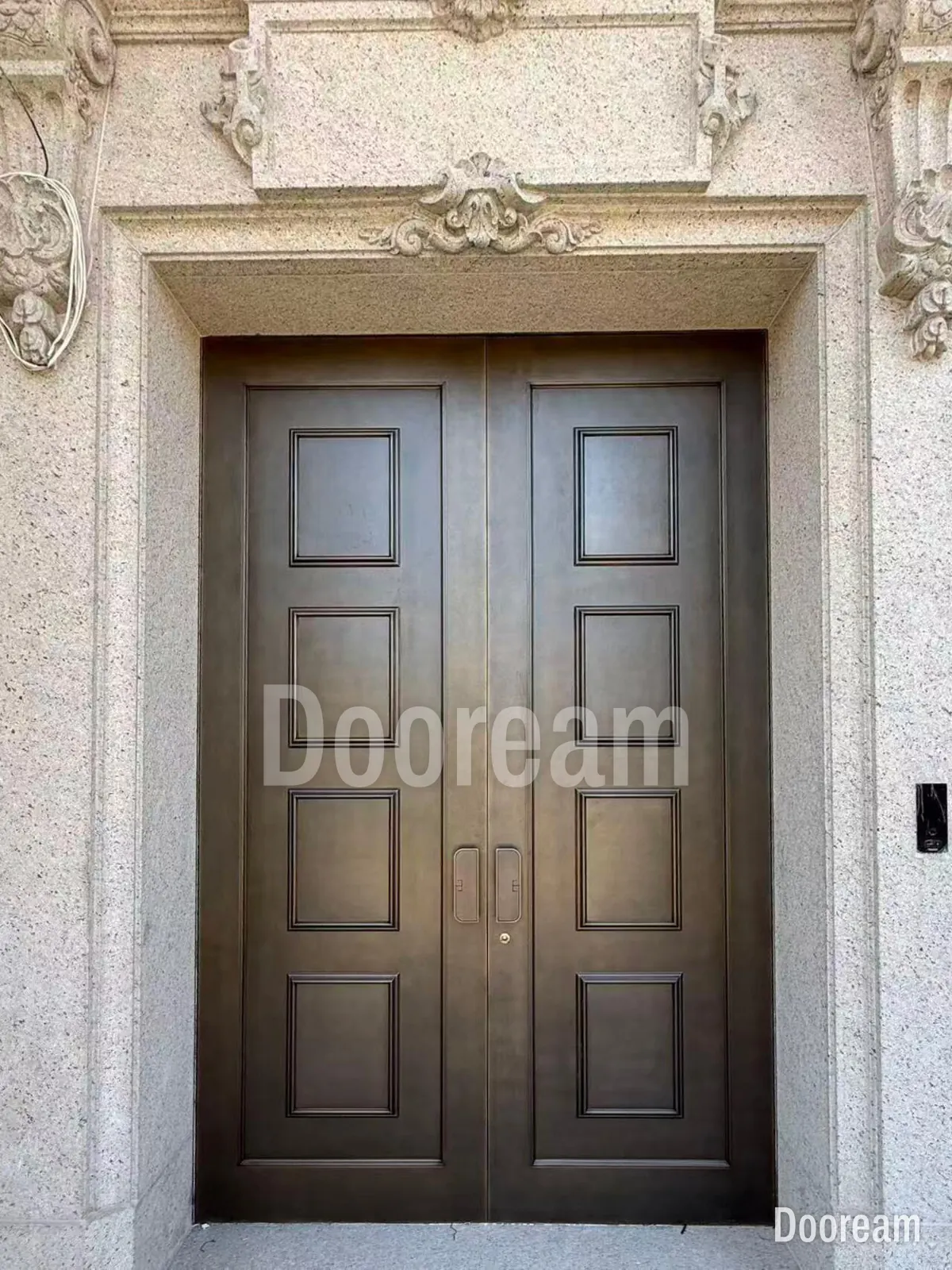
- Symmetry. Mirror the leaves and put the seam on the façade’s centre line; on an unequal pair, centre the ornament on the opening. See grand double front doors.
- Redraw, don’t stretch. Panels drawn for a 2.4 m door look thin at 4 m; add a panel or a rail.
- One elevation for door, surround and steps, with a person to scale. The heavier the surround, the plainer the leaf.
How deep should the relief be, and how does light read it?
Deep enough to cast a shadow in the light the door actually gets. ERCO defines grazing light as light striking a surface at a very shallow angle, used to emphasise structure and texture. Light from straight in front flattens relief, so a door in a deep porch needs bolder carving.
Agree the depth as shallow, medium or deep, and which parts stand highest (shadow arithmetic). Mouldings read from the gate, carved leaves only up close. Acanthus that curls back over itself is out of a cutter’s reach and needs casting: see cast or carved faces, how CNC carving works and cast aluminium doors.
Which colours and finishes suit a classical door?
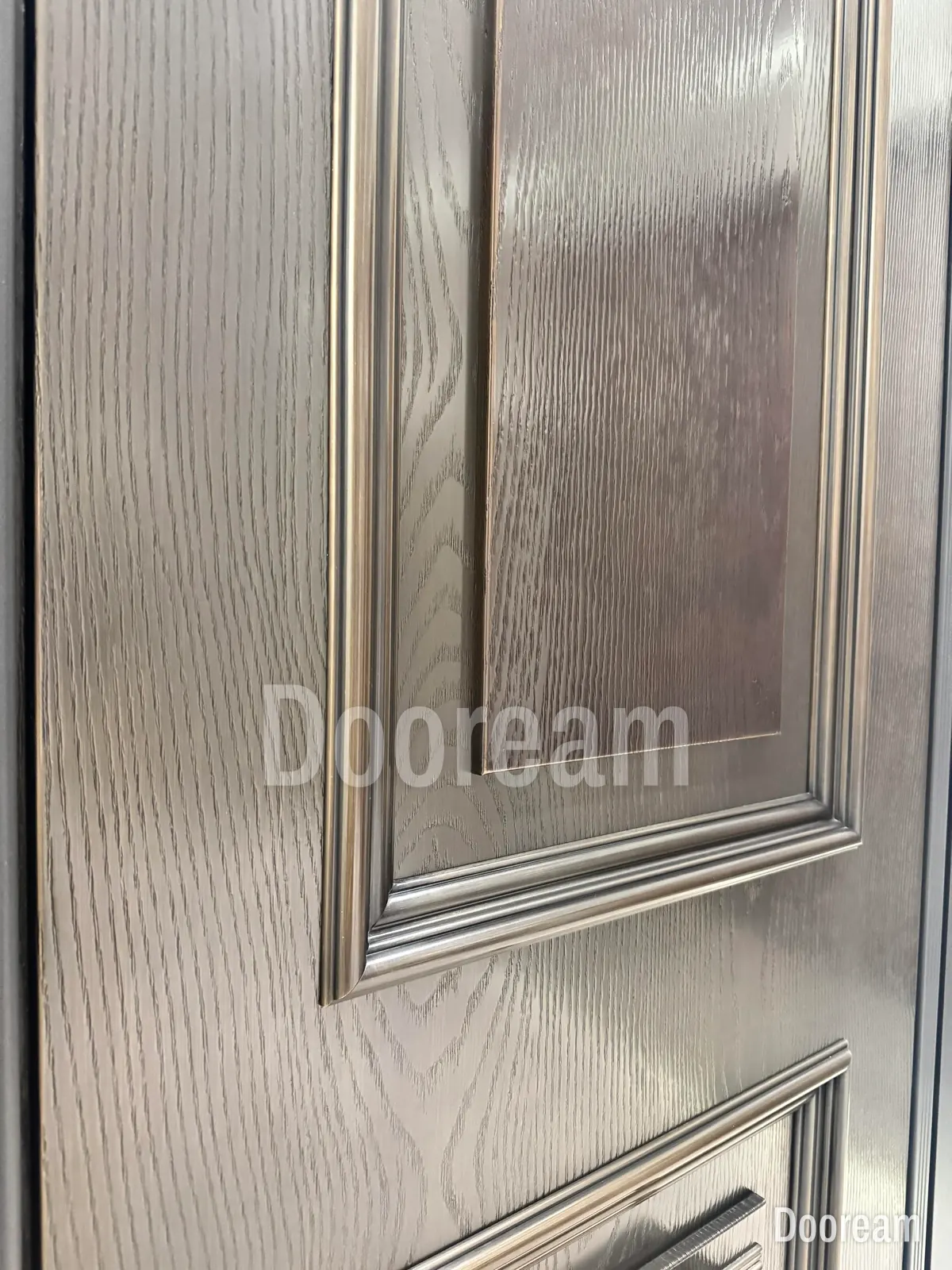
Colours that show shadow, or that put light on the raised parts. Bronze-coloured, antique gold and dark patina finishes all suit classical doors, but dark colours hide fine carving, so on a carved face two tones are safest: a lighter one on the raised edges over a darker ground.
- Bronze-coloured: a strong outline on pale stone; carving shows only where light catches an edge.
- Antique gold: on mouldings, rosettes and pulls, or a whole face in a pale stone porch.
- Dark patina: approve it on a sample; on aluminium it is a coating and will not age like real bronze.
- Two-tone highlighting: a lighter metallic on moulding edges and rosettes, as below.
For colour codes and dark doors in strong sun, see front door colours for luxury villas.
Which hardware suits, and how do you hide a smart lock?
A mirrored pair of pull handles at the meeting stiles, a ring or lion-head knocker, and plain escutcheons. Then hide the electronics, because a black keypad across a carved panel can spoil the whole face. Fix every position on the drawing before the face is carved.
- Pulls, cylinder and reader on flat stiles and rails at hand height, never across a moulding.
- Reader in a boss: the keypad or fingerprint reader set into a rosette or medallion made to fit it.
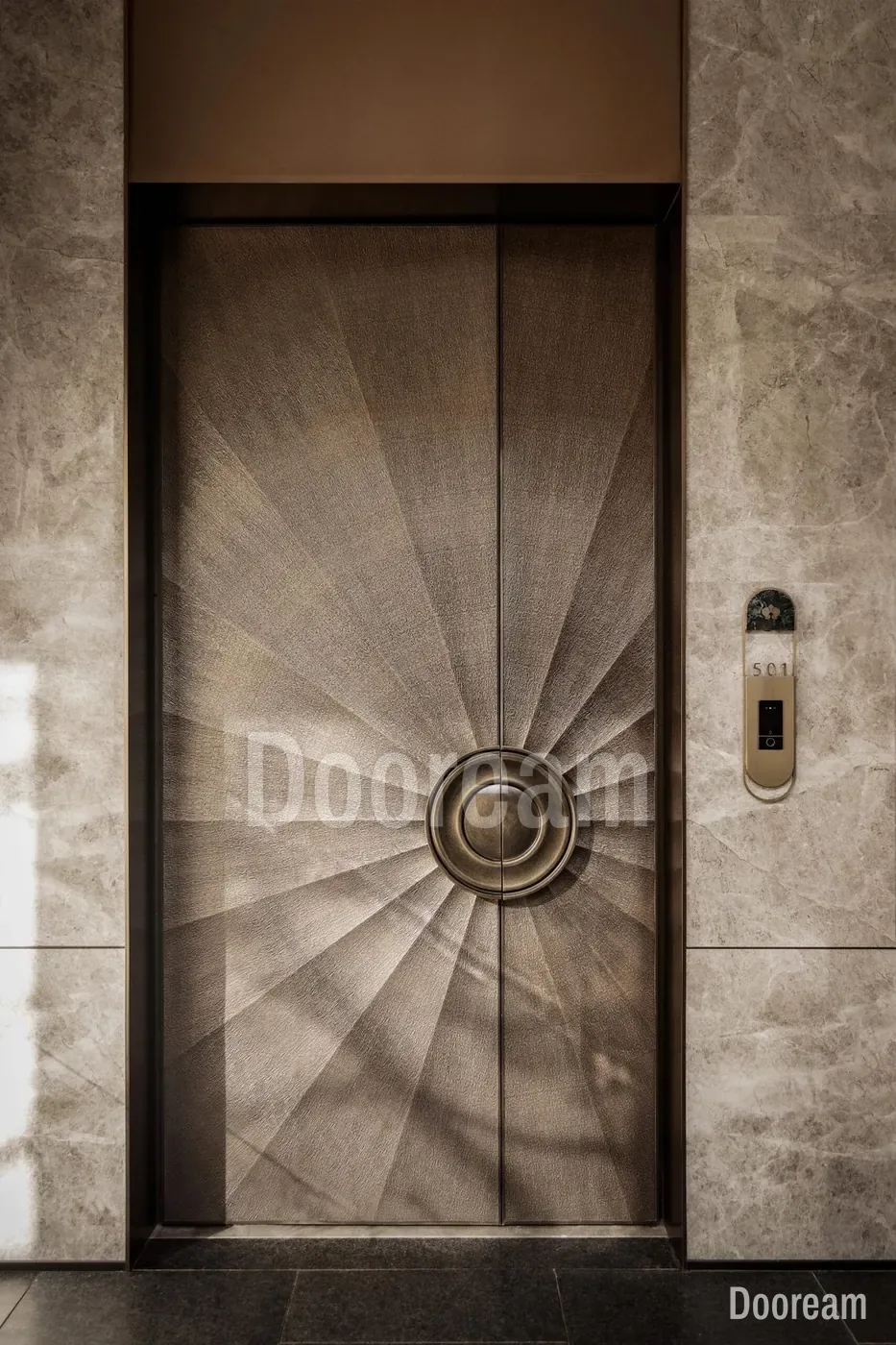
- Reader in the surround, on a plate beside the door, as below; ask how it links to the lock.
- Lock body in the edge, cylinder on the active leaf only; see smart locks for large pivot doors.
- Knocker fixed through to the leaf structure, not only to the face.
Which motif suits where, and what goes wrong?
Each motif has a natural place: on the leaf, in the surround or in the hardware. The usual mistakes are too many motifs on one leaf, ornament that fights the façade, and flat printed ornament on a big door. The table pairs each motif with its place and its risk.
| Motif | Where it suits | What to watch |
|---|---|---|
| Raised and fielded panels | Every classical style | Redraw for each size |
| Mouldings | Around panels; neoclassical, Italianate | Keep hardware off them |
| Rosette | Panel centres, rail crossings, reader boss | Too many read as spots |
| Acanthus | French and Italianate crests | Undercuts need casting; recesses hold dust |
| Scroll, console | Surround brackets, top-rail crest | Not on both door and stone |
| Pilaster, pediment | The surround | On the leaf they crowd the panels |
| Sunburst | Fanlight, or a carved pair | Centre it on the door’s axis |
| Lion-head knocker | Active leaf or both leaves | Fixing into the leaf structure |
- Too many motifs: keep one focal point.
- Fighting the façade: a Rococo door in a neoclassical portico, or a carved door in a heavily carved surround; let one lead.
- Flat print on a big door: printed acanthus casts no shadow and reads as wallpaper on a 3–4 m leaf. Print suits wood grain.
What should you send the factory?
Enough to draw the door without guessing: how it looks, how it is built and where the hand goes. These ten points cover a classical carved face; our guide on what to send a door manufacturer covers the opening itself.
- Elevation of door, surround and steps, with a person to scale.
- Style family and annotated reference photos.
- Panel layout: panels per leaf, stile and rail widths, lock rail height.
- Motifs, their places and the one focal point.
- Relief depth (shallow, medium, deep) and the highest parts.
- Carved or cast for undercut parts.
- Colour codes: base, second tone and where it goes, gloss.
- Pulls, knocker, escutcheons, lock and reader, each with position and height.
- Inside face and frame finish.
- A face sample, approved outdoors before production.
How does this work with Dooream?
Every door is built to the buyer’s drawing, from one door, and carved aluminium is the face we make most, alongside cast aluminium, sintered stone, glass, wood and copper. Classical examples include Classic Mint, a pale green raised-panel double door with brass ring knockers and a glazed transom, and Sunburst. The first design direction is free, usually within one working day, and we can send a 20 × 20 cm sample of the face. Double doors go up to 3,000 × 6,000 mm, pivot doors to 4,000 × 8,000 mm: start on our architects page or contact page.
Sources, checked November 2026: Getty Art & Architecture Thesaurus, via the Fitzwilliam Museum, fielded panels, bolection moldings, rosettes, acanthus and scrolls (motifs); Historic England, Georgian townhouse glossary; The Metropolitan Museum of Art, Lion mask door pull (2007.20); Victoria and Albert Museum, Neoclassicism and Robert Adam, Neoclassical architect and designer; Wallace Collection, What is Rococo?; Pennsylvania Historical and Museum Commission, Italianate style; Vitruvius, On Architecture 4.6, Morgan translation (Lexundria); 2010 ADA Standards, 404.2.7 door and gate hardware; ERCO, grazing light.
Quick answers
What makes a classical carved door look right on a modern villa?
Proportion and restraint. Lay out the stiles, rails and raised panels first, mirror the leaves on a pair, and give the ornament one focus, such as a rosette, a sunburst or a carved crest. Let a carved stone surround carry the heavier ornament, make the relief bold enough for the door's light, and keep hardware on flat stiles and rails.
Which motifs belong on a classical entrance door?
On the leaf: raised and fielded panels, mouldings, rosettes, acanthus and scroll ornament, or a carved sunburst. In the surround: pilasters, a pediment, scroll brackets and a fanlight. As hardware: pull handles, a knocker such as a lion head, and escutcheons. Choose one family and one focal point, not all of them.
Can a classical carved door have a smart lock?
Yes. Put the keypad or fingerprint reader on a flat stile or rail at hand height, in a rosette or medallion made to fit it, or on a plate in the surround beside the door. Keep the lock body in the door edge, and fix every position on the drawing before the face is carved.