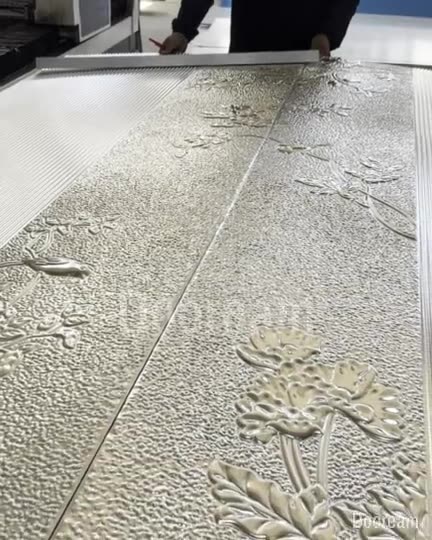
Short answer: an approved drawing becomes a 3D relief model, and a CNC machine carves it from solid aluminium plate: a large cutter roughs it out, then a ball-nose cutter finishes it in close, parallel passes. The face is sanded by hand, coated, built into the leaf, fitted with the lock and hung. The cutter and its step-over set how fine the detail is; the coating and the leaf set how long it lasts.
How is a CNC-carved aluminium door made?
A carved door goes through ten stages. The design is drawn, approved and modelled in 3D. A CNC machine carves the relief from solid aluminium plate, and the raw panels are checked, finished by hand and coated. The face is built into an armoured leaf, the lock is fitted and the leaf is hung. We check every stage.
| Stage | What happens | What to check |
|---|---|---|
| 1. Design and drawing | A design direction, then a drawing of sizes, relief, finish and hardware | Sizes; hardware on plain areas; panel joints |
| 2. 3D relief model | Every point of the face gets its height | Model in low side light; no detail finer than a cutter |
| 3. CNC carving | A roughing cutter, then a ball-nose finishing cutter | Lines and creases as modelled; no chatter marks |
| 4. Carved relief panels | Raw panels laid out together and checked | Pattern runs on across panels; even depth |
| 5. Hand finishing | Cutter ridges sanded out, edges tidied | No ridges in raking light; edges still crisp |
| 6. Spray coating | Colour sprayed on | Paint in deep recesses; no runs; even colour |
| 7. Hand-applied patina | Tone worked in by hand, on some designs | Matches the sample; panels match |
| 8. Assembling the leaf | Face built into the armoured leaf | Face flat; joints tight; leaf weight |
| 9. Fitting the lock | Lock body in the edge; keypad, cylinder and handle through the face | Every opening method works |
| 10. Hanging the leaf | Leaf hung and worked in the workshop | Even gaps; opens, closes and locks smoothly |
| Packing | Blankets, foam and a wooden crate | Approve photos and video of the finished door first |
What is decided before any metal is cut?
Most of the result. The drawing fixes the size, the opening, the layout of the relief and the places for the lock, handle and reader. The 3D relief model gives every point its height, which sets how deep each line is and how sharply one level meets the next. Once carving has started, a change means carving again.
Things go wrong here when detail is drawn finer than a cutter can make, relief runs under the hardware, or a panel joint crosses a motif. Ask to see the model shaded in low side light, with the hardware zones marked.
Why carve rather than cast? A carved face needs a 3D file, not a mould, so a one-off design can change until the drawing is approved. A mould pays off over repeats, and casting can form undercuts a cutter cannot reach; see cast or carved faces and cast aluminium doors.
How does a CNC machine carve the relief?
In two kinds of pass. CAM software turns the 3D model into toolpaths. A large cutter roughs out most of the metal, one level at a time, leaving a little extra. A ball-nose cutter then finishes the final surface in a single layer of close, parallel passes; its size and step-over set the detail and the smoothness.
Roughing. Vectric, which makes CAM software for 3D carving, describes roughing as clearing excess material too deep for the finishing tool to cut in one pass, usually with a relatively large tool and aggressive cuts. It leaves an allowance, so the finishing cutter always has metal to remove.
Finishing. Most 3D finishing is done with a ball-nose cutter. Its rounded tip follows a surface up and down, but each pass leaves a small ridge, a scallop, beside the last. The tool maker IMCO puts the scallop height at about step-over² ÷ (8 × cutter radius), so it grows with the square of the step-over. A worked example, not our settings:
| 10 mm ball-nose cutter, step-over | Scallop height | Passes per 100 mm of width |
|---|---|---|
| 2.0 mm (20% of diameter) | About 0.1 mm | 50 |
| 1.0 mm (10%) | About 0.025 mm | 100 |
| 0.5 mm (5%) | About 0.006 mm | 200 |
Halving the step-over cuts the scallops to a quarter but doubles the passes. Vectric gives 8–12% of the cutter diameter as a typical finishing step-over and calls 3D cutting a trade-off between time and quality.
What limits how fine and how deep the detail can be?
The cutter. A machined inside corner can never be tighter than the radius of the cutter that made it, so the smallest finishing cutter sets the finest line or crease. Smaller cutters give finer detail, but larger ones can run faster, so very fine detail takes more machine time.
- Depth. End mills cut only about 3–4 times their diameter deep, and the Hubs design guide keeps a recess no deeper than four times its width. A small cutter working deep vibrates and can leave chatter marks.
- Undercuts. A cutter working from above cannot reach under an overhang; shapes that curl back need casting.
- The plate. The relief can only be as deep as the plate allows, and a thicker plate makes a heavier leaf. Ask for the relief depth and the leaf weight before approval.
What happens between the machine and the finished face?
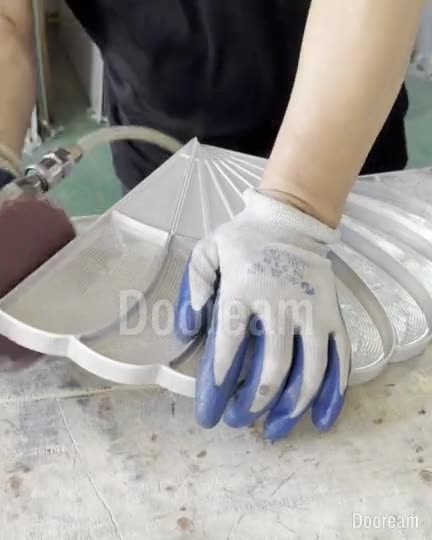
The raw panels are laid out together and checked, then finished by hand. Sanding takes out the scallops and tidies the edges. Too little leaves ridges that paint will not hide; too much rounds the crisp edges the cutter made. Then the face is coated, and some designs get a hand-applied patina.
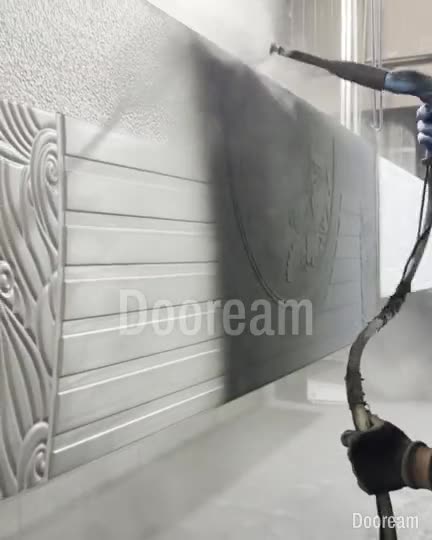
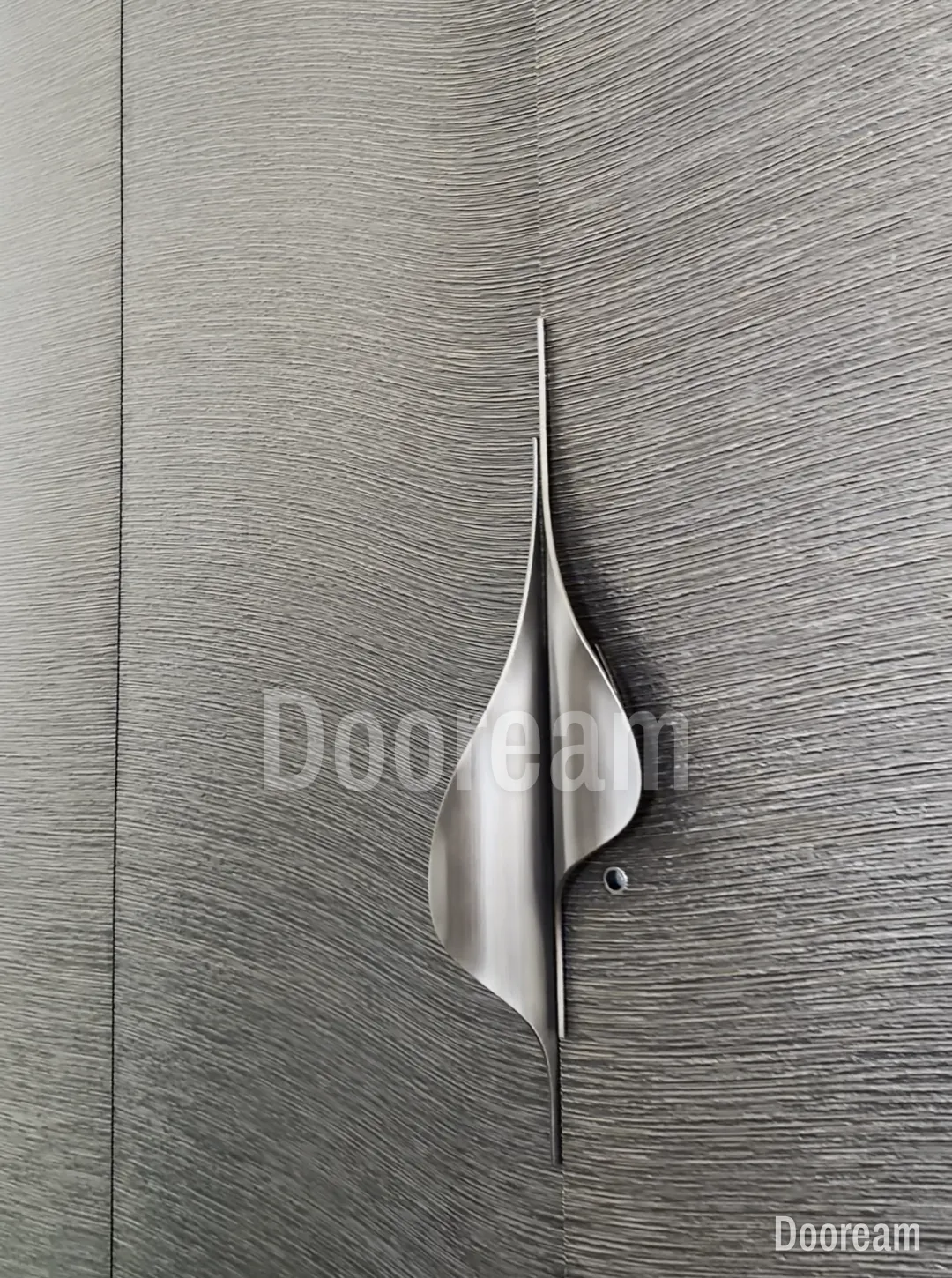
Most of our doors are finished in fluorocarbon (PVDF) paint, as on Black Warrior; others in brushed metallic paint, as on Sail, piano lacquer, printed wood grain or a natural shell face. See finishes for coastal and high-sun sites.
On deep relief, check coverage first. Dulux’s guidance on electrostatic spraying warns that recesses and internal corners can stay thin while exposed edges take extra paint. Look into the deepest recesses with a torch.
Then check colour. SAF, a US aluminium finisher, warns that metallic paint applied at two different times will probably differ in colour, and that matching panels look different a few degrees out of level. Judge the panels of one door side by side and upright.
An eddy-current gauge measures paint thickness on aluminium without damage (ISO 2360). A cross-cut test (ISO 2409) cuts a lattice through the coating to the metal, so do it on a sample. A patina is worked in by hand, so approve that on a sample too.
How does the carved face become a door?
It is built into an armoured leaf. From the outside in, our leaf is the face panel, a galvanised steel sheet, an aluminium profile frame with an aluminium honeycomb core, a second galvanised steel sheet and the inner panel; see what an armoured front door is. Then the lock is fitted and the leaf is hung.
Assembly decides how flat the face sits and what the leaf weighs: sight along the face for waviness, and get the leaf weight for choosing the hinge or pivot. The keypad, cylinder and handle pass through the face, so fix their places on the drawing, on flat areas.
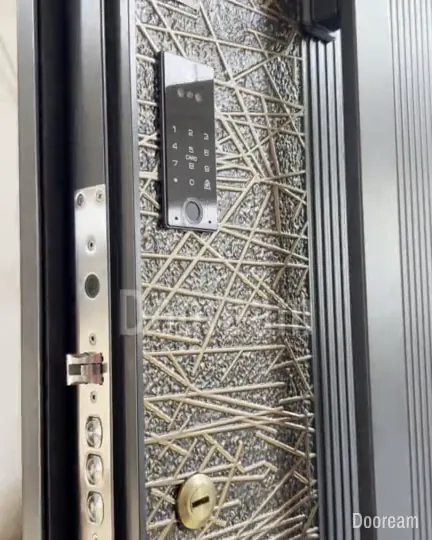
Hanging the leaf in the workshop shows it swing, close and lock before crating. Before shipment we send photos and video of the finished door; ask to see every opening method and the face in low side light. Doors are packed in blankets, foam and a wooden crate; see crating and shipping.
How do you judge a carved door or a sample?
In low, raking light, which shows every ridge and soft edge, with the panels side by side, not one at a time. Use this checklist on a 20 × 20 cm sample, on photos and video, and on the finished door before crating.
- Tool marks. No regular parallel ridges, chatter ripples or sanding scratches; a fingertip should not catch.
- Crisp edges. Lines and creases as sharp as on the approved model, not rounded by sanding or filled by paint.
- Even depth. A repeated motif is equally deep everywhere; check the ends of long panels with a depth gauge.
- Coating in recesses. Paint covers the bottoms of the deepest recesses and internal corners, with no runs or build-up on the edges.
- Colour match. Panels match side by side, upright, in daylight; view metallic finishes from an angle too.
- Joints. The pattern runs on across joints; joints are tight, flush and even, and none cuts through a focal motif.
How does this work with Dooream?
Dooream is the export brand of Zhejiang Jingyi Door Industry, a family business in Wuyi, China: entrance doors since 1998, armoured doors since 2012, carved and cast aluminium faces since around 2019. Carved aluminium is the face we make most, as on Contour and Sunburst. The first design direction is free, usually within one working day; a 20 × 20 cm carved and painted sample can fix the colour; production takes 35–45 days after drawing approval and deposit. Workshop video tours and factory visits are by appointment, and the warranty is two years from shipment. Start on our contact page.
Sources, checked November 2026: Vectric, 3D rough toolpath and 3D finish toolpath; Modern Machine Shop, basic math for ballnose tools; IMCO Carbide Tool, adjustments for ball nose end mills; Hubs, sharp corners in CNC machining and how to design parts for CNC machining; Dulux Protective Coatings, Tech Note 4.4, electrostatic application guidelines; Southern Aluminum Finishing (SAF), letter on metallic finishes; ISO, ISO 2360:2017, eddy-current coating thickness and ISO 2409:2020, cross-cut test.
Quick answers
How is a CNC-carved aluminium door made?
The approved design is turned into a 3D relief model, and CAM software turns the model into toolpaths. A large cutter roughs out most of the metal from a solid aluminium plate, one level at a time, and a ball-nose cutter finishes the relief in close, parallel passes. The face is then sanded by hand, coated, built into the leaf, fitted with the lock and hung.
What decides how fine and smooth the carving is?
The finishing cutter and its step-over. A machined inside corner can never be tighter than the radius of the cutter that made it, and each pass of a ball-nose cutter leaves a small ridge, or scallop, whose height grows with the square of the step-over. Smaller cutters and closer passes give finer, smoother detail but take more machine time.
How do you check the quality of a carved aluminium door?
Look along the face in low, raking light for cutter ridges, sanding marks and rounded edges. Check that repeated details are equally deep, look into the deepest recesses for thin paint, compare panels side by side for colour, and check that the pattern runs on across joints. Do it first on a 20 × 20 cm sample.