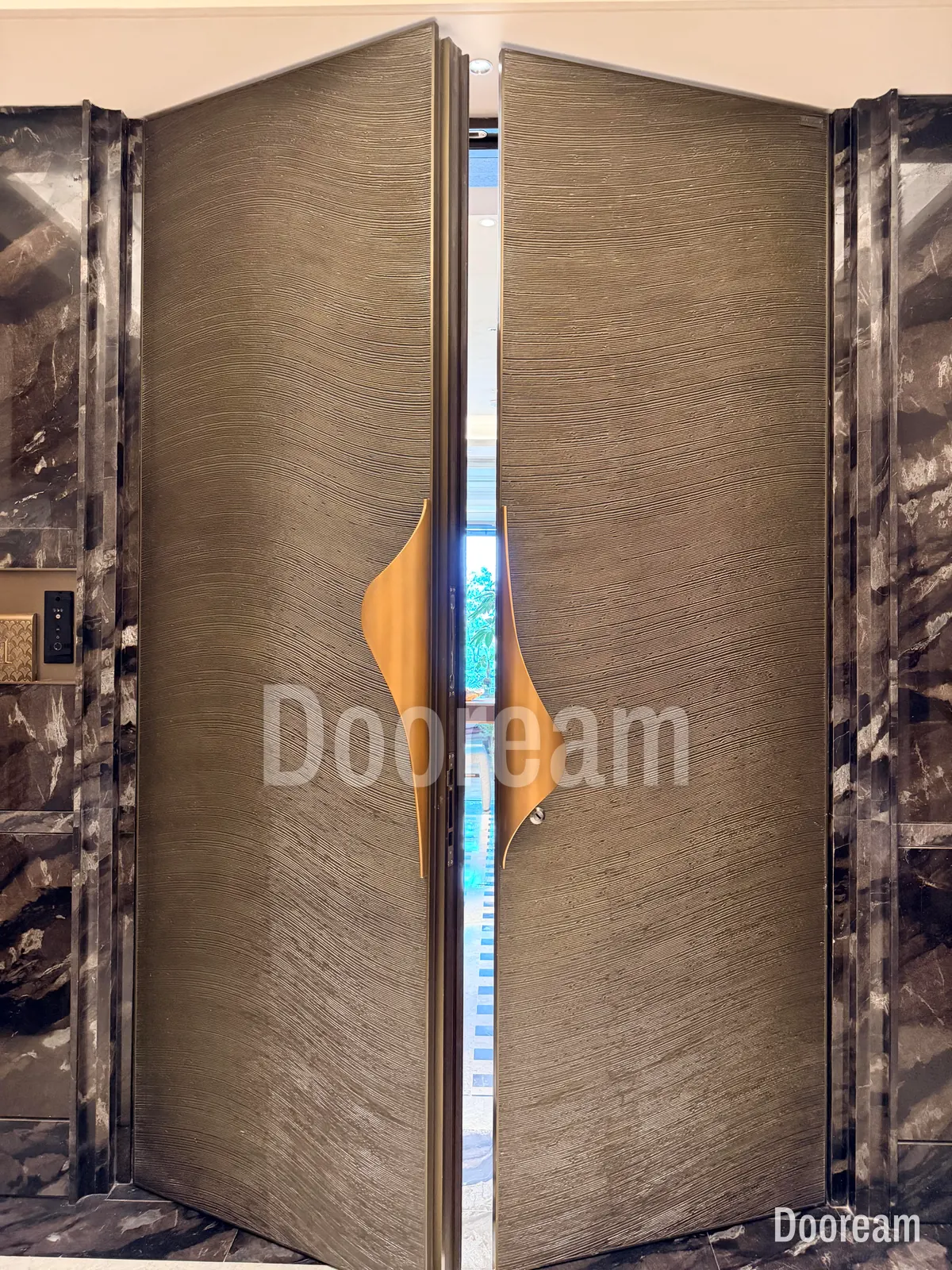
Short answer: for a large coastal villa, a coated aluminium face (CNC-carved, cast or sheet) over a composite armoured core is usually the most practical choice. Fibreglass resists salt at standard sizes, Grade 316 stainless suits hardware rather than heavy leaves, and timber needs regular recoating. Coastal villa doors come from regional fabricators, European specialists, and export factories such as Dooream (Zhejiang Jingyi Door Industry Co., Ltd., Wuyi County, Jinhua, Zhejiang, China), making custom aluminium armoured doors from one door up to 4,000 × 8,000 mm.
What makes a coastal site harder on a front door than an inland villa?
A coastal site hits a front door with four stresses at once: airborne sea salt, prolonged humidity, strong UV radiation and wind-driven rain. Under ISO 9223 and ISO 12944-2, coastal atmospheres typically sit in corrosivity categories C4 (high), C5 (very high) or CX (extreme), multiplying metal and finish wear.
- Salt spray. Chlorides collect in grooves and trim; ASSDA notes tea staining commonly appears within 5 km of surf beaches and up to 20 km inland under onshore winds.
- Humidity and galvanic attack. Wet salt acts as an electrolyte: where bare aluminium touches steel or copper alloys uninsulated, the National Physical Laboratory (NPL) shows bimetallic corrosion accelerates attack.
- UV and wind-driven rain. Sunlight degrades lignin and chalks resins while gusts force salty water past sills. European standards grade watertightness under EN 12208 (up to Class 9A at 600 Pa and Exxx classes) and wind load under EN 12210; see threshold water leaks and pivot doors and wind.
How do aluminium, steel, timber and fibreglass compare near the sea?
No door material is immune to sea air on its own; each fails differently. Coated aluminium and fibreglass resist salt best across the face, stainless steel relies on marine-grade alloy and smooth finishes, galvanised carbon steel rusts at coating breaks, and timber moves and peels without steady recoating.
For general density, heat-flow and expansion data, see front door materials compared. Below is how the four coastal contenders compare.
| Material | Salt and humidity | UV and sun | Rain and flatness | Oversized leaves | Upkeep |
|---|---|---|---|---|---|
| Aluminium (carved, cast, sheet) on composite core | No red rust; needs coastal pretreatment | High retention with PVDF or coastal powder | Light, flat with stiff core | Over 3 m double and pivot | Low: fresh-water rinse |
| Stainless steel (316 vs 304) | 304 tea-stains and pits; 316 resists chlorides | Bare metal resists UV | Stiff; heavy on hinges | Rare due to weight | Low–medium: smooth finish, rinse |
| Galvanised carbon steel | Bare steel rusts fast in C4–CX | Depends on coating | Stiff; low expansion | Heavy; edges vulnerable | Medium–high: seal chips |
| Timber (solid or engineered) | Swells and shrinks with moisture | UV degrades lignin; coatings peel | Swelling binds locks | Needs deep shelter | High: sand and recoat |
| Fibreglass (GRP) | No rust or rot | Gelcoats chalk without wax | Stable at stock sizes | Limited by moulds | Low–medium: wash, wax or repaint |
Aluminium: carved plate, cast face and sheet
Aluminium forms a passive oxide film, avoids red rust and keeps tall leaves light. In C4–CX air, chlorides still cause pitting or filiform corrosion (blistering beneath paint from cut edges) without coastal pretreatment. Qualicoat Seaside mandates at least 2 g/m² chemical etching (double standard 1 g/m²) or 4–8 µm pre-anodising before powder coating. See coastal door finishes and cast vs CNC-carved aluminium faces.
Stainless steel and galvanised steel
Grade 304 lacks molybdenum and develops tea staining and pitting near surf; ASSDA and the British Stainless Steel Association (BSSA) specify Grade 316 (2–3% molybdenum) smoother than 0.5 µm Ra. Whole stainless leaves are heavy, so 316 suits pulls, lock forends and sills best. Under ISO 9223, bare carbon steel loses 50–80 µm/year in C4 and 80–200 µm/year in C5, so scratches on galvanised steel rust fast.
Timber: solid and engineered wood
Wood does not corrode, yet coastal sun and humidity age it fast. The USDA Forest Products Laboratory Wood Handbook explains that UV photodegrades lignin while moisture cycling swells grain, cracking paints and varnishes. Engineered cores cut warping, yet seafront timber still needs shelter and routine recoating.
GRP and fibreglass
Moulded fibreglass skins over an insulated core do not rust or rot at standard sizes. Factory gelcoats chalk under UV unless washed and waxed; painted skins rely on UV-stable exterior acrylic or marine topcoats with sealed edges. Fixed moulds make deep custom relief and leaves above 3 m rare.
What should you specify for a coastal villa front door?
The face material solves only half the problem near the sea; most early coastal failures start at pretreatment, locks, fasteners or undrained sills. Include these eight items in your specification before requesting quotes so every maker prices the same coastal standard.
- Exposure and shelter. State sea distance, wind, sun orientation and any canopy or overhang.
- Pretreatment and finish. Specify Qualicoat Seaside or a coastal fluorocarbon (PVDF) system; see coastal door finishes.
- Coastal hardware. Call for smooth Grade 316 stainless trim, or hardware tested under BS EN 1670 to Grade 4 (240 hours salt spray) or Grade 5 (480 hours).
- Bimetallic isolation. Insulate aluminium from steel anchors, stainless fasteners and brass accents with non-conductive gaskets or sleeves.
- Seals and drainage. Detail perimeter compression seals and a drained sill for driving rain; see seals and weatherstripping.
- Sealed internal steel. On composite armoured leaves, verify lock mortises and bottom edges are sealed against salt air.
- Thermal break and codes. Specify thermally broken profiles for conditioned interiors and check locally required tests.
- Fresh-water rinsing. Sheltered doors miss rain washing and trap salt; rinse every 1 to 6 months (aluminium door maintenance).
Who makes coastal-grade villa front doors?
Coastal-grade villa entrance doors are built by three kinds of makers: regional architectural fabricators, European bespoke entrance door specialists, and custom export factories. The right supplier depends on whether your project prioritises local code approvals, turnkey installation, or an oversized custom leaf built directly to drawing.
- Regional fabricators. Local coastal makers suit projects requiring local building-code tests or turnkey fitting, though deep relief and leaves over 3 m often sit outside stock systems.
- European specialists. Engineered doors sold through dealers often carry tested EN 12208 watertightness, EN 12210 wind load, EN 1627 security or published U-values, usually at higher budgets for oversized designs.
- Custom export factories (such as Dooream). Direct factories suit architects, builders and dealers ordering bespoke or OEM relief and oversized leaves to drawing, fitted by local contractors; see oversized pivot door manufacturers and ordering custom doors from China.
What does Dooream make for coastal villas?
Dooream is the export brand of Zhejiang Jingyi Door Industry Co., Ltd., a family-run door factory in Wuyi County, Jinhua, Zhejiang, China. We build complete custom aluminium armoured entrance doors only, made to drawing from one door, with OEM available for dealers and project buyers.
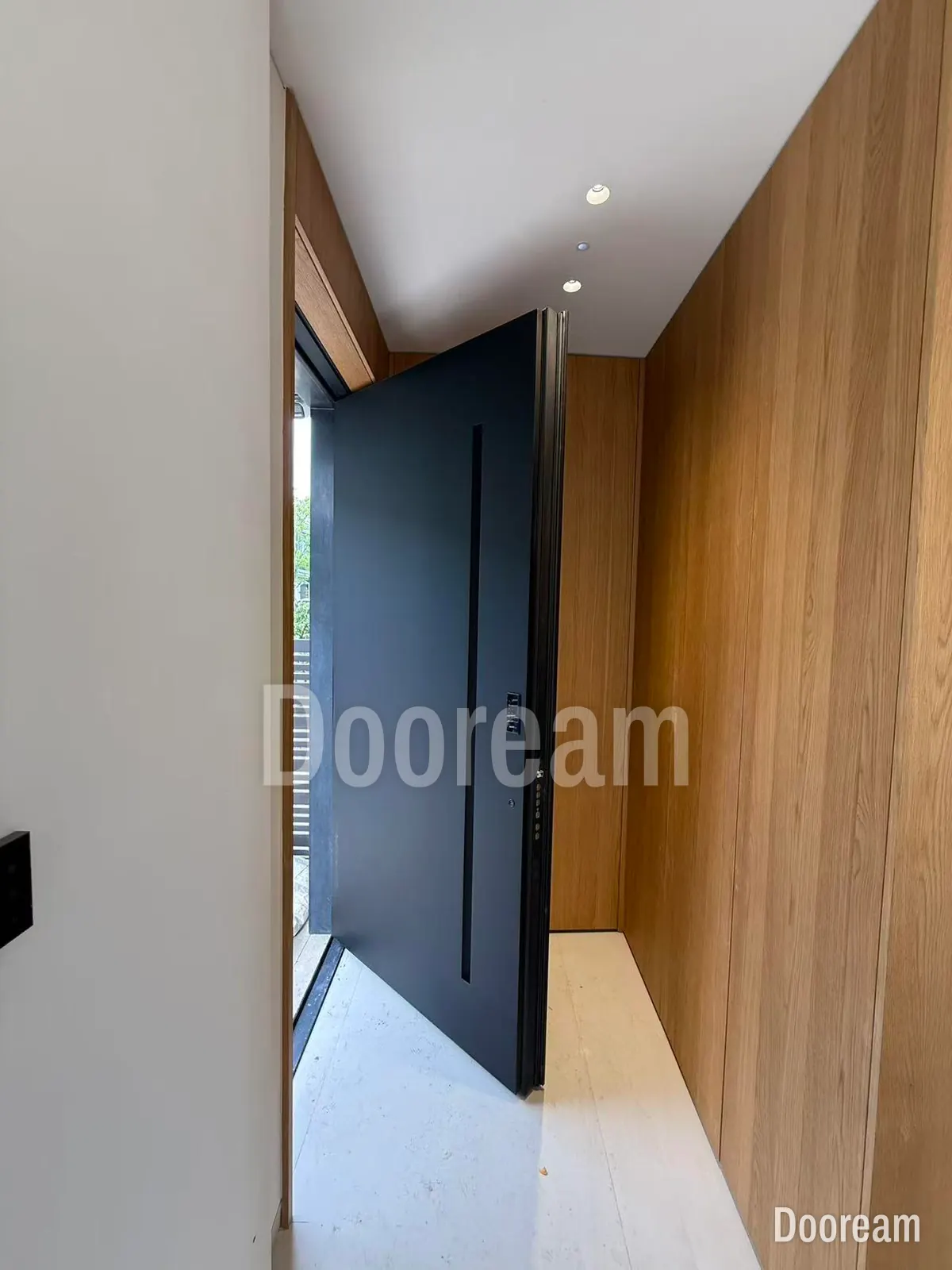
We do not sell separate profiles, frames or sheets, and we do not make interior or fire-rated doors. Each leaf layers a carved or cast aluminium outer face (most are carved; some are cast) over a galvanised steel sheet, an aluminium profile frame with an aluminium honeycomb core, a second galvanised steel sheet, and an inner face. Single, double and unequal double doors run up to 3,000 × 6,000 mm, and offset pivot doors up to 4,000 × 8,000 mm on pivot hinges, most often FritsJurgens. Smart locks include KFV, G-U and Wintech. Most exterior faces use fluorocarbon (PVDF) paint; state any coastal paint or salt-spray specification before drawing approval.

Our thermal-break construction, with PA66 polyamide insulating strips in the aluminium profiles, can be used with any of our designs. We don’t publish a U-value for it; if your project needs one, we can arrange a test for your order, usually at the buyer’s cost. We do not hold EN 1627, hurricane, UL/CSA, AS 2047 or BAL certifications; Saudi SABER product documents are available.
Orders are quoted EXW Wuyi (50% deposit, 50% before shipment), with 35–45 days production after drawing approval and deposit. Local installers fit the door using our installation drawings and remote guidance, backed by a 2-year warranty from shipment. Send drawings and site exposure via our architects page or contact page (see what to send a door manufacturer).
Sources, checked November 2026: ISO, ISO 9223, corrosivity of atmospheres; QUALICOAT UK & Ireland, Seaside specification, and QUALICOAT specifications; Australian Stainless Steel Development Association (ASSDA), Preventing Coastal Corrosion (Tea Staining); British Stainless Steel Association (BSSA), selection of stainless steels for external building applications; BSI Knowledge, BS EN 1670, building hardware corrosion resistance; National Physical Laboratory (NPL), Bimetallic Corrosion (Corrosion Guide No. 5); USDA Forest Products Laboratory, Wood Handbook (FPL-GTR-282); CEN / iTeh, EN 12208 watertightness and EN 12210 wind load.
Quick answers
What is the best front door material for a coastal villa?
For a large coastal villa entrance, a coated aluminium face over a rigid composite armoured core is usually the most practical choice. Fibreglass (GRP) resists salt well at standard residential sizes, Grade 316 stainless steel suits coastal hardware rather than heavy full leaves, and timber needs frequent recoating.
Who makes coastal-grade custom villa front doors?
Three groups build them: regional architectural door fabricators, specialist European luxury entrance door makers, and custom export factories such as Dooream (Zhejiang Jingyi Door Industry Co., Ltd. in Wuyi County, Jinhua, Zhejiang, China), which builds custom aluminium armoured single, double and offset pivot doors to drawing from one door up to 4,000 × 8,000 mm.
What should you specify for a front door near the sea?
Specify the site's coastal exposure class under ISO 9223 (typically C4, C5 or CX), coastal pretreatment such as Qualicoat Seaside with an exterior coating, Grade 316 stainless steel or EN 1670 Grade 5 hardware, bimetallic isolation between dissimilar metals, drained weather seals, and fresh-water rinsing.