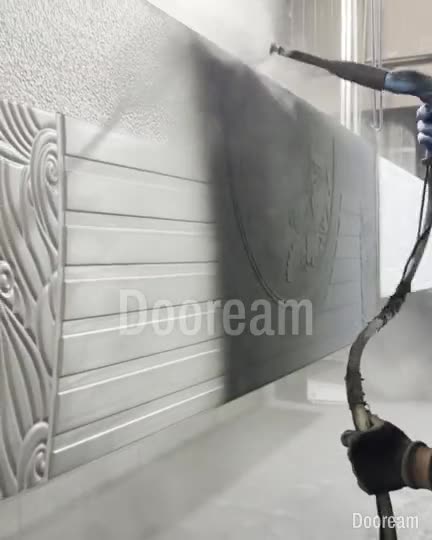
Short answer: collect names from B2B marketplaces, trade fairs, factory websites and referrals, then check who really does the work. Ask each supplier which steps happen in its own workshop (CNC carving, casting, coating, leaf assembly) and have it show each one live on video. Shortlist the makers that answer with numbers and footage, not adjectives.
How do you find a carved or cast aluminium door manufacturer in China?
Start wide, then check hard. Marketplaces and fairs give you many names quickly; factory websites and referrals usually give you fewer, better ones. Then confirm that each company carves or casts, coats and builds the door itself, at your size and in your construction.
| Where to look | What it gives you | Trade-off |
|---|---|---|
| B2B marketplaces, such as Alibaba.com and Made-in-China.com | Dozens of suppliers in an afternoon | Factories and traders side by side; photos are easy to copy |
| Canton Fair, Guangzhou | Many exhibitors in one place; samples you can touch | A booth shows samples, not the workshop |
| China (Yongkang) International Door Industry Expo | Doors, locks and door hardware, in the door-making town itself | Three days a year; you still have to filter for carved and cast aluminium |
| Factory websites | Process photos, models, the company name | Anyone can publish one; check the name in the register |
| Referrals from architects, dealers and installers | A maker someone has received doors from | Few names; one project’s match may not suit yours |
Marketplace badges. On Alibaba.com, a Verified Supplier badge means the seller paid for an on-site audit of more than 100 items by SGS or TÜV Rheinland. It shows that a site was audited, not that a listed door was made there.
The Canton Fair runs twice a year in Guangzhou, from mid-April and from mid-October, each session in three phases. Building & Decorative Materials is in Phase 2: 23–27 April 2026 at the 139th fair, 23–27 October 2026 at the 140th. Check the exhibitor list and the 2027 dates on the fair’s website before booking.
Where are China’s door makers concentrated?
Around Yongkang, in Jinhua, Zhejiang province. China Daily calls Yongkang the “Door Capital of China” and reported in 2023 that it was home to more than 500 large door manufacturers making 37 million doors a year. Wuyi County, where our factory is, adjoins it; Yongkang and Wuyi form one built-up area.
The door expo is held there each year in late May; the 15th edition opened on 26 May 2025 and ran for three days. But Yongkang is known as a national base for anti-theft doors, so do not assume a maker there carves or casts aluminium. Ask.
How do you tell a factory from a trading company?
By what it can show you, not by what it says. A factory can show a business scope that covers making doors, its own CNC machines carving a face today, its coating line and a part-built leaf, live, on one call. A trading company can show samples, not your door being made.
- Business scope. Every Chinese company’s licence lists a business scope (经营范围), and its activities must fall within it. An exporter needs “import and export” in its scope; a maker should also list door manufacturing. Sales and import and export alone is a trading registration.
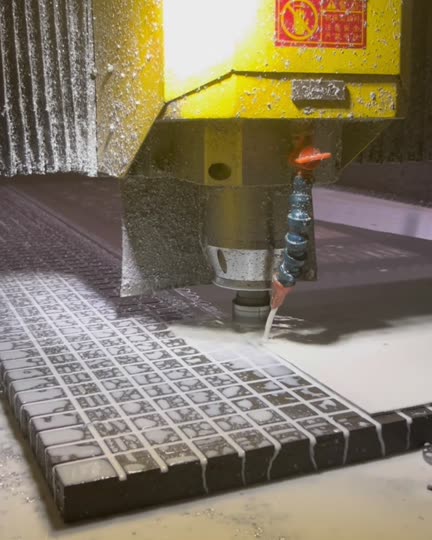
- Own CNC carving. Ask to see a machine running, the part on it, and which order it is for.
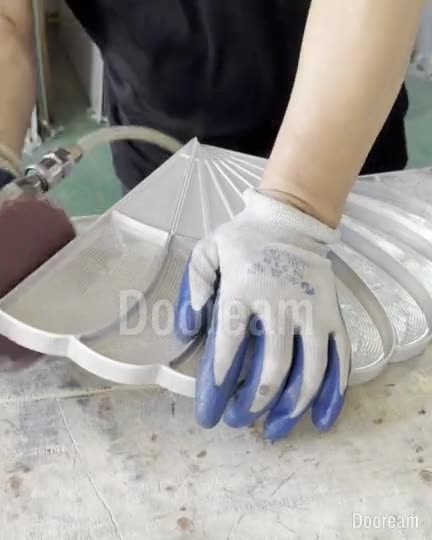
- Own finishing line. The spray booth, parts drying, and faces being sanded by hand before coating.
- A live tour of each process, unbroken, from raw plate to crate. Use the shot list in what to ask on a video factory tour.
A trading company is not wrong in itself, but you should know who builds your door. Register and bank checks are in how to check a Chinese door factory before you pay a deposit.
What should you check on a carved or cast face?
Who makes it, how deep it is, how it is finished and what it is fixed to. A carved face is cut from solid aluminium plate by a CNC machine following a 3D file; a cast face is poured into a mould. Either can be good, but the questions differ; see cast or CNC-carved faces.
- Who carves. Own machines, or a carving shop elsewhere? If bought in, who checks the relief before coating? See how CNC-carved aluminium doors are made.
- Who casts. Casting may be done on site or bought in from a foundry; either can be normal. Ask who makes the pattern and mould, how long a new one takes, and who owns it after your order.
- Relief depth. A number in millimetres on the drawing, not “deep”. A thicker face makes a heavier leaf, so get the leaf weight before the pivot or hinges are chosen.
- Finish line. Which coating system, applied where, and is the colour approved on a physical sample of the real face? See which samples to ask for.
- Joints. One piece or several panels, and where do the joints fall?
- Armoured core. The face is decoration; the leaf behind it carries the lock and the loads. Ask for every layer, outside to inside, and a part-built leaf on camera.
Which questions should you send each maker?
Send the same list to every supplier, in writing.
- Which steps of my door happen in your own workshop, and which are bought in?
- What is your registered Chinese company name, and what does your business scope say?
- Can you show me a face being carved or cast, live, on a video call?
- Will my face be carved or cast? If cast, who makes and owns the mould, and how long does it take?
- What relief depth is on the drawing, and what will the finished leaf weigh?
- What is the leaf made of, layer by layer, from outside to inside?
- Which coating system do you use, and is it applied in your own booth?
- What are your largest pivot, double and single doors, in millimetres?
- Which pivot hinge and lock brands do you fit, and what leaf weight is the hinge rated for?
- Which samples can I have, and are they made with the real face, finish and construction?
- How long is production, and from which event does it start?
- What will I see before shipment, and can my inspector check the door at the factory?
How do you compare makers on a shortlist?
Mark each maker against the same rows. A good answer is specific and can be shown on camera or on a drawing. A warning sign stays vague, changes between messages or cannot be shown.
| What to ask | Good answer | Warning sign |
|---|---|---|
| Who carves the face? | “Our machines”; the face shown on the machine, live | “Our partner does it”; no footage |
| Who casts it? | Says whether in-house or bought in; gives the mould time and owner | Treats cast and carved as the same thing |
| Relief depth and leaf weight | Numbers in millimetres and kilograms | “Very deep”, “heavy-duty” |
| Coating | System named; booth shown; sample in that finish | Colour approved from photos only |
| Leaf construction | Every layer named; part-built leaf shown | Will not show the inside |
| Maximum size | A figure per door type, with the hinge named | “Any size” |
| Ratings and tests | The report for the complete door, or a plain “none; testing can be arranged” | A certificate in another company’s name or for another product |
| Before shipment | Photos, video and your inspector allowed | Refuses an inspection |
Which red flags should take a maker off the list?
- Only the showroom or office ever appears on video.
- The business scope covers only sales and import and export, but the supplier calls itself the factory.
- The same door photos appear under several company names.
- Test evidence for another product, size or company. If your project needs a security, fire, wind or thermal rating, check what your jurisdiction requires and ask for evidence on the complete door.
- Full payment before production, or a personal bank account. The deposit checks take about an hour.
How does this work with Dooream?
Dooream is the export brand of Zhejiang Jingyi Door Industry Co., Ltd., a family door factory in Wuyi County, Jinhua, Zhejiang. We make complete armoured aluminium entrance doors only: offset pivot doors up to 4,000 × 8,000 mm, with pivot hinges, most often FritsJurgens; double and unequal double doors up to 3,000 × 6,000 mm; and single doors. Carved aluminium is the face we make most, as on Contour and Facet Light; we also build doors with cast aluminium faces, such as Lattice. Behind the face: a galvanised steel sheet, an aluminium profile frame with aluminium honeycomb core, a second galvanised steel sheet and the inner face. Our doors have no EN 1627 rating and we do not make fire-rated doors; testing can be arranged, usually at the buyer’s cost. We make to drawing from one door, also under a dealer’s own brand (OEM). The first design direction is free, usually within one working day; a 20 × 20 cm carved and painted sample or a scaled construction sample can come first. Production takes 35–45 days after drawing approval and deposit, with photos and video before shipment; see ordering custom doors from China. Send us these questions from our dealers page or contact page.
Sources, checked November 2026: China Daily, 15th China (Yongkang) International Door Industry Expo (27 May 2025) and Yongkang door fair (29 May 2023); Wikipedia, Yongkang, Zhejiang; Ministry of Commerce of China, 140th Canton Fair phases and dates; JETRO J-messe, 139th Canton Fair, Phase 2 and Phase 1; Alibaba.com, what is a Verified Supplier; China Briefing, examining a Chinese company business licence; China Justice Observer, business scope in company verification.
Quick answers
How do I find a carved or cast aluminium door manufacturer in China?
Collect names from B2B marketplaces, trade fairs such as the Canton Fair (Building & Decorative Materials is in Phase 2) and the door expo held in Yongkang each May, factory websites and referrals. Then keep only the companies that show CNC carving or casting, coating and leaf assembly in their own workshop on a live video call.
How can I tell a door factory from a trading company?
Read the business scope on its licence, which must cover what it does, and look for door manufacturing, not only sales and import and export. Then ask for a live, unbroken video call showing its own CNC machines carving a face, its coating line and a part-built leaf. A trading company can show samples, not your door being made.
What should I ask about a carved or cast door face?
Who carves or casts it, and whether that is done in-house or bought in; for a cast face, who makes and owns the mould and how long it takes. Ask for the relief depth in millimetres, the finished leaf weight, the coating system and where it is applied, and every layer of the leaf behind the face.