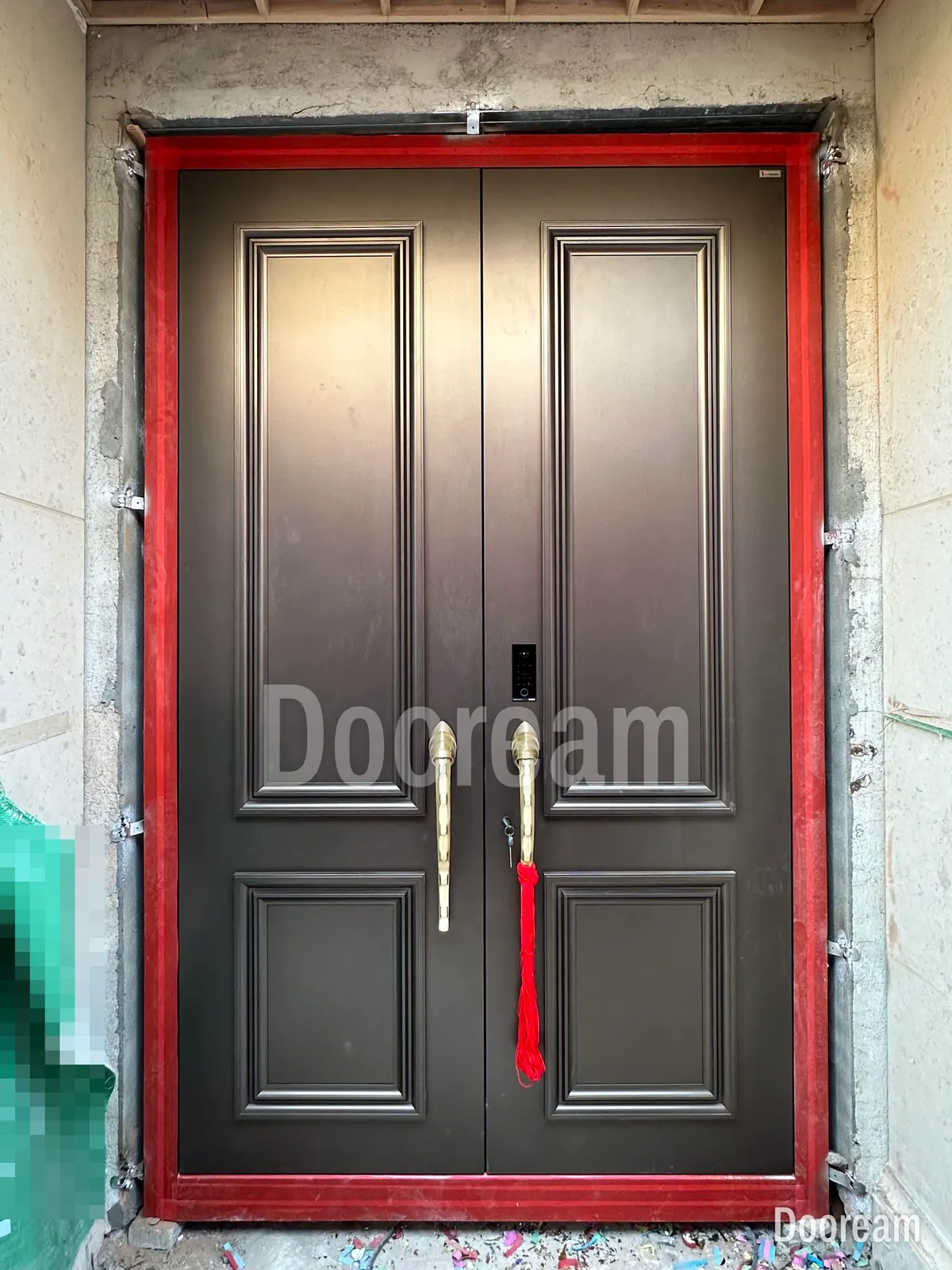
Short answer: a whole-door U-value that meets the local rule, from 1.8 W/m²K in Germany to 0.40 for an arctic Passive House door, and no cold spot on the room side. That takes thermal breaks in frame, leaf edges and threshold, seals that close in a frost, a sill that cannot ice up and an airtight wall joint.
What U-value does a front door need in a cold climate?
There is no single figure: each country sets its own, and lower is better. In cold regions the limits run from 1.8 W/m²K for a new door in an existing German building to 0.40 W/m²K for an arctic Passive House door. Compare only the whole-door value, Ud, at the size the rule sets.
| Region and rule (edition) | Applies to | Max Ud, W/m²K |
|---|---|---|
| England, Approved Document L, Vol. 1 (2021) | Doors in new dwellings | 1.6 |
| England, as above | New or replacement doors, existing dwellings | 1.4 |
| Germany, GModG Anlage 7 (the GEG, renamed 29 July 2026) | New external doors in existing buildings | 1.8 |
| Switzerland, SIA 380/1:2016 (EnDK leaflet, 2021) | Doors to outside air | 1.2 |
| Norway, TEK17 § 14-3; § 14-2 prescriptive route | Windows and doors: minimum level; housing | 1.2; 0.80 |
| Canada, NBC 2025 | Set by climate zone | See our Canada guide |
| Passive House, cool-temperate / cold / arctic (criteria v5.6, 2025) | Entrance door, 1.10 × 2.20 m | 0.80 / 0.60 / 0.40 (installed 0.85 / 0.65 / 0.45) |
Passive House reference glazing is Ug 0.52 W/m²K (cold) and 0.35 (arctic), in practice triple glazing. In Europe, EN 14351-1 makes the U-value a declared characteristic of external doorsets, calculated or measured (U-value guide).
Why does aluminium need a thermal break, and how does the strip work?
Because aluminium carries outdoor cold straight to the room face. A thermally broken profile is two aluminium halves joined by glass-fibre reinforced polyamide strips, which Technoform rates at 0.30 W/mK. The strip cuts the heat path, but it must also hold the two halves together as one beam.
Technoform’s method: knurl the grooves in each half sharply, since knurling sets the shear strength; slide the strip in; roll the groove lips into its head. EN 14024 sets the mechanical requirements. In 1960 Canada’s National Research Council called thermal breaks “absolutely necessary” in metal frames with multiple glazing (thermal breaks).
Where are the cold spots on an entrance door?
Wherever metal crosses the insulation or the seal line is broken: the frame, the threshold, the glass edges, the lock and keeps, the hinges or pivots, the meeting stiles of a double door and the joint with the wall. In a frost, condensation and ice show there first.
| Cold spot | Why it gets cold | Fix |
|---|---|---|
| Frame | Aluminium runs from outside to inside | Polyamide strips in every profile |
| Threshold | Low, load-bearing, on a cold slab, often wet | Thermally separated sill on load-bearing insulation |
| Glass edges | The spacer bridges the panes | Warm-edge spacer |
| Lock and keeps | Steel lock case and bolts cross leaf and frame | Insulated lock pocket; keeps on the warm side of the break |
| Hinges and pivots | Fixings and plates reach the cold zone | Fixings that do not bridge the break |
| Meeting stiles | Two leaf edges, an astragal, flush bolts | Thermally broken meeting profiles; seals run to head and sill |
| Frame-to-wall joint | Gaps and air leaks | Insulated, airtight joint |
How cold does the inside face get, and how humid can the house be?
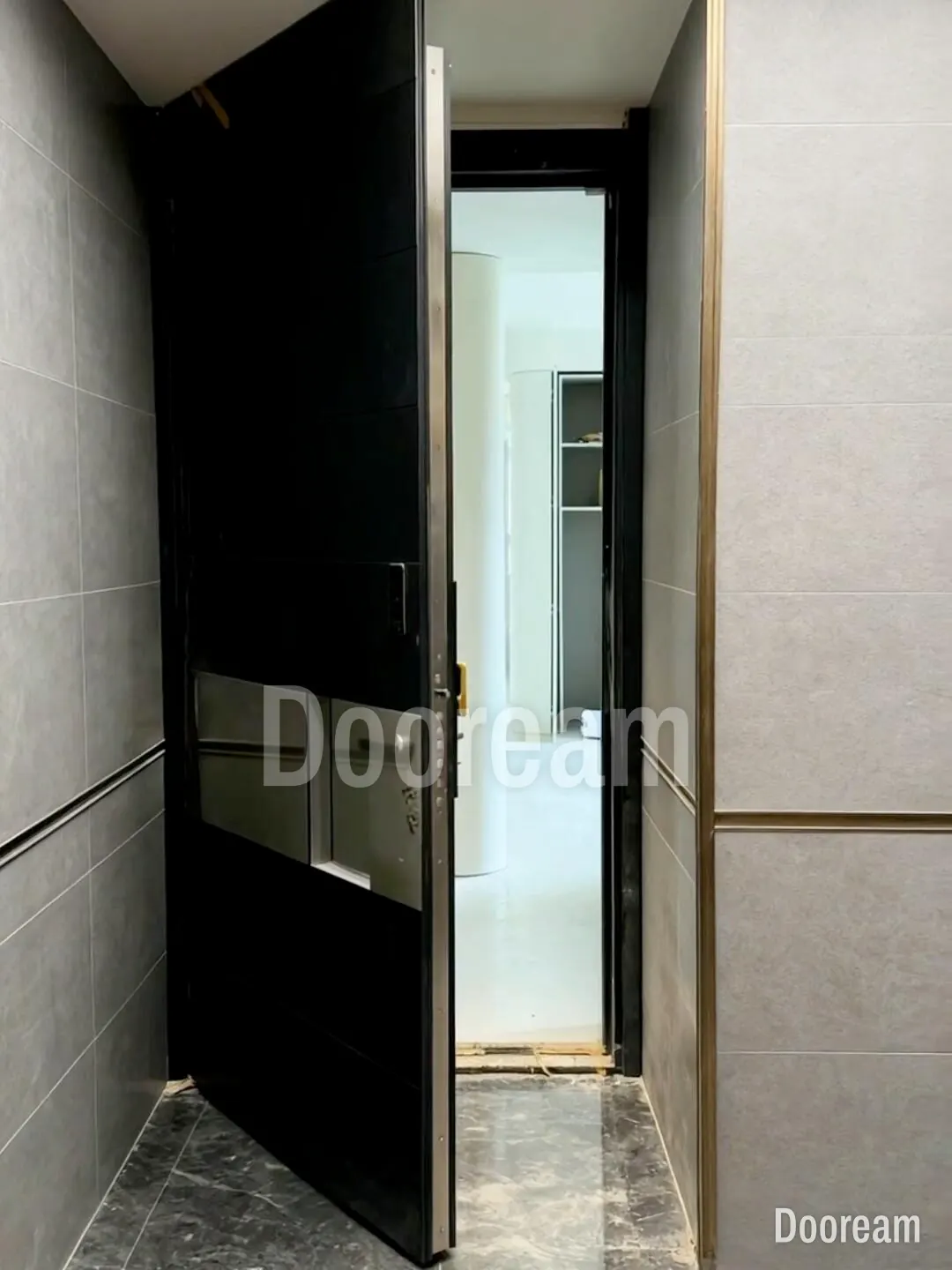
The temperature factor fRsi places the coldest inside surface between outdoor (0) and indoor (1) temperature. Passive House asks for at least 0.70 in cool-temperate, 0.75 in cold and 0.80 in arctic climates, with a dew-point check at thresholds instead. The colder the night, the drier the house must be.
Our calculation (Magnus formula, 20 °C hall): surface temperature, then the highest indoor humidity at which it stays dry.
| fRsi | −10 °C outside | −20 °C outside | −30 °C outside |
|---|---|---|---|
| 0.50 | 5.0 °C, 37% RH | 0.0 °C, 26% RH | −5.0 °C, frost above 17% |
| 0.75 | 12.5 °C, 62% RH | 10.0 °C, 53% RH | 7.5 °C, 44% RH |
| 0.80 | 14.0 °C, 68% RH | 12.0 °C, 60% RH | 10.0 °C, 53% RH |
Below 0 °C moisture arrives as frost, which can freeze a leaf to its frame. The NRC’s 1960 digest shows the trend for double glazing, 21 °C inside, in a 24 km/h wind: dry to 41% RH at −18 °C, 23% at −40 °C (condensation).
How do seals behave in winter?
Rubber stiffens and recovers more slowly as it cools, and the leaf moves, so a seal that closes the gap in autumn can leave one in January. Choose material and compression range for the coldest night, use two seal lines and drain the outer one, so water cannot freeze in the rebate (seals guide).
- EPDM. BAM, Germany’s materials-testing institute, puts its glass transition near −60 to −50 °C; in a 2013 test, EPDM seal leakage rose sharply only at about −63 °C.
- Silicone. NETZSCH puts it at −135 to −120 °C, so it stays flexible far below any weather.
- Compression set. A seal with a permanent set no longer fills the gap; ISO 815-2:2019 measures it at low temperatures.
- Under climate load. Passive House tests entrance-door air leakage with a climate difference across the door: at most 2.25 m³/(h·m) at 100 Pa, EN 12207 class 3.
What happens to the leaf when it is warm inside and freezing outside?
It bows. The warm inner face grows longer than the cold outer face, so the middle of the leaf moves towards the room and its corners move outwards, the reverse of a summer bow. Seals then open at some corners and are crushed at others.
EN 12219 adds climate d, −15 °C on one face, for external doors; in Arbonia’s summary, class 3 allows 2.0 mm of longitudinal curvature, class 1 8.0 mm. Low sun on a dark face can reverse the bow within a day. Locking points at top and bottom hold the corners (multipoint locks, bowing).
Why do thresholds ice up and locks freeze?
Melt water, driven snow and condensation collect at the sill and freeze under the drop seal, in drain slots and in the keeps. Ice then binds the leaf, stops the bolts and lifts the seals, so the sill needs warmth and drainage.
- Separate the sill thermally, on load-bearing insulation, not the cold slab.
- Keep it low: Passive House allows threshold profiles of at most 20 mm, citing DIN 18040.
- Drain outwards; slope the outside floor away.
- Add a canopy over sill and cylinder.
- Check the pivot floor plate, in the coldest zone (underfloor heating, threshold leaks).
Do smart locks and their batteries work in the cold?
Batteries are the usual weak point. Energizer rates its alkaline AA cell from −18 to 55 °C and its lithium iron disulfide AA cell from −40 to 60 °C. Batteries in the inside escutcheon stay near room temperature. Ask for each lock’s operating range.
Wired systems avoid batteries: G-U’s GU-SECURY Automatic with A-opener runs on 12 V AC or 12–24 V DC and is rated IP40, with no protection against water, so keep condensation out of the door. Keep a mechanical key (smart locks).
Which installation details matter most?
The joint between frame and wall. Teroson, citing the RAL installation guideline, describes three levels: airtight on the room side, insulated in the middle, and weather-tight outside while letting moisture out, “inside tighter than outside”. A good door still fails if this joint leaks.
- Fill the gap, with no voids behind fixing straps.
- Tape it airtight on the room side, to the wall’s air barrier.
- Set the frame in line with the wall insulation.
- In winter, check the minimum application temperature of foams and tapes (installing a pivot door).
Is a vestibule worth it?
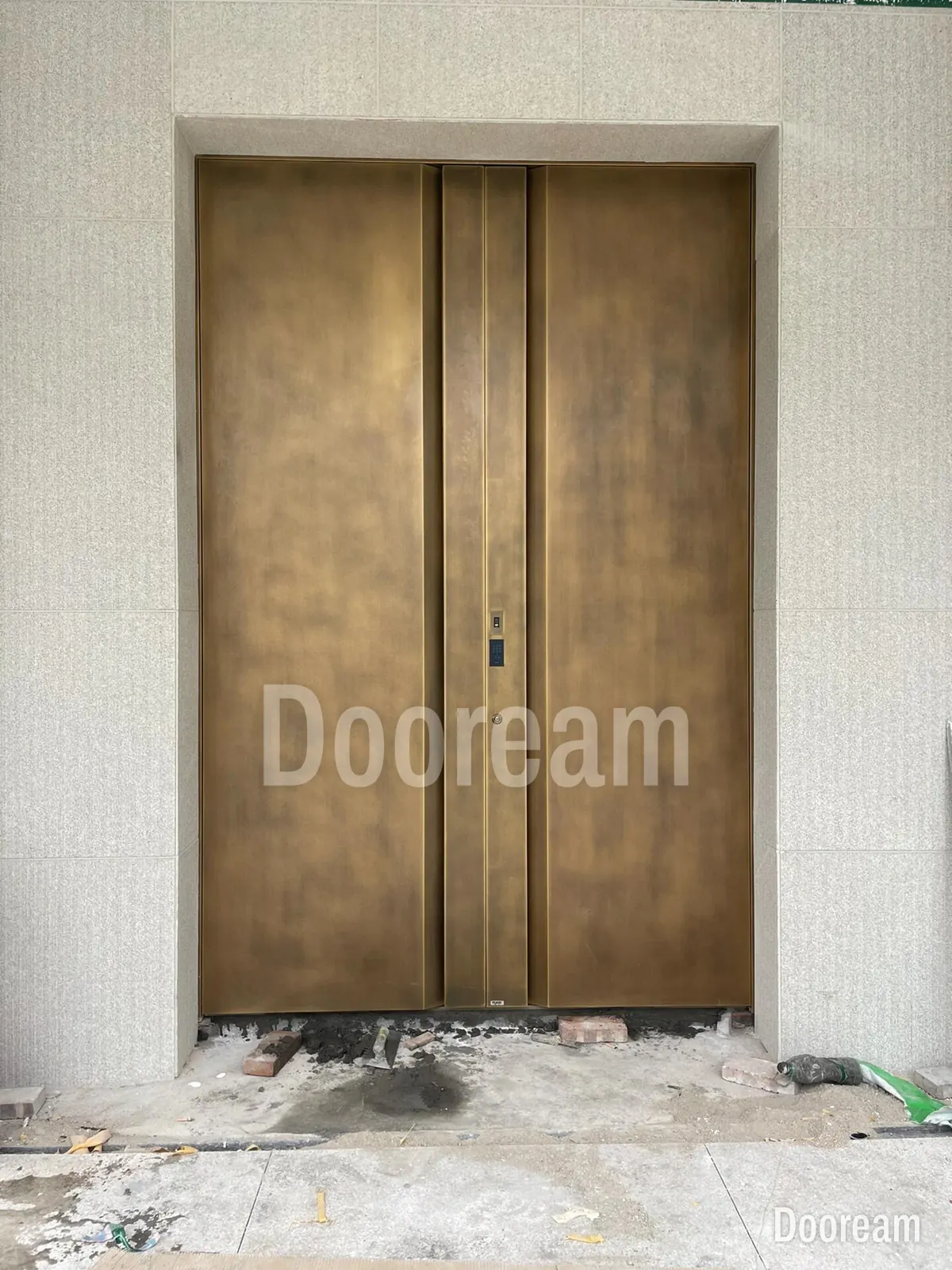
Yes, at a busy or exposed entrance: the house is never open straight to outdoor air, and with an unheated lobby each door sees a smaller temperature difference. The US commercial code, the IECC, requires them at most public entrances outside climate zones 1 and 2, but not on doors straight into a dwelling, where a porch does the job.
What should a cold-climate door specification include?
The design conditions, then figures for the door’s weakest points, not just its U-value, because condensation, ice and draughts start at the worst detail. Get each in writing for your door’s size, glass and configuration, and agree any tests before production.
- Design conditions: outdoor and indoor temperature, winter RH.
- The rule, and a Ud report for your door’s size and glass.
- Thermal breaks in frame, leaf edges, threshold, meeting stiles.
- fRsi at lock, threshold, corners and glass edge.
- Glass Ug and spacer.
- Seal materials, compression range, low-temperature compression set.
- Air leakage class, ideally tested under a climate difference.
- EN 12219 class, or an agreed maximum bow.
- Lock power, battery type and position, mechanical key.
- Three-level joint, insulated sill support, canopy or vestibule.
How does this work with Dooream?
Every door is built to the buyer’s drawing. Our thermal-break construction, with PA66 polyamide insulating strips in the aluminium profiles, reaches a U-value of 1.0 W/m²K in our test report, and any of our designs can be built with it. It is an option: specify it for a cold site, and ask for a copy of the report through our contact page. We have no Passive House certification, no NAFS or CSA test and no UK or EU energy label; lab testing can be arranged, usually at the buyer’s cost. We fit KFV, G-U and Wintech smart locks, and your local installers fit the door with our installation drawings and remote guidance.
Sources, checked November 2026: British Woodworking Federation, updated U-value requirements for new build and existing dwellings (2023) and external doorset characteristics (2024); Pilkington, existing dwellings, England; Bundesamt für Justiz, GModG Anlage 7; Gleiss Lutz, Germany's new Building Modernisation Act (August 2026); EnDK, Merkblatt Fenster (2021); Direktoratet for byggkvalitet, TEK17 § 14-3 and tiltaksmetoden; Passive House Institute, certification criteria for transparent components, version 5.6 (2025); Technoform, assembling polyamide insulating strips and quality documents; A. G. Wilson, National Research Council of Canada, CBD-4, condensation on inside window surfaces (1960); Jaunich, Wolff and Stark, BAM, investigating low temperature properties of rubber seals (WM2013); NETZSCH, silicone rubber; ISO, ISO 815-2:2019; Arbonia, climate stability (EN 12219); Energizer, L91 and E91 data sheets; G-U, G.U-SECURY Automatic with A-opener instructions; Teroson, window and door connection joints; L. Greene, iDigHardware, IECC requirements for vestibule doors (2020).
Quick answers
What U-value does a front door need in a cold climate?
It depends on the rule. Approved Document L in England limits doors to 1.6 W/m²K in new homes and 1.4 for new or replacement doors in existing homes. Germany allows 1.8 for new external doors in existing buildings, Switzerland's SIA 380/1 component limit is 1.2, and Norway's TEK17 sets 1.2 as a minimum and 0.80 in its prescriptive route. Passive House asks 0.80 in cool-temperate, 0.60 in cold and 0.40 in arctic climates.
Why does an aluminium front door need a thermal break in winter?
Aluminium carries the outdoor cold straight to the room side, so the inside of an unbroken frame can fall below the dew point of the room air and run wet or ice up. Polyamide strips rolled into the profile separate the outer and inner aluminium. Passive House asks for a temperature factor fRsi of at least 0.75 in cold climates and 0.80 in arctic ones.
Do smart locks work on a front door in freezing weather?
Check how each lock is powered. Energizer rates its alkaline AA cells from −18 to 55 °C and its lithium iron disulfide AA cells from −40 to 60 °C, so the battery type and where the batteries sit both matter. Wired systems such as G-U's A-opener run on a 12 V AC or 12–24 V DC supply instead. Every entrance door also needs a mechanical way in.