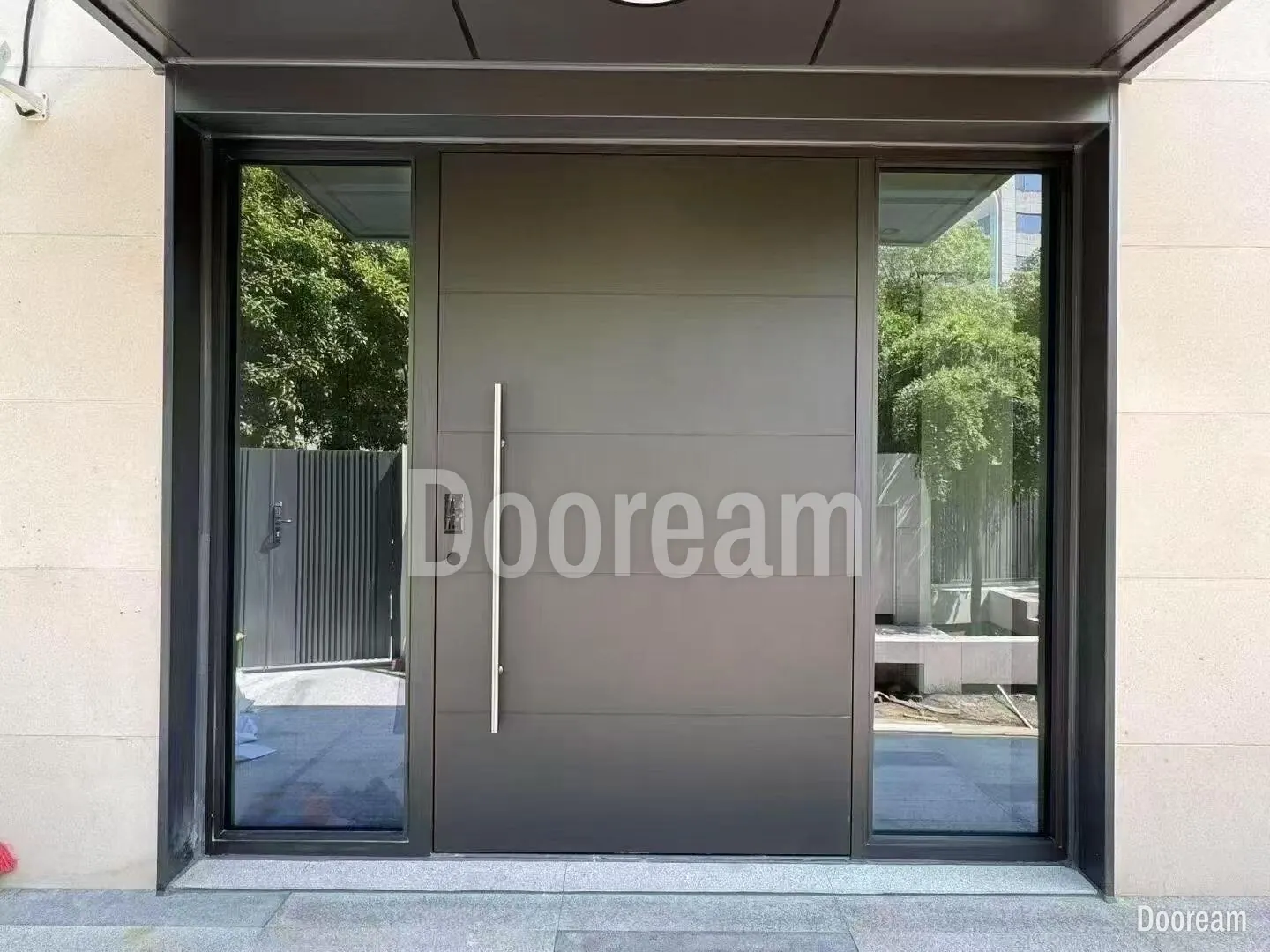
Short answer: in strong sun a door face runs tens of degrees above the air temperature, and aluminium grows as it heats. Shade the door first, then specify a light or “cool” colour, a thermal break, heat-rated seals and smart lock, clearances for movement, and solar-control glass.
How hot does a front door get in the sun?
Much hotter than the air, and more so the darker it is. For a summer afternoon in full sun, Lawrence Berkeley National Laboratory (LBNL) puts a grey surface that reflects 20% of sunlight about 38 K above the air, one reflecting only 10% about 44 K, and a clean white one about 5 K.
Those are roof figures. A vertical door gets less sun at midday, but one facing east or west takes low sun almost head-on for hours. Even at half the roof figure, a grey face passes 60 °C on a 45 °C afternoon; for Gulf summer temperatures, see villa entrance doors.
How much does an aluminium door grow in the heat?
About 1.2 mm per metre for every 50 K it warms. Hydro’s data sheet for the extrusion alloy EN AW-6063 gives a linear expansion coefficient of 23.5 × 10⁻⁶ per kelvin, so a 3,000 mm aluminium part that warms from 25 °C to 75 °C grows by 23.5 × 10⁻⁶ × 3,000 mm × 50 K ≈ 3.5 mm.
| Length of aluminium part | 30 K warmer | 50 K warmer |
|---|---|---|
| 3,000 mm | 2.1 mm | 3.5 mm |
| 6,000 mm | 4.2 mm | 7.1 mm |
| 8,000 mm | 5.6 mm | 9.4 mm |
A face bonded to a cooler core cannot grow freely, so the leaf bows instead.
- Gaps. A sunlit leaf moves more than a shaded frame, and a frame more than the wall; ask what temperature range the clearances and frame-to-wall joint were drawn for.
- Seals. A compression seal works over a set range of gap: beyond it, dust and air get in; below it, the door is stiff to close.
- Locks. A grown or bowed leaf can bind on its keeps; a multipoint lock holds it at several points. Set the keeps with the air-conditioning running, then recheck on a hot afternoon.
What happens when the outside is hot and the inside is air-conditioned?
Heat flows in, and the leaf tries to bow. Heat flow is roughly U-value × area × temperature difference: for a 2 × 3 m door with its face at 75 °C and the hall at 25 °C, each 1.0 W/m²K of U-value lets in about 300 W while the sun is on it.
A thermal break between the outer and inner aluminium profiles stops the frame carrying that heat straight in; see thermal breaks and door U-values.
The same difference bends the leaf: with the outer skin at 75 °C and the inner at 25 °C, one face of a 3,000 mm leaf tries to be 3.5 mm longer than the other, so it bows outwards unless built to stay flat. See tall doors, bowing and warping.
On humid coasts, condensation can form outside: a King Fahd University of Petroleum and Minerals study describes it on the outside of windows as a problem for air-conditioned buildings in hot, humid climates. Chilled metal can sweat too; a thermal break keeps the outer metal near outdoor temperature.
What should you specify for glass in or beside the door?
Specify its solar heat gain coefficient (SHGC): the share of the sun falling on the glass that enters as heat, so lower is better in a hot climate. Europe uses the similar g-value (total solar energy transmittance) from EN 410. For every 100 W of sun on it, SHGC 0.6 lets in about 60 W, SHGC 0.25 about 25 W.
- ENERGY STAR (US, version 7.0, since 23 October 2023) caps SHGC at 0.23 for doors up to half glass, and in its South-Central and Southern zones for doors with more glass.
- Spectrally selective low-e coatings filter out 40 to 70% of the heat normally transmitted through insulated glass while keeping visible transmittance high, says the US Department of Energy.
- Ask for the whole-product SHGC, counting sidelights and transoms. In Australia, see also AS 2047 and imported entrance doors.
Which colour and finish suit strong sun?
A light colour runs coolest: LBNL puts a clean white surface reflecting 80% of sunlight about 31 °C cooler than a grey one reflecting 20%. For a dark door, ask for “cool” pigments. They reflect more of the invisible near-infrared light, which carries about half of the sun’s energy, without changing the colour you see.
A cool colour reflecting 35% of sunlight stays about 12 °C cooler than a look-alike reflecting 10%, LBNL says, so ask for your colour’s measured solar reflectance. UV fades colour and dulls gloss: compare coatings in our powder, PVDF and anodising guide, and set colour and gloss limits.
How do heat and dust affect seals and smart locks?
Seals on a sunlit face work hot, so specify them by class. EN 12365-1 classifies door gaskets and weatherstrips of any material with a six-part code. One digit grades the working temperature, from 1 (0 to 45 °C) to 6 (0 to 200 °C); another grades recovery after ageing.
- Seals. On a sunlit face, use grade 3 (−20 to 85 °C), 4 (−25 to 100 °C) or 6; grades 1, 2 and 5 stop at 70 °C or below. Parker describes its EPDM compound E0540-80 as ozone, ageing and weather resistant, for −57 to 121 °C.
- Smart locks. Check the outside unit’s operating temperature range against the face temperatures above, shade the reader and keep a mechanical key; see smart locks on large doors.
- Sand and dust. Grit wears seals, bolts and pivots: use replaceable seals and a cleanable threshold, and wash the face. In LBNL’s figures, a white roof that ran 5 K above the air ran 16 K above it after three years of exposure.
Why does shade matter more than any material?
Because it removes the cause. A door in full shade gets no direct sun, so it stays much closer to the air temperature whatever its colour, and its finish, seals, lock and glass all gain at once. No single material choice does that.
A canopy at the door head shades a door of height H when it projects at least H ÷ tan A, where A is the sun’s height above the horizon, measured square to the façade. For a 3,000 mm door: 0.8 m at 75°, 1.7 m at 60°, 3.0 m at 45° and 5.2 m at 30°.
- Midday sun is high, mostly from the south in the Gulf and the north in Australia; a modest canopy stops it.
- Low east and west sun gets under any practical canopy; west is worst, as that sun comes with the day’s hottest air.
- Side walls stop slanting sun: a recess as deep as the door is wide shades it once the sun is more than 45° to one side. For low sun straight on, use a screen, planting or a deeper porch.
What should a hot-climate door specification cover?
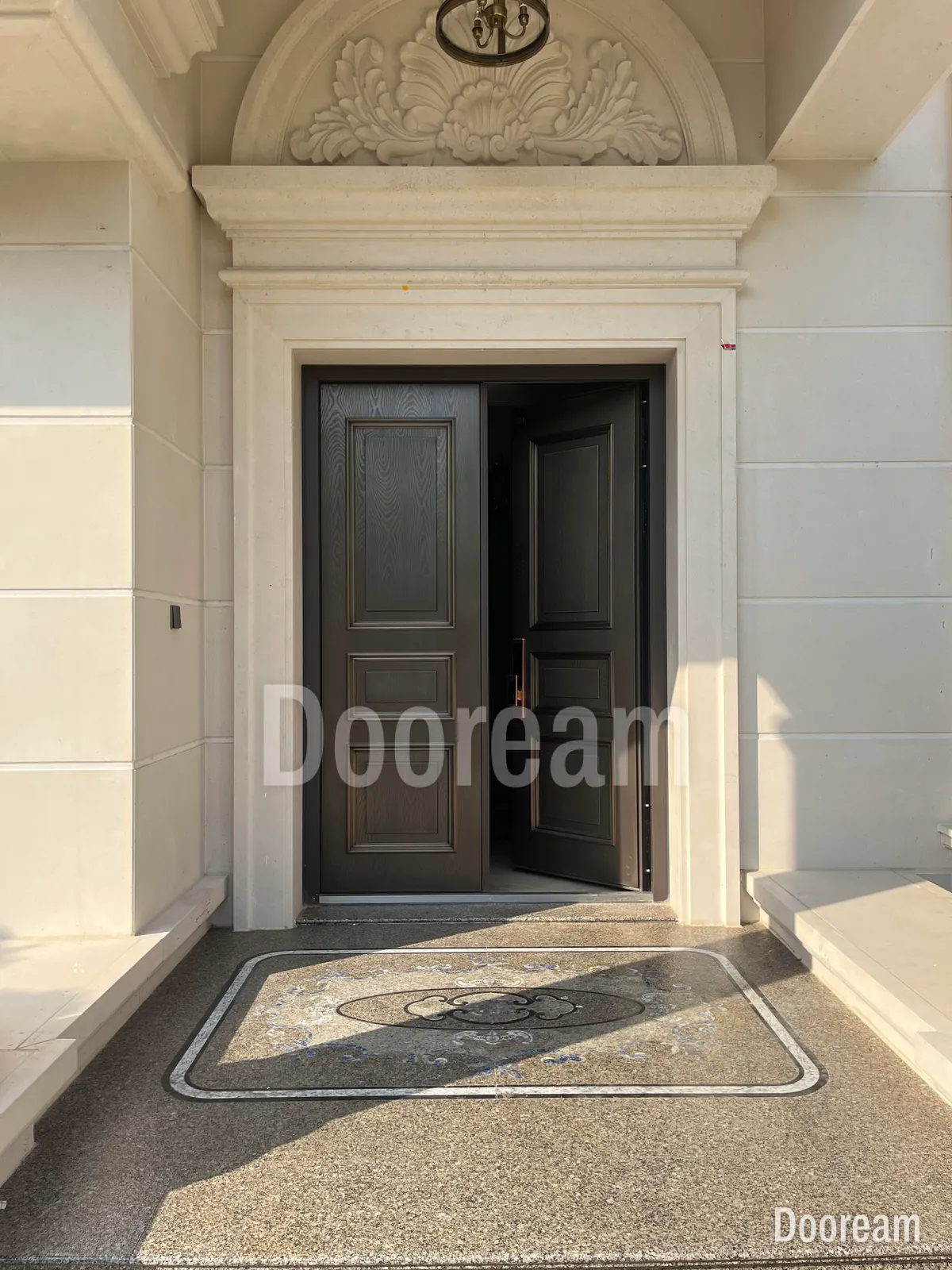
Every effect of heat, each tied to a figure the manufacturer can confirm: design face temperature, movement, U-value, glass SHGC, seal grade and the lock’s operating range. The table pairs each effect with what to specify; the checklist is the short form.
| What heat does | Effect on the door | What to specify |
|---|---|---|
| Sun and UV on the face | Fading, gloss loss, movement | Shade; light or cool colour; tested coating; colour and gloss limits |
| Expands aluminium | About 3.5 mm in 3 m at 50 K | Clearances, seal range and wall joint drawn for it |
| Hot outside, cool inside | Heat gain, bow, condensation on humid coasts | Thermal break; U-value report; allowed bow; multipoint lock |
| Sun through glass | Heat and glare indoors | Solar-control low-e glass; low product SHGC; shade |
| Heat and UV on seals | Poor recovery, leaks | EN 12365-1 grade 3, 4 or 6; replaceable seals |
| Heat on electronics | Lock or reader faults | Rated operating range; shaded reader; key |
| Sand and dust | Worn seals, gritty bolts | Replaceable seals; cleanable threshold |
- Orientation, hours of sun, canopy or recess depth.
- Face colour and its measured solar reflectance; cool pigments if dark.
- Coating test class, colour and gloss limits, approved sample.
- Design face temperature, with clearances, seals and wall joint drawn for the movement.
- Thermal break, whole-door U-value report, allowed bow in millimetres.
- Multipoint lock, keeps set with the air-conditioning running.
- Replaceable seals to EN 12365-1, grade 3, 4 or 6; a cleanable threshold.
- Glass: product SHGC, visible transmittance, safety glass to local rules.
- Smart lock: operating range, shaded reader, mechanical key.
- Tests and documents the project needs, and who pays.
How does this work with Dooream?
Our thermal-break construction, with PA66 polyamide insulating strips in the aluminium profiles, reaches a U-value of 1.0 W/m²K in our test report, and any of our designs can be built with it. It is a construction option, not on every door; ask us for a copy of the report. Most of our doors are finished in fluorocarbon (PVDF) paint. If a project specifies a test, we can arrange third-party testing, usually at the buyer’s cost, and we provide SABER product documents for Saudi Arabia. Every door has a two-year warranty from shipment. Send the opening size, orientation and a photo through our contact page, or see villa doors for Saudi Arabia and the UAE.
Sources, checked November 2026: Lawrence Berkeley National Laboratory, Heat Island Group, cool roofs, and R. Levinson, cool roof Q&A (draft, July 2009, US Department of Energy site, archived); Hydro, EN AW-6063 technical data sheet (rev. 4, March 2023); El Diasty and Budaiwi, King Fahd University of Petroleum and Minerals, external condensation on windows (Construction and Building Materials, 1989); ENERGY STAR, Version 7.0 windows, doors and skylights specification; US Department of Energy, Building Science Education Solution Center, types of windows; EN 410:2011; EN 12365-1:2003 and Schlegel, EN 12365 seal classifications; Parker, EPDM compound E0540-80.
Quick answers
How hot does a front door get in the sun?
Much hotter than the air. For a summer afternoon in full sun, Lawrence Berkeley National Laboratory puts a grey surface that reflects 20% of sunlight about 38 K above the air, one reflecting only 10% about 44 K, and a clean white one about 5 K. A vertical door gets less sun than a roof at midday, but a door facing east or west takes low sun almost head-on for hours.
How much does an aluminium door expand in the heat?
About 1.2 mm per metre for every 50 K it warms. Hydro gives 23.5 × 10⁻⁶ per kelvin for the extrusion alloy EN AW-6063, so a 3,000 mm aluminium part that warms from 25 °C to 75 °C grows by about 3.5 mm. Clearances, seals and lock keeps have to allow for that, and for the bow that comes when the outside face is hotter than the inside.
What matters most for an entrance door in a hot climate?
Shade. A door in full shade gets no direct sun, so it stays much closer to the air temperature, and its finish, seals, lock and glass all gain at once. Then specify a light or cool colour in a sun-tested finish, a thermal break, seals graded for heat under EN 12365-1, solar-control glass with a low SHGC and a smart lock rated for the site's temperatures.