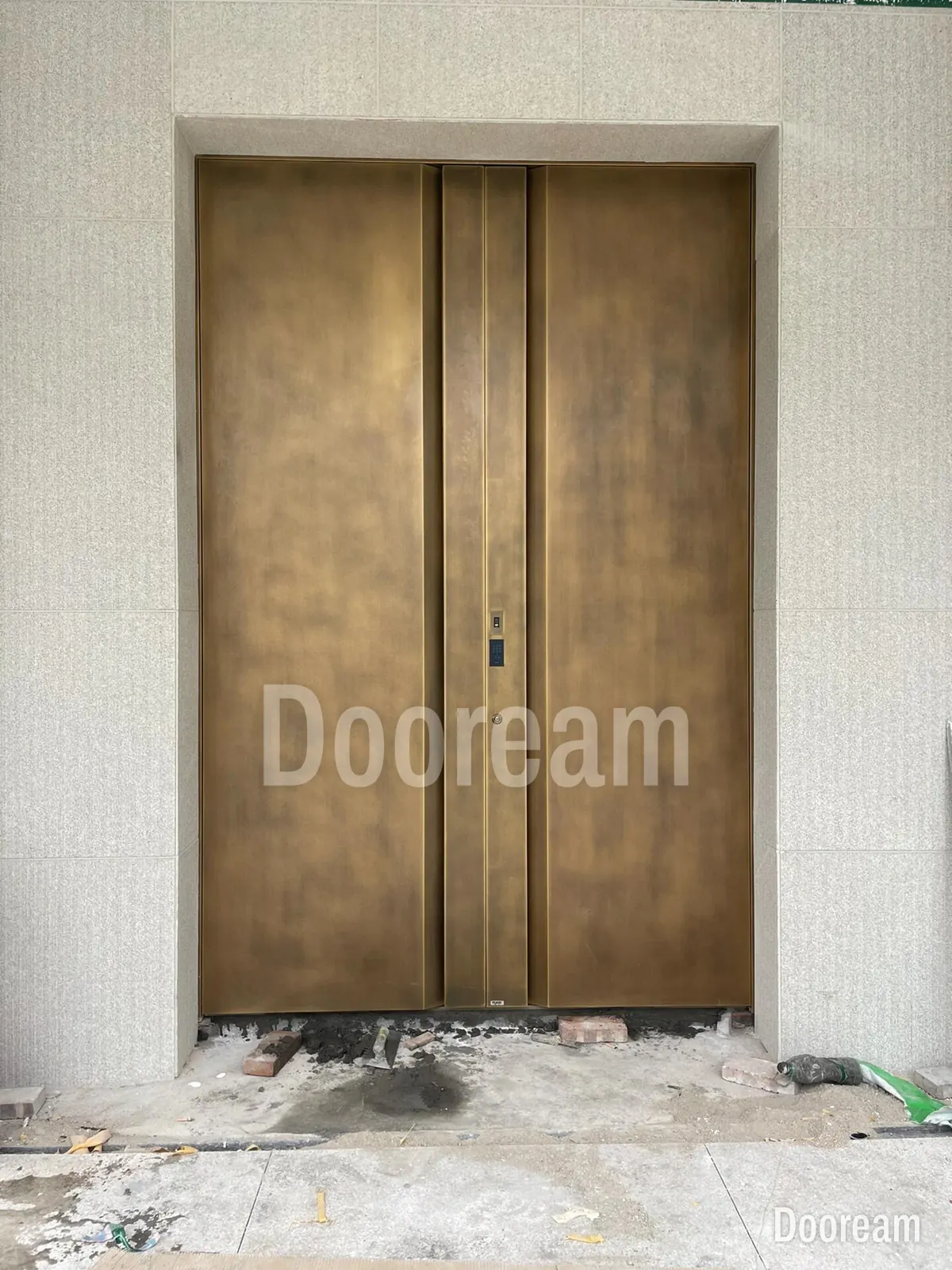
Short answer: dust travels with air, so a door keeps out dust only as well as it keeps out air. Close every air path with continuous compression seals, a sealed meeting stile and a drop seal on a sill that can be swept. Keep sand away with a lobby, canopy and sunken mat, protect the cylinder and reader, and ask for a tested air-leakage class, the best proxy for dust tightness.
How do sand and dust get past a front door?
Fine dust goes wherever air leaks: under the leaf, along the meeting stiles of a double door, through the keyhole, through open drainage slots and at corners where one seal meets another. Wind on the façade, and any pressure difference between house and outside, pushes it through, while heavier sand piles up at the sill.
The WMO describes a dust storm as particles “energetically lifted to great heights by a strong and turbulent wind”. ICAO calls it moderate below 1,500 m visibility with gusts of 30 knots or more, and heavy below 500 m with gusts of 40 knots or more.
- Saudi Arabia. Records from 27 stations, 1978–2008, show dust storms peaking from March to May, most in May, with most dust at Tabuk, Riyadh and Dhahran (Al-Abbasi and colleagues, 2023). For 2000–2016, Albugami and colleagues (2019) count 10 to 60 events a year in the east, 5 to 15 in the south and west.
- UAE. Dust activity peaks in summer, with a second maximum in late winter as cold fronts pass. During a dust event on 13 March 2021, northerly winds reached 15 m/s for three days (Nelli and colleagues, 2022).
A 30-knot gust straight at a door carries a stagnation pressure of about 140 Pa, a 40-knot gust about 250 Pa (our calculation), against the 100 Pa at which air-leakage classes are referenced. Shelter and the building’s shape decide how much of it reaches the door.
| Leak path | Why dust gets in | Fix |
|---|---|---|
| Under the leaf | Sand holds the drop seal up | Drop seal onto a flat, solid sill; sweep it |
| Jamb-to-sill corners | Jamb seal and drop seal do not meet | Continuous corner detail; end pads |
| Head and jambs | One seal line, or gap outside its range | Two compression lines; gaps drawn for heat |
| Meeting stiles | Full-height joint, open at the ends | Rebated stiles, gasket on each leaf, end pads |
| Pivot side | The leaf sweeps past the frame | Finned brush seal; see pivot door sealing |
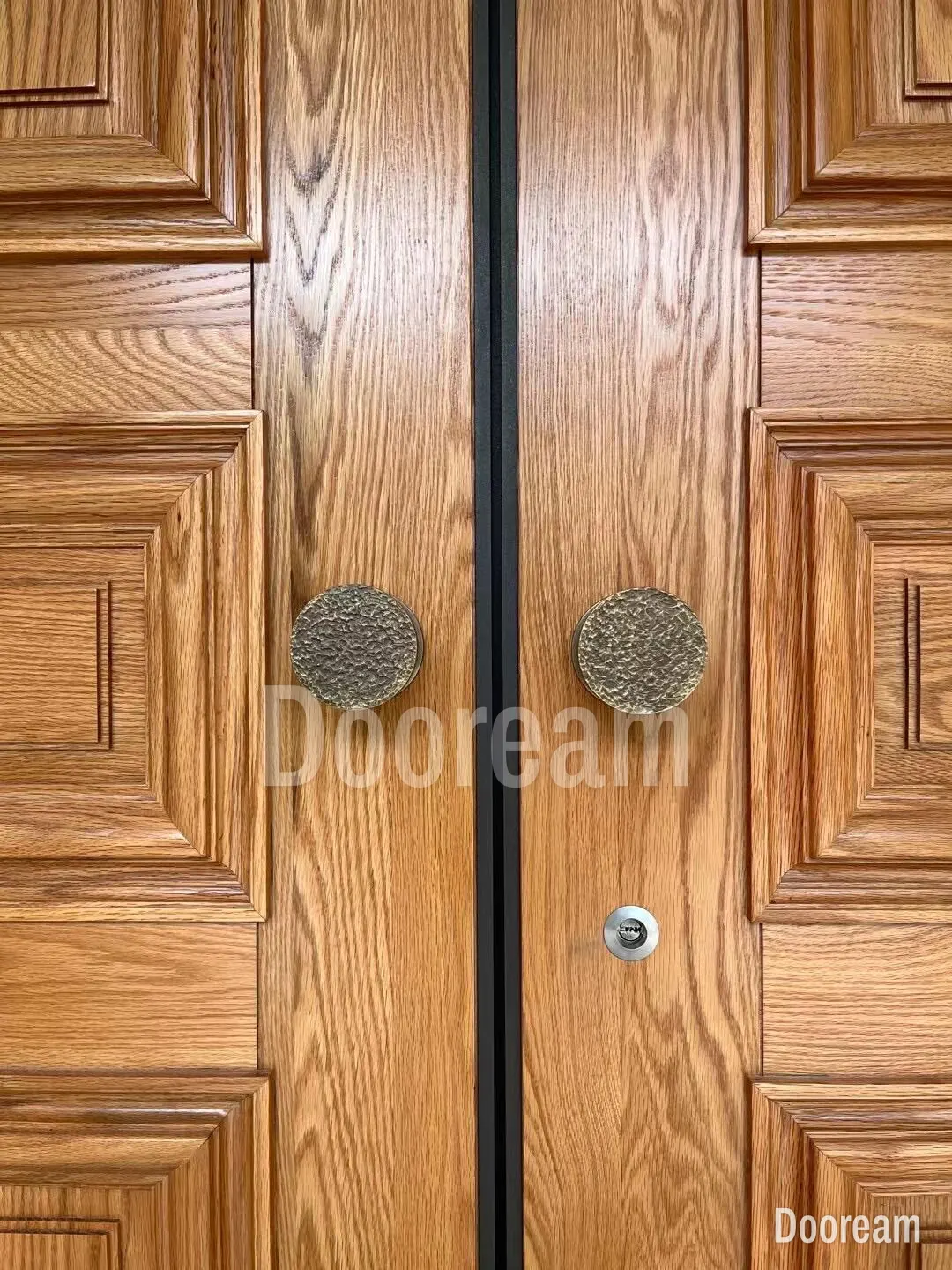
| Keyhole | An open keyway | Cylinder cover or shuttered escutcheon |
| Drainage slots | An open path into the rebate | Covered or baffled outlets draining outside |
| Frame-to-wall joint | Unsealed, or foam only | Continuous seal outside, airtight line inside |
Which seals keep fine dust out?
Compression seals do; brushes alone do not, because a brush is a bed of fibres. A door on a dusty site needs two continuous compression lines at the head and jambs, a sealed meeting stile on a double door and a drop seal on a solid sill, joined at every corner.
- Compression seals in EPDM or silicone seal only inside their working range. The outer line takes the sand; the inner line is the air seal. Materials and EN 12365-1 codes are in our seals guide.
- Brush seals suit “sliding and uneven surfaces”, in Schlegel’s words, and its Fin-Seal adds “one or two integrated polypropylene fins at centre position, improving air tightness”. Use a finned brush where a pivot leaf sweeps the frame, and replace it when grit has flattened the pile.
- Drop seals lower onto the sill as the door closes; a few grains of sand hold them up. Ask whether the seal comes out for cleaning with the leaf in place.
- The sill should shed sand as well as water: a flat face for the drop seal, no upward-facing grooves in the walking line. For falls and channels, see our threshold guide.
Is there a dust rating for doors?
No. There is no dust-tightness class for doorsets; the best proxy is tested air leakage, because dust needs moving air to carry it through a closed door. IP codes do not apply: IEC 60529 covers enclosures for electrical equipment up to 72.5 kV, ISO 20653 road vehicle electrics.
In both, a first digit of 5 (5K) means dust-protected: some dust may enter, not enough to impair operation or safety. A 6 (6K) means dust-tight. These suit a reader, not a door.
For the door, ask for an air test: EN 1026 in Europe, classified under EN 12207 at 100 Pa.
| EN 12207 class | Limit per m² at 100 Pa | Door 2,000 × 3,000 mm |
|---|---|---|
| 1 | 50 m³/h | 300 m³/h |
| 2 | 27 m³/h | 162 m³/h |
| 3 | 9 m³/h | 54 m³/h |
| 4 | 3 m³/h | 18 m³/h |
Class 4 lets through a ninth of the air of class 2, and every cubic metre that leaks in a storm carries dust. ASTM E283, a North American lab test, measures leakage “associated with the assembly and not the installation”; ASTM E783 tests installed units.
How do you protect locks, pivots and smart locks?
Keep sand out, clean before lubricating, and never oil. Allegion says not to put oil or aerosol lubricant in a cylinder. Where dust has affected the original lubricant, it says to clean the mechanism and relubricate with a silicone- or PTFE-based product. Oil holds grit, and grit grinds.
- Cylinder. Fit a cover or shuttered escutcheon. For a sticking key, Allegion suggests a little graphite on the key.
- Multipoint lock. Clean gritty bolts and keeps, then use only the lubricant the maker allows (multipoint locks).
- Pivots. On FritsJurgens System M+, “the pivot hinge sits in the door, the plates anchor it to floor and ceiling”. No closer box in the floor fills with sand, but the floor plate and the gap under the leaf need sweeping.
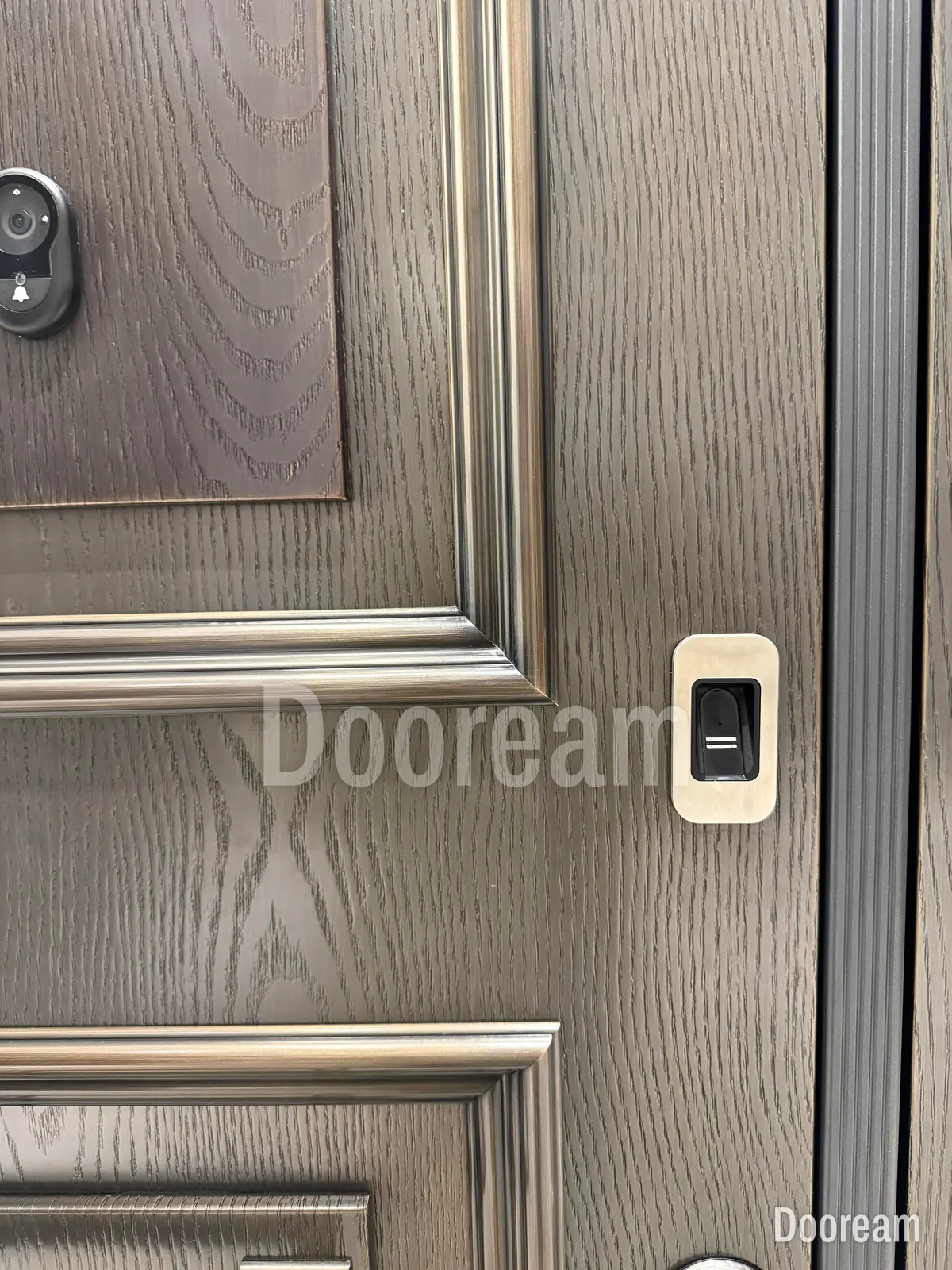
- Readers and keypads. Ask for the IP rating and operating range. ekey rates its dLine fingerprint reader IP56 with its decorative element fitted, for −25 to 70 °C: dust-protected, not dust-tight. Shade it (smart locks).
Which finish stands up to blown sand?
One tested for abrasion as well as sun. AAMA 2604 and 2605 include a falling-abrasive test to ASTM D968, the 2605 requirement twice the 2604 one; AAMA 2603 sets none. Ask for the abrasion result with the UV and salt results, and compare tests, not resin names; PVDF and powder are compared in our finishes guide.
Rinse sand off with plenty of water before anything touches the face, as a dry cloth drags grains across it; then wash as in our maintenance guide.
What site details keep dust away from the door?
Most protection stands in front of the door, because sand that never reaches the seals cannot wear them: a lobby, a canopy and side walls, a long walk-off mat, screens upwind, and air-conditioning that holds the house slightly above outdoor pressure.
- Lobby. The WELL Building Standard (v1, healthy entrance) asks for an entry vestibule with double doors, or revolving doors; in a villa, an enclosed porch with a second door.
- Walk-off mat. WELL asks for grilles, grates or slots “which allow for easy cleaning underneath”, the width of the entrance and 3 m long, maintained weekly. Set it in a sunken frame, clear of the drop seal.
- Canopy, side walls, screens break the wind; for depths, see hot climates.
- Positive pressure. ASHRAE recommends about 1.25 to 20 Pa of positive pressure to reduce infiltration, as Bohac and Quinnell summarise it for commercial buildings: supply slightly more filtered air than is extracted. Storm gusts are far stronger, so seals still matter.
What should you check after a sandstorm?
Clean the door before you use it hard, because every swing grinds sand into the seals, the sill and the bolts. In the dust season, spring in Saudi Arabia and summer in the UAE, repeat items 1, 3 and 4 monthly, and the whole list yearly.
- Brush or vacuum the sill and any pivot floor plate.
- Rinse the face from the top down, then wash it; brush out relief and rebates.
- Vacuum the seals; check brush pile for packed sand and that the drop seal meets the sill.
- Clear drainage slots and outlets.
- Vacuum the keyway; do not oil it.
- Wipe the reader and keypad with a damp cloth; test every way in, including the key.
- Lock and unlock from both sides: every bolt should meet its keep without grinding.
- Check the gap round the leaf and, on a pivot door, closing and latching.
- Check the lower face in raking light for dulled coating; photograph and date it.
How does this work with Dooream?
We have no air-permeability or dust test result for our doors and claim no IP rating. If your project needs an EN 12207 class or ASTM E283 result, testing can be arranged with a lab, usually at the buyer’s cost. Every door is built to your drawing: mark the seal lines, sill, cylinder cover and reader on it. Our pivot doors run on FritsJurgens pivot hinges, our smart locks are from KFV, G-U and Wintech, and most of our doors are finished in PVDF paint. Our thermal-break construction, with PA66 polyamide insulating strips in the aluminium profiles, reaches a U-value of 1.0 W/m²K in our test report, and any of our designs can be built with it. Your local installers fit and seal it, from our installation drawings with our remote guidance. See the architects page or contact us.
Sources, checked November 2026: UNDRR, PreventionWeb, hazard information profile, dust storm or sandstorm (WMO definition and ICAO criteria); K. A. Al-Abbasi, A. H. Labban and A. M. Awad, synoptic characteristics of spring dust storms over Saudi Arabia (Atmósfera, 2023); S. Albugami and colleagues, incidence of dust storms in Saudi Arabia from in situ observations (Geosciences, 2019); N. Nelli and colleagues, atmospheric circulation near the Empty Quarter during major weather events (Frontiers in Environmental Science, 2022); EN 12207:2016 (sample) and STN EN 12207:2017 (preview); ASTM, E283/E283M-19; iTeh Standards, IEC 60529:1989 and ISO 20653:2023 (sample); Schlegel, brush pile seals; Allegion, caring for door hardware; FritsJurgens, System M+ and pivot doors; ekey, dLine fingerprint data sheet; Knotwood, AAMA 2603, 2604 and 2605 comparison; Powder Coating Institute, architectural specification comparison (March 2021); IWBI, WELL v1, healthy entrance; D. Bohac and J. Quinnell, measured C&I building pressures (Buildings VIII conference, 2016).
Quick answers
How do you keep sand and dust out of a front door?
Dust travels with air, so close every air path. Use two continuous compression seal lines at the head and jambs, a sealed meeting stile on a double door, and an automatic drop seal landing on a solid sill that can be swept, joined at the corners. Then keep sand away from the door with a lobby, a canopy and side walls, and a walk-off mat in a sunken frame.
Is there a dust rating for entrance doors?
No. There is no dust-tightness class for doorsets, and IP codes such as IP5X and IP6X come from IEC 60529, which covers enclosures for electrical equipment, and ISO 20653 for road vehicle electrics. For a door, the closest measure is its tested air leakage, to EN 1026 with EN 12207 classes or to ASTM E283. EN 12207 class 4 allows at most 3 m³/h per m² of door at 100 Pa, class 2 nine times as much.
Should you oil a door lock in a dusty climate?
No. Allegion says not to put oil or aerosol lubricant in a cylinder. Where dust has affected the original lubricant, it says to clean the mechanism and relubricate with a silicone- or PTFE-based product, and to put a little graphite on the key if it sticks. For the multipoint lock, use only the lubricant its maker allows.