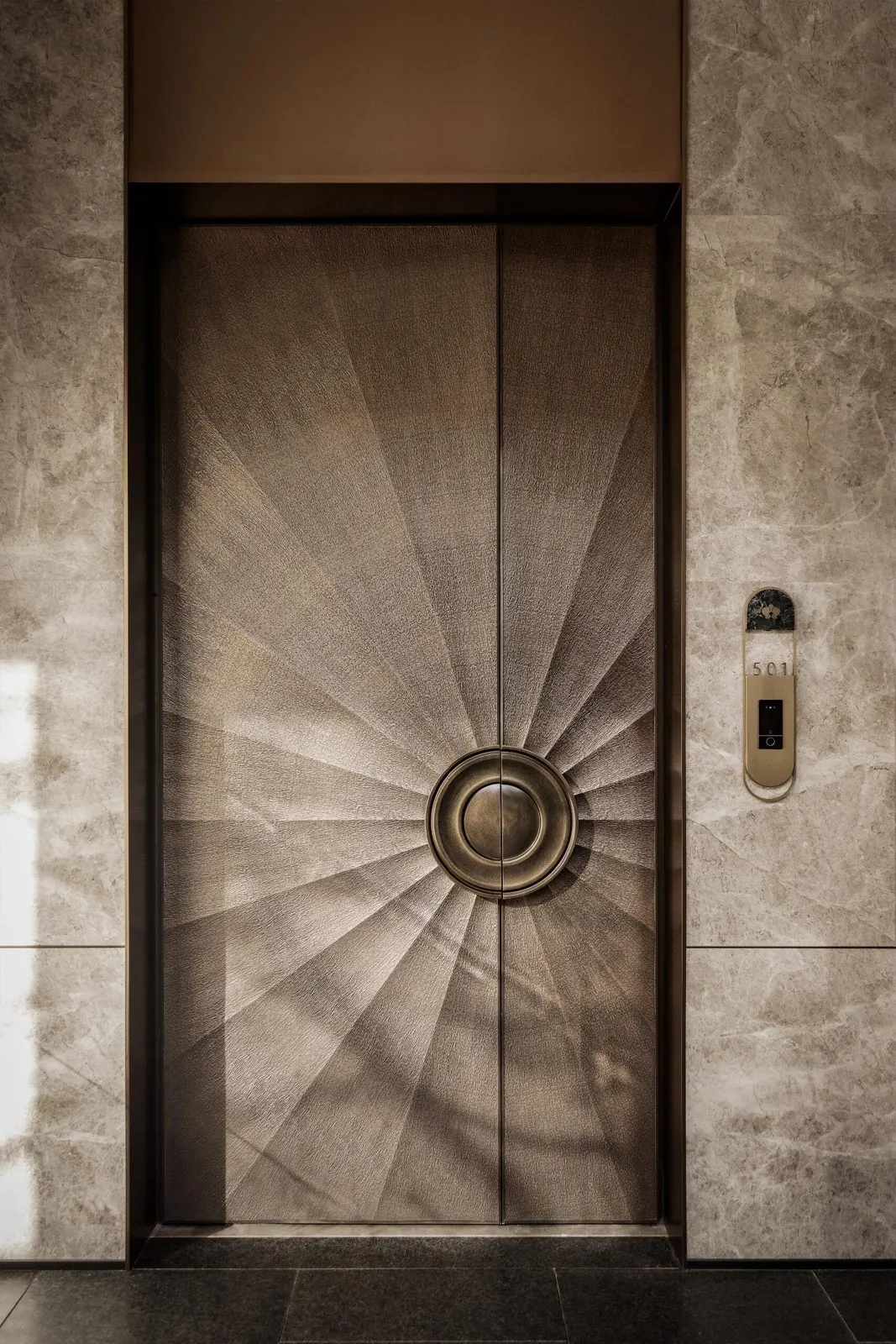
Short answer: choose the opening type first, then the face, finish and lock. We make single pivot doors up to 4,000 × 8,000 mm and double or unequal double doors up to 3,000 × 6,000 mm, with carved, cast or printed aluminium faces over an armoured core. A hotel’s main public entrance is different: egress, accessibility and sometimes fire rules decide it, and we do not make fire-rated doors.
Which opening type suits a villa or a hotel villa?
Choose a single pivot door for one uninterrupted face. Choose a double door for a wide opening split into two lighter, symmetrical leaves. Choose an unequal double door when one wide leaf does the daily work and a narrow one opens for furniture or occasions. All three are made to the opening, from one door.
| Single pivot | Double | Unequal double | |
|---|---|---|---|
| Largest we make (W × H) | 4,000 × 8,000 mm | 3,000 × 6,000 mm | 3,000 × 6,000 mm |
| Everyday use | The whole leaf turns on the pivot | Usually one leaf; both for occasions | The wide leaf; the narrow one stays bolted |
| Look | One face, no visible hinges | Symmetrical, often with a centre handle | Asymmetrical |
| Hinges | FritsJurgens pivot hinge | Heavy-duty hinges, concealed on some models | Heavy-duty hinges |
| Our examples | Contour, Black Warrior | Sunburst | Crystal Handle |
A pivot door’s clear opening is smaller than the leaf. A very large leaf is heavy, so check the hinge class, floor and head; see how big and how heavy a pivot door can be.
What can the face be made of?
Carved aluminium is the face we make most. We also make cast aluminium, 5D-printed aluminium sheet and natural shell faces. Sintered stone, glass, wood and copper faces are made on request. Behind every face is the same build: a galvanised steel sheet, an aluminium frame with an aluminium honeycomb core, a second steel sheet and the inner panel.
| Face | How it is made | Suits | Example |
|---|---|---|---|
| Carved aluminium | CNC-cut from solid plate, then hand-sanded | One-off designs, deep relief | Black Warrior 8 mm, Sunburst 10 mm, Contour 30 mm |
| Cast aluminium | Poured into a mould | Repeated patterns, undercuts | Lattice 8 mm |
| Aluminium sheet, 5D print | 4 mm sheet printed with wood grain or a stone look | A timber or stone look in metal | Grain Band |
| Natural shell | 2 mm shell panel on 8 mm aluminium | A natural mosaic face | Shell |
| Sintered stone, glass, wood, copper | On request | Matching the façade or interior | Black Warrior has sintered stone on the inside |
See cast or carved faces.
How does aluminium compare with solid timber, steel and bronze?
All four make fine doors; they differ in weight, ageing and upkeep. For the same thickness, aluminium weighs about a third as much as steel, which matters on a tall pivot leaf, and a thin oxide film protects it. Timber, steel and bronze need more care in sun, humidity or salt.
| Aluminium (our faces) | Solid timber | Steel | Bronze | |
|---|---|---|---|---|
| Weight of a 1 mm layer per m² | About 2.7 kg | Varies by species | About 7.8 kg | About 8.5 kg (architectural bronze) |
| Outdoors | An oxide film forms and reseals if scratched; the coating carries the colour | Takes up and loses moisture, so it swells and shrinks; sunlight breaks down the surface | Rusts where the coating is broken; galvanising protects it | Darkens through browns towards a green patina unless clear-coated; in arid climates the patina may never form |
| Upkeep | Washing; care depends on the coating | Finishes slow moisture change but never stop it, and need renewing | Keep the coating intact | Clear coatings degrade and must be stripped and renewed |
Copper faces age like bronze unless coated. Our doors also carry two galvanised steel sheets inside, so ask for the weight of the whole leaf.
Which finish suits sun, sand and sea?
Ask which test the coating has passed, not just its name, and shelter the door: a canopy or recess protects any finish, and the lock reader too. Most of our doors are finished in fluorocarbon (PVDF) paint; each door page lists its finish. Our guide to coastal and high-sun finishes explains AAMA 2605 and Qualicoat classes.
What should you specify for security and smart locks?
“Armoured” describes how a door is built, not a test result. If the client, insurer or code needs a security class such as EN 1627 RC3, ask for the test report for the whole door. We do not hold an EN 1627 rating; we can arrange a lab test, usually at the buyer’s cost. See door security ratings explained.
- Brands: we fit smart locks from KFV, G-U and Wintech. Contour, Black Warrior, Sunburst and Crystal Handle are shown with a Wintech fingerprint lock.
- Tall leaves: ask how many locking points hold the leaf against its seals.
- Power and backup: a wired lock on a pivot door needs its cable through the top pivot; every lock needs a mechanical key or emergency power.
- Hotel villas: ask the operator whether the door must take their key-card lock, and send us its details before production.
More in smart locks on large and pivot doors.
How is a villa entrance different from a hotel’s public entrance?
A villa entrance serves one household and its visitors. A hotel’s main or public entrance serves the public, so it is treated as a commercial egress door: building, accessibility and sometimes fire rules decide how it opens, how wide it is and what hardware it carries. Many hotels use automatic sliding or revolving doors there.
| Private villa or estate | Hotel villa with its own outside door | Hotel main or public entrance | |
|---|---|---|---|
| Used by | Family, staff, visitors | Guests, staff, housekeeping | The public, with luggage, in crowds |
| Rules to check | Local building code | Egress, accessible-room rules, the operator’s access system | Egress, accessibility, fire |
| Our doors | Yes | Yes, where no fire rating is required | Feature or secondary entrances only, where the code allows |
The US International Building Code (IBC 2021) and the 2010 ADA Standards show what is usually checked. The Saudi Building Code uses ICC codes as its basis; in the UAE, Civil Defence issues the fire code. Check local rules with the project’s consultant.
- No key to get out. Egress doors must open from the inside without a key or special knowledge or effort, and the exception for key-locked main doors does not cover hotels.
- Swing and force. Doors serving 50 or more people must swing in the direction of egress. An egress door must start moving with no more than 30 lbf (133 N) and open fully with no more than 15 lbf (67 N), however heavy the leaf.
- Accessibility. At least 60% of public entrances in new buildings must be accessible: a clear width of at least 32 inches (815 mm) on one active leaf, thresholds no higher than 1/2 inch (13 mm), and one-hand hardware 34–48 inches (865–1,220 mm) above the floor.
- Revolving doors are not accessible, so an accessible entrance with one also needs a compliant manual or automatic door.
- Fire. In the IBC, hotels are Group R-1. Corridors in Group R buildings serving more than 10 people are fire-rated, and doors in their walls need 20-minute fire door assemblies. A suite door onto such a corridor is a fire door.
Dooream makes statement entrance doors for villas, estates and private or feature entrances. We do not make fire-rated doors.
What should the specification cover?
- Opening type, structural opening, and the clear width of the everyday leaf.
- Face material and thickness, and the weight of the whole leaf.
- Hinge system and its weight class.
- Finish, the test it meets, and the entrance’s exposure.
- Lock: brand, locking points, power, backup, hotel access system.
- Finished floor levels and threshold.
- Egress, accessibility and fire rules, confirmed for the project.
- Any test report or import document needed.
How does ordering from Dooream work?
Send the opening size and door type through our architects page or contact page. The first design direction is free and usually comes within one working day. We draw in millimetres and convert inch drawings for you to check. Production takes 35–45 days after drawing approval and deposit. Every order comes with installation drawings, and we send photos and video of the finished door before shipment; factory inspection is welcome. A 20 × 20 cm carved and painted sample shows the finish first. For Saudi Arabia we supply SABER product documents; see villa doors for Saudi Arabia and the UAE or all our doors.
Sources, checked November 2026: US Access Board, guide to the ADA Standards, entrances, doors and gates; Lori Greene, iDigHardware, 2021 IBC key-operated locks, 2021 IBC opening force and door swing and Group R entry door fire rating; Minnesota Rules, 1305.0310, IBC Group R; Boon Edam, hotel entrances; Saudipedia, Saudi Building Code committee; Khaleej Times, UAE fire safety code updated; J.R. Davis, ASM International, Aluminum and aluminum alloys; AZoM, architectural bronze C38500; Copper Development Association, architectural finishes; Galvanizers Association of Australia, how galvanizing protects steel; USDA Forest Products Laboratory, Wood Handbook, chapter 4; USDA Forest Service, Finishing wood exteriors.
Quick answers
How large can a luxury villa entrance door be?
We make single pivot doors up to 4,000 mm wide and 8,000 mm tall, and double and unequal double doors up to 3,000 × 6,000 mm, each made to the opening from one door. On a large leaf, the hinge class, the floor and the head need to be checked early.
Is an aluminium entrance door better than solid bronze, steel or timber?
It depends on the look and the upkeep the owner accepts. For the same thickness, aluminium weighs about a third as much as steel and bronze, and it forms a thin oxide film that reseals if scratched. Bronze darkens towards a patina unless clear-coated, steel rusts where its coating is damaged, and timber swells and shrinks with moisture and needs refinishing.
Can your doors be used for a hotel's main public entrance?
Usually not. A hotel's public entrance is a commercial egress door, so egress, accessibility and sometimes fire rules decide how it opens and what hardware it carries, and many hotels use automatic or revolving doors there. We make statement entrance doors for villas, estates and private or feature entrances, and we do not make fire-rated doors.