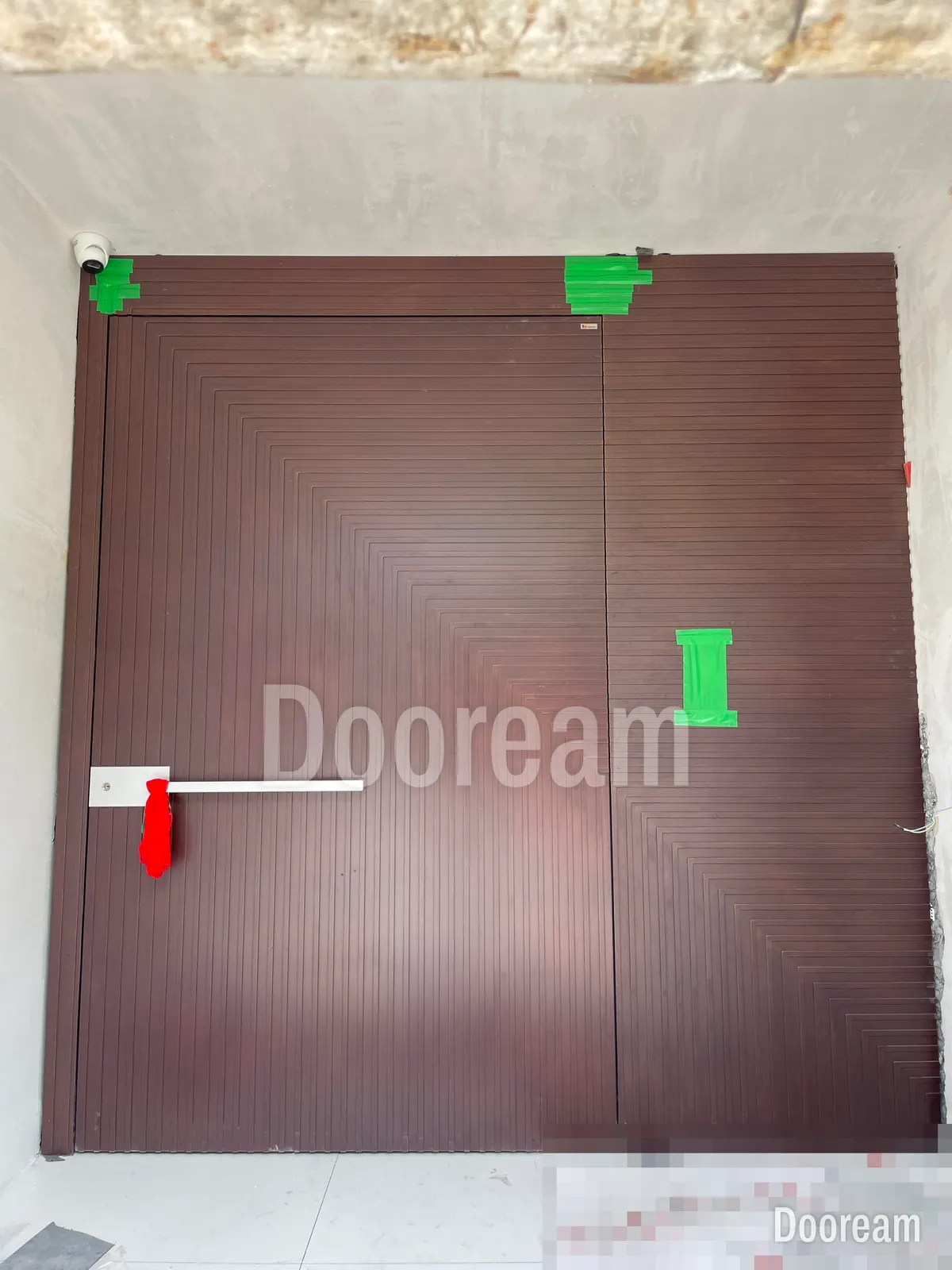
Short answer: your customs broker classifies the door, usually under HTS 7610.10.00 for aluminium. From 10 November 2026 that line pays 5.7% base duty, 7.5% Section 301 duty and 50% Section 232 duty on the full customs value, 63.2% in all, plus small fees. File the ISF, hold a bond, mark the origin and check the anti-dumping order. Local codes usually want the door tested and labelled for design pressure, and an NFRC U-factor or a default.
Which HTS code does an entrance door go under?
Doors are classified by material: HTS 7610.10.00 for aluminium doors and frames, 7308.30 for iron or steel. The importer’s broker decides, and the choice moves the duty by about twelve points. Our doors mix materials (face panel, galvanised steel sheet, aluminium profile frame with aluminium honeycomb core, galvanised steel sheet, inner panel), so send the broker a material breakdown.
What duties apply in November 2026?
An aluminium door under 7610.10.00 pays 63.2% in duties, and a steel door under 7308.30.50 pays 75%. These are HTS Revision 23 rates, in force from 10 November 2026; each is charged on the customs value and they add up. Your broker rechecks them for the entry date.
| Duty | Chapter 99 heading | Aluminium, 7610.10.00 | Steel, 7308.30.50 |
|---|---|---|---|
| Base duty | None | 5.7% | Free |
| Section 301 on China | 9903.88.15 (List 4A); 9903.88.03 (List 3) | 7.5% | 25% |
| Section 232, full value since 6 April 2026 | 9903.82.02 | 50% | 50% |
| Total | 63.2% | 75% |
Not charged on these doors:
- IEEPA duties (fentanyl and reciprocal) ended on 24 February 2026, after the Supreme Court ruled against them.
- The Section 122 surcharge that replaced them expired at the close of 23 July 2026.
- The Section 301 forced-labour duty on China (12.5%, from 24 July 2026) excludes goods paying Section 232 under 9903.82.02.
Only one Section 232 rate applies, even to a door of aluminium and steel. CBP also charges a Merchandise Processing Fee of 0.3464%, with a minimum and a cap per entry, and a Harbor Maintenance Fee of 0.125% on sea cargo at listed ports.
What do you need to clear customs?
Five things: an importer of record, an Importer Security Filing (ISF) before the crate is loaded, a customs bond, origin marking and a customs value the broker can support. Most importers have a licensed customs broker file the entry and the ISF.
- Importer of record. Under 19 CFR 141.1 the duty is the importer’s personal debt, even if a broker it paid fails to pay. With an EXW price, that is you or your client.
- ISF (“10+2”). Under 19 CFR 149.2, eight elements, including manufacturer, country of origin and HTS number, are due 24 hours before loading in China; stuffing location and consolidator by 24 hours before arrival. The carrier adds the “+2”: stow plan and container status messages.
- Bond. A single transaction bond is generally at least the entered value plus duties, taxes and fees; a continuous bond is usually 10% of the past year’s duties, taxes and fees. ISF needs bond cover too.
- Marking. Under 19 CFR 134.11 the door must show the English name of its country of origin, conspicuously, legibly and permanently. Put the label on the drawing; a dealer-branded door is still marked China.
- Customs value. Freight and insurance depend on the Incoterm; see which Incoterm to use.
Is the door caught by the aluminium extrusions anti-dumping order?
It might be. Anti-dumping and countervailing orders on aluminium extrusions from China (A-570-967 and C-570-968) have applied since 2011 and are still in force. In August 2026 Commerce set a China-wide anti-dumping rate of 86.01%, with the countervailing order alongside.
The scope covers extrusions and subassemblies, but excludes “finished merchandise containing aluminum extrusions as parts that are fully and permanently assembled and completed at the time of entry, such as finished windows with glass, doors with glass or vinyl”. Commerce reads that narrowly: in 2025 it held door thresholds to be in-scope subassemblies.
Our frames are aluminium profiles. A pre-hung door is complete at entry, but the examples name doors with glass or vinyl. Have your broker or a trade lawyer check the scope rulings, and ask Commerce for a ruling if in doubt.
What do US building codes ask of an imported entrance door?
The door must meet the code the state, county or city has adopted, with its amendments. Codes based on the IRC and IBC want exterior doors rated for design wind pressure, usually by testing and labelling to AAMA/WDMA/CSA 101/I.S.2/A440 (NAFS), whose gateway tests also cover air leakage and water penetration. Ask the building department first.
| Rule | What it asks | Where |
|---|---|---|
| IRC R609.2, R609.3, R609.5 | Resist design wind load; side-hinged doors labelled to AAMA/WDMA/CSA 101/I.S.2/A440, or ASTM E330 tested | Houses |
| IBC 1709.5 | Design pressure by NAFS label (1709.5.1) or ASTM E330 test (1709.5.2) | Other buildings |
| IRC R609.6 | Doors with glass in windborne debris regions need impact protection (ASTM E1886, E1996) | Hurricane-prone coasts |
| Florida Building Code, High-Velocity Hurricane Zone | Doors need product approval, such as a Miami-Dade Notice of Acceptance (NOA) | Miami-Dade and Broward |
| 2010 ADA Standards 404.2.3, 404.2.5 | 32 in (815 mm) clear width; threshold 1/2 in (13 mm) maximum (3/4 in, 19 mm, bevelled 1:2, if existing or altered) | Commercial entrances |
States amend the model codes; Washington, for example, adds exceptions to IBC 1709.5. For documents, see the submittal checklist.
What does the energy code ask for?
In IECC-based codes, a door’s U-factor is determined to NFRC 100 by an accredited, independent laboratory, and labelled and certified by the manufacturer. A door without a label is assigned a default U-factor from a table. One side-hinged opaque door of up to 24 ft² (2.22 m²) is exempt from the U-factor requirement.
Washington’s code, for example, defaults a foam-insulated steel slab door with a metal edge in a steel frame to 0.37 Btu/h·ft²·°F. A 1,200 × 2,400 mm leaf alone is 2.88 m², beyond the exemption. A W/m²K test report is not an NFRC rating; see door U-value explained.
Why ship the door pre-hung in its frame?
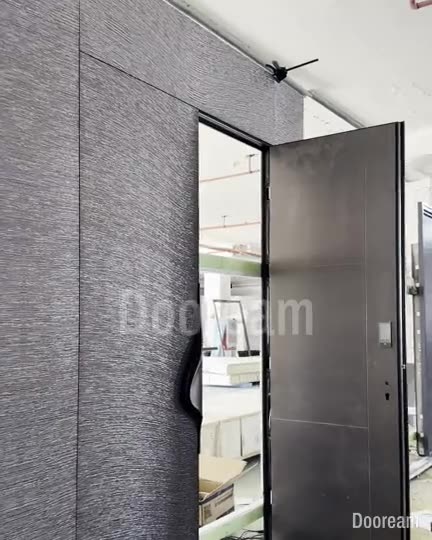
The installer sets one adjusted unit level and plumb, anchors and seals it, with no heavy leaf to hang on site. Gaps, pivot or hinge positions and lock keeps are set in the workshop and visible in the pre-shipment photos and video. NAFS and ASTM E330 tests also rate leaf and frame together.
The trade-off is a larger crate; see crating and shipping damage and pivot door size and weight.
Which port, and how long does shipping take?
Choose the port by the site. The West Coast has the shortest sea leg; the East Coast saves a long inland trip to an eastern site. These port-to-port times are from a SeaRates 2026 guide; ask your forwarder for current sailings.
| Route | Port to port |
|---|---|
| Shanghai to Los Angeles | 18–22 days |
| Ningbo to Oakland | 22–28 days |
| Shanghai to New York | 30–40 days |
| Shenzhen to Savannah | 32–38 days |
Add trucking from Wuyi to the port, clearance and delivery. An oversized crate needs an open-top container or flat rack, so send your forwarder its size and weight early.
What goes into the landed cost?
Add duties and CBP fees to the EXW invoice as percentages of customs value, then get quotes for the rest. For an aluminium door under 7610.10.00, duties and fees are about 63.7 per 100 of customs value in November 2026, before any anti-dumping duty.
| Item | Per 100 of customs value |
|---|---|
| Door, hardware and crate (EXW invoice) | 100 |
| Base duty, Section 301, Section 232 | 5.7 + 7.5 + 50 = 63.2 |
| Merchandise Processing Fee (capped per entry) | 0.3464 |
| Harbor Maintenance Fee | 0.125 |
| Anti-dumping and countervailing duty | Only if in scope; ask your broker |
| Freight, insurance, ISF, bond, broker, delivery, installation | Quotes |
| Sales or use tax | State rules |
| Laboratory testing, if the code needs it | Lab quote |
Method: EXW price vs landed cost.
What should an importer check before ordering?
- Broker and importer of record number.
- HTS code confirmed from a material breakdown.
- Anti-dumping scope checked.
- Bond sized for the duty, covering the ISF.
- ISF filed 24 hours before loading.
- Origin label on the approved drawing.
- Building department: code, test evidence, NFRC label or default, ADA.
- Testing arranged before production.
- Port, container type and cargo insurance.
- Installer booked; site access for the crate.
How does this work with Dooream?
Our prices are EXW at our factory in Wuyi, and your freight forwarder collects the door. Doors ship as complete units, leaf hung in its frame, in blankets, foam and a wooden crate, after we send photos and video of the finished door. Production takes 35–45 days after drawing approval and the 50% deposit; the other 50% is paid before shipment, and the warranty runs two years from shipment. Your local installers fit it with our installation drawings and remote guidance. We hold no US certification or test report: no AAMA/WDMA/CSA 101/I.S.2/A440, NFRC rating, Florida product approval, Miami-Dade NOA, UL listing or hurricane rating, and we do not make fire-rated doors. We do not supply doors for projects in Florida, where exterior doors need product approval. Our thermal-break construction, with PA66 polyamide insulating strips in the aluminium profiles, reaches a U-value of 1.0 W/m²K in our test report, and any of our designs can be built with it; it is not an NFRC rating. Where a code requires a tested product, testing can be arranged with a laboratory, usually at the buyer’s cost. Send your opening through our contact page, or see working with us as a dealer.
Sources, checked November 2026: USITC, Harmonized Tariff Schedule, 2026 Revision 23 (7610.10.00, 7308.30; chapter 99 headings 9903.82.02, 9903.88.15, 9903.88.03, 9903.05.31 and 9903.03.01; U.S. notes 2, 16, 19, 20 and 52); USTR, Section 301 List 4A notice (August 2019); The White House, Section 232 annexes, April 2026; Federal Register, Proclamation 11032 (4 June 2026), Executive Order 14389 (25 February 2026), CBP Dec. 26-14, user fees for fiscal year 2027 and CBP notice on stow plans, container status messages and ISF (3 August 2026); White & Case, United States terminates IEEPA-based tariffs following Supreme Court decision (February 2026); Cleary Gottlieb, new Section 301 tariffs on 60 trading partners (August 2026); eCFR, 19 CFR 24.24, 19 CFR 134.11 and 19 CFR 149.2; Cornell LII, 19 CFR 141.1; CBP, how CBP sets bond amounts (February 2024); Commerce, aluminium extrusions scope ruling on storm door kits (2014), amended scope rulings on door thresholds (March 2025) and final results of the 2024–25 anti-dumping review (August 2026); GoCodeBook, 2025 California Residential Code, section R609 (IRC-based); Washington State, WAC 51-50-17090, IBC 1709.5, and residential energy code chapter 51-11R, R402.3.4 and Table R303.1.3(2) (IECC-based); WDMA, fenestration for the complete building envelope; Miami-Dade County, construction materials product approval; U.S. Access Board, 2010 ADA Standards, chapter 4; SeaRates, sea freight from China to the USA, 2026 guide.
Quick answers
What duty applies to an aluminium entrance door imported from China into the US?
In HTS Revision 23, in force from 10 November 2026, a door classified under 7610.10.00 pays a 5.7% base duty, a 7.5% Section 301 duty and a 50% Section 232 duty on the full customs value, 63.2% in all, plus a 0.3464% Merchandise Processing Fee and a 0.125% Harbor Maintenance Fee. IEEPA duties ended on 24 February 2026. Your broker confirms the code and the rates on the day of entry.
Does an imported entrance door have to meet US building codes?
Yes, the code your state, county or city has adopted. Codes based on the IRC and IBC rate exterior doors for design wind pressure, usually by testing and labelling to AAMA/WDMA/CSA 101/I.S.2/A440 or by an ASTM E330 test. IECC-based energy codes want an NFRC 100 U-factor label or assign a default. In the High-Velocity Hurricane Zone (Miami-Dade and Broward counties), doors need product approval, such as a Miami-Dade Notice of Acceptance.
Do Dooream doors have US test reports or labels?
No. We hold no AAMA/WDMA/CSA 101/I.S.2/A440 report, no NFRC rating, no Florida product approval or Miami-Dade NOA, no UL listing and no hurricane rating, and we do not make fire-rated doors. Where a code requires a tested product, testing can be arranged with a laboratory, usually at the buyer's cost.